Work in progress. Partially finished elevation of the north wall, showing the planned corner unit and set of narrow drawers to the left of the stove.
After a long hiatus from shop time thanks to Indiana’s stay-at-home directive, I’ve been back in full force over the past two weeks. Sure, I could have kept working on the kitchen — my shop is next to our house. But why turn my work area into a life-size game of Tetris with cabinets as playing pieces a moment before that crowding was really necessary? Better to leave the roughsawn oak and sheets of plywood flat until we could firm up the schedule for delivery and installation.
Every kitchen I’ve worked on has entailed a few changes along the way. I do my best to help clients make the most important decisions early on. I also encourage them not just to order their plumbing fixtures and appliances, but to have them on hand before I start to cut materials, because reworking cabinets can get expensive quickly.
On this job we’ve done a lot of things differently because of the ongoing pandemic. With no clear idea how long the stay-at-home directive was going to last, my clients, Jenny and Ben, were in less of a hurry to order appliances, etc. and have them delivered — they’ve been working full-time from home in the company of their three children, whose schools were closed for in-person classes. Ordinarily we would have met to discuss a few questions that have cropped up; instead, we’ve hammered things out by email and phone. I’ve dropped off samples of milk paint at their back door. Everything has been slightly off — at times, surreal.
Soapstone slabs at Quality Surfaces near Spencer, Indiana
Our only recent meeting in person took place at a local stone yard, where Jenny and Ben fell in love with a slab of medium-gray soapstone. Compared to other stone, such as granite, this one is relatively soft, so I wanted them to be aware of how it would likely age. I sent snapshots from our kitchen, which has pale gray soapstone counters, and emphasized that even though we treat our counters with care, there’s significant wear along the front edge at the sink. This stone would require extra coddling.
They weighed my warnings. Then, intoxicated by the beauty of the stone, they concluded they had to have it.
To compensate, they decided to use a different kind of sink. The plans included an undermount sink, but after seeing pictures of our counter, Ben and Jenny decided to buy an enameled cast iron apron front, to do away with the especially vulnerable strip of stone across the front. Good thing I hadn’t started building the cabinets — not only did this change the doors from full height to more like 20″; it also meant the sink base would have to be 2″ longer.
Comparing milk paint samples (which have a topcoat of the same water-white conversion varnish we’ll be using on the cabinets) to colors in the stone
The second major change has been to the kitchen’s inside corner. In our earliest discussions I’d gone through my usual reasons for recommending a simple stack of drawers instead of attempting to use the blind space that would otherwise be wasted, but Ben and Jenny decided to go with a corner optimizer.
The unit holds four baskets — two on the left, and two on the right, with one above the other on each side. Here Tony is modeling the unit closed, with only the lower left basket in place.
Full disclosure: I had never installed one of these units, which I first learned of thanks to Craig Regan. It seemed like a better choice than the half-moon blind corner pull-out I once experimented with in my own kitchen (more about this in my forthcoming book); it’s sturdy, better looking and smooth in operation. But once I had it in the cabinet I could see trouble down the line: Unless you’re meticulous about pulling the unit straight out and extending it fully before you pull the second half forward, the face frame of the corner cabinet and the face of the cabinet next to it would get scratched and banged up in short order. For a family of five who really use their kitchen, it seemed like a bad idea.
The first step: pull the primary pair of baskets forward. You have to pull them all the way out before attempting to move them over so that you can pull the secondary baskets out.
Fully open. The primary side [only one basket is installed on each side here] pulls over to the side of the cabinet opening, freeing it up so you can pull the secondary baskets forward.I thought through every likely scenario with the corner optimizer and decided to recommend we nix it in favor of some intelligently-designed, fully-functional drawers; depending on what we discover during demolition, the blind area in the corner will probably become a storage cabinet in the wall flanking the stairs to the basement.
A set of four capacious drawers on full-extension slides will take the place of the original corner optimizer and the 12″-wide drawers that would have flanked it.
To those who complain about old-timers being unwilling to change/jump on the bandwagon of The Newest And Greatest Thing, I offer this story as one reason why some of us whose livelihood depends on this kind of work prefer to recommend the products we know well. We’re not being lazy, fearful or unimaginative. We might have learned something over the decades from our mistakes. In the future, if clients ask me about the advisability of using a corner optimizer such as this one (and I am aware that this is not the only style available), I will factor what I know about how they use their kitchen into my response, as I do with every other detail of kitchen design.
If anyone would like to buy this 15″ blind corner unit at a discount (it makes a great climbing frame/nap place/carnival ride for a cat), let me know in the comments.
Helen says this moody portrait, taken during a promotional shoot for a business bank, represents “the only time I’ve ever earned money for standing around doing very little.”
Chris Schwarz suggested I invite Helen Welch to be interviewed for the Lost Art Press blog. “She is a “[bleep]ing badass,” he wrote. “A tool nerd. Funny and sharp as hell.” So I wrote her by email. She sent back the following reply.
“If nothing else (other than saving lives), this lockdown has given us all a chance to do stuff we wouldn’t normally do. Things I’ve discovered during this time:
“I hate sourdough.
“I do not like to work from home. A one-bedroom apartment is no place to make the kind of mess I enjoy in the workshop.
“Practicing my golf swing indoors has aged the fixtures and fittings.
“The homemade wines I made two years ago are now drinking well. A rare case of serendipity.
“Danish is a very odd language but I’m enjoying the challenge.
“Videoing myself is a special kind of torture, only topped by having to edit the damn thing. Gruesome. Likewise Zoom, Skype etc.”
Then she said sure, she’d be happy to do the interview.
I knew I was going to enjoy our phone call.
Helen with Mark Armstrong (center) and Sam Brown. “Sam teaches all the classes I don’t want to do, basically evenings and weekends,” Helen says. “Mark is a carpenter and friend of the school. He comes in to hang out because the school is his happy place. He’s also partially responsible for my tool collecting habit.”
Most woodworkers familiar with Helen know her through the London School of Furniture Making, which she founded and has operated since 2013. “It’s nowhere near as august as the London College of Furniture,” she laughs, acknowledging the similarity between the two names. Woodworking schools pride themselves on a range of qualities, from their size and diversity of course offerings to their cultivation of individual students’ skill in artistic design, or their faithfulness to particular historical traditions. The London School of Furniture Making is tiny, with just four benches, which allows Helen and her fellow instructor, Sam Brown, to give each student an extraordinary level of attention. Course offerings are varied in terms of topic and duration, aimed primarily at amateur makers. Short courses build specific skills; project courses offer opportunities to put them into practice. Beyond this, students can pay a daily fee to come in and simply use the benches and tools, as well as pick her brains. If the London School of Furniture Making were to claim a special niche, it might be that these characteristics make learning there unusually customized and accessible.
Students from a three-day Core Skills – Joinery class last December. “As you can see,” notes Helen, “not everyone finishes their graduation project.”
Helen’s parents, Michael and Leonora (with friendly pigeons)
Helen started the school after decades of work in the trades. She was born and raised in North London, where her father sold film (the kind for cameras in the pre-digital era) at Boots, a nationwide pharmacy chain. Her mother had a variety of jobs that included work in a perfume factory but spent most of her career in retail sales at John Lewis, one of Britain’s best loved department stories. Helen’s older brother, Maurice, is a passionate photographer who’s all about electronics and gadgets.
Maurice and Helen
At the age of 11 Helen made a conscious decision to go to a girls’ school. “I didn’t want to have to fight for my teachers’ attention,” she explains. By the time she entered sixth form (senior high school in the United States), the school had become co-ed. In 1984, as she was preparing to take her A-Levels in biology, chemistry and business studies, she says, “all my fears about being overlooked came to fruition. I was simply exhausted from the struggle, so I left.”
Later that year she returned to the school to attend a careers fair, most of the offerings at which were “not interesting, just banks and boring things, not what I envisaged doing…” But as she wandered around the booths, a couple of people at a tiny stall in a corner called out “Come chat to us! If you’re not doing anything, why don’t you come and work in our woodwork-cum-training college?” Why not? she thought, and jumped right in.
The business was a collaboration of four people – two men and two women – who shared a shop in the north London area called Kentish Town. “Splinter Group was a training center which carried out woodworking jobs in the local community,” she told me. “I was paid £25 per week as part of the government’s Youth Training Scheme.” The shop was a large space with an eight-bench hand tool room and a separate machine shop, all on the first floor (which we in the States refer to as the second floor) of a Victorian-era light industrial building. The work entailed a mixture of teaching/learning and making. “If it was wood, they did it. They would bring their trainees on site as well as building in the shop.” While working there Helen made a set of stairs; a complicated play frame for a children’s play center; a table and shelves, and a toolbox for the tool set they gave her. “I remember thinking it was quite a good mix of skills and different woodworking projects. It gave me an idea of what was possible — there are all sorts of things I can make with these skills.”
After about six months at this cooperative shop, Helen spent a year doing a variety of work, “including making some fake French antiques for a guy I met in a pub.” She worked in building maintenance for a local women’s center and ended up applying for an apprenticeship in carpentry and joinery with Camden Council, where she spent three years – one year in building maintenance and repairs; one year of renovation and restoration on jobsites; and one year in a joiner’s shop making windows and doors. She earned her City & Guilds Certificate in carpentry and joinery in the late 1980s, specializing in (of all things) building forms for cast concrete structures, a skill she hasn’t used since. As soon as she had the certificate, she left the council job. “’This is a three-year prison sentence which is now up,’” she remembers thinking – “three years of misogyny and racism. I have very few happy memories [of that time]. It was tiresome, but I worked hard to not let it scar me.”
Helen took a job as a building inspector for the Building Control Department in Camden and then Islington, where she worked for five years. As someone who had worked in the trades, she says, “I realized there was a split between the people who came in from university and those from the trades. I quickly made friends with the ex-carpenters and the ex-plumbers. We were more collaborative when working with the chippies (Brit-speak for carpenters) on site, whereas some of our colleagues just wanted to read the letter of the law. [The work of building inspectors] is more of a problem-solving exercise,” she says, alluding to the kind of considered and constructive approach that anyone in construction or remodeling appreciates. She sums up that experience as “five years of interesting developments in my understanding of construction and the legal side [of that business].” But in the end, she felt “I was too young to be trapped telling people what to do. I missed being back in the workshop making things.”
So she took herself off to the London Metropolitan University (formerly the London Guildhall University/London College of Furniture, and before that, Shoreditch Technical Institute) to study guitar making. “I had a fantastic three years there,” she says of that time, which allowed her to develop her skills at a far higher level. She graduated from the program thinking “Wow, this is amazing – and there’s absolutely no career in it!”
Helen with the last guitar she made, about 15 years ago. “I keep thinking I’ll get around to making another…,” she says.
Being a determined individual in need of income, Helen started making built-ins and doing carpentry. She had no shop; she worked in people’s homes. “[It was] me, my van and tool kit. Me constructing things on site. It worked for a good number of years.” Her business came exclusively by word of mouth. Her customers were mostly married couples with a couple of kids, “quite well-paid people in their mid-30s who’d just bought their first proper house and wanted to have some built-in cupboards.”
She supported herself by means of this work, without a shop, for about 10 years, starting around 1994. She had a typical complement of trim carpentry tools: a portable Festool table saw (made up by fitting her track saw into a table), a jigsaw, planer, power tools, and used a couple of “trestles” (sawhorses) topped with a sheet of plywood for a bench. “Not a lot of hand tools,” she says, then throws in: “When I think about it now I wonder how did I manage to last 10 years doing that? Eight-by-four sheets of MDF. Hateful!”
A set of living room built-ins typical of the work Helen did for ten years without a shop.
As a side gig ever since completing her training in lutherie she taught part time at London Metropolitan University, City and Islington College, Women’s Education in Building and The School of Stuff, to name a few – some evening classes, sometimes one day a week. She enjoyed teaching but she still had no intention of doing so in her own set-up.
Around 2004 Helen finally got a workshop in a space shared with a fellow who went by the name Bob Smoke (not his real name); he made props and designed special effects for film and television. Although she describes it as “an enormous hangar of a place which was freezing cold in winter and hot in summer, never comfortable,” the new work situation gave her the opportunity to retrieve her better equipment from the storage unit where she’d been keeping it, and to make more interesting things than painted built-ins. Jobs still came entirely through word of mouth.
Oak sideboard, circa 2014, made for Helen’s friends David and Paul. She thinks this was the last commission she took on before closing down Welch Assembly, her cabinetmaking business.
By 2010 she’d decided it was time to commit to what she calls “a proper workshop.” She looked around. For £600 a month she could get a place that wasn’t much bigger than the living room in her apartment. But for £750 she could get something much better: a shared workspace in a complex of industrial warehouses built around the 1970s in Tottenham, North London, that’s home to 15 cabinetmaking businesses. She went to see the couple of guys who had the space to let, Alistair Williams and Joe Ridout – they run a furniture and cabinetmaking company – and she ended up renting the space. Since then, she says, “I really haven’t looked back.” When they moved into a bigger unit she asked if she could take on a couple of students as a new venture – “something sustainable that makes me feel like I’m having a good time…something that will not give me sleepless nights and leave me feeling resentful to[ward] customers.” She found that there were lots of people eager to learn, people who valued her flexible set-up. Her fledgling venture grew, and she decided it was going to be a school. Happily, Joe and Alistair were and still are very supportive.
Most students find her through the school’s website. Classes have been cancelled since mid-March. She’s spent her time at the shop alone streamlining things and improving ergonomics – much-needed improvements to what she calls the previous “controlled chaos,” while also “playing with my tool kit, as opposed to the school’s. I’m a tinkerer.” The last thing she made was a solid silver plane, just for fun. “I wanted to try my hand at jewelry, working with precious metal clay.” After firing you end up with 99 percent pure silver.
Most other businesses in the building have been carrying on as usual. For those doing custom furniture and cabinetmaking, there’s plenty of space to keep the recommended distance from others; for teaching detailed hand skills, not so much. She hopes to resume classes in June.
Ash and fumed oak display cabinet for a school in Essex, circa 2011
Along with her colleagues at Fine Woodworking magazine, Associate Editor Anissa Kapsales decamped from Taunton headquarters in Newtown, Conn., to her home in Upstate New York this March. Her office for the past several weeks has been her kitchen table, which she shares with her children, ages 9 and 10. Each has a designated area. She works, they study.
For fun they’re conducting an archeological dig in the backyard, complete with tape to keep curious (if imaginary) visitors a safe distance from the site. A couple of years ago the family dog, Bongo, killed an unlucky groundhog. After scolding Bongo, Anissa dug a grave and buried the deceased. Now that her kids have to get their kicks at home, she figured digging up the bones and putting them back together would be a creative educational venture.
Exhuming the groundhog. What finer activity could there be for a spring day?
The youngest of three siblings, Anissa grew up in Wilkes-Barre, Penn., where her father, George Kapsales, was a mechanical engineer. Mr. Kapsales designed production lines for Dana Perfumes, a cosmetics company that produced fragrances such as “Canoe,” “Ambush” and “Tabu.” In the evenings and on weekends he tinkered in the family’s basement or on one of his many jalopies, and Anissa liked nothing better than to hang out with him while he built furniture or components for major home repairs, a portable black and white TV always on in the background. “To this day,” she says, “I love the background sound of football games, and the smell of second-hand smoke. He was never without a cigarette.”
Family portrait: Anissa, Anastasia, Harry, George, Toni
Anissa’s mother, Anastasia Kapsales, has spent most of her career as a master seamstress who had a designer jeans store in the ’80s, at the height of the designer jeans movement, and alterations shop. “She could make anything, all the way up to wedding gowns,” Anissa says. “She’s a fantastic seamstress. She still works now, in her 80s.”
Anissa’s father, George Kapsales, in his lab coat at work
As soon as she had her driver’s license, Anissa made a habit of visiting her father at Dana Perfumes, where they’d have lunch together. “The building was just super cool,” she says, “built in the early ’60s, so the architecture and office furniture were fantastic. It had a lot of glass and a giant ‘D’ sculpture in front.”
Whenever his employer was getting rid of stuff, George would take it home and put it in the basement. This is how the Kapsales family came to own such diverse artifacts as “a giant photocopier,” speakers, rubber and cork bottle stoppers and a collection of leftover balls from roll-on deodorant. Because you never know when a 6′-long commercial stainless steel lab sink from 1979 might come in handy.
Modernist influences show up in Anissa’s modular wall unit.
Anissa and her now-former husband grew up in the same town and went to the same high school, though they didn’t know each other at the time. They met when she visited the outdoor outfitters shop, where he happened to be working, to buy a pair of hiking boots. Over the intervening years she’d worked a variety of jobs – lifeguard, waitress, bartender, juvenile detention center guard – and continued college, majoring in English with a specialization in creative writing/poetry. After attending a few colleges, including the University of the Arts in Philadelphia and the University of Colorado-Boulder, Anissa finally graduated from East Stroudsburg University in 1999 when she was 30, and moved to the Catskill Mountains in Upstate New York, where her partner was living. She took a job as manager of the rental shop at Hunter Mountain ski resort and did a brief stint as a rock climbing guide. They bought a 1915 house in a small town in the Hudson Valley and settled into married life.
Planning to become a teacher, Anissa started work on a master’s in education through SUNY-New Paltz. At the same time, she taught eighth grade full-time at a public middle school in the Bronx, a 90-minute commute each way, to generate income while her husband built up his outdoor guide business. Describing the school, she says, “There were armed guards at the door. It was pretty rough. I had about 35 kids in every class. There were some really bright kids, some troubled kids. For a first-time teacher, it was trial by fire. You really got put in the hot seat fast. It was an intense environment to walk into having only substitute-taught. My principal and vice principal were super supportive, strong New York City women. But in the end, you’re in the classroom yourself with 35 kids. They were tough. It was a challenging environment.”
Nicholas and Despina Barounis, Anissa’s maternal grandparents
James and Antonia, Anissa’s paternal grandparents, with their children
Anissa’s father died in February 2002. Devastated, she quit the master’s program and couldn’t bring herself to go back to teaching in the Bronx. “I just kind of didn’t work for a few months,” she says. But her grief, which was inextricable from her memories of those years in the basement with her father, sparked an epiphany. One day as she awoke from a nap, it popped into her head that she had a friend, Sandie, whose neighbor, Eric Keil, was a woodworker. (You can see Eric’s work on Instagram at @baldmountainwoodworks.) She thought: “I need to ask Sandie if she’ll talk with Eric about taking me on as an apprentice.”
“I just knew,” she recalls.
Sandie asked. Eric said yes. Anissa spent a few months working with him. “He was fantastic,” she says. “So smart. He had been had been in Fine Woodworking; he’d worked with Mark Schofield. I knew there were woodworking magazines out there but didn’t really know specifically about Fine Woodworking until I worked with Eric in the summer of 2002.”
That fall she took a job teaching sixth-grade English and ancient history at a Quaker school in Poughkeepsie. “I was able to run with both subjects at the same time. I learned the history part as I went. It was all really interesting. Ancient Greece, ancient China, Mesopotamia. All the religions. I was able to do an English curriculum that tied into them and then we would tie current events into them. It was really fun.”
The school had a shop; one of her fellow teachers suggested they take a Shaker hall table class at the Connecticut Valley School of Woodworking. That summer, they did.
Bob Van Dyke, who runs the school, shared this memory, which conveys Anissa’s tendency to deflect attention while also playing around with her friends’ heads:
“Anissa and her friend Jeremy took my week-long Fundamentals of Furniture Making…. The two of them were great to have in class — lots of fun. Jeremy was especially funny. The last day of class we were having lunch on the picnic tables behind the school. Jeremy had gotten a birthday cake for Anissa – “Happy Birthday Anissa” written on it – candles, the whole bit. He had us sing Happy bday to her. The whole time she kept saying – “but it’s not my birthday, it’s not my birthday!” He kept at it, and we all had birthday cake and Anissa kept insisting the rest of the day that it was not her birthday. No one believed her….”
The class led to a deeper exploration of the craft.
“I was obsessed with it at that point,” Anissa says. “Working with Eric had opened up so much more than I realized was possible in woodworking. In his shop I learned how to use a table saw! Until then I did everything with a circ saw and my dad’s radial arm saw. It was my first real exposure to hand tools and sharpening. And Eric’s refined design sensibility inspired so many new ideas and spurred a lot of research into everything woodworking. I started to get why my dad was so meticulous. But Eric was doing it professionally at a caliber beyond my dad’s.” Inspired to explore the craft more deeply, she applied to the College of the Redwoods (now the Krenov School), where she completed a one-year course.
Anissa with a classmate at the College of the Redwoods
In 2006, Anissa was getting ready to graduate and thinking about what she’d do next. She knew that Fine Woodworking was based in Newtown, within driving distance of her home in Upstate New York. While looking for postings there (they weren’t hiring), she found an ad for an editorial position at Fine Homebuilding. “I’ve had my own property since I was 21,” she thought. “I’ve done woodworking. I can just get the job there and maybe I can jump over to Fine Woodworking.” She did the edit tests, went to Tim Snyder, senior editor at the time, and interviewed with the entire FineHomebuilding staff. Rob Yagid (now editorial director) was interviewing at the same time. “The process took one-and-a-half or two months. Snyder called me and said ‘We’re going forward without you, but I know you’d be a really great fit at Fine Woodworking, so with your permission I’d like to forward your résumé over to the editor at Fine Woodworking.”
He passed all of her information on and she went through the tests and interviews all over again. “It was late August,” she continues. “I was on the phone with Michael Hurwitz, trying to persuade him to let me be his shop assistant, when the call came in from Asa (Christiana).” Two months later, Anissa did her first shoot involving a flight out of town, with all the scheduling, rental car, hotel and equipment schlepping such travel entails. That trip was to my shop; Mike Pekovich came with her to show her the ropes.
As it happened, Newtown, like the Bronx, was a 90-minute commute each way from her home. For the first year and a half, she commuted four days a week. Since then, she has switched to spending three days a week on the Taunton campus and two working remotely.
Pregnant woodworking, 2009. Anissa in a shoot for her article on sawhorses two weeks before she gave birth to her first child.
Anissa had her daughter in 2009 and her son a year later. She worked at Fine Woodworking through both pregnancies but left in 2011, when her son was one year old. “I had a 90-minute commute and two infants,” she explains. “It was just too much. I wanted to focus on my children.” She tried taking the children to shoots, breast pump at the ready, but for that plan to succeed, her husband had to accompany her and keep a close eye on the kids. “What you have to give changes when you’ve had kids,” she says. “That never jived with my work ethic.”
While she was not on staff, she freelanced for Taunton’s special-interest publications. I had no idea what had become of her, when one day, at an airport, I happened to spot Arts & Crafts Furniture on a magazine rack. I cracked the cover, and there she was, with an editor’s note. She also edited several other special interest publications, including the tool guide – work she enjoyed for its challenges. “You have to re-edit the articles to make them fit,” she explains. “It’s the problem-solving part of the puzzle that I really like.” Kind of like putting a groundhog skeleton back together from a pile of bones.
“I’m not office job material on the whole,” she says. “But I’m able to function in this job and love it because it’s so different all the time. It’s so creative, and the people I work with – we’re such a great crew right now. It’s such a joy to be working with people in creating this thing that goes out into the world and allows other people to create things.”
When Asa stepped down in 2014, Tom McKenna became editorial director. She’d worked for him on the freelance gigs and he made clear that he would love to have her back on staff, should a position open up. “Yeah, I would really consider that,” she remembers thinking. A job became available in late 2015. Both of her children were in school (kindergarten and first grade, respectively). She was getting divorced. The timing was good. She accepted the position.
Sometimes the job requires extra patience.
The work at Fine Woodworking has changed over the years. There are fewer staff members today than when Anissa started the job. There’s significantly more digital content, such as podcasts and blogging. The basics, though, remain the same: She works with authors to hone article proposals; meets with fellow editors to discuss the concept and art direction; gets a manuscript from the author and generates a shot list. She collaborates with Creative Director Mike Pekovich to fine-tune the article’s focus and determine which props should be on hand for the shoot. And then she travels to authors’ shops for photo shoots, which have taken her all over the U.S. and Canada. (She currently has some articles lined up with Aled Lewis in Wales.) In addition to working on feature articles she’s the editor of the Designer’s Notebook and Handwork departments.
“Coming back after four years, I was ready to throw myself right back into it,” she continues. “I was so excited to be back at the magazine. I pitched this wall unit article and had all this stuff going. And then, bam! It was about a month and a half before I was diagnosed with Stage 2 breast cancer.
“The radiologist was not good at hiding his emotions. I knew. I already knew it was cancer even before getting the biopsy. The surgeon called and said ‘Come in right now.’ I was on my way to the office. I stopped the car and emailed Tom. He was great through the whole thing. It was just really hard. At first, I didn’t tell anybody but Tom at work.
“People handle it differently. I needed to process all of it. I couldn’t just instantly jump into surgery the next week. I was diagnosed in mid-January and didn’t have my surgery until mid- to late-March. For those two months, I was just working and taking sick days and going to appointments and figuring things out.
“I kept things pretty quiet, but as people found out everybody was just amazing. The HR people were super supportive. As I got closer to the surgery date, Liz Knapp and Betsy Engel said, ‘I don’t know if you know this, but I know a couple people who… Would you like to talk to some people who have been through this?’ There were three people in the company I ended up talking with. It was immensely helpful to be able to speak with these people, to talk about what they chose to do and how they handled everything.
“People outside of Fine Woodworking did that, too. There is this unspoken club. You don’t want to be in it, but once you’re in it you’re grateful for the support. And I had health insurance. I was glad that I had the support I did from the people I work with in terms of logistics. I felt so bad, because I’d left Fine Woodworking after two maternity leaves and then I was back with cancer.
“That’s what cancer does for you. It’s that hidden gift. You know that things are out of your control and you just have to give it up. You make the best decisions you can for yourself. You cannot rely on doctors and nurses and health insurance companies to make those decisions for you. This was the second time in my life I realized ‘You have power.’ I knew I was on the right path. I just slowed down and made these decisions for myself. I gathered information and took care of my kids and did my job and took time off after my surgery; it may have been two months. And then started chemo in July. I was going back and forth to the city for appointments and treatment. I switched from Sloan Kettering to an oncologist in the Hudson Valley who managed to be an oncologist in an artistic sort of way. She listens and thinks outside of the box and does things differently. I knew that was the right choice, too.”
Anissa had chemo every other Wednesday, was off the rest of the week and went back to the office on Monday. “As the end of the four months got closer, I was really tired. I just plodded through it.”
Almost a year to the day after finishing chemo, she ran the 2017 New York Marathon.
“But then I tore my meniscus in the middle of the marathon!” she adds. “But I finished. It was just slower! And ended up with knee surgery in March of 2018.”
Her running partner, Judy (in the pink top, above), has been a close friend since the two of them had their kids. Entry to the marathon was by lottery, and Judy hadn’t won a place, even though they’d applied together. Those who didn’t get in could buy a place by raising money for designated causes, so to honor her friend, Judy did a breast cancer fundraiser. “She had yard sales, a gofundme site through the breast cancer group and sold socks that said ‘I love boobs.’” Between them Judy and Anissa raised $3,000 or $4,000. They ran the marathon together.
“Fine Woodworking has seen me through a lot,” Anissa continues. “A divorce. Two kids. Cancer. It’s been a steady in my life for 13, 14 years. And this crew! We’re just very even. Very funny. There’s no drama. We don’t acknowledge big things in an overt way, positive or negative. If we do, it’s so subtle, or low key. It’s a really healthy place to work in terms of drama and emotion. A solid place with solid, good people.
Colleagues, clockwise from top left: John Tetreault, Betsy Engle, Barry Dima, Liz Knapp, Anissa, Ben Strano (center), Jon Binzen and Rocky Knapp
With her children and Bongo
“One of my biggest regrets when my dad died is that he didn’t get to meet my kids,” Anissa says. “And he wasn’t around when I got this job. We were really close and I loved building things with him. He was so meticulous, and I was so young and impatient. I just wanted the bookshelf finished, or the box we made finished. And he would say ‘No, you have to do it this way.’
George Kapsales in his youth
“He would want it done the right way, and I would say, ‘Dad, can’t we just throw this thing together?’ And now I get why he persisted. The fact that he died prior to me getting into woodworking the way I did and being able to show him the magazine and talk to him about the magazine… I’m sure if he were still around he would be making things from the magazine all the time. Hanging out with him was what got me into woodworking.”
After her father died, she photographed his basement shop to document it. “I still have the weird stuff he would bring home from work,” she says. She took it to a storage unit for a while, then moved it into her own basement, along with his tools and woodworking machines, a way to keep him close.
Anissa’s father, George (far left), with friends after the flood of 1972 in front of the Kapsales family home. The Susquehanna River flooded the whole city, and everybody helped each other rebuild their homes.
Noted woodworker, teacher and author Robert Wearing (1921-2020) died peacefully on April 27 at age 99, according to his son, Dave Wearing.
Wearing was “interested in wood to the end,” Dave wrote in an email.
Wearing was the author of many important books on woodworking, including “The Resourceful Woodworker,” “Making Woodwork Aids & Devices” and “Hand Tools for Woodworkers.” Lost Art Press had the privilege of republishing Wearing’s “The Essential Woodworker” in 2010 and compiling a collection of his best hand-tool appliances for “The Solution at Hand” (2019).
Wearing’s career as a craftsman began after his service during World War II. He was formally trained at Loughborough College (now University) in Leicestershire, England. After graduating, he went on to teach for 50 more years and write countless articles on woodwork and several well-received books.
During our relationship with the Wearing family, we have published two short biographies you might like to read. One, from 2011, was written by Wearing. The other, from 2017, was written by Kara Gebhart Uhl.
“The Essential Woodworker,” originally released in 1988, was the third book Lost Art Press published. It was also our introduction to the rough-and-tumble world of book publishing. After Wearing readily agreed to have us republish the book, it was up to us to get the original materials back from a former publisher.
They were uncooperative, despite the fact that they didn’t own the rights. After a scuffle, they admitted they had lost all the original materials, including the drawings and photos. (This, we have found, is a common problem – or perhaps a tactic – employed by corporate publishers.)
So we recreated the book from scratch with the guidance and support of Wearing and his son David. We reset all the text and restaged all the photos to produce our edition.
“The Essential Woodworker” has always been a strong seller. As I write this, its seventh press run is at our Michigan plant. The only book that has sold better for us is “The Anarchist’s Tool Chest.”
John and I owe a huge debt to Wearing and his son Dave. They supported and encouraged us at every turn. They took a leap of faith in 2010 when they signed on with a tiny publisher that no one had heard of. Without a doubt, we owe a lot of our early success to “The Essential Woodworker,” which is still a strong seller – a testament to its excellence as a clear and concise path to enter handwork.
— Christopher Schwarz
P.S. We hope to continue our relationship with the Wearing estate for as long as it is willing for us to remain the publisher. It is entirely too soon for us to enter into negotiations, but we don’t expect to run out of stock on any of his titles in the near future.
Editor’s note: I was recently intrigued to discover the Instagram feed of a young woman who is blazing an inspiring trail for others. Barbie, of Barbie Woodshop, is fearless in the face of new joinery challenges; while always ready to acknowledge the difficulty of new things, she jumps right in, understanding that the most important key to mastery is practice. She is strategic about collecting high-quality hand tools and other equipment, has a supportive partner and manages to combine genuine niceness with razor-sharp wit. I recently requested permission to publish a Q&A interview for the blog, confident that readers would be delighted and enlightened by Barbie’s thoughts on woodworking and other topics.
NH: Barbie, thank you for agreeing to this interview. Let me start by asking what got you into woodworking. How old were you? What kind of shop space did you start with? (I ask because my first shop set-up was in what should have been the dining room of the house I was renting.)
BW: Thank you for having me.
I’ve been crafting my whole life. All things you do with your hands support other types of hand working. I have small hands so I guess they excel in detailed working.
I started woodworking before I went to school. I spent my summers in my family’s summer house. I was always outdoors whittling and tinkering. I especially liked working with pine bark because it was soft and easy to work with, and I didn’t know how to sharpen my tools. Later I discovered power tools. At some point I thought a power router and a pocket screw jig were the most fantastic tools ever.
Before I moved in with Ken, I was first living with two of my friends in a shared flat. We had a shared kitchen and bathroom and we had our own small bedrooms. My room was always filled with tools and dust. I made all kinds of things using all kinds of materials – wood, MDF, aluminum, plaster, you name it. I worked on the floor because I didn’t have any kind of workbench or even a little table space. Luckily my friends were really easy-going. Sometimes in the morning they asked something like, were you sawing something at 2 am. And I was like, no… I was filing. I can’t stop when I get in the zone. I love how the momentum grabs you and doesn’t let go.
NH: How do you feel about being a role model for other girls and women?
BW: I don’t know about being a role model. I’d like for people to see me as a person woodworking, instead of a woman woodworking. Chromosomes have nothing to do with your abilities or potential in a woodshop. I believe many of my IG followers are kids or parents who show their kids what I’ve been working on. I hope to see more kids, both boys and girls, get into woodworking instead of only gaming and consuming social media. When you get into making things, you won’t ever feel bored in life.
At first I cleaned the shop before taking pictures but changed that pretty quickly as I felt it was the wrong approach. It’s the easy way out, to make things look a bit better than they actually are, on social media. A real role model wouldn’t do that. So, I stopped cleaning. It’s like an American ninja warrior track in there but with sharp objects.
NH: In one of your posts, Ken was delivering dinner to you in your workshop (or perhaps it was lunch?). You said it was because he knew better than to disturb you when you were working. He seems extraordinarily supportive! Can you tell us a bit more about how he encourages your work?
BW: It’s not like I eat all my meals in the woodshop, but from time to time Ken brings me lunch or dinner or a cup of coffee when I’m on a roll. I fed him once like a baby when he was working on his car and he was all covered in grease and filth.
What would you have thought if it was Ken who was working in the woodshop and I brought him dinner? Life should be a balance of give and take, wouldn’t you agree?
NH: How did you and Ken meet each other?
BW: Local hardware store, aisle 12, miscellaneous screws and fasteners section. We both reached for the last threaded insert. Our hands touched…
NH: Is woodworking your hobby or your profession?
BW: It’s a hobby. I wouldn’t want to do this for living. I’d starve.
I admire the makers who can support themselves woodworking, but I’m afraid only a handful of people can make a living out of handmade furniture and objects. The rest of us can enjoy it as a hobby. I’m not going to sell any of my creations, but I enjoy making gifts for friends and family. Money changing hands only creates stress.
Barbie with a few of her favorite tools and test joints
NH: You have some really nice tools, as well as a great workbench. Those things don’t come cheap. How do you prioritize spending?
BW: She who dies with the most tools wins! I love tools. The shinier the better. I’d rather spend my money on tools than traveling.
There’s no such thing as too many tools. If you feel like you need a bigger tool cabinet or a second tool chest, get one. I’ve read you don’t need all the tools in the world, but you shouldn’t believe everything you read.
My dad always says it’s better to buy one good tool instead of a thousand bad ones. It’s true, but sometimes it hurts too much to pay the price. But then it hurts every time you use a bad tool. Everybody knows that, but sometimes we forget. The first plane I bought was a new Stanley SB-4. Later on, I sold it to someone. Does that make me a bad person? The thought still haunts me at nights.
Experienced woodworkers say that you first need to learn how to sharpen your tools and the next thing you need is a good workbench. When you buy or make a good workbench it will last the rest of your life. I love my workbench. I haven’t regretted going “all in” on that purchase.
Ken criticizes me for buying new tools, but I keep telling him it’s the tool fairy that keeps bringing me new toys. He’s not buying it.
“I love tools,” Barbie says. “The shinier the better.”
NH: Fifty years ago, your forebears thought it was of the utmost importance to amass a vast wardrobe of stylish outfits – they had a special outfit for every occasion, whether playing tennis, horseback riding or going to the office. You seem to wear regular clothes in the workshop; I believe I even recall you working in a kilt one day. I think readers would find it interesting to hear your thoughts on this.
BW: It’s not like I choose to wear the clothes that I wear in the workshop. It just happens. A few weeks ago, we were having a night out and I thought I would just pop into the workshop for a quick visit before going to bed. I ended up applying some wood stain while wearing an evening dress. I don’t think I have any clothes that don’t have a little glue or paint here and there. My friends say it’s my trademark. I know I should wear an apron before I make a mess but I forget sometimes.
One of Barbie’s recent obsessions has been kumiko.
NH: Do you have a favorite style of furniture?
BW: I like anything I can make. Last year I stacked a few pallets together and called it a sofa. I was so proud of myself. I guess I’ve moved on from that now. Now I’m making my first kumiko. Maybe next year I’ll be making Louis XIV style furniture (not likely). I’m probably going to try my new dovetailing skills with a Dutch tool chest build. A greenwood chair is also high on my to-do list. What I don’t like is the look of mass-produced “perfect” furniture. That stuff lacks soul and character. And I can’t see myself ever making an epoxy river table.
Barbie swears by a sharp marking knife and blue tape.
NH: Do you find that men are intimidated by your woodworking skills?
BW: I hope not. The thing is that many people are scared of trying new things because of fear of failure. I boldly go where I have never gone before. I try to take my time with the first try. I’m using sharp, good-quality tools, and I’m being careful and patient. And I don’t use a pencil to mark critical cuts. A marking knife and the blue masking tape trick are the keys to my early success. If you approach the scribe lines patiently and don’t pass them, what can go wrong?
I always thought dovetails were impossible to make and only mythical creatures could make them. After watching a few YouTube videos, they didn’t seem so intimidating anymore. I must admit that before making the first attempt at dovetails I thought I needed to buy some sort of jig or sawing guide. Luckily my woodworking friend talked me out of that silly belief. I feel using a sawing guide is cheating on myself, but hey, that’s just me!
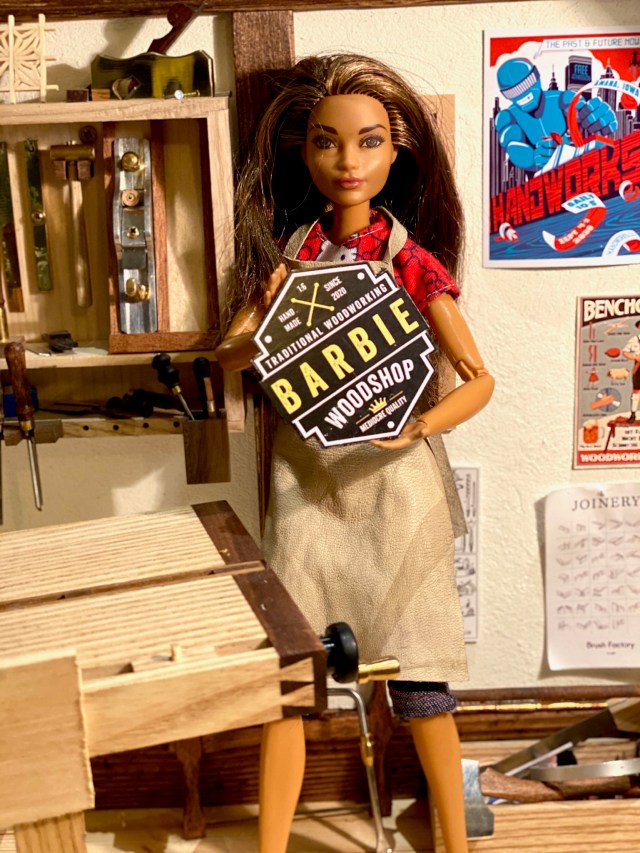
Barbie and her business sign, which is based on her logo
NH: On your logo, you describe the quality of your work as “mediocre,” but the joinery you show on your feed is exemplary. Do you plan to modify your logo soon, in light of your ever-increasing proficiency? It’s not that one needs to boast, but exaggerated modesty is arguably one of those traditionally feminine traits that are less than helpful to girls today.
BW: When I started to build up my woodshop, one of the first things I knew I had to make was a logo. I’ve been admiring maker logos on social media and I couldn’t resist designing a logo for my woodshop. Designing the logo was easy. I just downloaded an app and made it.
I designed the sign before I knew if I could make anything. I am happy about how my practice projects have turned out and the quality of the results have been delightful for me, too.
We can all benefit from a little humility and having a sense of humor about ourselves and the world can go a long way. I think the logo is funny and it draws attention. Just like it should.
Proper stance and not a hair out of place
NH: How has Instagram shaped your experience as a woodworker?
BW: I really like social media, but I’m not interested in seeing celebrity selfies or people showing off their imaginary wealth. I’m looking for inspiration and new skills. I’ve learned so much watching YouTube and Instagram content. If it wasn’t for the makers who share their knowledge or skills, I would never have found the joy of hand tool woodworking and I wouldn’t have any idea how to use them. I just want to chip in and share my story and show people that you can learn new skills if you just try. Doing beats mere intention, always.
I had no intention of posting anything to Instagram. My friends twisted my arm and so, I ended up setting up an Instagram account. I’m glad I started this. It has been a lot of fun. People are supportive, give me good advice and suggestions, which I’m more than happy to receive. Many people have offered to send me materials from their own stash. That’s really overwhelming. I really appreciate the positive vibe in the woodworking community. When I make something, I get a feeling of fulfillment when I behold the accomplishment. It’s even better when you can share the moment with the woodworking community.
Barbie’s homage to Megan Fitzpatrick’s sweater-girl-style cover for Popular Woodworking