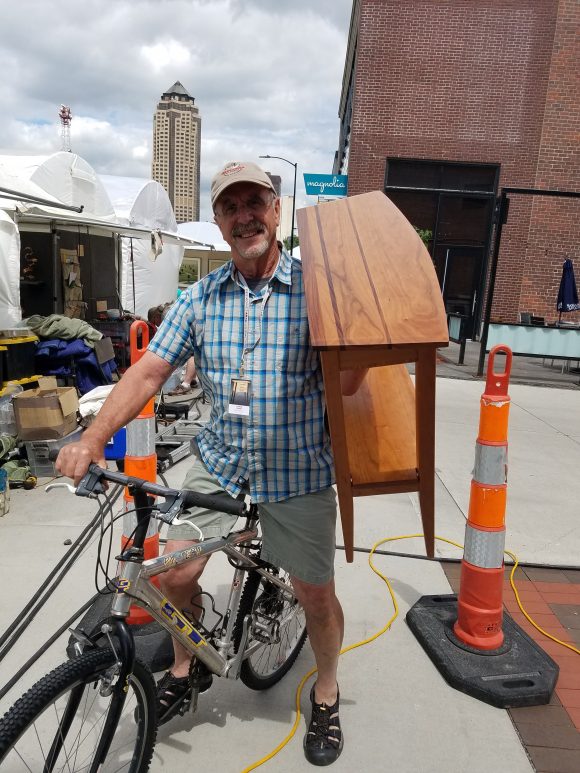
Today I reviewed a big batch of Crucible dividers for quality control problems and sent them on to our warehouse in Indiana. Barring some delivery stupidity (it happens), they should go on sale on Saturday.
These dividers are the most complex tool we make and are difficult to manufacture, especially considering the $110 price tag. If they were $300, we could lavish a couple hours of polishing and tuning on each tool and still come out in the black. But that’s not what we’re about.
Instead, these tools are manufactured – like our books. Yes, there is a lot of handwork, hand-assembly and tuning involved in these tools. But a lot of the skill to make them is in programming the robots and ensuring the processes are foolproof so that even I can assemble them – even though I’m not a skilled machinist. And so far, I’ve assembled quite a few of them.
Because I’m not a fan of hype, I’ve tried to downplay these dividers quite a bit (maybe too much). They aren’t like an infill plane or a blacksmith-made fretsaw. But when I pick up our dividers and use them – as I have every day for the last six months – I am tickled by their presence. Despite the fact that my personal dividers aren’t cosmetically perfect, I carry them around all day like a nice pen. I hold them when I’m thinking or on the stupid phone.
I open them and shut them over and over, and think about the mechanism inside. It looks so simple, but the angles and tolerances have almost broken my head a few times. But still they make me think. And now that we have the mechanism (almost) perfected, we’ve been designing other tools that use it.
(EDIT: When I say “almost” perfect, I mean that we are improving the hinge to make the assembly process easier. Right now we have to do a couple extra steps to get the hinge working perfectly. Nothing leaves our hands that isn’t 100 percent functional and meets our standards for fit and finish.)
Books have authors, but there is always a team of people behind them that makes the thing look good and read well. Tools are the same way. And so I will continue to call out the people who have made this tool really work: Craig Jackson at Machine Time and Josh Cook, a mechanical designer. Thanks guys.
So look for the dividers on Saturday. And if we sell out, know that we now are making hundreds more. Our goal is that everyone who wants one can get one.
James Krenov and several students mill lumber in the backyard of the Krenovs’ home in Fort Bragg. Milling lumber from logs with the Alaskan chainsaw mill, as Robert Sperber had done with Krenov a decade earlier, became a part of the school’s curriculum and is still taught each year. Photo courtesy of the Krenov family.
After these experiences at the other schools, it seems [James] Krenov’s relocation to California remained his central focus. When Krenov returned to Mendocino in 1980 for his longest engagement yet, he brought Britta, having already considered the area as a possible place to resettle and start a new life. The couple stayed in a renovated water tower in Mendocino, and used their time in the area to look for a new home. They found it just north of Fort Bragg on Forest Lane. Tina remembers her mother being thrilled at the palm tree in the front yard, an enticing embodiment of the exotic locale, far away from her native Sweden where she had lived up to that point. The Krenovs were also taken with the coastal environment – Krenov had always lived in cities and towns with an active maritime culture, and the presence of working boats in the Noyo harbor was a comfortable familiarity. During their first visits, the Krenovs began a practice of walking along the steep headlands along the coast, one they continued on a daily basis for the next 30 years.
Creighton Hoke, after returning to Richmond, Va., to pack up his tools and quit his cabinetmaking job, had moved back to Mendocino in hopes of attending the school that fall. He arrived just a few weeks after attending the workshop and was dismayed to find what he perceived to be little progress in the establishment of the school. Initially, Hoke took on a foreman position at Brian Lee’s millwork shop, hoping to use the skills he had developed as the lead in a cabinet shop in Richmond. This employment quickly fell through – Hoke was living on Lee’s land, in a tree house that had been built by Crispin Hollinshead on the rural property a few years earlier. And the workshop was, in his recollection, literally knee deep in shavings from the machines. Hoke left his position in Lee’s shop, and was looking for another opportunity, still driven by the hope that in a year’s time, he might be enrolled in the still-unrealized woodworking school under Krenov.
Under Lee’s organization and efforts, several craftspeople from the workshops and the community gathered to make a formal pitch to the College of the Redwoods administration in the fall of 1980. The administration was, by all accounts, enthusiastic about the proposition. The establishment of a woodworking school meant a boost in income for the community college system, which was paid based on student hours; a six-day intensive over nine months constituted a sizable number of credit hours. With Krenov at the helm, it would also bring national exposure to the otherwise locally focused school system. The pitch that the group made also noted that the program would be exceptionally rewarding for the local community’s craftspeople, as well. For that community, tying the program to the community college network would also drastically reduce the tuition for students – for California residents, the program would only cost $100 for the nine months.
A plan of the school, redrawn by David Welter in 1997. Image courtesy of the Krenov School.
After this proposal to the board in Fort Bragg, a second meeting was held on the main campus of the College of the Redwoods, 150 miles north in Eureka. At this second meeting, Hoke and Hollinshead, who had been central in the initial meetings, were joined by Bob Winn and Judy Brooks, members of the College of the Redwoods staff in Fort Bragg who had been on the board that heard their initial proposal. Winn and Brooks were early champions of the proposed program and central members of the community in Fort Bragg.
“The fact is that many of us were disconnected from the larger community, and had no real profile among our neighbors aside from breaking down in our pickup trucks downtown,” Hoke remembers. Winn, Michael Burns’s close friend, was an English and history teacher at the Fort Bragg campus and a persuasive voice from the school system and community in support of the school, a role he continued to play in subsequent years. Brooks, who would become a trustee in the College of the Redwoods school system, also lent her voice in support of the program, and developed a strong relationship with the woodworking program. Both advocated for the promise of the woodworking program, and all were excited to find that the administration at the college was already on board with the plan.
After this positive meeting with the administration in Eureka, the program was approved, and a part-time position to prepare and execute the plans for the school was created. Where Brian Lee had been instrumental in bringing the group together and providing the enthusiasm for the organization, the Guild took a back seat to some of the newcomers, especially Hoke and Burns, who were more driven in their specific hopes of working with Krenov. Lee would continue on as a driving force among the Guild and woodworking community, but a falling out with Krenov and disagreements with some of the newcomers led him to pull away from the school.
“Almost everyone – maybe everyone, in fact – would have gone right on doing whatever it was they were already doing, had it not been for the original, organizing energy of Brian Lee,” Hoke remembers. “There wouldn’t have been a Guild, or the workshops with Krenov. No ad in Fine Woodworking for me to see and respond to.”
Hoke took the part-time job with the college to set up the program, eager to find meaningful employment after his mismatch with Lee’s commercial business, and moved into an office at the Fort Bragg campus of the College of the Redwoods. A small piece of property was purchased at the eastern edge of town, behind the local school district’s bus barn, and construction of the facilities was underway by the end of 1980. During the next several months, Hoke worked with the school’s construction supervisors to design the school’s workshop, a daunting task that included everything from ordering materials, specifying the layout of the windows for the best natural light and ordering the machinery.
One of dozens of pages of invoices, requests and budgets that Creighton Hoke composed for the opening of the school in 1980. Image courtesy of the Krenov School.
Gary Church, a member of the Guild, was contracted to build the tool cabinets, made in the same manner as Krenov’s own tool cabinet in the workshop in Bromma. One of Krenov’s students from his first stint at RIT, Hunter Kariher, was contracted to build the 22 workbenches; it’s interesting to note that Kariher also built the workbenches for Wendell Castle’s workshop school a few years earlier. The benches were built in the same European style that Krenov himself used and were shipped from Kariher’s Rochester workshop to Fort Bragg that summer.
By his own account, Hoke was driven by the dream of attending the school, but the task laid before him was far from simple. Krenov, over the phone, was a demanding presence, and threatened Hoke that he may not make the planned resettlement if the school wasn’t properly equipped. Krenov’s demands were informed by the ill-fated arrangements he had encountered at his prior engagements with RIT and BU, where he had found the facilities inadequate or the demands on him as a teacher either unfair or ill-informed. His exacting requirements were likely motivated by a hope that this last engagement would be a good fit.
That Christmas, Hoke and Burns worked together to lay out the building plan on graph paper on the kitchen table of Burns’s family’s home. Burns, whose experience in the trades and homebuilding, complemented Hoke’s now-nuanced understanding of Krenov’s expectations, and in the course of a day, the layout was finalized. Hoke worked closely with Larry Kavanaugh, the school’s director, to put these plans into place, and the two of them ordered the machinery and supplies for the program, specifying everything from window shades to lumber racks to the particular style of fluted dowel Krenov preferred. Kavanaugh, who became a close friend and advocate of Krenov’s in subsequent years, worked closely with Hoke through the process, and the purchase lists for equipment and materials show that the school was sparing little expense in equipping the workshop.
Hoke was also tasked with outlining a curriculum for the program – while the basic understanding among those involved was to simply follow Krenov’s lead, the administration required a detailed plan for the 1,728 credit hours that constituted the nine-month program. Here again, Hoke interpolated from Krenov’s books, and consulted with their author over the phone form a structured plan for the year.
One of the last, if not the last, photos of Krenov in his basement shop in Bromma. Two of his cabinets are visible on his bench in the background of the photo, and his “Writing Table of Italian Walnut” is in the foreground. The photo illustrates Krenov’s preferred surface treatment for such a piece; the luster of the waxed tabletop illustrates his preference for satin surfaces. Many of the wall cabinets he made earlier in the 1970s and late 1960s were left completely untreated. Photo by Rolf Salomonsson.
This process was a daunting one for Hoke, and over the course of the year a tradition developed that continued into the school’s weekly rituals. Michael Burns, who was helping Hoke develop the program and work with Krenov to build out the home he had bought the prior summer, arrived at his office to pull him away for therapeutic drinks outside a local liquor store. The beverage of choice was Carlsberg Elephants, a malt-liquor from the Danish brewery, and the “Elephants” meetings continued as a ritual on Friday evenings. The meetings began as a small group of the school’s community, who circled up their cars outside the Sprouse-Reitz variety store downtown. In later years, the meetings moved to the “North O’ Town” industrial park, where a small satellite shop was set up by the school’s faculty and students, and by the late 1980s, it finally relocated to the school, becoming a weekly get-together for the students and the extended community of alumni, supporters and family members growing in the area. After its informal beginnings in the parking lot, Krenov began attending the gatherings with Britta, and it was especially Britta’s constant presence that students remember. During the next several decades, Britta would only miss a handful of “Elephants.”
More than 43′ long and 5,000 years old, the top of the table made by The Fenland Black Oak Project is the culmination of more than 30 years of research, trial and error in milling and drying bog oak.
Around 2012 I was building some cabinets into a sitting room off my clients’ kitchen when Paul, a member of the general contractor’s crew, struck up a conversation. “I just saw this amazing video about bog oak,” he said. “There’s this guy in England digging up 4,000-year-old trees and using them for furniture. I bet you know him.”
Know him? I had never even heard of bog oak and certainly had no idea who Paul might be talking about. That night I Googled “bog oak and furniture UK.” Up popped a link to an article by Derek Jones published in Furniture & Cabinetmaking magazine, on the website of Adamson & Low.
It was one of those small-world moments in which time and space collapse. Here I was, working in rural Indiana, suddenly transported back more than 30 years to the woodworking shop at the Isle of Ely College in Wisbech, Cambridgeshire, where Hamish Low was a fellow student in a City & Guilds furniture making course. It was no surprise that Hamish had distinguished himself in the field – he’d been the most impressive student in our cohort. The culture of that classroom was brutal, with intense competition and merciless teasing; I used to swear that someday people would brag about their “low quality” furniture. I knew he’d gone on to train at West Dean, then worked for the Edward Barnsley Workshop. But beyond that, his adult life was a mystery to me. So I was interested to read that he had partnered with Nicola Adamson to build a business and a family, and was involved in pioneering work.
Nicola and Hamish, 2018.
Nicola Adamson and Hamish Low met in 1989 when she was a student in the two-year residential program at the John Makepeace School of Craftsmanship in Wood at Parnham House. Hamish was employed in Makepeace’s workshops as one of the craftsmen who turned the renowned designer’s drawings into three-dimensional furniture.
Makepeace wasn’t keen on having students mix with his cabinetmakers – students who were being trained in business and design might try to make off with an experienced cabinetmaker, robbing Makepeace of an invaluable member of his workforce. “Every student wanted a cabinetmaker to make their designs,” says Hamish, adding, “I was just head-hunted [by Nicola] for my cabinetmaking skills. Plus, Nicola had a whole load of machinery, so that was obviously part of her dowry! So it was basically a marriage of convenience.” Same old humor, even after three decades.
Bog oak ball and chain jewelry box, Hamish’s wedding gift to Nicola in 2000. The part that goes around your leg is laminated veneer with a knuckle joint.The chain is carved out of a solid block of plied bog oak, with alternating grain direction..
“I had started setting up a workshop in Kent,” Nicola adds. She planned to use the shop herself following her time at Parnham. For a couple of years, while she and Hamish had a long-distance relationship, she rented bench space to another student, until the couple started working together in 1992. “Business and I are just hopeless,” Hamish says. “Nicola has always run the business. Nicola is also more of a designer, so I was really shackled to the bench.” Another bit of hyperbole. They worked together until the birth of their first child, Hazel, in 1996.
Nicola has always lived in Kent, southeast of London. Her father was a motor engineer. Her mother was a housewife who also worked from home making lampshades and curtains commercially. In other words, “both [parents were] quite practical.” She went to the local comprehensive school, then to art college for two years before leaving for Parnham.
Initially, their work came by word of mouth. They did whatever clients wanted – furniture, as well as a few kitchens. One kitchen stands out – the cabinets were in burr oak, and the job was for an oast house. Oast houses are a traditional Kentish architectural form, built to dry hops for brewing beer. In recent decades, they’ve become popular for conversion to residential use. Circular in form, their roofs rise to a point, so anything built-in must be custom-designed. After Hamish and Nicola did that kitchen, the oast house clients called them back for a new commission each year. Gradually those clients’ friends began to hire them, as well. When clients had children, they wanted beds and desks “and stuff to go on uneven floors of Kentish barn houses,” Nicola adds. So while their clients were few in number, they had multiple commissions from each one.
“You only need one customer, one client, and if you’re successful they recommend you,” says Hamish. “It just seemed to snowball. We’ve always had a year’s work booked up ahead of us. When you work to commission, everything is always a compromise because [the clients are] paying the bill. You can’t really progress from that unless you make what you want and exhibit it. But it’s in your clients’ interest [for you to move on to your own work]. People are speculating on you more. You try to break into the art market.”
Early on, kitchens paid for everything. “It was a lot of work for two people,” Nicola says. “We designed it, made it, installed it, did all the plumbing and electrical; it was all-consuming.”
“People would spend a fortune on their kitchens,” notes Hamish, “and yet something that would become a family heirloom and become collectible, they didn’t seem to value it in the same way.”
Although the income from kitchens was good, they switched to freestanding furniture when their children were young – their son, Archie, was born in 2001. “The last [kitchen] we did, Archie was born in the middle of Hamish installing it,” says Nicola. Both children were born at home. “I had to call the client to say ‘I think Hamish ought to come home.’”
“It was just easier,” Hamish says, prompting Nicola to add, “I could just get down from the drawing board!”
Bog oak bench. Hamish made this piece before he had his drying technique worked out. The plank had twisted and also cupped significantly. He decided to embrace the defects. Before carving the seats he blasted it with crushed glass in a process like sandblasting, then he did the carving. The result: a lovely contrast between the rough texture of the main sections and the smoothness of the seats.
Backgammon set made with brown oak, burr oak, quartersawn and bog oak.
Part of a set of six bog oak tables.
Marquetry folding door screens inspired by the elevators in the Chrysler Building. The clients live in a 1930s Art Deco house and are Art Deco collectors.
Drinks cabinet in burr acacia and bog oak.
Since the beginning of their partnership, they’ve focused on using native hardwoods that would otherwise be wasted. Some of the timber came from their clients’ own trees. “We were quite unusual in that we would do everything, from tree to chair,” Hamish says. The client would be engaged in the entire process. “That was quite interesting to them; a lot of it is very old, established country tradition, and yet a lot of it was sophisticated technology.”
For example, he explains, air drying of oak has been done the same way for centuries. “It’s a very direct process.” But the “technology” would come from the new mills, such as Wood-Mizers. “We would use technology alongside established traditional approaches to drying timber. You start with a huge, sopping-wet liability and you turn it into a plank of wood. Everything we make starts with a plank of wood. It becomes the most usable, fantastic thing. And there’s a lot of technology involved in drying it in the kiln. The client was involved in all of that.”
So much of the beauty of wood can depend on how you cut the tree, he points out. “Amazing grain and visual impact can be created from pretty shit trees. If you’re a little bit savvy and a little bit arty about how you apply yourself to using very defective trees, you can produce some very beautiful things.”
This appreciation for the design potential of timber considered low grade or defective is what led Nicola and Hamish to their work with bog oak.
Bog Oak
Hamish grew up near Cambridge and attended the Isle of Ely College in Wisbech, a town built on the banks of the River Nene. Wisbech and its environs lie close to sea level in a marshy region known as the fens. At the end of the last Ice Age, some 10,000 years ago, the area was densely forested with gigantic oaks, yews and pines. As the Earth warmed, sea levels rose and the area between England’s south and eastern borders was cut off from the European mainland by what we now call the English Channel. In low-lying areas of the east coast, such as the fens, the forests were flooded. Trees fell into the silt, where the absence of oxygen led to their preservation.
In the 1600s, wealthy landowners hired Dutch engineers to drain the fens and build dams in hopes of increasing their agricultural acreage. Newly exposed to oxygen, the peat began to oxidize, shrink and slowly blow away. Drainage work began anew in the late 18th and early 19th centuries; the entire region is crisscrossed by drainage ditches today.
Hamish had known about bog oak for years, because he often visited an uncle who lived in Wisbech to go fishing in the fens. He’d see bog oaks just lying in the fields. Farmers hit the logs with expensive modern farming machinery, which causes damage, so they typically want to get rid of them. His friend Frank, whose father was the vicar in the nearby village of Methwold, was into photography and had shown him photos of bog oaks coming out of the fields. “They were very arty photographs,” Hamish remembers. He asked what happened to the trees. “They’re going on the fire,” Frank told him. Hamish decided he’d be interested in trying to process them. As he soon learned, “That is notoriously difficult.”
“Other, very famous makers were using [bog oak], he says – Makepeace, Alan Peters, Wendell Castle. But no one knew how to dry it, so they were using it as details and accents, such as inlays or handles.” He was convinced there must be some way to process the wood for structural use in furniture. “It’s such amazing material. We’re doing it with all the other native hardwoods,” he remembers thinking. “This is the mother of waste! It’s the holy grail of trying to use material that would otherwise be wasted. They burn it, for God’s sake!”
The newly unearthed Jubilee Oak.
Air-drying is too aggressive, he learned. Bog oaks must be dried under the most carefully controlled conditions. While most woodworkers kiln-dry for speed, Hamish dries bog oak in a kiln because it’s a far more precise way to manage the process. “You can take a thimble of water over a year, or ten gallons in a day.” His kilns never go above 35° Celsius (95° F). It’s a technique in which he has invested 30 years of trial and error – “mostly error!” he adds.
“It’s the weirdest thing you’ve ever seen,” he continues, describing the kind of scene where bog oaks tend to appear. “The soil is jet black. Flat. You turn up and there’s the most enormous lump of black mud sitting there and you think ‘Where the hell does this come from?’ He has watched bog oaks get unearthed with huge machinery; a machine operator puts the bucket into the ground, “and you can see the peat moving 20 meters away. It’s an extraordinary sight. They are so straight – such perfect specimen oak trees.”
“You’ve found it,” he continues. “Then you have to decide whether it’s worth investing in. You can dry bog oak and it can be soft and full of splits; or it can be super dense, as dense as ebony – 1,166 kilos per cubic meter.” (That’s roughly 72 pounds per cubic foot.) “And it’s figured, so it’s like a figured ebony if it’s quartersawn. It has a particularly fat medullary vessel.”
“A log can be rubbish or black gold. You have to identify whether it’s any good. They all look the same and weigh the same.” So, how do you tell? “You get a very sharp hand axe and chip away at it. If it’s any good, you’ll meet resistance; it will sound like it’s going to be good. It vibrates.” It’s a subtle way of knowing material, he explains. “What you don’t want: It’s soft and mushy and you can keep going; it doesn’t reverberate. You can feel it and hear it.”
You have to test the whole length of the log, because there are pretty much always pockets of rot. The really big logs were typically immersed unevenly in the peat, with parts exposed to the elements and subject to insect attack, splitting and fungal disease. Color is another good indicator, once you cut into the log, as is how far below sea level the log has been buried. Hamish looks for logs from 3′-4′ below sea level as a guide.
Generally speaking, he cuts logs with a chainsaw, in the field, into 12′ lengths; anything over 6′ is usable. He looks for those that look like a half moon, a segment of an orange – no heart, no pith, and so, no heart shake. Nicola explains: “The logs are often dug up half-moon-shaped, as one half has already rotted away.” They mill them to produce quartersawn planks for optimal figure and stability.
At times he has brought trees back in the round, planked them and put them in the kiln. Even boards close to each other in the log can vary dramatically – one will have splits all over; the next won’t, even though both have been processed in exactly the same way. This variation in quality is often due to part of the tree having been exposed to the elements, which causes it to split along its medullary vessels. To illustrate this, Hamish once put a tree back together after it was dried. While the “top” half of the log was all split, the bottom was perfect, because the bottom half had originally fallen into the silt. The part that had been exposed to oxygen “split like mad” before falling into the silt, whereupon the splits filled up to absolute fiber saturation, only to split again when dried.
In 2012, Hamish and his colleagues found the best bog oak they had ever encountered. The log was perfectly preserved, with not so much as a single pocket of rot or insect fly hole. And it was massive, at 43′. “You couldn’t even tell which end was which; it was so parallel,” he recalls. “It was only part of a much, much bigger tree.”
Nicola and Hamish call this image “18 people carrying a wet 43′ Black Oak plank.”
“I don’t think we should cut this,” Hamish decided on the spot. “We should keep it full-length.” He and his crew returned home empty-handed. The whole way back, Bob, a friend, neighbor and experienced woodworker who often travels with Hamish to the fens when collecting trunks, was saying, “You’re bloody mad. How are you going to lift it and dry it?” Hamish simply replied: “Imagine jet-black planks that are 13.2 meters long.” They subsequently named it the Jubilee Oak.
Tell me you’re not drooling as you look at this material.
Nicola recounts how they put together the people and resources required to turn this prized find into a piece of furniture – a table – worthy of its history and rareness. “After finding the Jubilee oak, Hamish contacted The Worshipful Company of Carpenters and subsequently The Building Crafts College (The Worshipful Company of Carpenters run this college) to help further this endeavor. Steve Cook and Mauro Dell’Orco were both students there at the time and have now become part of the long-term project. Steve became artist-in-residence at The Building Crafts College for a year after he completed his course and was also funded for a year by the Queen Elizabeth Scholarship Trust to assist Hamish in the drying of the boards. Mauro, who previously had a career in architecture, has become the lead designer for The Fenland Black Oak Project.
They milled the tree in 2012 and dried it in a purpose-built kiln at The Building Crafts College. The drying took nine months. In 2019, with help from more than 20 students who gave up part of their summer holidays for the privilege of contributing to the project, Hamish painstakingly constructed the table’s top from four of the boards in the spacious and well-equipped workshop at the Building Crafts College.
The tabletop at the Building Crafts College.The joints between the boards are not glued. They’re a perfect fit (you can find information about the process on Instagram @fenlandblackoakproject).
In the intervening years, they had set up a charitable trust to manage and protect the boards. The trustees come from varying backgrounds – farming, accounting, film making, legal work and administration. Hamish was appointed chairman in 2020, after the previous chair stood down.
The tabletop is currently in a climate-controlled kiln while the group raises funds to complete the base, which will be fabricated in bronze, in recognition of the era during which the trees were standing. “There’s a whole team of people who have worked on the design,” Hamish says. “It’s the most important thing I’ve ever done, and the most amazing.” When I ask, in view of how integral Nicola is to their business, whether Hamish really means to use the first-person singular in that quote – “It’s the most important thing I’ve ever done” – Nicola replies: “I in theory am not involved in The Fenland Black Oak Project. It is very much Hamish’s other woman! That said, there does seem to be quite a big workload that comes my way!”
For the first 18 months after its completion, the Jubilee Oak table will be on display at Ely Cathedral, a spectacular Gothic structure on high ground overlooking the fields where the ancient oaks were buried. “By displaying this table at Ely Cathedral we are hoping to raise awareness amongst local land owners of the urgent need to preserve as much black oak as we can,” says Hamish. “It’s going to run out. We just want to save this best-ever example so people can see it when it’s all gone.”
Other Work
Nicola and Hamish are no longer working to commission. After 30 years of that, they’re ready to switch to spec work and are currently developing some innovative construction techniques. “In order to make something amazing, you’ve got to go back to the basics,” Hamish says. His motivation: “Let’s develop some construction techniques that will allow us to do something visually amazing! You can’t just decorate something in a different way. Who cares? You need to start again.” For now, this is all I can reveal, as they’re keeping the particulars of these techniques under wraps.
They make their home on a smallholding in Kent, where they live with cats, chickens and Paisley, their dog, and finished building their own workshop in 2020.
Hazel, Nicola, Archie and Hamish.
At this point we return to Hamish’s youth. His father worked as an underwriter for Lloyds of London. His mother was a school teacher who eventually became a headmistress. Hamish went to a Quaker school, Sibford Ferris, that had a good woodworking department.
“I was severely dyslexic,” he says. “Still am. Basically I was hopeless at school until we were allowed in the woodwork shop. The woodwork teacher said, ‘You’re good at this!’ This useless pupil was good at something.”
“Don’t ever underestimate a craftsman,” he emphasizes, “because they’re highly disciplined, highly trained, very determined individuals. I’m a real advocate of traditional apprenticeships. I don’t think you could be good at this job other than by doing it as an apprenticeship. Doing it as an apprenticeship teaches you humility. One of the people I worked with said, ‘Somebody who never made a mistake never made anything.’ Processing bog oak went so wrong, so often; you could take the view that it’s a waste of time. Or you can say, ‘I’ve applied myself to this in the wrong way, so what can I do to do it right?’ A craftsman accepts that they’ve made a mistake. Then, rather than saying, ‘That’s a stupid idea,’ or ‘This is impossible,’ they say ‘What did I do wrong and what have I got to do to make it work?’”
With bog oak, Hamish applied himself to this question for 30 years and now says, “You only have to get it right a couple of times for it to show you that this is worth it.”
If you’d like to contribute to The Fenland Black Oak project, you can do so here. All contributors donating £1,000 or more will have their names carved into the underside of The Jubilee Oak top as a reminder to future generations of this shared vision.
Paisley, whomNicola calls “the bog oak inspector.”
It was Peter Follansbee who suggested I consider interviewing Ed Maday for the Lost Art Press blog. “We’ve only met once, before I ‘knew who he was,’” he wrote in a note a few weeks ago.
Back when I worked in the museum field, one day this ordinary tourist type was slumping around. Belt & suspenders, shorts, shirt not tucked in. I happened to be hewing a bowl from a catalpa log and when this fellow made his way to my spot, he told me he used catalpa a lot, as an instrument maker. Made the backs of non-traditional violins from catalpa & loved the sound it makes…didn’t get his name. It was a short interaction. Probably 7-10 years ago.
Some time later, I was at Connecticut Valley School of Woodworking w[ith] Bob Van Dyke. When I’m there, we usually have dinner with Leslie Dockeray, a friend/student/collaborator there. She teaches violin to children in NYC. My twins had just started violin lessons, and we were generally talking violins. I mentioned this man, and his use of catalpa. Leslie exclaimed “THAT’S ED MADAY!” – which meant nothing to me. Then she went on to tell me he’s one of the best violin-makers in New York.
He’s amazing. I can make all manner of household junk out of wood – but it doesn’t make a sound. Ed’s things come to life.
At the corner of Broadway and Johnson Place, in the playground of Woodmere Public School on Long Island, N.Y., a catalpa tree grew three stories high, Ed recalled. Always among the last trees to form leaves, it blanketed the ground with popcorn as the end of spring semester approached. On close inspection, each exploded kernel revealed an orchid-like form – creamy petals surrounding a magenta- and gold-flecked throat. In summer, the tree’s dense canopy of bright-green leaves, each shaped like a heart, offered shade and a backrest to readers. It littered the playground with long brown seedpods just as children began to dream about costumes for Halloween.
“In the 1960s, we all played under this tree,” he said. The living landmark had stood over the monkey bars even when his father was a kid at the same school.
The playground was closed when the school expanded its library in the mid-1990s. The authorities took down the tree.
“When I saw the tree down,” said Ed, “I went up there that night with my Chevy Astro van. My wife went…with me. We rolled the logs in.” His brothers Jimmy and Albert set their band saw mill in the yard and cut up the tree with help from Ed and their eldest brother, Joe. “From this catalpa tree I’ve made about 80 instruments so far,” said Ed. “It’s a little like black walnut in density. It rings like a bell and has this beautiful grain and is perfect for instrument making. It’s even great for violins. [Most] people will choose Bosnian maple, but this catalpa makes a beautiful sound for fiddles, for old-time music.” So beautiful that he made a model of Maybelle Carter’s 1929 Gibson L5 as a gift for Nashville-based bluegrass musician Molly Tuttle (the first woman awarded an International Bluegrass Music Association’s Guitar Player of the Year) in 2019. “I knew her from going to the bluegrass festivals,” he continued, adding that he has always loved the Maybelle Carter Gibson. He also made a cello from the catalpa for Madeline Fayette, who plays with the Orpheus Chamber Group (you can hear a performance of hers on the Maday catalpa cello here); her sister, Abigail, is a professional musician who plays a violin Ed made from Bosnian maple.
The arch top guitar Ed made for bluegrass musician Molly Tuttle, a model of Maybelle Carter’s 1929 Gibson L5.
Tuttle with her guitar.
The headstock of Tuttle’s guitar.
Catalpa back of Tuttle’s’ guitar.
Ed, 63, earns his living by making highly customized string instruments, from the daintiest of fiddles to the most sonorous double bass. To date, he has made some 350 of them; his repertoire also extends to viola dagambas and mandolins. Many of his customers know him from his time repairing and restoring antique instruments; in addition to work for well-known musicians, he performed basic sound adjustments to his customers’ preferences. “I’ll make [an instrument] play to the way they want to hear it and feel it,” he explains. “[All instruments] are affected by weather changes in the wood. Mostly people come here…because they know me, they like me.”
Ed used Bosnian maple for the back of this violin.
A vielle with the back and sides carved from a single piece of catalpa.
The top of the catalpa vielle.
His customers select their preferred wood, partly for looks but mainly for sound. Ed buys Lombardy poplar, a common wood for cellos and violas, from Italy. Most people who come to him for a classical instrument want flamed Bosnian maple for the back and sides, and spruce from Italy or Bavaria for the tops (i.e., the front). Some come to him for custom dimensions; it’s critical that the instrument fit the player’s body. Almost all want something “really cool that’s not commercial.”
One commission was a rebec he made for a client who wanted her instrument to resemble Rocinante, Don Quixote’s horse. A predecessor to the violin, used from the 13th-15th centuries, the rebec is carved entirely from a single block of wood, as you’d carve a spoon. Some customers ask him to carve a head at the scroll; several months ago, during the pandemic, he carved a John the Baptist head, complete with a beard and eyes looking to heaven for guidance. An upcoming job will have a dolphin instead of a human head. Once, a lady in Portugal commissioned an instrument with the head of a dragon. As Follansbee observed, these are musical instruments: they not only demand an artist’s skill in carving; they also have to sound good. Ed assured me, “I get ’em to sound nice.”
A customer taking curbside delivery of his new John the Baptist cello.
Detail, John the Baptist head.
The carving of Rocinante, with finish.
The Rocinante rebec, with case and bow also by Ed.
Back of peg box, viola dagamba.
For the past 2-1/2 months Ed has been working on a double bass for a teacher on Long Island who plays jazz. Ed carved the back from catalpa planks, though these didn’t come from his childhood tree. At 44″ long in the body and requiring two 3″-thick pieces, each 10-12″ wide, he needed something more substantial. That catalpa came from his friend Jimmy Koehler’s yard. “His tree is big enough to make double basses out of,” he said. Ed has carved the neck and scroll, and dovetailed the neck to the body. With luck, the piece will be ready for varnish in the next three to four weeks. He’ll finish it with a traditional violin maker’s varnish made with fossil amber (also known as Baltic amber), the same material used by Dutch masters in the 17th century. He cooks the amber with linseed oil and rosin for 4-5 hours, until it polymerizes – that’s the process that makes it dry – and colors it with pigments made from natural materials such as madder root and walnut husks, “pretty much the way it was done in the 1700s.”
Viola d’amore in a barn wood case.
The barn wood case.
Family
Ed, the second of five children, was born in Woodmere in 1957. He has lived there his whole life. Today, he and his wife live in the house where he grew up, a place his parents built in 1960 that’s less than a half-mile from the Woodmere Public School.
Ed (left) with siblings Johnny and Jane.Most of Ed’s family, when Ed and his siblings were kids. Left to right: Ed, “Papa,” Jane, Jim, Joe and Johnny.
Ed’s father, who was born in 1930, grew up in the house next door. He owned an auto body shop in Woodmere but was a lifelong woodworker who spent hours in a shop converted from a garage, building boats, carving wood and making furniture for his family. He always encouraged Ed and his siblings to join him in the shop and make whatever they wanted; Ed recalls making balsa airplanes. The only catch: They were not allowed to use power tools of any sort, because their father had lost four fingers on his left hand in a woodworking accident at the age of 16.
Another influence Ed mentioned is the traditional culture of Woodmere Bay (also cited on maps as Brosewere Bay), which was historically home to clam diggers and farmers. Along with many others who lived near the bay, his family had a bay house on stilts where they spent a good part of each summer. At a time when much of America was abandoning traditional ways of living for new conveniences, from electric washers to frozen dinners, and the nation’s evening ritual became relaxing in front of a black-and-white TV, these bay houses had no electricity; kerosene lamps provided light, and coal stoves generated heat. “Everyone did stuff by hand,” Ed said. Those summers made a deep impression. Sadly, the Madays’ stilt house was washed away by Hurricane Sandy, but its echoes linger in Ed’s cluttered shop, which he likens to Geppetto’s.
Another generation. Janet (Ed’s wife) with children Elizabeth and Eddy Jr. at the bay house.
After Ed came Johnny, followed by their sister, Jane, then brother Jimmy. Albert is the baby of the family. Everyone played the violin except Joe, who played banjo. Ed has played violin since third grade. Their mother worked at their school, first as a kindergarten aid and later as a library assistant. “She played folk guitar and sang songs around the house. At family gatherings everyone would hang out in the kitchen and sing,” said Ed.
His parents didn’t push him in any particular direction, which was nice, considering that he knew he wanted to be a violin maker from an early age. He made his first violin at 15, after three years of reading library books on the subject and experimenting with materials and techniques. In the mandatory meeting with his guidance counselor to discuss further education and possibilities for a career, he expressed his interest in making violins. “She didn’t know what to do with that,” he said. She suggested he should first learn a bit about business and talked him into studying accounting at Hofstra University.
He applied to Hofstra and decided to major in business, but flunked out of business after two semesters. “The courses I did really good with were music, English, philosophy, arts. Any of the arts: the humanities.”
Meanwhile, he had never stopped playing violin. His violin teacher, Olga Bloom (best known as the force behind Bargemusic, a floating concert venue under the Brooklyn Bridge), was one of his professors at Hofstra. She encouraged him to stick with music. He won a scholarship to play violin, which got him parts in chamber group sessions and playing in the orchestra pit for the theater department.
Throughout his time at college he built and repaired instruments on the side. Three or four nights each week he also played fiddle on stage in Long Island and the metro area, and sometimes in New York City – early style jazz and swing with The Uptown Radio Cowboys, bluegrass with the Jumbo String Band – sometimes working ’til dawn. It was the mid-’70s – a time, said Ed, when there was “a bluegrass wave.” He could see a future combining bluegrass and swing with violin making.
In the end, he didn’t graduate from Hofstra. He took a part-time job in the produce department of his local Key Food grocery store, where his work ethic made such an impression on his employers that they offered him the position of produce manager, a regular job with 40 hours a week and grown-up benefits. “I remember looking at the guy and saying, ‘No, man, that’s not why I’m here.’” A pivotal moment came soon after, while he was eating a slice of pizza on his lunch break. He spotted an ad in the Long Island Newsday for a scholarship at Molloy College, which had recently added a music department. “It always bothered me that I didn’t finish college,” he says. “I walked over to the payphone, put in a quarter and called.” They scheduled him to audition on violin. He won a full scholarship and graduated in 1984 with a degree in violin performance.
Within a month and a half of graduating, he found a job with Kolstein’s, a well-respected business that repaired and restored string instruments. Ed “did a lot of repair work,” much of it for musicians with household names. He met Percy Heath and George Duvivier, who played for jazz greats Coleman Hawkins and Sy Oliver, as well as more widely known stars such as Frank Sinatra, Judy Garland and Lena Horne. Beverly Peer, who played bass for such stars as Ella Fitzgerald, Sarah Vaughan, Barbra Streisand, Johnny Mathis and Bobby Short, was a customer. “He’d come over and stick a couple of bucks in [your] shirt pocket and say ‘Get yourself something nice for lunch.’ All these cool old guys would come in there. So I’ve always kept in touch with the Kolsteins.”
Still, Ed wanted to make violins. His friend Joe Tripodi, whose place Ed had taken at Kolstein’s when Joe left to open his own business, hosted quartet parties in his home once a week, where he and his friends got together to play Beethoven and Mozart. Joe had trained at the Cremona International School of Violin Making in Italy, where 17th-century master Antonio Stradivari had made violins; he was steeped in the Italian method. Around 1984 he offered Ed a job he couldn’t refuse – it was, said Ed, “a super-great opportunity for me to learn. Joe taught me a whole lot of cool stuff.” (Note the typical Ed Maday understatement.)
One of Joe Tripodi’s friends, Stan Schmidt, was a Chicago-based painting conservator. Because his clients were museums, he was seriously interested in original pigments used in the 17th and 18th centuries. Stan’s enthusiasm spread to Ed and Joe, who began to research historic Italian varnishes. Ed quoted a widespread belief to underscore the importance of finishes in string instrument making: “The varnish is the secret of the sound.” Stan showed them how to precipitate pigments and make varnishes as an artist would, rather than using methods common among furniture makers. Historically, Ed pointed out, varnish makers were a separate guild from violin makers. Thanks in good part to Stan’s encouragement, Ed’s varnish today is as historically accurate as possible.
“Joe was very anti-capitalist” in those days, Ed said. “He wanted everyone to be treated fairly. When repair work came in, he’d ask, ‘Who wants the job?’” Joe might take 10 percent of the cost of the job, but the rest went to the person who did the work. Ed appreciates the respect for workers inherent in this m.o. but said “it didn’t really work out. Joe wasn’t making any money, and nobody else was [either].”
Ed left Joe’s shop in 1990 and went to work at his childhood home. He’d always kept a work area there, routinely putting in 20-30 hours a week after his regular job. (He’s had his bench, a gift from a neighbor, since he was 12 or 13, and still uses it for carving.) He expanded the shop, and when his parents moved out in 1997, he and Janet bought the place and moved in. “Now,” he said, “the whole house is stuffed up with instruments and wood” – not so surprising when you consider Janet’s a cellist who gives lessons in their home. A devoted instructor, she teaches well into the evenings – from 2:30 in the afternoon to 9:30 or 10 at night in the school season. With the pandemic, however, “everything’s done through Zoom,” said Ed. “It makes it hard, because some of the younger ones can’t physically manage their cellos yet.”
Pandemic-protocol curbside pickup. Arch top guitar made for Nick Albanese.
Despite the pandemic, Ed’s business is thriving. He has six instruments on order after the double bass that’s currently on his bench; his customer has been talking for three years about hiring Ed to make the instrument. “All the musicians I know, they’re out of work. They’re taking on any odd jobs they can find to make money. Some of the greatest musicians. Around here, in New York, they have no work. The ones that would work in clubs, bars, little venues, that’s all out the window. [There’s] minimal work here and there, but not enough to make a living.” For college students who hope to make a living playing music in orchestras, hopes have dwindled. “It’s kind of depressing,” he said. “It’s not good for the music.”
As for that stash of catalpa from his beloved childhood tree, he says, “I have a lot of it. I don’t think I’ll ever get through it all, ’cause I’m 63 now.” Whether Ed uses it up or not, the playground catalpa lives on in the music brought to life through the instruments he makes.
Ed, Eddy and Janet.Elizabeth, Ed and Janet.
A recent picture of Ed’s mother with one of his instruments.
From the vantage point of 2020, it’s jarring to recall a time before you could Google the length of a human colon while taking a bathroom break, share shots via Zoom in real time with friends in another hemisphere or ask Siri for the latest update on the Kardashians. (Then again, why would you want to do any of these?) Has Facebook really been around for just 16 years? Instagram no more than a decade? In fact, the internet itself only became publicly available in 1991.
In the primitive age that preceded this era of often-superficial connection, woodworkers and their fellow artisans had other ways to communicate and show their work to potential buyers. Some published paper catalogs sent to thousands of prospective customers by U.S. Mail. Some bought ads in newspapers and magazines where they might also be lucky enough to have their products featured. Others displayed their work in what we now call brick-and-mortar galleries, in exchange for a cut of the price – often as much as 40 percent. But one of the most affordable ways to show and sell work was at art fairs and craft shows.
After a strong start to 2020, shows, conferences and in-person performances of all kinds have been cancelled due to the COVID-19 pandemic, demanding that those whose livelihoods depend on such events find new ways of teaching, entertaining and selling their wares. Given how challenging such pivots can be, Vicki and Lance Munn have found a silver lining of sorts in the timing of their unexpected retirement in late 2019. For 40 years, they’d supported themselves by making furnishings, from Japanese-style vases, wood-framed mirrors and wall-hung artwork to freestanding cabinets, desks and tables, all of which they sold at shows throughout the Midwest and on the East coast.
Vicki and Lance in 1972, before they began doing shows. (The photograph is water-stained.)
Lance and Vicki met in 1969. Lance, who’d been drafted, was stationed at Fort Riley, Kansas, where Vicki had a job in the post exchange. Lance was lucky to avoid deployment to Vietnam; he served in the States as a member of the military police. “The Army made him grow up,” says Vicki. “All of a sudden you’re not special. You get your head shaved, you wear a uniform. You’re only what you are inside, not the projected image others see.”
After completing his term, Lance moved home to Indianapolis to live and work with his parents, who were in the restaurant business. Vicki earned a degree in political science at Kansas State University-Manhattan while continuing to work part-time at the post exchange. She lived in her employer’s basement. (“At the time, I didn’t realize I was poor,” she says of the arrangement.) She graduated in 1971, packed up her belongings in cardboard boxes, shipped them to Indianapolis on a Greyhound Bus and took a plane to join Lance. Shortly after, they were married.
At first they each worked two jobs, a logistical feat considering that they shared a car – and it was more than 20 years old. Lance returned to college while working part-time and graduated with a degree in biological science from Purdue University. Meanwhile, Vicki worked her way up to office manager in her job at an electrical supply office. When she asked for a raise in keeping with her increased responsibilities, her employer told her the job was only worth the $100 a week she was already getting – not much on which to build a future. With no prospect of advancement, she gave her notice. That would be her last regular job until 2020.
While renting a house on the western outskirts of Indianapolis, they decided to put in a garden. They saved up for a Troy-Bilt tiller; once they’d bought it, they realized they owned a potentially valuable asset, so they ran a classified ad for tilling services in the local paper. Business took off, and before long they needed a pickup truck to move the tiller. “Now we’re in the hauling business,” Vicki remembers thinking. They added moving services to their repertoire and trucked junk to the recycling center for people who were clearing out garages. When winter brought a major ice storm that downed trees, blocking streets and closing the city, they invested in a chainsaw and worked to clear limbs.
Around this time a friend who’d moved to Hawaii sent them a gift of some puka-shell necklaces. Where others saw a cool bit of jewelry made of natural objects, Vicki and Lance saw opportunity: They invested in some shells and made their own necklaces to sell at art fairs. At one show they spotted some wooden planters backed with mirrors – another item Vicki suggested Lance could make. “We had tools,” she says, “because we did everything for ourselves.” The planters sold even better than the jewelry. That was their start in wood.
Their son, Peter Brian, was born in 1977, followed by their daughter, Kelly, two years later. It was time to look for a piece of property to make their own. They searched in Brown County, an area some 60 miles southeast of Indianapolis known for its forested hills and history as a home to artists since the early 20th century, but found nothing affordable. They looked on the outskirts of Bloomington, home to the flagship campus of Indiana University, which draws students and faculty members from around the world. Also unaffordable. From there they set their sights farther to the south and west, in Greene County, where for $40,000 they found a property of 50 acres “with an old farmhouse at the top of a hill and a garage that stood at a slant.” The owner was willing to sell on contract, which clinched the deal. They made the down payment in cash, because that was how people paid for purchases at art shows in the ’70s. “I think they thought we were drug dealers,” Vicki laughs. “We had no business sense at all.” It was 1979. Vicki was 29, Lance 31.
A major show in Indianapolis’s Broadripple neighborhood was coming up in May. They plugged their tools into an outlet in an old shed on their new property and worked in the yard to prepare. Shortly after, they had a 40’ x 40’ pole barn built for a shop. They still weren’t making furniture, but looking back, it’s clear they were headed in that direction as they ventured into simple wooden table bases topped with Italian tile. They learned about wood movement from their mistakes; before long they had to decide between making a fast buck and doing things right. “We read Tage Frid, we read Fine Woodworking, we read books,” Vicki says. “We never considered ourselves artists; we wanted to be the best craftsmen we could.” They named their business Viclan Designs.
Early on, thinking that a business should have employees, they hired a few to work in the shop. Before long they concluded they were chasing their tails. Having employees proved exhausting; as Vicki says, “it was like I’d gone through five divorces and 10 DUIs without ever having had any of them myself.” On top of that, Vicki and Lance were gone all the time; it looked like their children were going to be raised by a babysitter. It made more sense to let the employees go and do everything themselves.
They added more shows every year, packing up their booth and stock for sale and driving – first, to Ann Arbor, Louisville, Cincinnati and Toledo, in addition to selling at shows closer to home in Broadripple and at Bloomington’s Fourth Street Festival, then increasingly far afield. Things improved. “Lance and I together are such a good team,” Vicki says. “People would buy stuff from us because they liked us. People want to meet the artists. The internet is not the same as talking to the artists and touching things before you buy them.” When Peter was a baby, she put him in a crib under one of the tables in the booth, but having two small children at a show was too much, so Lance did some of the shows by himself while Vicki and the kids stayed home.
Special delivery. Lance carrying in a piece for a customer at the Des Moines Arts Festival.
As anyone who has tried to make a living by doing art and craft shows can attest, their schedule was grueling, their income totally undependable. “Shows are fickle,” as Vicki puts it. They always worked hard, but there were years when they made no money beyond basic expenses.
Vicki with fellow exhibitors enjoying mimosas on a Sunday morning, which she calls “an art show tradition among friends.”
Building the Business
They made improvements to the shop as they were able, starting with a loft for storage, then adding another 600 square feet at the back. Later they added 300 square feet more for lumber storage. In 1990 they built a new house to replace the dilapidated farmhouse. They’d started with antique equipment – a chain-fed rip saw from the 1930s, a ’40s overhead router – driving to auctions and buying what they could afford. Their first piece of new equipment was a wide-belt sander they purchased in the mid-1980s; they took out a loan to pay the $10,000 cost. For their anniversary around 2014, they bought each other a Powermatic band saw – an unusual anniversary gift, but they enjoyed buying things for the business because it made their lives easier.
The beloved Powermatic band saw. “I loved that beast,” Vicki says.“The cabinet was a custom order for a couple in Washington, D.C.,” she wrote when I asked about it. “They furnished their condo with our olive and smoke-dyed tiger maple pieces. Olive was one of my custom colors. We made a dining table for them. We delivered while doing a show in Bethesda, Md. We ate their first meal on the table with them.”
The more they learned, the more sophisticated their work became and their sales improved. Vicki traveled to Japan in 2000; Peter’s girlfriend, a Japanese-American, was teaching English there and invited her to visit. “It was my 50th birthday present,” she explains, adding that Lance took the opportunity to go fly fishing in New Zealand. During her month in Japan, Vicki happened on a thousand-year-old pagoda. “It was red,” she exclaims, which prompted her to wonder “Why can’t we do red?” They started to experiment with aniline dyes.
Red.Vicki says they sold this cabinet for use in almost every room of the house.
Experience had taught them the importance of having smaller, affordable pieces to sell at shows. “If you have an item that sells, that gives you the freedom to make other things that you want to.” For a while they made Craftsman-style picture frames. Vicki was drawn to the Japanese art of floral arranging called ikebana. Ikebana vessels became one of their business staples; she made them until she was sick of them, then kept on making more. She cut out the basic shape at the band saw, then moved to the edge sander. “I’d put on my headphones and step up to the edge sander and go “fifty dollars, fifty dollars, fifty dollars. I know a lot of our artist friends would say ‘how can you do that?’ And I’d say ‘it pays our phone, it pays our gas…’ When you’re selling something for $50 it’s an easier sale then something for $5,000. Pretty soon, as we got into the better shows, we could [afford to] make cabinets.”
Ikebana vessel with yarrow, daylily and garlic scape from the Munns’ garden.
As time went by, the Munns found they could sell more substantial pieces. “Mostly we looked at ourselves and thought ‘how can anybody pay that?’ But as [we did] the better shows, we always seemed to pick up someone who would buy more than one piece, and then they’d call and [ask for custom work]. We made things for people that they couldn’t find. Often in later years we would sell more by order than from the booth.”
In their booth, ready to sell. Fourth Street Festival, Bloomington, Ind., 2018.
Among the unusual features of their work are the wooden pulls they made for doors and drawers.
Pull options: smooth or gnarly.
Lance had made a pull like those on the olive-tiger maple cabinet (in the image with the band saw) for some doors in their house. “I always loved them,” Vicki says. “At first when we got into the cabinets, we offered two types of pulls…smooth and gnarly.” She notes that they “would invariably have the wrong pull on the cabinet the customer wanted in the booth,” a situation that will be familiar to most of those who build to order. “Finally, gnarly won out. [Making those was] a very dirty job on the bullnose of our edge sander. Lance did an excellent job of making matched sets of pulls. I was never able to get two the same.”
Business & Aging
Today Vicki is 70, Lance 72. For most of their years in business, Viclan Designs was organized as a sole proprietorship, but when Lance was old enough to qualify for Social Security, their accountant advised them to incorporate so that their joint income wouldn’t disqualify them for the Social Security they were due.
Vicki working on one of the biggest pieces they ever made, a walnut closet for a loft in Kansas City.
They finished parts of this cabinet before clamping, which Vicki says made things “very nerve wracking as we put it together.”
Lance working on the same cabinet. (For those interested in his excellent tool jacket, please look here.)
When I asked about economic downturns such as the Great Recession, which devastated many furniture makers, Vicki said they’ve always come through relatively unscathed. Some of their artist friends maintained that Vicki and Lance charged too little for their work, but as Vicki says, “We always felt we need to make a living at this,” so they made sure they had pieces that were all but guaranteed to sell.
The Munns’ granddaughter, Piper.
Having started with so little, they spent 40 years investing in their shop and business and were rewarded not just with higher income, but opportunities to grow as designers and craftspersons. With loyal customers who returned yearly to buy from them at shows around the Midwest and on the East coast, in addition to commissioning custom work, they were enjoying a successful season in 2019 and building up stock for the upcoming Fourth Street Festival – Vicki was a longstanding member of the show’s organizing committee.
In the small hours of August 5th, they awoke to the sound of someone banging on the front door. “We have no neighbors,” Vicki remarks, recalling the shock. It was the sheriff, asking “Does anybody live in that building?” He was pointing to their shop.
“The roof was already [falling] in,” Vicki says. A stranger who happened to be passing on the road a half-mile away had spotted the flames and called 911. By then it was too late – the building, the tools, the lumber, the completed pieces ready for the upcoming show and their two shop cats – all gone.
“Every woodworker’s worst nightmare,” Vicki calls this image.
The shock was devastating. They wracked their minds, trying to figure out what had happened. It was August; the woodstove had been cold for months. Nor had they been staining, she was relieved to realize. In their early days, when they worked in the garage at a rented house, they used Danish oil; after working late one night they’d dumped the rags in their garden cart and pushed it out on the driveway. The only thing left of the cart the next morning was the wheels. After that, they’d always been extremely careful with finishes, storing rags in a firmly shut can and finishes in a metal safety cabinet. An inspector suspected the fire had started in the electrical wiring.
Although they’d insured the shop in their early years, the cost of coverage had gone through the roof. First it was $4,000 a year, then $5,000. Pretty soon the premium had increased to $10,000, partly because they heated with wood and used solvent-based finishes, partly because their location was so remote and the local fire department was all-volunteer. They’d decided they would just have to be careful.
Friends organized a fundraiser. “That saved us,” says Vicki. “It enabled us to pay off our bills. We had just gotten lumber on Friday, a delivery of cherry, and the fire was Sunday.” Not only did they still have to pay for that lumber; they also had to return deposits to customers who had commissioned pieces to pick up at upcoming shows – Cherry Creek (in Colorado) and Ann Arbor (in Michigan). “We had some customers who wouldn’t even take their deposits back,” she says, her voice breaking. (Among them were the patrons for whom Vicki and Lance made the olive-tiger maple cabinet in the photo of the band saw.) “It makes you feel good about yourself and thankful for other people.”
“We lost our cats, our bicycles, our kayaks. And all of the little things. We paid off our bills, returned our deposits, and got a grant from CERF (the Craft Emergency Relief Fund) and bought tools.” The maximum grant available through CERF is $3,000. “To us it was $3,000-worth of tools. We didn’t have that money.” This time, they bought smaller tools – a Festool sander, a Domino mortiser, a track saw – that enable them to work on projects around the house, but not the kind of furniture they used to make.
Their daughter offered Vicki a part-time job in her medical office to help her parents make ends meet. They also receive some Social Security income. “We’re not doing anything great, but we’re happy. We’re pleased to have more time for our granddaughter, Piper,” Vicki says, adding “we miss the shop.”
Bundles of joy. Tuck (left) and Kiki shortly, after their adoption.
After decades of not having a dog because they were on the road for so much of each year, they adopted a couple of Labrador puppies, Kiki and Tuck, in July.
Growing up. A more recent portrait.
They took down their website, because most of their inventory was destroyed. “We were in shock for a long time. Then came COVID. But life is getting more normal. If it weren’t for the fire, we’d still be working in the shop…. We have just a few things left that we are showing at By Hand Gallery in Bloomington. Basically, we are starting a new life in our seventies.”
Heading home from a show (with bike on front of truck).