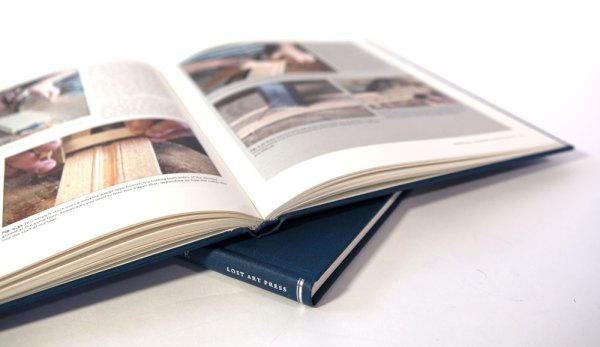
“Make a Joint Stool from a Tree” was a first on several fronts for Lost Art Press. It was the first book in full color, the first to use a larger format and the first to have a dust jacket.
It was also the first “edition” book Chris designed, with the guidance of Wesley Tanner (who would later design the award-winning Roubo books for Lost Art Press). That’s who introduced Chris to the venerable book designer’s bible: “Methods of Book Design,” by Hugh Williamson (1956).
It took so long…they were working on it for more than 15 years (most of that prior to signing on with Lost Art Press). A fun drinking game: Every time Peter’s outfit has changed in the pictures, take a shot. (On second thought, that’s not such a good idea…). You can also watch Peter and JA age and change throughout the pages.
Fig. 7.2 Clockwise from the left, these pigments are: bone black, iron oxide and yellow ochre. A little goes a long way, especially with the red. Store them in a dry place and they’ll last a long time.
Now that the stool is all assembled and trimmed, it’s time to apply a finish. At this stage, you can use your favorite finish, but if you would like to explore period-style work further, then oil-based paint is an excellent choice for a period finish. This is attainable, but with some cautions.
Surviving artifacts sometimes have remnants of their original painted finish, and these can be analyzed and the pigments and vehicles identified.
This analysis is rarely applied to “clear” finishes; it usually centers on surviving colors appearing on period works. We have benefited from colleagues who have shared with us the findings of their studies, but there is still a long way to go in this aspect of 17th-century furniture studies.
Fig. 7.3 Another ingredient in period paints was calcium carbonate. It was used as a filler to extend the paints’ covering abilities. A good easy source for small quantities is blackboard chalk. Break it up with a hammer into the smallest bits you can, then mix it in with your pigments.
Paint consists mainly of a color, the pigment, that is dissolved in a medium. In many cases the medium is a plant or nut oil, such as linseed oil (from the flax plant) or walnut oil. It is often thinned with turpentine. One aspect of period paints that is best avoided today is the use of lead as an ingredient. The lead served to dry the oil, and in its stead you can add just a few drops of Japan drier, which will help the linseed oil dry a little more quickly. A little umber pigment mixed in with your other colors will also help with drying; usually it’s too small of an amount to affect the color much.
Fig. 7.4 There’s no way around it – paint-making is messy. A dropcloth on the bench is a good idea. If you have a small piece of glass such as this one, you can scrape your mixed paint into a shallow dish as you go, them mix more to add to it.
For our stools, we paint them with homemade paints made by grinding dry mineral pigments in oil, or an oil/varnish combination. The available colors are usually earth colors – reds, yellows, browns – and carbon pigments – lampblack or bone black. Artists’ supply outfits are a good source for dry pigments. Use their linseed oil also; it is better quality than the boiled linseed oil from the hardware store.
Red is the standard color based on what little evidence we have seen from studying period pieces. We use iron oxide pigment. It goes by various names: iron oxide, Indian red, Venetian red or red ochre. The best tools for mixing the paint are a muller and a piece of plate glass. The muller is essentially a flat-bottomed pestle made of glass. Like many good tools, they are expensive. You might try your first batches of paint by grinding with a mortar and pestle, or even just a palette knife on glass. Then if you plan on going further, you’ll want the muller and glass.
Fig. 7.5 If you decide that mixing paint is for you, then eventually you’ll want a muller such as this. A mortar and pestle works, but it’s harder to get paint out of a mortar than off a flat piece of glass.
Make a ring of pigment, and pour in some of the medium. Slowly mix the medium and pigment together with a palette knife, then take the muller and work in a circular motion to dissolve the pigment in the medium. Mix up enough to paint your whole stool; you don’t want to stop during the painting to mix up more paint.
Use a clean, soft, natural-bristle brush to paint the stool. Period brushes were round; the most common modern ones are flat. If you want to try round ones, get them from an art supply store rather than a hardware store. Thin paint will have a better chance at drying than thicker, more opaque paints. Several coats will result in a more solid color and finish. You can combine the red and black in a contrasting application, using the black for the mouldings, or even pick out aspects of the turned decoration in alternating red and black.
Warning: Linseed oil generates heat as it dries. This can cause spontaneous combustion of rags and brushes and any other absorbent materials that have come in contact with the oil. After use, put all such materials outside to dry in a well-ventilated place for at least 24 hours in a temperature of not less than 40° Fahrenheit. Or you can thoroughly wash all contacted materials with water and detergent and rinse.
Fig. 7.6 Iron oxide reds can vary from place to place. Some are brick-red, some are brighter. You can also mix pigments together, add some yellow ochre to iron oxide to add some variety to your colors. Vermillion is a very bright red, so use it as an accent color.
Recent research at Winterthur Museum and the Museum of Fine Arts, Boston, has identified examples of 17th-century paint made with pigments mixed in thin solutions of hide glue instead of oil. To do this yourself, prepare the glue granules just as you would for using adhesive, but with more water. Fill the bottom of a glass jar with the glue granules, add enough water to cover them plus a little more, and let it soak overnight. When you’re ready to make paint, heat the glue mixture slowly. If you don’t have a dedicated glue pot, you can put the glue in a glass jar sitting in a few inches of water in a pot. Stir regularly. Keep the mixture thin. When the glue is nice and thin, turn off the heat, and you’re ready to mix the paint.
Just as with the oil, start by sifting some pigment onto your plate glass, or in a mortar. Then pour some glue in and start mixing them. Keep adjusting by adding pigment and glue until you reach the solution you’re after. Painting a whole stool with this paint is tricky; the glue thickens as it cools. It requires a little tinkering, so add water if it thickens, and return the glue to the heat from time to time as well. This protein paint needs a finish over it, or it can rub off. The research indicates a plant-resin varnish as a top coat.
A twisted Ligustrum sinense. This Chinese privet has the status of a Champion Tree in the U.K. It’s found at Thorp Perrow Arboretum, Bedale, North Yorkshire, and gained its Champion status through being the tallest and largest specimen in the country. In addition to these characteristics its status as a champion is surely derived from its most notable feature being the remarkably twisted trunk thought to be caused by a systemic fault.
I first learned about the Twin Oaks Community while working on “Cut & Dried” with Richard Jones. We needed an index. Members of Twin Oaks, an intentional community in rural central Virginia, make their living, in part, by indexing books. Additional income is generated by making hammocks and furniture and tofu, and seed growing. The Twin Oaks Community, comprised of about 90 adults and 15 children, are income-sharing. Members complete about 42 hours of business and domestic work a week, and in return receive housing, food, healthcare and personal spending money.
Rachel Nishan from Twin Oaks responded to my indexing query, and we agreed to work together. Indexing a technical book such as “Cut & Dried” is a rather monumental task, and just thinking about it made my eye twitch. Yet Rachel approached the project without an air of stress, asking detailed questions about tree types, specificity and British spellings. Throughout our correspondence one sentence has stayed with me, years later: “… a more technically-inclined reader could want to look through the index in a variety of different ways, so I have tried to be pretty redundant, which is the kindest for the user of the index.”
“Kindest for the user.” I think that’s the heart of bookmaking, no?
Richard and I sent hundreds of emails to each other while working together to turn his years of work into book form. And all of that correspondence, from image selection to epsilon size, was written with Rachel’s not-yet-said phrase in mind: kindest for the user.
I was nervous to begin work on this book. Honestly, I thought the content would be too technical for me to understand. But then I read it. And realized Richard used his genius to transform his scholarly work into easy reading. And Rachel made topics within the text easy to find. And Meghan designed the book to be easy on the eyes. All with kindness in mind.
Many woodworkers are initially reluctant to study trees in detail fearing the subject is dauntingly heavy. Whilst it’s true the subject can be studied with scientific precision it’s really only necessary to get to grips with the main elements to gain a firm basic knowledge. Wood isn’t created with the needs of the woodworker in mind. The creation of wood is necessary for trees’ survival. We simply use what nature provides. Understanding the original function of wood helps woodworkers use it sympathetically and successfully. One example of useful basic knowledge described earlier is to understand the essentials of Latin scientific classification resulting in precision and clarity in any discussion of the subject.
All trees are members of the plant family. Specifically, they are all spermatophytes meaning they are seed-bearing plants. Trees are generally characterised as being perennial seed-bearing vascular woody plants with a root system and (ordinarily) a single trunk supporting a crown of leaf-bearing branches. With exceptions (see mention of the Arctic willow, Salix arctica, earlier) they normally reach a minimum height at maturity of five m (15′) and survive for at least three years.
This basic classification then breaks trees down into two distinctive types – the angiosperms (covered seeds) and the gymnosperms (naked seeds). Alternative names for these two groups are hardwoods, deciduous or broad-leaved trees (angiosperms), and conifers or softwoods (gymnosperms). The terms hardwood and softwood can be misleading as not all hardwoods produce hard wood, e.g., soft balsa wood is the product of a hardwood tree whereas yew is hard and comes from a softwood tree.
Figure 3.1. Trees increase girth by adding growth rings annually. They increase in height by adding new growth at the tips of branches. Roots and root tips grow in the same manner.
Typical of deciduous trees in temperate climates is the loss of leaves during autumn as the tree loses vitality followed by a dormant winter period. As usual there are exceptions where many of the hollies (Ilex spp.) retain their spiky and waxy leaves throughout the year. Spring, with its longer daylight hours and warmer weather, heralds a new period of rapid growth with the emergence of new leaves, flowering and reproduction. This is not true of all hardwoods in all climates. Many equatorial living hardwoods are able to grow all year round and may never lose their leaves en masse. With these trees the cycle is continuous as old leaves reach the end of their useful life to be replaced by new ones.
Figure 3.2 . Dendritic (deliquescent) growth pattern of broad-leaved trees. The main trunk branches and rebranches.Figure 3.3. Excurrent form of coniferous Japanese larch. A single bole or trunk with subordinate branching. Larch is an exception to the rule because it loses its needles in winter. In this managed forest, juvenile Sitka spruce have established themselves between the planted larches. Dalby Forest, North Yorkshire, England.
Angiosperms (deciduous trees) from all climatic conditions have a characteristic growth pattern. Their form is deliquescent or dendritic, meaning there is branching and re-branching of a main trunk.
Gymnosperms (coniferous or evergreen) trees typically retain their leaves throughout the year, with larch being one exception to this trait. Their form is generally excurrent – the main trunk rises singly with lesser sideways branching. Broadleaved trees usually have large, relatively fragile, blade-like leaves and, to prevent dehydration of the tree resulting from their retention, they are lost before winter. Conifers on the other hand typically are able to resist dehydration because of their tough, needle-like waxy leaves, which stay on the tree through all the seasons. As with tropical hardwoods discussed earlier they lose leaves and replace them all year round. However, I’ve noticed even the much-despised fast growing leylandii (Cupressocyparis x leylandii) planted in my back garden by a previous owner loses more leaves in the winter than in the summer. Leylandii are, in truth, a very attractive tree grown where they have space. They grow very swiftly and are really too large in small British gardens – they rapidly exclude light and dominate these small spaces.
Figure 3.4. Scots pine (Pinus sylvestris). Needles (leaves) and seed cone. In common with broad-leaved trees conifers can be identified by a combination of factors – general form, bark, flowers, seeds and leaves. Scots pine needles, for example, occur in pairs, are bluish-green, twisted and about 50 mm (2″) long. They survive about four years before turning brown and dropping as a pair. Cones vary in size between 25 mm to 60 mm (1″ to 2-1/2″) in length and are usually rounded. The bark is distinctive being orange and flaky.
In common with hardwood trees living in cool temperate climates, evergreens have a dormant winter period.
Tree growth occurs in just three places. The first two are the tips of the branches and roots, which increases the tree’s height and the spread of the crown along with the range of the roots. The third place where growth occurs is in the girth of the trunk, branches and roots by the addition of an annual growth ring. Meristem or meristematic tissue refers to the growth tissue in trees. The growing tips of twigs and roots is the apical meristem. The lateral meristem is the cambium layer adding girth to the tree’s structure.
The cells produced by meristematic tissue, whether they are leaves, flowers, bark or wood, are largely of cellulose. Cellulose forms strong and stable long chain molecular structures. This, along with the lignin bonded with, or to it, is what gives wood its strength. Lignin is the “glue” holding wood together and is a complex mixture of polymers of phenolic acids. Lignin forms about 25 percent of wood’s composition and becomes elastic when heated. It is lignin’s flexible plastic property allowing wood cells to rearrange themselves that woodworkers use to their advantage during steam-bending wood into new shapes.
The majority of cells making up a tree’s structure are elongated longitudinal cells. Their long axis runs vertically up the trunk (and along the branches and roots). Some of these cells are short and stumpy and others are long and slender. The vascular function of the newly formed longitudinal cells is to conduct liquid raw essentials up the tree to the leaves and processed sugary food down the tree to nourish it. Spread through the wood are rays or medullary rays. These ray cells are also elongated but their long axis radiates from the centre of the tree toward the bark. They are stacked one upon the other throughout the length of the trunk in slender wavy bands.
In many wood species the rays are invisible to the naked eye but in others, such as numerous oaks and maples, they are usually highly visible because the groups of cells are large. Some ray cells – the parenchyma – store carbohydrates for use in cell development. The other primary purpose of the medullary rays is to transport nourishing sap toward the centre of the tree.
3.1 Log Cross Section From the outside there is the outer bark (see figure 3.6), which is a protective insulating layer against weather, animal, fungal and insect attack. The bark has millions of tiny pores called lenticels through which necessary oxygen passes into the inner living cells beneath. In polluted atmospheres such as cities the lenticels clog with dirt. London plane (Platanus x hispanica) is well suited to city life because it sheds its bark regularly, exposing clear lenticels. The bark of all trees flakes off as the girth gets bigger.
Figure 3.5. Medullary rays in European oak. On the left they are visible as light-coloured flaky patches – the sought-after quartersawn oak figuring or “silver grain.” To the right where the horizontal bands of end grain show the rays are visible as thin, light-coloured vertical lines. The centre of the living tree in this example is toward the bottom of the photograph.
Inside the outer bark is phloem, bast or inner bark. The phloem is produced by the cambium layer and is a soft spongy liquid-conducting vascular tissue that carries processed food – sugary sap – from the leaves to the rest of the tree.
Figure 3.6. End section view of small yew log. Identifying the most significant structures visible to the naked eye.
Beneath this layer is cambium – the lateral meristem (growing tissue) that adds girth to the tree. The cambium is a slimy layer only one cell thick. These cells divide constantly when the tree is active. The cambium produces not only phloem towards the outside but, towards the centre, it produces xylem.
Xylem has two major functions. As sapwood it conducts water and minerals from the roots to the leaves. Sapwood contains both live tissue and dead tissue. Dead xylem, the heartwood, is the trees’ structural support. The longitudinal cells described earlier are organised to form water- and nutrient-conducting tracheids in gymnosperms or conifers, although some hardwoods also contain tracheids. In angiosperms (broad-leaved trees) the order is different. Vessels, which are continuous tubular structures, form a pipeline from the root tips to the leaves rather akin to drinking straws bundled and glued together. (Note, though, the comment I made about some hardwoods also containing tracheids.) In oaks, for example (see figure 3.7), the naked eye easily picks out the initial spring-laid vessels or pores. In other tree types magnification is required. Sapwood is often attacked by food-seeking life forms such as fungi, insect and animal life.
As sapwood xylem ages it loses its vitality through the loss of the living protoplasm within the cells and turns into heartwood. In some species the transition between living xylem and heartwood is abrupt and clearly visible as seen in the yew cross section at left. With others it is hard to distinguish between sapwood and heartwood. The sapwood can remain as living protoplasmic cells for several years but this period varies from species to species, and even within trees of the same species. The yew sample at left shows newly laid sapwood that took about 8 or 12 years to convert to heartwood.
Figure 3.7. Close-up of European oak end grain showing light-coloured medullary rays and spongy, adsorbent, open-pored spring growth and denser less-porous late growth – European oak is a ring-porous hardwood.
Heartwood is the column of xylem supporting the tree. It is dead because it has lost its active protoplasm. Whilst outer layers of the tree are intact – protecting the heartwood nourished by foodstuffs transported to it by the medullary rays – it will not decay. Heartwood is usually, but not always, distinct in colour from sapwood. Extractives cause the colour change. Extractives are trace elements imparting various combinations of characteristics to heartwood, such as colour, fungal- and bacterial-resistance, reduced permeability of the wood tissue, additional density of heartwood, and abrasive deposits.
Tyloses are bubble-like structures that develop in the tubular vessels of many hardwoods during the changeover from sapwood to heartwood. Tyloses block the previously open vessels, preventing free movement of liquid. Red oaks form very few tyloses whereas white oaks produce many and this explains why white oaks are preferred for barrels. It’s possible to blow through a stick of red oak submerged in water and create bubbles. Whisky distillers are well aware of the “Angels’ Share,” which is the part of the spirit, usually about 2 percent, that evaporates through the wood of the oak barrel (Whisky Magazine, 2008).
Growth rings are the result of the cambium layer adding new tissue year upon year. The cambium layer (in temperate climates) becomes active in spring, reacting to chemical signals produced in the tree brought about by warming temperatures and longer daylight hours. During its active period the cambium layer adds open, fast-grown porous tissue to cope with the rush of water and minerals required of the freshly opened leaves. As the summer approaches and the initial high demand for food subsides, the cambium lays down denser, harder latewood, which adds strength to the trunk and branches.
At the centre of the tree cross section is the pith or medulla. The pith is the small core of soft spongy tissue forming the original trunk or branch.
3.2 Gymnosperms & Angiosperms – Differences 3.2.1 Gymnosperms Gymnosperms (conifers, softwoods) are simpler in structure than angiosperms. Gymnosperms evolved earlier than angiosperms and have some distinct structural characteristics. More than 90 percent of the wood’s volume is made of tracheids. Tracheids are long fibrous cellulosic8 cells approximately 100 times longer than their diameter. They range between about 2 mm and 6 mm (about 1/16″ to 1/4″) in length depending on the species.
The two main functions of tracheids are as structure for the tree and as conductors of sap – nourishment. Tracheids conduct liquid food up the tree after the living protoplasm has left. Water and minerals pass upward to the leaves from one tracheid to the next via osmosis. Osmosis is the process where liquid from a high water (weak) solution passes through a cell wall into a low water (strong) solution. In softwood trees water and minerals move upward from the roots initially through upward root pressure created by soil-borne water migration into the root tracheid cells. Secondly, there is also transpirational pull created by water evaporating from the leaves. This method of conducting foodstuffs is distinctly different to the method used in broad-leaved trees described later.
The cambium layer lays down different forms of tracheids at different times of year. In the spring, the tracheids laid down are thin walled with a large diameter and are lighter in colour. Late-growth tracheids are dark coloured, have thicker walls and a smaller diameter. The early-wood tracheids with their thin walls are better at conducting liquid than the later thick-walled tracheids. Both will conduct water, but a tree needs structure as well as the ability to transport liquid – there is a necessary balance struck between the two functions in tracheid cell structure.
A distinctive characteristic found in some gymnosperms is resin carried in resin canals. Pine, spruce, larch and Douglas fir have resin canals. These timbers have a characteristic scent when worked, and the resin can cause bleeding problems under paint and polishes. One way of setting the resin solid to reduce bleeding problems is to raise the temperature of the wood during kiln drying to 175º F for a sustained period. Genuine gum turpentine is a product of the resin from Southern yellow pine, a tree of the North American continent.
Medullary rays are narrow in conifers and invisible to the naked eye, so to see them it’s necessary to mount thin wood samples on a slide for examination under a microscope.
3.2.2 Angiosperms Hardwoods are more complex than gymnosperms. There are a number of specialised cells present in angiosperms absent from gymnosperms. For instance, the means of conducting liquid foodstuffs up and down the tree in nearly all cases is through the vascular tubular vessels. This is distinctly different to the liquid-conducting tracheids of conifers. The vessels in angiosperms form a bundle of pipes encircling the tree. The fibrous tracheids of hardwoods are much smaller than they are in conifers and because of their thick walls they are not well suited to conduct liquids. Unlike the softwoods, the rays of deciduous trees are often easily visible, e.g., in oaks, sycamore, maple, beech etc. Resin canals are rare in angiosperms, but some tropical plants such as the rubber tree produce gum and have gum ducts.
Throw a spanner in the works, and even the smoothest-running machinery will come to a stop. Most of the time you can diagnose the problem, make a quick repair and get back to business with minimal delay.
But when the spanner takes the form of a pandemic, not so much. You can moan and groan, lament lost income and opportunities, retreat into a funk. If you’re lucky, you may reach a point where you recognize yourself as weirdly liberated from the everyday grind and be open to new directions.
This is how I found Australian woodworker Bern Chandley when we spoke at the end of September. Ordinarily a prolific and highly focused designer-builder of contemporary chairs, Bern, based in Melbourne, has spent much of his time over the past few months laboring over a single piece of furniture: a small settee in blackwood. “I’ve had very limited time in the workshop this year,” he says. With schools closed, he has been helping his wife, Alice, home-school their 9-year-old son, Flannery. Since March, Bern has had just two or three short days a week to work in the shop; a curfew has kept him from staying into the night.
Detail of the settee
The settee is a commission, the form and joinery – Nakashima meets Wegner, with staked legs (both curved and tapered), steam-bent spindles, a hand-scooped seat and stretchers that swoop up to support the arms – a new paradigm in the Chandley repertoire. There are more jigs than usual, as well as more machines, including a PantoRouter. There’s not a single right angle. Even though he’s getting paid well for the piece, the pay won’t cover the investment required to puzzle out the making. “But because it’s a new design,” he reasons, “it’s going to give me a whole lot of other chairs.” The sculptural piece of seating will become a mainstay of his build-to-order portfolio, so he’s putting in the work to make all of the processes readily repeatable. “I want them all down pat,” he says, because efficient production is important to how he makes his living.
A slightly larger view of the current commission, with a prototype visible in the background.
Family & Starting Out
In July Bern turned 50. “Aging has never been something that has particularly preoccupied my thoughts,” he wrote in an Instagram post. “I’ve always felt birthdays were a good excuse to draw in close the ones you love and that the warmth of their returned love is a reflection of the happiness I’ve achieved in life. I don’t care how old I am each time I feel it, just that I’m feeling it. It is life affirming.
Bern at age 50.
“Today as I turn 50, in this time of physical isolation, I count myself incredibly lucky to spend the day on remote learning with my son Flann Brian Chandley, Grandson to Brian Frederick Chandley, my beautiful Dad, who we lost just a little more th[a]n 6 months ago today. Every time I think of him I’m flooded with longing to see him and speak with him. We miss him an enormous amount. He was and is, along with Mum, my greatest inspiration to be as good a person as I can be. As I look at my son, as he looks at me, as we talk to each other I’m aware of how lucky I am to have had such brilliant role models. Dad’s in my thoughts daily but I feel him especially close today.”
Bern with his father, sister and brother.
You can chart how important Bern’s family is to him in his voice. Nothing in our conversation makes him more animated than the stories he tells about family members, each anecdote filled with detail and color. Most of his ancestors came to Australia from Ireland. Some arrived against their will, he notes, referring to the British practice of exporting convicts to penal colonies in the late 18th century. Others came as farmers looking for opportunity. Farming remained central to the family for generations. Bern’s father, Brian, was one of nine children born on a farm near the port city of Geelong (pronounced “Ja-long”) in the state of Victoria, about 50 miles southwest of the capital, Melbourne.
Bern’s father’s family. Brian is at the back right.
The family lost the farm during the Great Depression and had to move into Geelong to look for employment. His paternal grandfather, Bill Chandley, went to work at a factory. Bern has fond memories of Bill, who was “already quite on in years” by the time Bern came along. Bill had one leg that was longer than the other, due to a bout of polio he suffered as a child. The family didn’t own a car, so he got around by bus. “He knew all the bus drivers in Geelong by their first name. He rode on a bus with a little airline bag and his rollie (handrolled) cigarettes. He was a very warm, lovely fellow,” Bern remembers, then adds in the kind of detail especially important to a child: “My nana” – her name was Nellie – “made a sponge cake for everyone’s birthday.”
Readers of a certain age will recall the airline bags Bern mentions.
Bern’s mother was a nurse-midwife, his dad a diesel mechanic fitter and turner. “You call them engineers over there,” he offers, “like toolmaking – working with heavy machinery.” Geelong being a port town, many businesses were involved with shipping.
Bern (center, in yellow) with his family, left to right: sister Teresa; Brian; baby sister Jennifer; brother Paul; and mother, Anne.
In 1986, at the age of 16, Bern left school to start an apprenticeship as a carpenter and joiner. “I’m from a big working-class family,” he says. “I’ve got a million cousins who are all tradesmen. I’m one of four kids; my older brother was the first in our extended family to go to university.”
It was meant to be a four-year apprenticeship, with time alternating between coursework at trade school and work for a boss who ran a house framing business. At school Bern studied building methodology – stairs, joinery techniques and traditional handwork with dovetails and mortise and tenons – not because there was a market for that kind of work (there wasn’t), but because the curriculum hadn’t been updated in years, for which he gives thanks. On the job, they framed houses; Bern has vivid memories of building pitched roofs in eucalyptus, “big, tall, straight-grain trees used in construction.” The roofs would then be topped with weatherproof corrugated steel. That way of roofing is long gone, he says; these days builders simply install trusses.
Bern finished his apprenticeship early, at the age of 19. Typically an apprentice would stay on with the boss who’d sponsored the training, but these two didn’t get along. “He was a bit of a hammer thrower,” Bern says – “a good carpenter, but always the most hated person on the site. The day I finished my apprenticeship, I quit-slash-he fired me. We had a big fight on the site.”
After a few more carpentry jobs he was ready to leave Geelong. His older sister was training to be a nurse in Melbourne, so he moved there. For two years he worked as a hospital orderly, an experience he found fascinating. “I was suddenly confronted with life and death. I was still a silly young bloke. I had to come to terms with people dying on a regular basis…and form an understanding of it…. Nurses are amazing. They’ve just got to carry on, no matter what.” He worked in the emergency room. “You’re on the front line,” he says. “There are some horrific injuries. People were thrashing around, semi-conscious, and you had to hold them down.” Part of his job was to help the nurses wrap cadavers in plastic and take them to the mortuary. “It knocked the immaturity out of me, which I’m very thankful for.”
Bern in Göttingen, Germany, a destination he sought out on account of its many timber-frame buildings. He traveled alone and loved meeting people, some of whom became good friends.
In his 20s he did some traveling around Europe. On his return, he found his way into building sets for television, theater and American movies that were being filmed in Melbourne. Each gig lasted almost a year. One of these productions was set in the Second World War; when the crew couldn’t find a specific piece of period-authentic furniture, they brought him a picture and he figured out how to make it. “I was just knocking the [props] out, out of MDF and pine,” he says; the painters on the set “were magicians” who made the stuff look like it was built of mahogany.
“The thing with set building is, it’s very good for problem solving. The designers are notorious for giving you the easy measurements” while leaving the challenging stuff involved in curves and angles for the set builders to work out. “Depending on the job, there could be nary a right angle. ‘Star Wars’ had the most curves and angles. That’s space ships for you!” He points out that this was before CNC routers, so you couldn’t just pop what values you had into a computer. “You had to work it out yourself. You had to be very inventive.”
He’d always had an interest in furniture, so Bern filled the time between jobs with furniture commissions, taking on “anything and everything” – tables, cabinets, built-ins, carpentry jobs. He realized that making furniture was what he really wanted to do and started his own business, getting work by word of mouth. Without a shop, he built things in his backyard, or in the client’s. “I got it done,” he says. He persevered and learned from his mistakes.
Between 2005 and 2016 he shared space in group shops, a good way to build up a business when you don’t have the capital to tool up on your own. Needless to say, it could be trying; people had different priorities and interests. The others were building furniture part-time, whereas he was running a business. Eventually he concluded he needed a space of his own.
Alice in her studio
He got to know his wife, Alice Byrne, as a friend in 2006. It was summer, and Bern was in Paris. Alice happened to be there, too; her boyfriend, Alan, had been awarded a traveling scholarship. An oil painter, she’d been in Paris seven years before as the scholarship’s inaugural winner. She and Bern spent some time together visiting galleries. “I was smitten,” he says, “in the sense of ‘I’ve really got to meet a girl like Alice.’” After about a week, Bern went on his way, not knowing whether he’d ever see her again.
But shortly after he got home to Melbourne, Alice’s brother George called with news that Alice was back. Alan wasn’t with her; he had returned to Sydney. Soon after, Bern and Alice went on a first date, a pub meal and dancing – with George. They’ve been together ever since, and were married in 2009.
Alice, Flann and Bern in the States
Alice put her painting aside when she got pregnant, concerned about the health risks of solvents. After Flannery was born, in 2011, Bern was the family’s main breadwinner. Alice went back to work outside the home part-time when Flann was 2; she manages an art supply shop that does both retail and wholesale work, along with specialty painting services such as framing and stretching canvas. Although she still has a studio space, she has largely put that work aside while raising Flann.
The Move to Chairs
Lowbow dining chair
Like many of us, Bern started out in “bespoke” (custom) work. In retrospect, he sees custom work as “a bit of a trap you can fall into. That’s the best way to burn yourself; if you haven’t built something before, you’re not ever going to get paid enough to sort out all the preliminary stuff before you make it. But it’s the best way to learn a lot.”
Seventeenth-century-inspired cabinet in oak with Huon pine interior and ancient kauri shiplapped back
Shaker nightstands in maple
He stuck with custom work until about 2010, building tables, cabinets, whatever a client might want, while working part-time for a fellow woodworker, Alastair Boell, who had a school, the Melbourne Guild of Fine Woodworking. Alastair was eager to have Bern teach, but Bern had always hated public speaking. “It kind of terrified me.” He gave it a try. He’s glad he did. When Alastair invited Peter Galbert to teach a class on North American Windsor chairs, Bern assisted and found himself smitten with the joinery. Pete, Bern says, is “egoless. Very comprehending, very inventive as a maker… a very inspiring teacher.” In fact, so inspiring “that from that moment all I wanted to do was make chairs.”
CoCo Armchair
Pete encouraged Bern to visit the States and teach at his school in New Hampshire. They made it happen. He taught one class in 2018 and two in 2019 on a chair of his own design that he calls the “No. 14 Chair” – “after Thonet,” he laughs, “because I’m shit at naming things.”
Fifteen No. 14 Chairs
Bern with Peter Galbert on a beach in Maine.
He still makes other forms when he’s really keen on a particular piece, but chairs have become his livelihood. Here we return to the topic of efficiency. “You have to have your own product,” he believes; that way, you’ve got the jigs and processes in place. People order one (or 14!) of that thing “and you can just go straight to work, without thinking” – at least, in principle. He admits “that’s easier said than done.”
He now teaches chairmaking classes at his shop in Thomastown, an industrial area on the northern outskirts of Melbourne. With block walls and a concrete floor, it’s around 2,000 square feet in a gray brick building surrounded by old factories. Teaching has changed the nature of his business, injecting a welcome bit of variety. He keeps classes small, with no more than four students at a time, so that people with different skill levels can all keep up, and he tries to design each class so that students at any level of experience can get something from it.
Teaching has also proved a stabilizing influence in economic terms. “It’s more lucrative than general chairmaking,” he says. “It can afford you that little bit of extra time.” He’s come to regard a few teaching gigs through the year as “economic pillars” around which he can schedule the rest of his work and hopes the higher income from teaching will allow him more time to develop new designs. In Bern’s view, a good chair design combines durability, structural integrity and comfort. “I love designing chairs. Developing them is the most fun you can possibly have.”
“Highland Woodworking is unlike any other woodworking store I’ve ever been in on the whole planet,” Chris Schwarz told me, explaining why he thought the business and the family behind it would make an ideal contribution to this series. “It’s this wonderful, family, homey…” here he trailed off, as though in a happy dream, before resuming the narration of his reverie. “It’s just kind of overwhelming, like a candy store. If every town had a Highland, woodworking would be as popular as golf.”
Having seen pictures of the store’s façade, a drool-worthy architectural confection in century-old brick, a clay tile roof overhang supported by curly corbels, tall divided-light windows spanning nearly its entire front, I found his description almost compelling enough to plan a drive to Atlanta. Then I remembered we’re in the middle of a pandemic.
Chris discovered the place in the 1990s through the company’s black and white catalog, which they mail to a list that has grown to more than 100,000 addresses. If you know anything about Chris, you won’t be surprised to learn that he was attracted to the catalog not just by its promise of great tools, but by the warmth of its hand-drawn illustrations, a striking anachronism in the digital age. “They were one of the few people that had a full range of hand tools,” he says. “In the ’90s it was hard to find anybody who had more than one or two brands.” In fact, he adds, they had pretty much “EVERYTHING. And they were always supporting small makers, such as Independence Tool.”
It was Highland Woodworking that introduced Chris to Lie-Nielsen Toolworks, before the internet, when he called in his orders by phone. Though he still hadn’t seen the place in person, it felt familiar, largely thanks to the employee bios in the catalog. One year, Popular Woodworking assigned him to cover the International Woodworking Fair (IWF), which takes place in Atlanta. He played hooky one afternoon and made the pilgrimage. “I was speechless,” he says. “There was a suitcase on the floor; Roy Underhill was there, demonstrating. “I just couldn’t believe it. It exceeded my every expectation.”
Left to right: Sharon Bagby, Deneb Puchalski, Chris Bagby, Nick Offerman, Molly Bagby, Roy Underhill, Kelley Bagby. (Photo: Bill Rush Photography)
Charmed by everything he’d seen, he got to know the owners, Chris and Sharon Bagby, and their daughters, Kelley and Molly. Their zaniness appeals to him – their willingness to do stuff “that’s off the beaten path,” as he says, proceeding to invoke a SawStop demonstration video in which Roy Underhill uses fried chicken, a good Southern staple, instead of the classic hot dog to trigger the stop. “They’re solid fried-gold people. It’s a funky neighborhood. They’re the bedrock there. The neighborhood has grown up around them.”
How could the Bagbys be so good at running a hardware store for specialty tools when neither of them was a woodworker? Jimmy Carter has taken classes at Highland Woodworking; Sam Maloof taught there. Here’s a glimpse into the business that should provide at least some clues.
Sharon with baby Kelley in 1976
Chris Bagby provided the following introduction:
“In 1974 Chris and Sharon Bagby, then recent Georgia Tech graduates, became managers of a King Hardware branch store on Piedmont Avenue in Atlanta. By coincidence, this particular King Hardware store happened to be the lone southeastern dealership for the Shopsmith combination woodworking machine. As the Bagbys worked to find ways to dramatically increase Shopsmith sales at the store, including introducing the sale of hardwood lumber, the store began to attract a growing community of woodworkers.
“In 1977 the Bagbys and their staff published a four-page woodworking newsletter they called “Wood News.” Response to it was enthusiastic. They published two more issues before deciding in the spring of 1978 to resign from King Hardware and start their own hardware store, Highland Hardware. Chris was 28. Sharon was 26.”
“At that time Shopsmith had begun opening its own retail stores nationwide and told the Bagbys they were not interested in making Highland Hardware a Shopsmith dealer. However, the couple soon connected with the Garrett Wade Company of New York, the U.S. importer of Swiss-made Inca Tools, and in 1978 began selling Inca tablesaws, bandsaws and planer-jointers. Highland Hardware became a local Atlanta retail source for Record and ECE hand planes, Marples chisels, Tyzack handsaws and many other fine woodworking tools purchased wholesale from Garrett Wade. They also continued to sell hardwood lumber and established a small millwork shop in the basement of the store.”
I spoke with Molly, 34, the younger daughter, who provided most of what follows. Both she and Kelley, who’s 10 years older, work for the business – Molly in Atlanta; Kelley, from her home in Massachusetts.
The business started out as an old-fashioned mom and pop hardware store selling the kind of stuff you need to fix a washing machine or plant flowers in a barrel – screwdrivers, nails, plumbing supplies, gardening tools. As time went on, they had more and more requests from woodworkers looking for specialized tools, so they brought in hand saws of higher quality, along with chisels, planes and more – now, as Chris Schwarz can attest, much more. Along with a full range of tools by Lie-Nielsen and some 400 distinct manufacturers, they also sell products by Festool and SawStop. Early on, when Home Depot, Lowe’s and Ace Hardware branches were proliferating across the country, selling really good woodworking tools was especially critical in setting the small, friendly store apart and giving them a competitive edge.
They moved the business to its present location (across the street from the original one) in 1984, more than doubling the store’s square footage. This time they set down roots, buying the property instead of paying rent. In 1995, just over a decade later, they did a large-scale renovation, adding 8,000 square feet of space, including a large classroom where seminars and hands-on woodworking classes are now taught. Also included in the renovation was a new shipping and receiving department, complete with loading dock and office space for management. The following year they launched their website; before long, the online business was hard to keep up with. They increased their shipping department and added more warehouse storage.
“Before long,” Chris Bagby continues,
“Highland Hardware published its own small tool catalog as the company evolved to become an importer of fine tools in its own right, and began to develop a wide following nationwide with a reputation as a leader in woodworking education, offering weekend classes throughout the year. In 1992, the company decided to merge the newsletter into the catalog and thereafter began publishing three catalogs a year. “Wood News” as a separate entity was no more, until 2005 when it was resurrected on the web as Wood News Online , where it continues to be published monthly.”
A page from an old issue of “Wood News” includes a picture of Kelley, age 5, taking part in an E.J. Tangerman carving seminar at the store in 1982.
(You can read the 1981-82 catalog here, thanks to John Cashman, who sent me this document.)
Molly shared one of Sharon’s memories of working at the cash register. “She looks up and sees a man with an earpiece and sunglasses and gets a little worried. And then she looks to the left of him and sees it’s Jimmy Carter!”
Sharon checking out President Carter, a frequent customer at the store
Chris adds another Carter story:
“Back in the early ‘80s when we were still hand applying labels to our annual tool catalog mailings ourselves, Kelley [who was only about 6 or 7 at the time] came to the one with President Carter’s name and address on it. On a whim she wrote him a little note and stuck it in the catalog. A few days later she received a personally handwritten reply from Mr. Carter, thanking her for the note. We framed it and I think it is still hanging on the wall at Sharon’s house.”
President Carter first visited the store in March 1981, a couple of months after he left office, adds Chris.
“He arrived with a dozen Secret Service agents and shopped for some glue, a book and a few other things. While touring our store, he saw where we taught woodworking classes in the basement. He told me that if we were ever able to host Tage Frid for a seminar, he would like to attend.
“The next day I wrote to Mr. Frid (whom I did not know personally) and told him that President Carter would like to come to Highland to attend a class taught by him. Mr. Frid was interested, and indeed came to Atlanta to teach a weekend seminar that Mr. Carter attended on both days. As part of the event we arranged for us all to have dinner together at a nearby restaurant.
“Tage Frid went on to teach a seminar at Highland every year for 11 years. He and President Carter remained friends until Frid’s death in 2004.”
President Carter in Tage Frid’s class at Highland Woodworking
Today, Highland Woodworking employs about 20 people, most of whom live in Atlanta or the greater metro area. Three work in shipping. Sharon, says her daughter, is a “jack of all trades”; she dabbles in almost every aspect of operating the business, including purchasing, receiving, accounting and answering the phones. Several managers run all aspects of the website, SEO, catalog production, marketing and social media. A products manager searches out new stuff at conferences and tool shows, and orders stock from vendors. A dozen or so, most of them part-time, work the sales floor helping customers, showing them how to use tools, answering the phone, taking orders and providing technical support.
That’s a lot of employees for a mom and pop business. I asked Molly why they stay. “It’s a very laid-back work environment,” she answers. “My parents kind of just run the store in their own management style, and I think that has helped [with] employee retention, because it’s not super-corporate, not super-reliant on ‘human resources’ and a strict schedule with meetings and everything.” They provide full-time employees with health insurance.
Chris, Kelley and Molly share the marketing. All work remotely much of the time. Though Molly now lives in Atlanta, she used to work from Queens in New York City. Chris dials in from wherever he happens to be. (It might well be a spot along the Appalachian Trail, which he has hiked three times.)
Highland Woodworking holds tent sales and promotional events to celebrate anniversaries; these sound more like giant parties than the usual stuffy corporate affair. The most recent was in 2018, when they toasted their 40th year in business. Molly produced the event, bringing in Nick Offerman and Tom Lie-Nielsen to join Roy Underhill, who’s based closer by. The trio proved a big draw. “We weren’t expecting as big of a crowd as we got with Nick Offerman,” she says. Nick was there to sign copies of his latest book “Good Clean Fun.” “It was a very steady crowd to come meet him, the whole day, from 10 a.m. to 4 p.m.”
Phil Colson, long-time Highland Woodworking employee and instructor teaching a woodturning class
One of the company’s strengths since its inception has been classes in a variety of woodworking skills. “Part of the reason we have so many staff on the sales floor is we want to be able to answer your woodworking questions,” Molly notes. “Our staff have the knowledge to be able to answer whatever question you ask about.” She mentions Phil Colson as an example; he started working for them in 1985 (he’s also Molly’s godfather, which says something about how close this family is with its employees) and teaches woodturning in addition to his other work at the store.
Sharon and Chris tried to retire – she in 1994, he in 1998. They also got divorced in 1994. But when the economy crashed in 2008 and the store took a hit, both came out of retirement to get the place running again. Says Molly: “they haven’t had time to retire since.” They’re great friends and work well together.
With the onset of the pandemic, they closed the retail storefront. Most of the business, even before, came from online sales, which have only increased, rivaling the pace during most years’ holiday rush. To save local customers the delay and cost of shipping, they offer curbside pickup. Unable to run classes in-store, they’re moving at least temporarily to an online model. (You can learn more here.)
“We’re blessed to have attracted a core group of longtime employees who know their stuff and enjoy sharing what they know about any of the tools we sell, in person during normal times and otherwise by phone,” adds Chris.
Of our 18 current staff members, 12 have been with us for over 20 years each. Phil and Sidney have both worked here since 1985. Only one of our current employees has been here less than 5 years. For all that they faithfully contribute, our employees are the main reason we have been fortunate enough to attract generations of loyal customers from all over the country since 1978. We are very grateful.”
The following is excerpted from “Grandpa’s Workshop,” by Maurice Pommier. This 48-page book was translated by Brian Anderson, an American-born writer and woodworker who lives and works in France. It is ostensibly a book for children, though the stories, lessons and drawing style will appeal to anyone who has an appreciation for the natural and the fantastical.