This Thursday, July 23, I’ll be appearing live on Bench.Talk.101 to talk about “Chairmaking for Flat Woodworkers” and take your questions. The event is free and should last about an hour.
The event will occur at 3:30 p.m. Eastern time on Thursday – 8:30 p.m. U.K. time. You can join the conversation by going to Bench.Talk.101’s profile 5 minutes before the event begins and there will be a link to join. Or send them a Direct Message (DM), and they will send you a link to join the Zoom meeting.
If you can’t join the live event (do you have a job or family or something?) you can watch the whole thing on Bench.Talk.101’s YouTube channel. Nancy Hiller, the author of the forthcoming book “Kitchen Think,” was on last week, and you can hear the whole thing here.
I’m looking forward to the chat and hope to not make too much trouble for the hosts.
John with a pair of 800-gallon fermenting tanks called “washbacks” that he made in clear fir for Stoutridge Vineyard and Distillery
Question: What does that glass of Bulleit bourbon or Lagavulin Scotch have in common with a Chicago water tower and a wooden hot tub?
Answer: They all belong to the culture of tight cooperage, a subject on which John Cox is a fount of information.
I met John on a sweltering afternoon in 2018 while delivering a small piece of furniture to the Hudson Valley. Anissa Kapsales had invited me to meet her at John’s workplace, located in a large warehouse building on the outskirts of High Falls (population 627), about 90 minutes north of New York City. While I have long appreciated the fruits of the distiller’s art, I confess I hadn’t given much thought to the oak barrels that play such an important part in their production. John was the ideal person to enlighten me; a polymath with the personality of a showman and boundless enthusiasm for his work, he’s a natural teacher.
John was born in Philadelphia in 1969. His father was a tool and die maker who’d followed in his own father’s footsteps. They hoped John would become a doctor and not work with his hands. Oh well.
John (lower right) with his family: parents John, Joyce and brother Jay, Easter, 1983.
In high school John played music. He attended Muhlenberg College for a year of pre-med studies, then transferred to the Esther Boyer School of Music at Temple University. Many of his fellow students had been studying music seriously for years, and he soon realized that he was not in a position to compete – he’d never get a chair or play on Broadway. However, he knew some luthiers and thought “if I can’t play, I can build.”
He did a traditional apprenticeship with Richard Buccigrosse and John DelVecchio, who ran a millwork shop in his South Philadelphia neighborhood. Richard made flamenco guitars, in addition to fabricating millwork and repairing antiques. Richard was very strict – the shop culture was closer to that of a Philadelphia furniture shop in the 18th century than in the 20th. John worked full days in the shop, unpaid, then went to his job as a short order cook in a diner.
Affordable shop space was plentiful in Philadelphia in the 1980s; the recession had hit the area hard. John opened his own shop, and Richard sent turning and millwork jobs his way so he could spend more of his own time on flamenco guitars. On weekends, John took finishing classes with George Frank (author of “Adventures in Wood Finishing”) at the Olde Mill Cabinet Shoppe on the outskirts of Philadelphia.
Meanwhile – and this is where John’s story starts to sound like a Who’s Who of woodworking – the Snyderman Gallery, located a couple of blocks from John’s shop, was regularly exhibiting studio furniture. John developed a niche as a finisher, catering to local studio furniture makers and doing repairs and touch-up for the gallery. He specialized in ebonizing, French polishing and work with color, using a lot of aniline dye. At the age of 21 he found himself repairing a Gary Knox Bennett desk. Several graduates of Wendell Castle’s school had opened a group shop in Fishtown; John became the finisher for the group and worked with Michael Hurwitz and Peter Pierobon, among others.
In 1994 he took a job as foreman in a finishing shop, Finish Resources Studio, in New York City. They developed specialty finishes for designers, such as cerusing (decorative pore filling) for Tom O’Brien of Aero. “George [Frank] taught me the process,” John says. “It was us in the workroom that developed it.”
Four years later, he met Danish craftsman Jan Engberg and his son, Ian, who had a shop making high-end furniture; John ran their finishing shop from 1998 to 2001. “For the fourth or fifth time in my life, I find myself working with an old European master,” he says with appreciation for these opportunities. “I kept falling into these relationships with them, sort of avuncular. I’m very fortunate – to be working with these insanely talented older Europeans.” Working for the Engbergs, John did jobs for high-end interior designers such as Steven Harris (a protégé of Robert Stern) and Lucien Rees-Roberts. “Everything got published – Elle Décor, Architectural Digest. This was before Instagram,” he adds as a slightly wistful side note (that’s quite familiar to me). “We would never get pictures of anything unless it got published.”
Lucien designed some “wacky stuff,” says John, that was inspired by 20th-century designers Jean Michel Frank and Samuel Marx. They used a lot of goat skin, cow hide, leather, parchment and gilding, and produced pieces destined for swanky apartments in such upscale areas as Central Park West. Recalling the kinds of orders they got from the designers, John says “’Let’s do the rosewood tables we did for the last client…let’s do the leather closet doors we did for Cabo – let’s do that for this client, but bigger.’ They sent me to Cabo right during the mad cow disease outbreak … with 42 cow hides! I feel like we worked for everybody that ran Lehman Brothers,” as well as entertainers such as John Leguizamo. “They flew me all over the world. It was all custom work.”
Then came 9/11. “We stood on the roof of the shop and watched it go down,” John says. “It affected our business. I wanted to leave New York.”
At a finishing convention in St. Paul the following year, he met Greg Johnson, who worked for Wendell Castle. Wendell had opened up a 42-man furniture factory called Icon Design outside Rochester; they were so busy they’d reached a bottleneck in production. Greg asked John to join them, and he did. As you’d expect, the work was meticulous. Each piece involved about 21 quality control checks, right down to razor-fine specs for the sheen of the finish. While working for Wendell, he met the sculptor Albert Paley and took on jobs for him, too, flying to installations around the country where a piece of work needed repair due to damage suffered in a move.
The downside: all of this work involved a lot of chemicals. John was spraying urethane and lacquer – “doing great things that were not good for me. But I got really good at it and got a reputation…”
After a year in Rochester, he was ready for a change of scene. They moved to the Hudson Valley, where John opened a one-man shop combining restoration work with commissioned pieces like a goatskin side table. He found himself running all over the area for jobs that barely paid the bills. Even with freelance gigs for Albert Paley, it was tough to make a living.
One day in 2015 John was talking with a friend who planned to open a mushroom-growing operation. “I said ‘I’d love a change. Why don’t you bring me in?’” His friend suggested something different. “Do you know there’s a barrel crisis right now? Why don’t you make barrels?” About a week later, Time ran an article about the barrel shortage, which has been exacerbated by a federal mandate that American distillers must use newly charred oak – in other words, a whisky barrel gets one-time use. Kentucky cooperages couldn’t keep up – they were working with lead times of 18 months. Craft distilling was a burgeoning business, but distilleries couldn’t find barrels.
John discovered that there was scarcely any information available on how to make barrels. Fine Woodworking had published an article about coopered joinery, and he found another on coopering by Tage Frid, but that was about it. It was truly, he says, a lost art. “So I bought three different barrels from three cooperages, took them apart and reverse-engineered them. It was a cipher. What’s the formula? It was like a cryptogram.” A cryptogram indeed – the research and development for Quercus Cooperage took more than two years. In the meantime, John was still running his furniture restoration business.
There are three types of coopers
1. Tight coopers make watertight containers.
2. Slack coopers make containers for dry goods. Everything shipped in the 19th century went in these containers, which were made by giant factories – nails, cotton, tobacco, salted meat and fish, gunpowder, oysters, fruit, cement.
3. White coopers have traditionally made household containers such as buckets, butter churns, bowls and pails. In Japan, white coopers made koji trays.
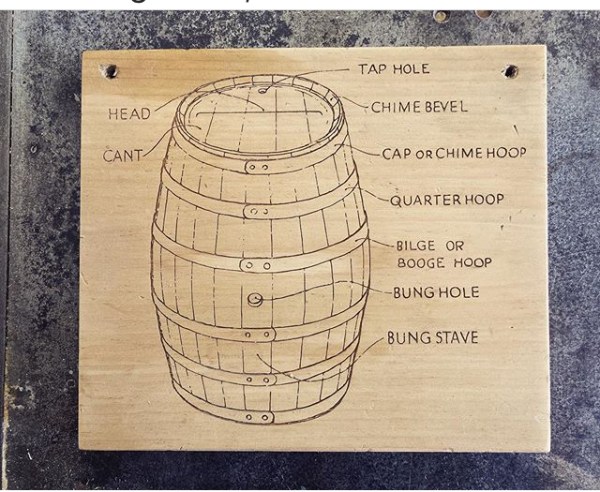
Cooper’s adze, used for pounding down the hoops. In the past, the blade end would have been sharpened and used to cut out a semi-circular groove at the top and bottom of the barrel.
The cooper’s adze was used to cut the chime and croze (top right).
When he heard about a large collection of 19th-centuring coopering tools for sale by a museum in Ottawa, he bought it. Then he set about learning what each one was, and how it should be used. “There was every tool you would need in a cooperage. Some looked familiar; some I had no idea what they were. Eric Sloane had some of them in his books; one of the first books Taunton did was a republication of a book of tools from England. I identified some from that.”
Next, he worked to figure out how to get his 20th-century machine tools to do what these hand tools did in the 1800s. “I held these 19th-century tools in my hand and said ‘How can I get my 3-horsepower shaper to do the same thing?’ How would I make this stave?’”
Here’s where his jazz background came in handy: there’s a lot of math in both fields. “Embracing the mathematics behind it really helped me figure it out,” he says, noting that Johannes Kepler had laid the groundwork for calculus by trying to figure the volume of a wine barrel. “It was becoming an obsession.”
Using a winch to pull the barrel together after it has been steamed.
He broke the process of barrel-making down into five stages:
1. Acquire and air-dry the wood. It has to be air-dried, not kilned. He bought locally grown oak logs and had them quartersawn, then stickered.
2. Mill the staves. He had shaper knives custom-ground.
3. Find the steel for the rings, then make the rings and hoops.
4. Toast and char the oak to the client’s specifications. Toasting the sugars in the wood is an art that can make or break a whiskey.
5. Assembly. The point is to make a watertight cask. “It can’t even have a pin hole.”
On Dec. 22, 2017, the Winter Solstice, John succeeded in getting a barrel to hold water for the first time.
He’s now one of 33 cooperages in North America, and he makes his barrels largely by hand. A cadre of “meddling woodworking friends, machining savants and a welder” have helped along the way. As with most highly skilled custom work that uses top-quality materials, the economic side of the business remains a challenge. The wood for a barrel comes in at around $150. You can buy a barrel for less than half that from a major manufacturer.
John recently expanded into another of the traditional cooper’s arts: tanks for fermentation. Stoutridge Vineyard and Distillery, his regular client in Upstate New York, asked for an 800-gallon tank, the kind used for Scottish whisky. Adds John: “That’s also what the soy sauce guys ferment in. Before Covid hit, everyone was starting to make shoyu. But no one’s making barrels for shoyu; they were using stainless steel. You’re not going to get the flavor profiles you want from fermenting in steel. In Japan they use open-tank traditional wooden fermentation. No one makes them here.” He made a 2-gallon prototype, and things took off.
Two-gallon kioke made in fir, used for shoyu production. The contents are soybeans and fermented rice. John points out that the barrel is just the same form as the two 800-gallon tanks at the top of this post.
“I pivoted into this culinary world. This koji thing that’s happening – they’ve been fermenting rice for 7,000 years. No one in America was making koji trays. If I hadn’t pivoted into the culinary stuff last fall I don’t know where I would be now.”
Brad Leone of Bon Appetitdiscovered John through Instagram; a chef John knows had asked him to make koji trays, and his name and pictures quickly made their way around that community. “They came to the shop and posted some stuff and it really blew up. [People] want to do this traditional Japanese work” – think sauerkraut, or kimchi – “but they don’t have the traditional objects to make it.”
Still, he says, it remains challenging economically. Margins are slim. “I’m a struggling one-man shop no different from any other.” Every barrel is custom made and takes time. Even with the technical challenges involved in figuring out his methods, John says the biggest learning curve has related to shipping and logistics. Instagram has helped him market the work; it’s one thing to get press in a print magazine, but there’s a two (or more)-month lag between the writing and publication. There’s no lag-time in Internet publishing, which makes it easier to change course swiftly.
Because of Covid, John’s craft distillery and brewer clients are closed, so the culinary stuff is filling his time. There’s a market, for now; it’s also more affordable. He says he’s the only person making the small tanks in America right now and adds, “I’m 5’6” so they actually call me a mini cooper.”
Yoav’s drawing for his knockdown table “Merritt,” made with reclaimed materials, inspired by the Merritt Parkway
Imagine this: You’re a teacher of woodworking. Your students are kids. The school where you teach is in a big city, and most of your students live nearby. It’s March 2020: Your school, along with much of the rest of the world, shuts down in response to the pandemic. But your job is to go on teaching. What do you do?
A typical fourth-grade project is a walking stick made from a branch
One of Yoav’s sixth-grade students
A typical sixth-grade project: a saw
This is the reality that hit Yoav Liberman three months ago. His students and their families were in lockdown, confined to their homes in New York City, which has suffered some of the world’s highest numbers of infection and death from Covid-19. Instead of teaching face-to-face in a workshop at Manhattan’s Rudolf Steiner school, as he has for the past eight years, he was expected to teach remotely, via computer screen. “How do I participate in this in a meaningful way?” he wondered, aware that his students lacked access not just to workbenches and woodworking tools, but also to lumber. With parks closed, and few trees on the streets, “even getting them a branch would be almost impossible.”
Fortunately for Yoav’s students, their teacher has a lifetime’s experience of turning challenges into opportunities.
Yoav with his father, Eliezer, and brother, Dan
Yoav was born on the outskirts of Tel Aviv, Israel, and has one younger brother, Dan. His dad, Eliezer, was a machinist, handyman and maritime officer who worked as chief engineer on a merchant ship. Thanks to his position, Eliezer could bring his family along in the summers; Yoav recalls two-month voyages from Haifa to the Mediterranean, then on to America and Canada. It was the late 1960s. Ships were small. The world was not connected as it is today. “Those voyages are a very important part of my childhood memories,” he says. They might stop in Athens, where they’d pay a quick visit to the Acropolis, then in a day they’d be in Florence. Another day would pass and they were in Marseilles; then they’d cross the Atlantic. In addition to providing a dazzling introduction to different landscapes and architectural styles, those vacations opened Yoav’s eyes to the world of engineering and mechanics. “I was seeing the world not from a luxurious point, but from a merchant ship perspective,” he explains – and as often as not, he was immersed in the guts of the ship, because it was his father’s job to keep things running, through storms as well as calm seas.
Liberman ancestors in Czechoslovakia, 1930s. Yoav’s father is at far right.
Yoav’s maternal grandparents
When Yoav was 6, his father died, an experience that had a powerful effect on the course of his life. Aside from the emotional wounds caused by such a loss, especially at a young age, he and his family were forced to learn a multitude of new skills. His mother (today, a retired school teacher) and grandfather were now responsible for fixing things around the house. Yoav has a vivid recollection of watching his mom mix epoxy. “In other homes the only glue that people used to use was silly contact cement, [but] my mom kept two epoxy tubes that my dad got from one of his trips to the USA and taught her how to use.”
Yoav with his maternal grandfather
“I was not such a good student in elementary school,” he says. “My mom said that I ‘withered inward’ after my dad died. Without any academic achievements to be proud of, I was destined to attend a vocational high school, which actually ended up as a godsend. With a curriculum that included machining, plastic and polymer studies, robotics and electronics, and most importantly, technical drawing, I was in heaven. At home I [built] scale models of ships and planes, and in school I leaned over a metal lathe to turn a hammer head or held an acetylene torch to build a small garden stool.”
Like all able-bodied Israeli citizens, Yoav did a compulsory stint in the armed forces – in his case, the navy – then considered going on to higher education. He didn’t want to study pure engineering, but he wanted to do something involving art that would also be functional. There were no furniture making programs in Israel at the time, so he thought “I’ll just try architecture. You design buildings and furniture, get training that’s lofty in terms of art and principles of design but also down-to-earth training in materials and construction.”
The summer before he started his studies at the Israel Institute of Technology (Technion), he worked for a family friend who had a woodshop. The work was low-level and mundane, but that shop launched him on his lifelong project of collecting wood scraps and other materials that most people throw away.
With his mother, Ruth (lower right), aunt, uncle and cousins, mid-1990s
Yoav completed a five-year program in architecture at Technion. It was the early 1990s, before widespread publishing on the internet. His teachers were architects, not woodworkers. To get his woodshop fix he subscribed to Fine Woodworking and devoured the content. As his interest in woodworking grew, so did his collection of tools.
After graduation he “gave architecture a chance,” as he puts it, by working at a couple of small firms. But he spent his spare time building and restoring furniture. While he enjoyed some of the sketching and 3-D work in his architectural apprenticeship, he was put off by the layers of mediation between the clients, the work and himself. “You’re so remote,” he explains. “There are so many hurdles to jump over. So much red tape. Some are completely justified, [though] as a junior architect you’re even more remote. But working on furniture is so in tune. [You’re] so in touch with the material and the processes. It’s fulfilling.” An invitation to teach a class in furniture refurbishing and design at a small DIY center in Tel Aviv proved pivotal. “I was much more interested in that than in working in front of the computer to compile square footages for a building my boss designed.”
During his apprenticeship Yoav had also taught architecture, drawing and design as an adjunct professor at a community college. He kept that work going and began writing about furniture for a DIY magazine in Israel, as well as teaching classes in furniture refurbishing.
Yoav
In the late ’90s Yoav’s (now-former) partner moved to Cambridge, Mass., to begin work toward a doctorate at Harvard. While visiting his partner, Yoav discovered the Worcester Center for Crafts; he made some inquiries and showed them his portfolio. Impressed, they accepted him as an artist in residence and sponsored his student visa. “It was a dream,” says Yoav. “The magazines were from New England, and many of the people [whose articles] I read were working in the Boston area.” It felt like destiny.
Yoav moved to Massachusetts in 2000. He lived in Cambridge and commuted to Worcester. His job: to build a meaningful body of work. He worked long days, grateful for access to the school’s resources and the opportunity to think about things he wanted to build. He also took classes in turning, jewelry making and glass. Looking back, he says, “I was in Candy Land.”
His collection of salvaged materials grew; he was constantly thinking about how to save stuff from being destroyed or thrown away. Reclaimed materials became the hallmark of his work. The city of Worcester contributed to his stash: He scored a bunch of heart pine beams from a mill that had been demolished for a highway. The firewood bin at the craft school provided riches, too. As Yoav saw it, “I was happy not to allow this material to be lost to the landfill but regain respect from its users or viewers for as long as the furniture I built would last.”
He sought out other teachers and found his way to the Powderhouse Woodworkers – Mitch Ryerson, John Everdell, Judy Kensley McKie and Nathan Rome, who had set up a co-op in an old millwork building rented from Tufts University; there was a communal machine space and kitchen, with open studios. Each member of the co-op had his or her own style. Yoav worked with John and Mitch; he particularly admired John for the complexity and variety of materials with which he worked and calls him “a virtuoso in using bronze and copper and stone and ebony.” Yoav wrote an article about John for Woodwork magazine.
Yoav apprenticed with the group on and off for about six years. Asked how he made a living, he replies: “My partner got a stipend from Harvard. We lived in a grad dorm. I was riding my bike to my mentors’ studio. We survived on his stipend plus my savings and some family support. We were very frugal. Officially I was a student, so I was not supposed to work.” (He has since been granted a green card.)
Those years overlapped with other work. After finishing his residency in Worcester, Yoav found himself without a studio, but he was offered an artist in residence/tutorial position at Harvard’s Eliot House, which had a shop in the basement. There he would mentor students from Harvard who wanted to learn woodworking He created a program of instruction and launched an annual furniture show, took students on field trips and invited fellow woodworkers and speakers, such as Tom Lie-Nielsen and Albert LeCoff, to give presentations. The affiliation with Harvard opened other doors; he was invited to write a blog for American Woodworker; he wrote articles for Woodwork magazine; he pursued his own furniture projects. This was toward the end of 2009.
For four years he also taught three-month stints in furniture design, sometimes with cardboard as the primary material, for college interior and industrial design programs in Israel.
Light fixture by student at Shenkar in Israel (Photo: Sasha Flit)
Open storage by student at Shenkar in Israel (Photo: Sasha Flit)
Around 2010 he was accepted to an artist in residence program at Purchase College. It was a prestigious position that came with a studio, stipend, room and board in exchange for teaching one class and spending the rest of his time on his own work. He calls the experience “formidable” and says that during those four months he built his most important body of work to date.
“Attn: John Everdell” is a campaign-style piece inspired by the form of a highboy. It incorporates salvaged boards from a packing crate addressed to Yoav’s mentor, John Everdell
“Merritt,” assembled (Photo: Bill Hoo)
“Merritt,” knocked down (Photo: Bill Hoo)
“Ascent” (Photo: Bill Hoo)
Just as that residency was drawing to a close, he met James, a psychologist in private practice, who is now his partner. “James is also a wonderful bread maker, knitter and gardener,” Yoav adds.
James, Asher and Yoav
When American Woodworker was bought by Popular Woodworking, Yoav met Megan Fitzpatrick. He’d been thinking about writing a book about building furniture with reclaimed wood; Megan was enthusiastic and had Scott Francis, her books editor, get in touch to discuss possibilities. “That was an affirmation by two people I appreciate,” he says. “If she thinks it’s a good idea, I will put the time into it.” He wanted the book to include work by others as well as his own – people from all over the world, in different disciplines. “The purpose is to let us pause a little and think, how can we utilize any sort of discarded material that has still so much potential? Sometimes the potential exceeds that of virgin-cut wood.”
Yoav spent two years working on the book, “Working with Reclaimed Wood,” which was published in 2018. By then he had made a home with James in the greater New York City region, adopted their son, Asher, who is now 5, and was working at his current job as a teacher of woodworking in the city. Ordinarily, he commutes four days a week.
So here’s how Yoav faced his reality this past March.
He started with a process of elimination: What kind of woodworking-related activity can you do with your hands when you don’t have access to woodworking tools? He thought back to the design classes he’d taught in Israel, where students built pieces out of corrugated cardboard. It’s made from wood. It’s a readily available material – in fact, with so many parents confined to home and ordering products online instead of shopping in stores, there’s been an excess of cardboard to dispose of. And all you need to work with cardboard are scissors. (If you really want to go wild, Yoav adds, you could splurge on a $5 utility knife.)
His next challenge was to come up with a project that would be appropriate for each of the grades. He consulted the students’ other teachers. Fourth-graders were studying local geography; in Manhattan, that means skyscrapers. So Yoav decided to have his fourth-grade students make the Empire State Building. He found some plans of the building online, made a cutting list and templates, then sent the kit to parents to print out. Now the kids are making the building, right down to the spire and antenna. (You can read Yoav’s blog post about the project here.) He meets with students for half an hour a week via Zoom; sometimes he tutors individuals. “It’s such a shift in teaching,” he says, acknowledging the irony of the situation. “[Ordinarily] we say ‘No screens, no electronics!’”
The fifth-grade students are making animals – panthers, a dolphin, a penguin, a whale. Each student brings her or his own interpretation of the material to the project. For example, one wanted to sand the edges but had no sandpaper; she used her mother’s nail file instead.
Ninth-graders are tackling more complicated designs. They started with a box-jointed cardboard box. (Did you get that?) After that they moved on to furniture. Yoav has encouraged them to use notched designs, which can be elegant. Other designs involve layering the cardboard for stability. Origami, he notes, provides yet another way to think about using cardboard as a furniture-making material.
Adapting to new circumstances. Whale, bear, Empire State Building and tools, including a laptop and camera.
As they near semester’s end, Yoav has been teaching the older students (and some of their parents, who couldn’t resist getting involved) to carve simple designs in basswood purchased online – decorative patterns, animals, letters – with a carving knife. Constantly thinking about how to keep them from cutting their fingers, Yoav recommended that they invest in mesh tape. “You sit in front of a camera,” he explains; “the student is miles away from you.”
Odds are, he’s inspiring a new generation of makers who will design and build innovative furnishings out of this abundant waste material, cardboard.
Work in progress. Partially finished elevation of the north wall, showing the planned corner unit and set of narrow drawers to the left of the stove.
After a long hiatus from shop time thanks to Indiana’s stay-at-home directive, I’ve been back in full force over the past two weeks. Sure, I could have kept working on the kitchen — my shop is next to our house. But why turn my work area into a life-size game of Tetris with cabinets as playing pieces a moment before that crowding was really necessary? Better to leave the roughsawn oak and sheets of plywood flat until we could firm up the schedule for delivery and installation.
Every kitchen I’ve worked on has entailed a few changes along the way. I do my best to help clients make the most important decisions early on. I also encourage them not just to order their plumbing fixtures and appliances, but to have them on hand before I start to cut materials, because reworking cabinets can get expensive quickly.
On this job we’ve done a lot of things differently because of the ongoing pandemic. With no clear idea how long the stay-at-home directive was going to last, my clients, Jenny and Ben, were in less of a hurry to order appliances, etc. and have them delivered — they’ve been working full-time from home in the company of their three children, whose schools were closed for in-person classes. Ordinarily we would have met to discuss a few questions that have cropped up; instead, we’ve hammered things out by email and phone. I’ve dropped off samples of milk paint at their back door. Everything has been slightly off — at times, surreal.
Soapstone slabs at Quality Surfaces near Spencer, Indiana
Our only recent meeting in person took place at a local stone yard, where Jenny and Ben fell in love with a slab of medium-gray soapstone. Compared to other stone, such as granite, this one is relatively soft, so I wanted them to be aware of how it would likely age. I sent snapshots from our kitchen, which has pale gray soapstone counters, and emphasized that even though we treat our counters with care, there’s significant wear along the front edge at the sink. This stone would require extra coddling.
They weighed my warnings. Then, intoxicated by the beauty of the stone, they concluded they had to have it.
To compensate, they decided to use a different kind of sink. The plans included an undermount sink, but after seeing pictures of our counter, Ben and Jenny decided to buy an enameled cast iron apron front, to do away with the especially vulnerable strip of stone across the front. Good thing I hadn’t started building the cabinets — not only did this change the doors from full height to more like 20″; it also meant the sink base would have to be 2″ longer.
Comparing milk paint samples (which have a topcoat of the same water-white conversion varnish we’ll be using on the cabinets) to colors in the stone
The second major change has been to the kitchen’s inside corner. In our earliest discussions I’d gone through my usual reasons for recommending a simple stack of drawers instead of attempting to use the blind space that would otherwise be wasted, but Ben and Jenny decided to go with a corner optimizer.
The unit holds four baskets — two on the left, and two on the right, with one above the other on each side. Here Tony is modeling the unit closed, with only the lower left basket in place.
Full disclosure: I had never installed one of these units, which I first learned of thanks to Craig Regan. It seemed like a better choice than the half-moon blind corner pull-out I once experimented with in my own kitchen (more about this in my forthcoming book); it’s sturdy, better looking and smooth in operation. But once I had it in the cabinet I could see trouble down the line: Unless you’re meticulous about pulling the unit straight out and extending it fully before you pull the second half forward, the face frame of the corner cabinet and the face of the cabinet next to it would get scratched and banged up in short order. For a family of five who really use their kitchen, it seemed like a bad idea.
The first step: pull the primary pair of baskets forward. You have to pull them all the way out before attempting to move them over so that you can pull the secondary baskets out.
Fully open. The primary side [only one basket is installed on each side here] pulls over to the side of the cabinet opening, freeing it up so you can pull the secondary baskets forward.I thought through every likely scenario with the corner optimizer and decided to recommend we nix it in favor of some intelligently-designed, fully-functional drawers; depending on what we discover during demolition, the blind area in the corner will probably become a storage cabinet in the wall flanking the stairs to the basement.
A set of four capacious drawers on full-extension slides will take the place of the original corner optimizer and the 12″-wide drawers that would have flanked it.
To those who complain about old-timers being unwilling to change/jump on the bandwagon of The Newest And Greatest Thing, I offer this story as one reason why some of us whose livelihood depends on this kind of work prefer to recommend the products we know well. We’re not being lazy, fearful or unimaginative. We might have learned something over the decades from our mistakes. In the future, if clients ask me about the advisability of using a corner optimizer such as this one (and I am aware that this is not the only style available), I will factor what I know about how they use their kitchen into my response, as I do with every other detail of kitchen design.
If anyone would like to buy this 15″ blind corner unit at a discount (it makes a great climbing frame/nap place/carnival ride for a cat), let me know in the comments.
Helen says this moody portrait, taken during a promotional shoot for a business bank, represents “the only time I’ve ever earned money for standing around doing very little.”
Chris Schwarz suggested I invite Helen Welch to be interviewed for the Lost Art Press blog. “She is a “[bleep]ing badass,” he wrote. “A tool nerd. Funny and sharp as hell.” So I wrote her by email. She sent back the following reply.
“If nothing else (other than saving lives), this lockdown has given us all a chance to do stuff we wouldn’t normally do. Things I’ve discovered during this time:
“I hate sourdough.
“I do not like to work from home. A one-bedroom apartment is no place to make the kind of mess I enjoy in the workshop.
“Practicing my golf swing indoors has aged the fixtures and fittings.
“The homemade wines I made two years ago are now drinking well. A rare case of serendipity.
“Danish is a very odd language but I’m enjoying the challenge.
“Videoing myself is a special kind of torture, only topped by having to edit the damn thing. Gruesome. Likewise Zoom, Skype etc.”
Then she said sure, she’d be happy to do the interview.
I knew I was going to enjoy our phone call.
Helen with Mark Armstrong (center) and Sam Brown. “Sam teaches all the classes I don’t want to do, basically evenings and weekends,” Helen says. “Mark is a carpenter and friend of the school. He comes in to hang out because the school is his happy place. He’s also partially responsible for my tool collecting habit.”
Most woodworkers familiar with Helen know her through the London School of Furniture Making, which she founded and has operated since 2013. “It’s nowhere near as august as the London College of Furniture,” she laughs, acknowledging the similarity between the two names. Woodworking schools pride themselves on a range of qualities, from their size and diversity of course offerings to their cultivation of individual students’ skill in artistic design, or their faithfulness to particular historical traditions. The London School of Furniture Making is tiny, with just four benches, which allows Helen and her fellow instructor, Sam Brown, to give each student an extraordinary level of attention. Course offerings are varied in terms of topic and duration, aimed primarily at amateur makers. Short courses build specific skills; project courses offer opportunities to put them into practice. Beyond this, students can pay a daily fee to come in and simply use the benches and tools, as well as pick her brains. If the London School of Furniture Making were to claim a special niche, it might be that these characteristics make learning there unusually customized and accessible.
Students from a three-day Core Skills – Joinery class last December. “As you can see,” notes Helen, “not everyone finishes their graduation project.”
Helen’s parents, Michael and Leonora (with friendly pigeons)
Helen started the school after decades of work in the trades. She was born and raised in North London, where her father sold film (the kind for cameras in the pre-digital era) at Boots, a nationwide pharmacy chain. Her mother had a variety of jobs that included work in a perfume factory but spent most of her career in retail sales at John Lewis, one of Britain’s best loved department stories. Helen’s older brother, Maurice, is a passionate photographer who’s all about electronics and gadgets.
Maurice and Helen
At the age of 11 Helen made a conscious decision to go to a girls’ school. “I didn’t want to have to fight for my teachers’ attention,” she explains. By the time she entered sixth form (senior high school in the United States), the school had become co-ed. In 1984, as she was preparing to take her A-Levels in biology, chemistry and business studies, she says, “all my fears about being overlooked came to fruition. I was simply exhausted from the struggle, so I left.”
Later that year she returned to the school to attend a careers fair, most of the offerings at which were “not interesting, just banks and boring things, not what I envisaged doing…” But as she wandered around the booths, a couple of people at a tiny stall in a corner called out “Come chat to us! If you’re not doing anything, why don’t you come and work in our woodwork-cum-training college?” Why not? she thought, and jumped right in.
The business was a collaboration of four people – two men and two women – who shared a shop in the north London area called Kentish Town. “Splinter Group was a training center which carried out woodworking jobs in the local community,” she told me. “I was paid £25 per week as part of the government’s Youth Training Scheme.” The shop was a large space with an eight-bench hand tool room and a separate machine shop, all on the first floor (which we in the States refer to as the second floor) of a Victorian-era light industrial building. The work entailed a mixture of teaching/learning and making. “If it was wood, they did it. They would bring their trainees on site as well as building in the shop.” While working there Helen made a set of stairs; a complicated play frame for a children’s play center; a table and shelves, and a toolbox for the tool set they gave her. “I remember thinking it was quite a good mix of skills and different woodworking projects. It gave me an idea of what was possible — there are all sorts of things I can make with these skills.”
After about six months at this cooperative shop, Helen spent a year doing a variety of work, “including making some fake French antiques for a guy I met in a pub.” She worked in building maintenance for a local women’s center and ended up applying for an apprenticeship in carpentry and joinery with Camden Council, where she spent three years – one year in building maintenance and repairs; one year of renovation and restoration on jobsites; and one year in a joiner’s shop making windows and doors. She earned her City & Guilds Certificate in carpentry and joinery in the late 1980s, specializing in (of all things) building forms for cast concrete structures, a skill she hasn’t used since. As soon as she had the certificate, she left the council job. “’This is a three-year prison sentence which is now up,’” she remembers thinking – “three years of misogyny and racism. I have very few happy memories [of that time]. It was tiresome, but I worked hard to not let it scar me.”
Helen took a job as a building inspector for the Building Control Department in Camden and then Islington, where she worked for five years. As someone who had worked in the trades, she says, “I realized there was a split between the people who came in from university and those from the trades. I quickly made friends with the ex-carpenters and the ex-plumbers. We were more collaborative when working with the chippies (Brit-speak for carpenters) on site, whereas some of our colleagues just wanted to read the letter of the law. [The work of building inspectors] is more of a problem-solving exercise,” she says, alluding to the kind of considered and constructive approach that anyone in construction or remodeling appreciates. She sums up that experience as “five years of interesting developments in my understanding of construction and the legal side [of that business].” But in the end, she felt “I was too young to be trapped telling people what to do. I missed being back in the workshop making things.”
So she took herself off to the London Metropolitan University (formerly the London Guildhall University/London College of Furniture, and before that, Shoreditch Technical Institute) to study guitar making. “I had a fantastic three years there,” she says of that time, which allowed her to develop her skills at a far higher level. She graduated from the program thinking “Wow, this is amazing – and there’s absolutely no career in it!”
Helen with the last guitar she made, about 15 years ago. “I keep thinking I’ll get around to making another…,” she says.
Being a determined individual in need of income, Helen started making built-ins and doing carpentry. She had no shop; she worked in people’s homes. “[It was] me, my van and tool kit. Me constructing things on site. It worked for a good number of years.” Her business came exclusively by word of mouth. Her customers were mostly married couples with a couple of kids, “quite well-paid people in their mid-30s who’d just bought their first proper house and wanted to have some built-in cupboards.”
She supported herself by means of this work, without a shop, for about 10 years, starting around 1994. She had a typical complement of trim carpentry tools: a portable Festool table saw (made up by fitting her track saw into a table), a jigsaw, planer, power tools, and used a couple of “trestles” (sawhorses) topped with a sheet of plywood for a bench. “Not a lot of hand tools,” she says, then throws in: “When I think about it now I wonder how did I manage to last 10 years doing that? Eight-by-four sheets of MDF. Hateful!”
A set of living room built-ins typical of the work Helen did for ten years without a shop.
As a side gig ever since completing her training in lutherie she taught part time at London Metropolitan University, City and Islington College, Women’s Education in Building and The School of Stuff, to name a few – some evening classes, sometimes one day a week. She enjoyed teaching but she still had no intention of doing so in her own set-up.
Around 2004 Helen finally got a workshop in a space shared with a fellow who went by the name Bob Smoke (not his real name); he made props and designed special effects for film and television. Although she describes it as “an enormous hangar of a place which was freezing cold in winter and hot in summer, never comfortable,” the new work situation gave her the opportunity to retrieve her better equipment from the storage unit where she’d been keeping it, and to make more interesting things than painted built-ins. Jobs still came entirely through word of mouth.
Oak sideboard, circa 2014, made for Helen’s friends David and Paul. She thinks this was the last commission she took on before closing down Welch Assembly, her cabinetmaking business.
By 2010 she’d decided it was time to commit to what she calls “a proper workshop.” She looked around. For £600 a month she could get a place that wasn’t much bigger than the living room in her apartment. But for £750 she could get something much better: a shared workspace in a complex of industrial warehouses built around the 1970s in Tottenham, North London, that’s home to 15 cabinetmaking businesses. She went to see the couple of guys who had the space to let, Alistair Williams and Joe Ridout – they run a furniture and cabinetmaking company – and she ended up renting the space. Since then, she says, “I really haven’t looked back.” When they moved into a bigger unit she asked if she could take on a couple of students as a new venture – “something sustainable that makes me feel like I’m having a good time…something that will not give me sleepless nights and leave me feeling resentful to[ward] customers.” She found that there were lots of people eager to learn, people who valued her flexible set-up. Her fledgling venture grew, and she decided it was going to be a school. Happily, Joe and Alistair were and still are very supportive.
Most students find her through the school’s website. Classes have been cancelled since mid-March. She’s spent her time at the shop alone streamlining things and improving ergonomics – much-needed improvements to what she calls the previous “controlled chaos,” while also “playing with my tool kit, as opposed to the school’s. I’m a tinkerer.” The last thing she made was a solid silver plane, just for fun. “I wanted to try my hand at jewelry, working with precious metal clay.” After firing you end up with 99 percent pure silver.
Most other businesses in the building have been carrying on as usual. For those doing custom furniture and cabinetmaking, there’s plenty of space to keep the recommended distance from others; for teaching detailed hand skills, not so much. She hopes to resume classes in June.
Ash and fumed oak display cabinet for a school in Essex, circa 2011