Good Morning and Happy Monday! It’s that time of the week for a forum update. Remember, if you have a question about our products, procedures in our books or anything related to Lost Art Press, the fastest way to get an answer is our forum. Check it out here.
Making a Wider Bookshelf
Thomas needed a bookshelf to fit a 6 foot space in his home, so he modified the bookshelf from “The Anarchist’s Design Book.” (shown above) Now he is trying to decide on a paint color. See his modifications and put in your vote for a paint color here.
1770 French Bench Doe’s Foot
Ever wonder how one would plane the edge of a board that was too short to reach the hold fast holes on the right hand leg on the vise-less French benches? Or wonder why the doe’s feet shown on most plates are so wide and short? Chris had. And then he saw the recent posts on the Lost Art Press blog. See his thought process here.
The Campaign Worktable of Necessity
How do you guarantee yourself a great workspace if your job moves you around to different offices on a regular basis with no promise of a decent desk at the next location? Build yourself a campaign worktable of course. And not just any table, one with style. Above it is shown disassembled and ready to be moved. See the table assembled here.
Why do cut nails rotate when driven?
John has noticed a rotation when driving cut nails and was wondering if there is a way to avoid it. A few suggestions have been provided to him as to how to prevent this. Have your own solution or the same problem? Here is the place to comment.
A Boarded Campaign Chest Joshua’s Campaign Chest that he was looking for some feedback on a couple weeks ago is coming along really well. (shown at right) The hardware is a great touch. Now for some feet and it will be set to go!
Parallel Guides
Jeremy has been working on a split top Ruobo and has a couple questions on parallel guides. Check out the specifics of his build and see if you can offer some advice here.
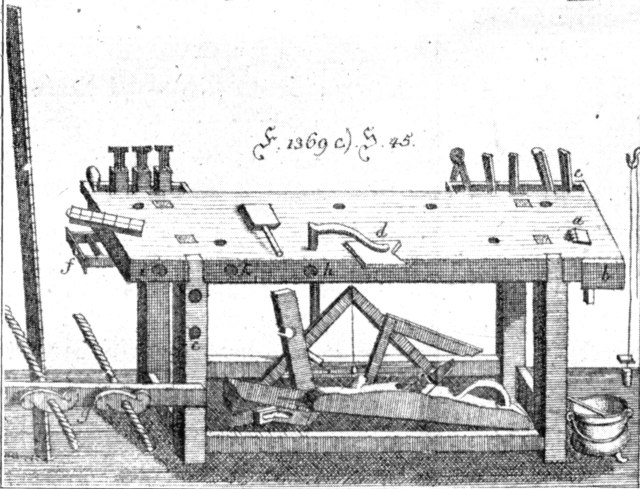
The workbench shown above is featured in Johann Georg Krünitz’s “Oekonomische Encyklopädie,” a remarkable work of 242 volumes. I don’t have the translated text that accompanies this plate, so I’m going to make some educated guesses about this workbench. (In other words, you get what you paid for with this blog entry.)
This 1781 plate looks like a French workbench, not just in its form but also based on the handplanes shown on the floor (that tote is tres French). Also, this bench is shown on a page of “Oekonomische Encyklopädie” with other benches that are quite obviously Germanic, perhaps as a contrast between the forms.
My best guess is the engraver copied it from another work, which is why the bench is shown in reverse – the crochet and planing stop are on the right side of the bench.
Several things are notable about this bench. Briefly:
It shows a “doe’s foot” in use on the benchtop, secured under the pad of a holdfast.
And look: A fathom leaning against the wall to the left of the bench.
The most titillating part of the plate is the double-screw device shown on the floor at bottom left. It looks like half of a Moxon-style vise that is missing its back chop. My best guess is that the screws thread into the holes shown on the left side of the benchtop. This is what Moxon’s engraver seemed to be showing in his 17th-century plate. I measured the distance between the two screws on this plate from Krünitz, and it matches the distance between the two holes on the left end of the benchtop. And this is exactly where I would put such a device.
For me this plate raises a lot of questions about the original source material. I have always assumed that Joseph Moxon copied his bench from André Félibien and modified the engraving to add a double screw vise and some other bits and pieces. This plate makes me want to search a little harder for French drawings of benches in the 17th century in addition to André Félibien’s. I know this sounds like a grassy knoll theory. That’s because it is.
Volcán Cotopaxi (5,897m/19,347ft) peeking through the clouds. Cotopaxi is about 50km from our house, and last erupted in August 2015.
I’m used to working up a sweat while involved in some heavy sawing or planing, but what I’m not used to doing is gasping for air and getting a pounding headache in the process.
The Andes are big mountains, and Quito is one of the highest-elevation metropolitan areas in the world. Fortunately, we are living in the suburb of Tumbaco, which is about 1600 ft lower in elevation than Quito proper. Unfortunately, that means that we’re still at 7800 ft.
The traditional treatment for symptoms of altitude sickness is mate de coca, or coca leaf tea. In Peru, commercially produced mate de coca, in teabag form, can be found just about anywhere, and in the higher elevation cities like Cusco, you can purchase large plastic bags of the dried leaves for only a few dollars. Just about every hotel in Cusco has a bowl of coca leaves and a pot of hot water in the lobby for you to brew your mate. Strictly speaking, I don’t think the bulk leaves are legal, but nobody seems to care (probably because they’re all drinking mate).
Mate de coca, the quicker picker-upper.
Mate de coca is far less common in Ecuador, apparently because of greater influence from U.S. Government policymakers. There is some tension between its classification as a harmful drug and its traditional use as a natural medicinal/spiritual plant. You won’t see mate de coca in a supermarket, but you can find it if you look. (I know of a specialty gourmet coffee and chocolate shop in Quito that stocks it, for example.) The only place I’ve seen whole leaves is at the market in Otavalo, and even there it’s in itty-bitty little bags.
The active ingredients in mate de coca are cocaine and related alkaloids (of course), as well as methyl salicylate, which is chemically similar to aspirin and has analogous pain-relieving properties.
Does it work? It seems to, although it might be that it’s the methyl salicylate that’s doing the bulk of the work, rather than the cocaine. Consuming mate de coca does have a couple of noticeable additional consequences: For one thing, it has an energizing effect (which the Incas used to advantage when they wanted their slaves to work harder). It also inspires confidence, which can be a good thing when one is immersed in artistic pursuits, but is probably not such a great idea while working with tools having very sharp edges. So for woodworking, I think I’ll stick to acetazolamide and ibuprofen.
Mike Mascelli, upholsterer extraordinaire, dropped by the Lost Art Press storefront today. He had just finished shooting a couple DVDs with F+W Media and was on his way to teach at the Marc Adams School of Woodworking.
He also had a small treasure to show me.
An Estonian friend of his, Indrek Lepson, had given him an Estonian draw knife (what we might call a draw shave or scorp) and it was like looking at an illustration right out of our forthcoming book “Woodworking in Estonia.”
Like the shaves shown in the book, this one was made from a forked branch and the blade was secured in exactly the same manner as shown in the illustration. Here is Mr. Lepson’s description:
“Scorp made from an Estonian woodworker from the island of Saremaa.
“I visited the island about 25 years ago, and his 90+ year old widow, who still lived on the farm, showed me his workshop, with his hand made tools and an amazing workbench.
“The island has its own history, and style, of woodcraft, and that was a veritable museum of old craftsmanship, pertaining to a specific region of Estonia.
“Her husband was among the thousands on Saaremaa, killed, or deported to Siberia, by the Russians in the early years of the Russian occupation, when over 200,000 men, women and children were crammed into cattle cars, shipped off to Siberia, and their properties confiscated. With the collapse of the Soviet Union, properties were returned to the survivors of the purges. It’s more complicated than that, but family properties were eventually returned to their original owners, if they survived the purges, or to their kin.”
Here is a small part of Ants Viires’s description of the tool from the book:
“The Estonian draw knife finds may be divided into three different groups, mainly due to the nature of the handle. The most widespread is the fork handle type (Fig. 25), which makes it possible to work with one hand. It is rare only in the easternmost parts of the country, or it does not exist there at all (see Fig. 27). The two-pronged fork handle has usually been carved from wood, but a natural fork is relatively seldom used. Such a handle can be either short or wide (Fig. 25.2) so that it is necessary to stick the fingers between its prongs, or with a shorter or longer “tail,“ by which the worker can hold it in place (Fig. 25.1, 3). Such a handle with a “tail“ measures seldom more than about 7-3/4″ (20 cm); Pakri Swedes have produced some pieces that are nearly half a meter long. (ERM A 489:189). The shaft of the blade is attached to the handle either below or above it. With that type the blade is fastened to the lower side of the handle (usual on the islands and in northwest Estonia) or on the upper side (the dominating method on the mainland) where a respective slot has been made there. The ends of the shaft are bent and knocked into the wood. Often the shafts are attached with tight rings, sometimes made of string, all along the handle (Fig. 25.3). The curve in such draw knives usually ranges around 4″ (10 cm).”
The work this tool does is far-ranging – basically anything that deals with hollow work (which includes a lot of different items in Estonia).
It was a small thrill to see this tool in person – still sharp and ready to go after decades of not being used.
I think you’ll find many small treasures like this in “Woodworking in Estonia” when it arrives in early August.
How do you build a saw bench…without a saw bench? In The Naked Woodworker, Mike Siemsen shows how to begin with a length of 2 × 6 and a pair of 5-gallon buckets. It would appear that 5-gallon buckets aren’t really a thing in Ecuador, as I haven’t been able to find any. I did manage to purchase a couple of reasonably sturdy buckets, but they’re shorter than I would like.
Mark 0 saw bench
While it may be feasible to build a saw bench without a saw bench, I think even Mike Siemsen would have trouble building one without a saw. The only saws that I brought with me were joinery saws, and so aren’t suitable for rough cutting lumber to size. As I mentioned in my previous installment, the saw that I bought at the Mega Kywi looked passable but not that great. As it turns out, I was being optimistic. After a few cuts (in pine), I decided that I wasn’t going to get anywhere unless I sharpened the saw. As delivered, the saw was filed punched straight across (no fleam), with a rather aggressive rake angle. So it actually rips softwood decently well, albeit with so much set in the teeth that the cut wanders like an Amazon tributary.
There are plenty of instructions and videos available online (and also in The Naked Woodworker) that show how to file a saw, but they all involve two things that I don’t have: (1) a saw vise, purpose-built or makeshift, to hold the saw during filing, and (2) a bench upon which to mount said vise.
I spent a full two days pondering the question of how I was going to file this saw without these two crucial tools, but finally hit upon a solution: I removed the handle from the saw and sandwiched the blade between two 2 × 4’s held together with a pair of screws, passing through two holes in the blade. I didn’t yet have anything to mount this “vise” onto, but at least it was substantial enough that I could hold it down on a table top with one hand while I filed with the other.
Mark 0 saw vise
The vise ended up working pretty well, if not the most comfortable way to file a saw. It took me three passes of jointing and shaping the teeth until I was reasonably happy. These passes were straight across; I then took one more pass to add some fleam. The goal was to end up with a hybrid rip/crosscut saw, having a negative rake angle of about 1:4 (14°) and a fleam angle of about 1:5 (11°).
Four passes later…
The saw crosscuts decently now, and the steel is hard (maybe a little too hard for easy filing), so I think it will work. It still has far too much set, but I don’t think there’s much I can do about that without risking damage.
The proof is in the cutting.
Ripping is still a chore, but the saw was cheap enough that I might buy another and set the pair up as dedicated rip and crosscut saws, which should help. I’m expecting some visitors from the U.S. in about a week and a half, and I’ve arranged for them to bring down a couple of good saw files, which should ease the pain.
This particular saw had an interesting little feature that I hadn’t noticed when I bought it: a specialized bloodletting tooth at the heel of the blade. As I already donate more than enough blood while woodworking, I decided to defang my saw and remove the tooth.
The bloodletting tooth. Normally an extra-cost option, I got this one for free.
In related news, my first trip to Aserradero San Morita (aserradero = sawmill) was productive. I neglected to take any photos while I was there, but I will try to do so next time. The place is pretty big, and I only saw a small part of it, but there were piles and piles of boards in all shapes and sizes. It was in many ways a scaled-down version of Midwest Woodworking in Cincinnati, and I got the impression that they do similar kinds of things that Midwest used to do, selling some lumber, doing custom millwork, etc.
Even though walk-in customers are clearly not their main focus, the guy I spoke with was patient enough with my meager Spanish to help me out. It was there that I learned that my interpretation of colorado as being synonymous with quebracho (“axe breaker”) was incorrect, and that in Ecuador, at least, colorado is Eucalyptus grandis x urophylla, better known in the U.S. as Lyptus®.
Lyptus has a mixed reputation. Some people claim that it is unstable and therefore unsuitable for furniture and the like, while others say that it is great to work with. The difference in opinion may at least in part be due to differences in origin, as it is known that Lyptus from different plantations can have significantly different appearance and working characteristics. (You can even buy single-origin Lyptus from Uruguay, if you’re willing to pay the premium.)
Two Lyptus boards (plus one non-Lyptus board—can you spot it?)
I bought two boards, about 1 1/8″ thick by 9″ wide, and just under 8′ long. Both boards have some end checks and the like, but they’re straight, clear and show no signs of warp or twist. The price worked out to $2.50 per board foot, about a third of the cost in the U.S. In addition to the Lyptus, which seems to be the favored wood for furniture and cabinetry in Ecuador, I saw some seique (known as tornillo in the U.S.) and some pine that did not look like P. radiata. They clearly had other kinds of wood in stock, but I didn’t want to take up more of their time than I had to; I’ll do some exploring later.