Here’s a last-minute surprise: Don Williams will be at our storefront this Saturday (Oct. 14) to sign books and talk about all things A.J. Roubo, H.O. Studley and historical finishing.
If you’d like to chat with Don and ask him to sign a book, be sure to stop by between 11 a.m. and 2 p.m. (I don’t want to force him to stay in one place all day.) Don is the author (or co-author) of some of our most intense and rewarding books, including:
Don is a wellspring of information on historical finishing techniques (he is the only person I know with a shellac collection?). And is a remarkably generous person with his time and his hard-won information. So this visit is a very pleasant surprise.
As I mentioned before, we’ll have lots to see this weekend, including my completed Saalburg workbench (a replica of a surviving 1,800-year-old workbench) and the Horse Garage, which will become our machine room. Plus Megan Fitzpatrick and Brendan Gaffney from Popular Woodworking Magazine will be hanging around. It should be a fun day.
The storefront is located at 837 Willard St. in Covington, Ky. We’re open from 10 a.m. to 5 p.m.
When the doors open at Handworks 2017 at 10 a.m. on Friday, May 19, here’s a list of the stuff we’ll have in limited supply. In other words, stop by early to avoid disappointment. Also, please don’t ask us to reserve items for you via [email protected] or phone calls to John. To be fair to all of our customers, it’s first-come-first-served.
H.O. Studley Posters These 13” x 19” posters are printed on 80 lb. recycled paper with a matte aqueous coating (in other words, they aren’t shiny like your Farrah Fawcett poster from high school). The poster features an image taken by Narayan Nayar during our work for the book “Virtuoso: The Tool Cabinet and Workbench of H.O. Studley.” Both Narayan and the author, Don Williams, will be at Handworks, so you can track them down to get yours signed.
We’re bringing about 1,000 of these posters, which will be $20 each. We’ll have kraft paper and tape on hand so you can roll your own protective covering (we don’t have the room in our trailer for mailing tubes). After Handworks, we will sell these posters in the online store.
Crucible Improved Pattern Dividers Raney and John have been working every day to finish and assemble dividers for Handworks. We hope to have 130 pairs or so to sell at Handworks. If we don’t sell out, these will go up in the online store as well. As you might know, we have had a heck of a time getting these made to keep up with demand. After this batch, I suspect we are going to retool the process (again), so this might be the last time we’ll have dividers for a while.
Crucible Design Curves When I’m not editing or building, I’m sanding these design curves to get the sets ready for Handworks. We’ll be selling a set of three for $37 and they will come in a protective box suitable for traveling. I hope to have 250 sets of curves ready for handworks with another 750 sets ready soon after the show.
Other Stuff We are bringing our full line of books, plus a variety of American-made T-shirts for Lost Art Press and Crucible. Because books are heavy, we can tow only so much. As a result, if you are there to get a particular book so you can get it signed by one of the many Lost Art Press authors in attendance, don’t tarry.
Authors who have told us they’re attending:
Don Williams
George Walker
Jim Tolpin
Peter Galbert
Roy Underhill
Matt Bickford
Mike Siemsen
Joel Moskowitz
Nancy Hiller (she’ll be signing her book in our booth at 2 p.m. Saturday)
Wesley Tanner (the designer of our Roubo and Studley volumes)
Narayan Nayar (photographer for the Studley book)
And me (duh).
Though we’re on the eve of Handworks (and are a little ragged around the edges), we’ll open the Covington storefront this Saturday to the public with lots of good stuff to see.
Here’s a quick list of interesting objects:
We should have some copies of our H.O. Studley poster to sell at the special introductory price of $20. (They are supposed to arrive today.)
I have two repaired letterpress copies of “Roman Workbenches” we can sell.
Come try out the new Crucible Design Curves. I have the prototypes at the store now. I’m not sure I’ll have complete sets packaged and ready to sell, however.
We have lots of blemished and returned Lost Art Press books this month. They are 50 percent off retail (cash only and in-store only).
Come check out the Swedish gateleg table I just finished (it ships to a customer next month). And I have a couple other pieces that are for sale, including one of my staked three-legged stools with the charred finish.
Plus all the usual stuff: all our books, T-shirts, stickers and gabbing about woodworking.
The storefront is open from 10 a.m. to 5 p.m. and is located at 837 Willard St. in Covington, Ky. The Covington Farmer’s Market will be running the same day from 9 a.m. to 1 p.m. It’s a short walk from our store and a great place to get lunch or snacks. And pet a goat.
Editor’s Note: One of the many exciting books in the works at Lost Art Press is Joshua Klein’s book on Jonathan Fisher (more on Fisher here). Fisher was an ingenious American colonial polymath and woodworker who could fashion almost anything out of wood – a clock, a lathe turned by a windmill, his own tools, furniture for his town, convertible beds and on and on.
This project will be in our hands for editing soon and you’re going to hear a lot more about Fisher and Klein’s personal journey of discovery in researching Fisher. In the meantime, here’s a crazy story about the lengths Joshua is going to for the book.
— Christopher Schwarz
I remember talking with Don Williams about his struggles working on the H.O. Studley book, “Virtuoso: The Tool Cabinet and Workbench of Henry O. Studley.” He said the challenge was unearthing information about who H.O. Studley was. Don searched far and wide to understand the story of this man and his legendary tool cabinet. Studley left no paper trail of letters describing his work, little if any of his other woodwork has been identified and much of the research required extensive traveling. Talk about a complicated project!
When Don visited my wife and me in Maine a few years ago, I took him through the Jonathan Fisher house. As we walked around the house looking at artifacts, we discussed the fact that the Fisher story has the opposite problem. Fisher’s house (five minutes from my own) is full of furniture, tools, paintings, journals, letters, etc. The archives are brimming with tiny little notebooks full of 18th- and 19th-century script, most of which was written in a shorthand he developed at Harvard. There are boxes of drawings, historic photographs and archaeological findings. Digesting this enormous body of information in order to discern a cogent furniture-making narrative would be an enormous task. If Studley was about accumulation, Fisher is about distillation.
As I was writing the chapter about Jonathan Fisher’s barn workshop, I was presented with the task of bringing together all of these artifacts into one scene. I know them all so well and am so immersed in the journals that I could picture it in my mind. His “tool closet” of planes, his lathe in the background, the sheep in the corner, his bald head and the “grave” demeanor on his face. It was almost like I was there. The problem was to describe it to the reader. Although I explained the setting as best as I could, I realized that looking at photographs of objects was not going to be enough. I wanted the reader to see things in context.
To my knowledge, no one writing a historic monograph on a pre-industrial furniture maker has ever commissioned an artist to recreate a workshop scene. Usually, there just isn’t enough information to create such a thing. But because almost everything from Fisher’s shop is either extant or we have paintings or photographs of it, I knew it was possible.
Is it necessary? No. Is it awesome? YES!
Fortunately, I’m working with Chris and John on this book so, of course, they were game. I contacted my first-choice artist, Jessica Roux, from Brooklyn, N.Y. I’ve admired Jessica’s work since seeing it on the covers of Taproot magazine. It struck me right away because it reminded me of Fisher’s own balance of academic training and folk whimsy. Also, the way she uses color and texture reminded of the many 18th/19th-century workshop paintings we all drool over. Her aesthetic vision seemed just right for this.
When I explained the project to Jessica, she was interested. I expressed how important historical accuracy was and she assured me she was used to several rounds of back and forth with authors to make sure things were conveyed correctly.
With the green light, I assembled images of the tools, historic paintings and Fisher himself and sent them along with a rough compositional sketch as a starting point. Then the back and forth began. During the last three weeks, Jessica has been refining a sketch that Chris and I will approve before she creates the final image. The color will happen in a magical digital process I look forward to learning more about.
We hope this artwork will bring Jonathan Fisher to life for you as you read this book. His life was one full of beauty, drama and lots of wood shavings — I can’t wait to share this unbelievable story.
The manuscript will be in Chris’ hands in a matter of weeks. Stay tuned.
Don Williams says his love of learning was probably fostered by the fact that his father was going through seminary when he was a child. Don grew up in a household without television. Instead, his family listened to classical music and read.
“But much to my parents’ dismay, I veered off into jazz as my primary interest, so they were pretty much convinced in my teenage years that they had picked up the wrong kid in the hospital,” he says.
Don maintains a love of jazz.
Jazz can loosely be defined as a combination of polyphony, syncopation and improvisation — simultaneous but independent melodic lines playing at the same time with unexpected and off-beat rhythms achieved extemporaneously. For Williams, jazz is not only what he listens to, still to this day, but serves as an outline for how he lives his life.
A self-proclaimed conservator, educator, scholar and all-around inquisitive guy, Don was a curious child who delved deep into varying topics – some unexpected – and from a young age, found connections.
“I think that being interested in many things, not everything, but many things allowed me to gather a lot of information,” he says. “And since I didn’t necessarily accept the rubric of the classroom, I think I’m able to see connections between distinct bodies of knowledge that wouldn’t necessarily be apparent if you were stuck in the tyranny of specialized knowledge.”
Don believes that the whole notion of specialized knowledge is a modern thing. “In the past, our predecessors in much earlier generations saw knowledge as the continuum rather than a series of cubbyholes,” he says. He mentions Robert A. Heinlein, who famously wrote:
A human being should be able to change a diaper, plan an invasion, butcher a hog, conn a ship, design a building, write a sonnet, balance accounts, build a wall, set a bone, comfort the dying, take orders, give orders, cooperate, act alone, solve equations, analyze a new problem, pitch manure, program a computer, cook a tasty meal, fight efficiently, die gallantly. Specialization is for insects.
Don believes pluralism and knowledge to be good things. “That’s part of why I was able to study lots of different things, both formally and informally, and manage to synthesize them into some body of working knowledge,” he says. “It doesn’t necessarily [make me] an expert at anything, but it does make adaptable I think.”
But expert, he is. In many things.
Williams spent his early years in southern Minnesota, and his adolescent and post-adolescent years in South Florida. His mother was an office worker, his father a pastor. Williams is the fourth child out of five.
At that time there was a program in Florida called the Faculty Scholars program that pinpointed high-achieving students on factors outside of grade point average. Williams had his high school guidance counselor convinced he was a solid “B” student.
“And then when the senior standardized placement test results came back, she literally left her office, came and dragged me out of class and read me the riot act,” Don says. He had received the second highest score in his very large high school.
This test result, through the Faculty Scholars program, allowed Don to begin college as a junior. He enrolled at Florida Atlantic University planning to double major in economics and political science. “This was 1972 and everybody was pre-law in 1972,” he says.
Improvisation
Around this time Don was working in the finishing room of the now-closed Schindler & Son, then a well-known restoration shop in West Palm Beach, Fla. “I found my attraction and interest at the workbench,” he says. “[The work there] was so much greater than the stuff I was studying in college that I dropped out of college around the beginning of my senior year. It just didn’t pull my fascination.”
Don began working full time for Schindler in 1974, and there met Nick Hlopoff, an internationally renowned decorative art conservator. “He was an exotic figure to me,” Don says. “Being a kid of the Midwest, Baptist parentage, here was this fellow who was an ethnic Russian, born and raised in Paris, trained by his father to care for artworks of exquisite importance.”
Nick, who lived outside of Detroit, would come into town and use shop space to care for the artworks of one of Schindler’s clients. “He was the guy who introduced me to the world of museum conservation as a livelihood,” Don says.
So Don decided to go back to college. “I still didn’t know precisely the path to art conservation as a career so I did the closest thing I could find which was to go to the University of Florida and major in architectural historic preservation.” But a year and a half in, the university changed its curriculum in a direction Don didn’t like. So he left school again.
Don worked in restoration and reproductions at Colonial Woodworking in Archer, Fla., and then in 1978 got a job at Maddox Foundry and Machine Works. “I worked as a patternmaker, which is ultra-precise woodworking,” he says. “I mean, ultra-precise.”
At Schindler’s, Don learned all about historical furniture, having worked on thousands of old-money European and French furniture pieces for wealthy clients in Palm Beach. At Maddox, he learned all about precision woodworking.
Polyphony
It’s the early 1980s now, and Don has married Carolyn, who he met on a blind date at his sister’s house. Carolyn wanted to pursue graduate work, and Don wanted to pursue art conservation. So they chose the southern most of the four colleges in North America that offered both — University of Delaware. Don enrolled in an undergraduate art conservation program, which was an interdisciplinary triple major of studio art, chemistry and art history. “Those are the very disparate disciplines that are the foundation for art conservation,” he says. “It’s fully left brain and right brain, both evolving simultaneously.”
There were 17 incoming students in Don’s program, but by the end of the first semester of the second year, Don was the only one left. “For most people either the hard science is going to weed you out or the fine art is going to weed you out,” he says.
A semester shy of graduating, he received three job offers in the museum field.
“I accepted the job offer from the Smithsonian with the promise that I would finish my studies and get my degree.” He did. It took him another year and a half of commuting one day a week to Delaware and back, but in 1985 he earned a B.A. in “Technology of Artistic and Historic Objects.” (The degree is now, more simply called “Art Conservation.”) Don was the program’s first graduate.
One of the ironies of the Smithsonian gig was that Don was hired in part to be on a team that was developing an art conservation graduate degree program, even though he hadn’t received a graduate degree himself. “So my time for the first couple of years was split between working on the curriculum for this new master’s degree program and doing hands-on caretaking and inquiries and research into the materials and artifacts that related to the Smithsonian.”
Don was 29 when the Smithsonian offered him a job. “You pinch yourself,” he says. “You just can’t believe it.” In his later years, when working alongside his best work friend, Melvin Wachowiak (“With All the Precision Possible: Roubo on Furniture” is dedicated to him), Don says they would often say to each other how unbelievable it was that they were being paid to do this type of work. “Because it was so much fun,” Don says.
Don describes the small group he worked with as semi-autonomous, with a think-tank-like culture. “We were given just extraordinary latitudes in pursuing the intersection of our interests and Smithsonian collection needs,” he says. His official job description, which he wrote, was 15 pages long. When asked to distill that down he says this: Be productively curious.
He was. And he was good at it.
“Part of my success in this poly-dimensional disciplinary world was that I could synthesize information from completely unconnected sources,” he says. “I hope I’m not bragging about it but it’s just a way, it’s a familiarity with the way I work. My wife has identified me as severely ADD so that’s perhaps worked out well there.”
A cabinet by the French-born 19th century New York cabinetmaker Alexander Roux.
Don’s restoration is on display in Washington DC.
Day to day, Don said he got to “literally intrude into the fabric of some of the most prominent artifacts in the history of the nation. And so some days I was working on irreplaceable treasures, and some days I was just sitting and reading. And still, the paycheck showed up at 12:01 a.m. every other Tuesday morning.”
The pieces that most interested Don during his time at the Smithsonian weren’t those with historical prominence but rather those that had “attractable degradation.” He talks about a 19th-century replica of a 17th-century French desk with spectacularly decorated marquetry but was run-of-the-mill in the 19th century.
“But it was in the Smithsonian collection,” he says. “And it was undergoing really catastrophic damage because the carcass underneath it – the veneer was coming apart. Working on that was really an amazing experience. But it wasn’t owned by anyone important. It wasn’t made by anyone important. It was a typical sort of French replica that an industrialist of the gilded age would have in their sitting room or library to kind of evoke a false nobility.”
Don also worked on a desk that was one of the earliest and largest examples of artificial tortoise shell. “I’m nuts about tortoise shell,” he says. “I’ve invented a really persuasive imitation tortoise shell for my own work so studying that piece was really great.”
The Mace of the United States House of Representatives
During the second half of Don’s career he was very much involved in the caretaking of the Mace of the United States House of Representatives (look it up on Wikipedia). “Most people don’t know about it, but it is one of the biggies, it’s right up there with the Liberty Bell,” he says. “For me, that was a such a powerful, powerful artifact symbol for us as a nation. And that has touched me to this day.” For 20 minutes Don’s work on the Mace was featured in a C-SPAN documentary called “The Capitol.” (The next time you watch C-SPAN, and they offer a panoramic view of the House Chamber in the Capitol Building, you’ll see the Mace at the very left edge of your screen.)
After more than 25 years of service to the Smithsonian, Don left his job on the last day of the last pay period of 2012. “I was ready,” he says. Don describes the Smithsonian as a scientific arts bureaucracy wrapped inside an academic bureaucracy wrapped inside a federal bureaucracy. “For us, geological timeframes were not merely some abstract idea, that’s how things worked sometimes,” he says. “It was pretty clear that my own particular interests no longer coincided with the organization that I worked for. That’s not malevolence or anything else. People’s priorities change. My priorities stayed pretty much the same, my organization’s priorities changed. They offered me the chance to retire at the age of 57 with lots of years of woodworking left and I said, ‘Wow. That’s pretty good.’”
Michele and Don at work on Roubo.
Don studying the tool cabinet of Henry O. Studley.
By now Don and Michele Pietryka-Pagán had already begun working on “To Make as Perfectly as Possible: Roubo on Marquetry.” And Don had begun work on “Virtuoso: The Tool Cabinet and Workbench of Henry O. Studley.” The Smithsonian (which demands right of first refusal on all intellectual property relative to your job when employed) had no interest in either. So he already had two projects dialed in that he knew were of interest to Lost Art Press. “I already had a working relationship with Chris and he was very much interested in the kind of scholarship I was trying to pursue,” Don says. “So really, Lost Art Press was a big part of my decision-making for this fairly substantial lifestyle change because frankly, it was a really, really good job. It was way too much fun, part of it, and paid way too much, but somebody had to have that job and it might as well have been me.”
So Don and Carolyn left Washington for a new life on a secluded property in the mountains of Virginia, which they had purchased a dozen years before.
Syncopation
These days, Don follows his muse. On the day we spoke he had plans to finish formatting photos for an article he wrote for Popular Woodworking Magazine. Then, lunch. “One of the advantages of me being here is that there’s always a fresh, hot lunch – every day. I’ll come down the hill and my wife will have made us a wonderful, wonderful lunch.” In the afternoon he’ll continue work on replicating a desk for a client.
He does a lot of writing. In addition to his woodworking-related writing he says he also has a “fairly vigorous email circle of circumstantial and political and economic commentary that I carry on with my virtual community of observers.” He also writes fiction – thrillers, specifically. His latest is about a museum conservator who has withdrawn to the mountains and gets drawn into a mystery dealing with documents hidden in a piece of furniture. Those documents threaten the structure of Western civilization, and the bodies start piling up.
“My wife says I like to do it because I get to put words in everyone’s mouth,” he says, laughing.
Often, while drifting off to sleep, Don says he’ll compose things in his mind — an artistic design, an essay on the state of the civilization, theological apologetics.
“One of the things that I celebrate the most is that I do not have to regimen my life,” he says. “It’s fairly mercurial. To be utterly frank about it I’ve reach a position of status in the artifact world that you know clients are willing to wait for whatever it is that I do.” (A recent call with once such client resulted in a request to call back after Christmas 2018.) “And I never for a moment take for granted that blessing. I’ve been restoring furniture and decorative objects with some level of accomplishment now since 1971. So that’s a fair amount of time.”
While Don says certain kinds of problem-solving skills are innate to him, he says his success is due, in part, to some marginal native artistic talent. “And I do mean marginal,” he says. “But through skill you can overcome limitations and challenges. Because skill is about repetition. It’s like in writing. The more you understand the meaning, the power, the organization of the words, the greater facility you have using those words for their intended purpose. And when you’re talking about working with artifacts it helps to be interested in and able to comprehend the nature of the materials from whence they are fabricated, the technologies by which they are fabricated and then the trajectory of their degradation. And I guess the thing that I am every thankful for is that I, for reasons unknown to me, can sort of put those pieces together. I’m not sure if that’s a talent or a skill or something else, but it’s something that I just sort of get.”
And frankly, he says, he loves being intimately associated with beautiful things. And not just aesthetic beauty. “Sometimes just thinking skillfully or thinking clearly or thinking creatively is a beautiful thing,” he says. “I love a beautifully crafted concept.” He says his daily expenditure of resources, time and energy spent on restoration is diminishing, “in part because there are other new avenues of rediscovering historical craftsmanship. The related expression is much more prominent on my horizon than before.”
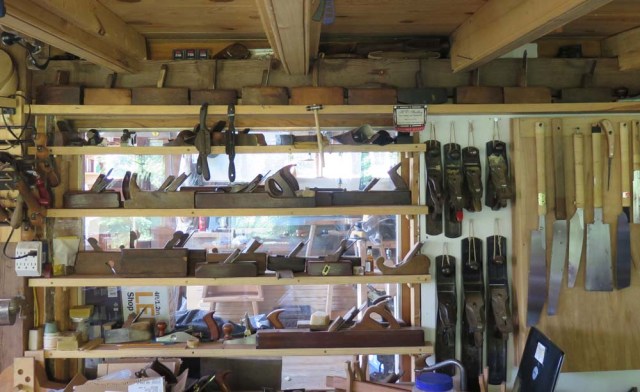
Note Don’s toothing plane collection.
Don’s ideal week is not a whole lot different than what he’s doing now. He hopes to make more replicas of prominent, historic, smaller-scale furniture. He hopes to continue working for a very few number of clients whose collections he has a strong affection for (think: caring for tortoise shell). He has a series of sketchbooks, and the drawings in them are a car wreck between James Krenov’s car and André-Jacob Roubo’s car (his words). “I’m trying to apply some of the technology and artistic vocabulary of Roubo with the technology and artistic vocabulary of Krenov with a dash or two of some 16th-century Chinese furniture in there.” He likes writing. He likes collecting. He likes communicating. He doesn’t like traveling. For Don, a 50-50 mix of studio time and time spent at the keyboard is a good mix.
“I would just like to continue what I’m doing both artistically and intellectually and stay healthy,” he says. “I’m going to be 62 coming up. I just returned from Florida where we celebrated my mom’s 100th birthday, so I figure I have about 40 good years of woodworking left so I want to be careful so I can do it.”
Don and Carolyn live in the least populous county east of the Mississippi. Folks keep up with him online at donsbarn.com. The Barn on White Run, a three-story 19th century barn he found on eBay, houses his studio, classroom, library and dorm space. It took several years to dismantle, move and rebuild the barn, but for Don, it’s a dream fulfilled, a dream he’s had since he was a teenager.
Don enjoys the solitude of rural living. Since he was a child he’s sought out remoteness and isolation. “If I have an mp3 player, that’s about all the human contact I need most days,” he says. “I love being out here. It is exceedingly remote.”
At least four times a year Don and Carolyn head over the mountains to Charlottesville, Va., where he visits University of Virgina’s ophthalmology department for some issues with his eyes. They make a day of it, eating a nice lunch and stocking up at Trader Joe’s and Costco. He also relies on online shopping, and says he’s learned to appreciate “the astounding sophistication of the economy and its distribution network.” Most items arrive in 48 hours.
“You know, I’m just at traditional guy pursuing my faith and my family out in the mountains here,” Don says. “I have daughters who I love to death and a wife who I’ve been married to for 35 years, hopefully we’re on our way to forever, but that’s pretty much it.”
Except, it’s not. His life is an eclectic mixture of conservation, restoration, woodworking, finishing, metal casting, collecting obscure books, tools and shellac (yes, really), writing, gardening, presenting, discussing politics and making connections between all of it while forever remaining curious. All while listening to podcast lectures. Or, of course, jazz.