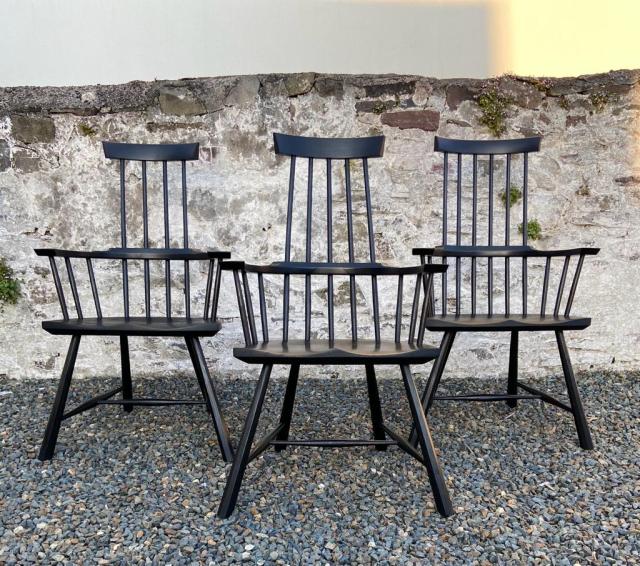
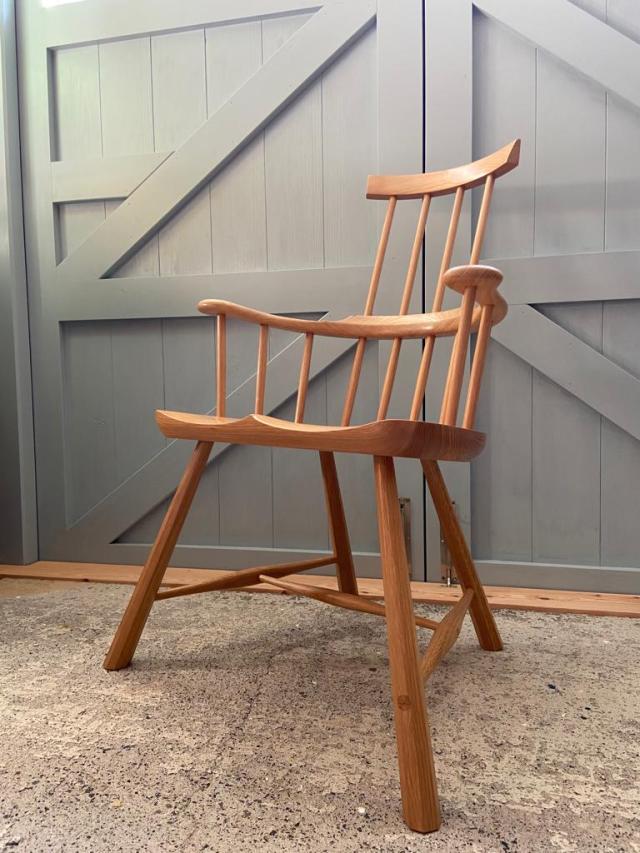
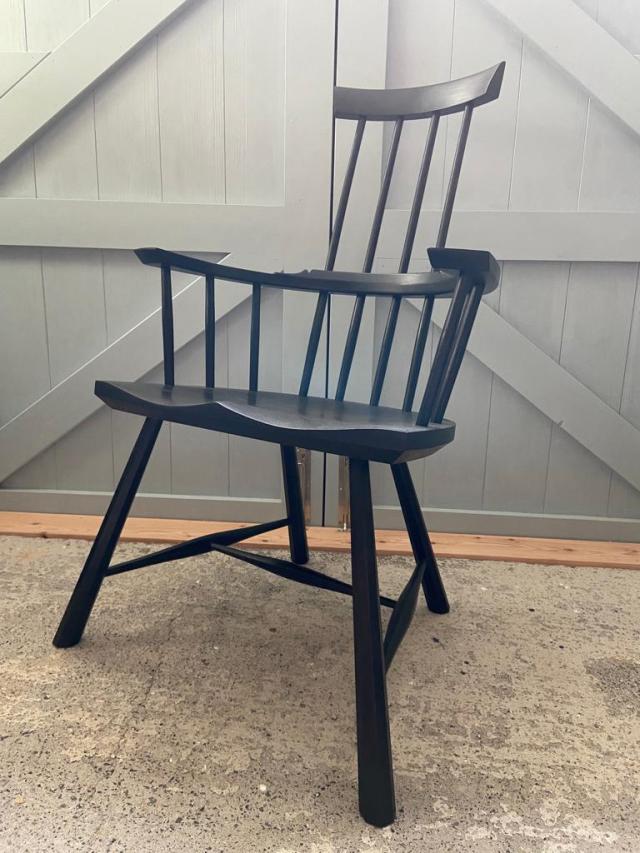
We are thrilled to welcome Welsh chairmaker Chris Williams back to Lost Art Press this summer to teach two week-long chairmaking classes in our storefront. Chris worked with John Brown making chairs for almost a decade, and Chris has continued making chairs in this Welsh tradition ever since.
A class with Chris is about as close as you can get to working with the late, great John Brown.
The two classes run June 5-9 and June 12-16 here in our Covington storefront. Each class is limited to six students. Chris will lead the instruction, with Christopher Schwarz and Megan Fitzpatrick assisting the entire week.
Registration for the classes will open at 9 a.m. March 15 (Eastern) through our registration portal. If the classes fill, we recommend getting on the waiting list as cancellations do occur.
Students will each build a comb-back stick chair using traditional hand-tool methods and American woods under the guidance of Chris Williams. In the spirit of these chairs, students will personalize their chairs with different stick arrangements, undercarriages, arm shapes and combs.
In the end, no two chairs will come out alike – just as it was with antique Welsh chairs and the ones made by John Brown and Chris.
It’s also worth noting that this chair class is unlike many others taught today. There are almost no jigs or specialty tools used. There are no tenon cutters or jigs to guide you as you drill the mortises for the sticks. Chris doesn’t use sightlines or resultants in his drilling. Instead, he relies on simpler, more direct methods.
Instead of jigs, Chris will show you how to make these chairs using mostly a jack plane, block plane and spokeshave, plus a few auger bits. We will use a band saw at times (freehand) to speed up some sawing operations due to the time constraints of the class.
Chris, the author of “Good Work,” has dedicated his life to making these chairs to an extremely high level. If you would like a taste of these methods and this kind of life, a week-long class with Chris will set you on this path.
Also, Chris is an absolute wealth of knowledge when it comes to antique stick chairs, plus he has a thousand stories about working with John Brown and as an independent chairmaker for most of his adult life. The class is about way more than making tenons and sticks, it’s about immersing yourself in a difficult, creative and beautiful lifestyle.
Note, because of the intense nature of these classes, we ask that all students have some prior experience at chairmaking. Students should be confident in maintaining and working with edge tools. This is a class for intermediate and advanced woodworkers.
The class fee is $1,800 per student, which includes the wood and all other raw materials needed to make the chair.
The last cabinet Krenov made at the school, the “Pearwood Drawer Cabinet.” David Welter pointed out that this leg shape, with its tapered and faceted shaping, was a new style for Krenov. “Jim often said that it was curiosity that kept him going,” noted Welter. Photo by David Welter.
The following is excerpted from “James Krenov: Leave Fingerprints,” by Brendan Bernhardt Gaffney. After years of research and more than 150 interviews, Gaffney produced the first and definitive biography of Krenov, featuring historical documents, press clippings and hundreds of historical photographs. Gaffney traced Krenov’s life from his birth in a small village in far-flung Russia, to China, Seattle, Alaska, Sweden and finally to Northern California where he founded the College of the Redwoods Fine Woodworking Program.
While the school [what is now the Krenov School of Fine Furniture]was preparing for his withdrawal, [James] Krenov, too, was making plans for his life after the program. His craft practice had been uninterrupted in his last year, in spite of the turbulent conditions of his departure. He completed three cabinets, even venturing into a new form, a “drawer cabinet” whose interior was occupied by an array of drawers, with little or no open space inside the carcase. As he prepared to leave the school, unsure if he would or could return to the facilities, one student remembers that Krenov spent a sizable amount of time preparing and sawing materials for the cabinets he hoped to make when he returned home. The students, too, helped with Krenov’s move. Along with helping him with the physical move of his materials, the students built him a going-away gift of a veneer press, smaller than the school’s but sized to Krenov’s smaller scale of work.
Erik Owen, a student from the class of ’96, worked with the family to build an addition to the cabin behind the house on Forest Lane, to serve as a small workshop reminiscent of his Bromma basement workshop from Sweden. Into the shop they moved his workbench, a few small machines and his still ample supply of wood, all he needed for the construction of his small veneered cabinets on stands.
The move home was turbulent, and after leaving the school, it would be several months before Krenov would complete a cabinet in this diminutive space. But his family and friends also were careful to help see that Krenov would not have to endure too long a separation from his daily routine, for both Krenov’s and their own sakes. Tina remembers that Britta knew it was time for her husband to retire, having seen his demeanor and attitude with the school worsen, but was saddened to see it happen on terms not entirely his own.
Krenov’s ultimate critique of the school he gave after his retirement, now coming out from under his 20-year tenure, was that it could not bring the students to a place of maturity, both as technically solid craftspeople and capable designers. Krenov had never shied away from helping those students who sought his help, and many of his favorite students had come to the school without any background in furniture. Krenov had delighted at bringing many of those students far past a point of accomplishment that they themselves had thought possible. But he had long used an analogy that he had overheard Arthur Rubinstein, the famed Polish-American pianist, give when addressing the talents of his students.
“For example, you cannot teach a person to be musical,” he told Oscar Fitzgerald, just a few years later. “You can teach them to play, but you can’t teach them to be musical. I was in New York and I came back to my hotel room and they were having the 80th birthday concert by [Arthur] Rubinstein – Carnegie Hall, the whole ball of wax. And they were interviewing him in the intermission and somebody asked him … about the students of that time. He says, ‘Oh, such technicians, such skills. Oh, sometimes I ask one of them, when are you going to make music?’”
Krenov lectures from the bench in his back room at the school in 2002. Photo courtesy of the Krenov School.
In May 2002, Krenov officially retired from the program, after his 20th year at the school. Burns remembers that the last day was cathartic. Knowing that their time as colleagues was over, he and Krenov had a final argument, one that was their last conversation. However turbulent Krenov’s last years had been, the school’s faculty, with the addition of Hjorth-Westh and Smith, would forge ahead without Krenov, and the school continued outside of his presence on staff.
Krenov himself would not retreat, in totality, from the school for a few more years. He returned on occasion in subsequent years to see and advise on student work, suggest or offer up a board of wood for a certain project and, sometimes, to fill his pockets with dowels from the boxes in the machine room. The school’s students, too, would not cease to visit Krenov. Laura Mays, a second-year student in the first year without Krenov in residence, remembers that many of her classmates, even those who hadn’t studied under Krenov, would make frequent trips to the Krenovs’ house for tea and conversation. And alumni, those who had stayed in the area or who returned for visits, would come to their teacher’s home to check up on the aging cabinetmaker. Krenov would even weigh in on some students’ attempts at recreations or reinterpretations of his own designs; as late as 2008, Krenov advised one student, Tom Reid, on his version of Krenov’s “Carved Curves” cabinet, and gave Reid the compass plane he had made decades earlier for his own construction of the cabinet.
Krenov’s departure began the last chapter of his life. In those years, visitors to his home remember his fondness for Dylan Thomas’s poem “Do not go gentle into that good night.” Krenov, with failing eyesight, arthritis, body pains and faltering hearing was moving toward the end of his life, but retirement was never an option for the 82-year-old. From his small world on Forest Lane, he would still host a rotating cast of visitors, friends and well wishers, reach out into the world by phone and written word, and continue to pursue a craft practice by any means necessary.
John Porritt, author of “The Belligerent Finisher,” has been designing and building furniture, restoring furniture and tools, as well as making chairs inspired by older Welsh stick chairs and English country Windsor chairs for more than four decades.
Born in 1953 in a military hospital in Aldershot, a town in Hampshire, England, John was the youngest child of John and Myra Porritt. At the time, his father was teaching at the Royal Military Academy Sandhurst. Growing up in an army family, John moved around a lot, eventually attending six different schools throughout his childhood.
“I’ve always felt slightly removed, not part of any group, an outsider through the years. And that’s OK. It opened my eyes to a lot of things, meeting different people and getting to know some of them. My mother was very supporting and accepting of my brother, sister and I. She was very creative. She understood line and form. My father’s credo was: ‘Be firm but fair’.”
John’s family growing up: His mum, Myra; father, John; older brother, Wilson; and sister, Pam. John is the little one on the right.
In 1957, the Gold Coast became Ghana, gaining independence from British rule. Prior to this, John’s father had been seconded from the British Army to help train the Ghanaian Army, so John’s family had moved to West Africa.
“Some of my earliest memories are from the village of Teshi, outside of the capital Accra,” John says. “Company Degarti, originally from Liberia, would watch out for me in the garden, pointing out lurking snakes, including a very thin poisonous black one that looked like a boot lace. I remember him picking me up to get bananas from the trees in the garden, cutting the pineapples growing down low, and us together digging up peanuts – which my mum would roast. Once, I saw Company sit down suddenly, take out his knife, cut into his heel, then quickly sucking at the wound and spitting out the poison from the snake bite. He did get better. What wonderful man with a great name – Company.
“I would see the Hausa men from the north, selling their beautiful carvings door to door, very tall and dark in their immaculate white robes. They moved so slowly, pacing themselves in the heat.
“I remember my family together on a golden, sandy beach, looking off in the distance to a beautiful white castle: Christiansborg Castle. My father wouldn’t take us there. Years later, I found out that it was a slavers’ castle, built for human beings to go directly into the boats to be sent to the slave markets.”
When John was 6 years old, they moved back to England. They lived on the 5th floor of a hotel in Portsmouth, Hampshire.
“I started to go bald,” John says. “It was something called alopecia. My mom would take me to a hospital to have this stuff rubbed into my hair. They worked out that I was so used to being on the ground in the bungalows that living up high was very stressful for me, or, at least, that’s what the theory was.”
So John and his family moved to Romsey, Hampshire. A quiet boy at the time, John attended church school. The head teacher “…was a bit of a sadist,” he says, “who used to cane certain children regularly.” At just 10 years old, John walked out of school one day, angry that he was about to be caned yet again for something he did not do. Through school, John spent a lot of time in Romsey Abbey, built in the 10th century.
“I remember, at 10, being impressed with the light coming through the windows of the stained glass onto the stone, that soft sunlight and the effects it would make on the building,” he says. “And I loved singing in the choir.”
Broadlands, Lord Louis Mountbatten’s estate, was nearby, so Queen Elizabeth II would come twice a year and attend services in the abbey. During those services, John, a choir boy, would steal glances at the Queen – the head of the Church of England – sitting alone in her pew by the high altar instead of his tucked-away Southampton football program, which was his usual go-to.
“I remember being completely impressed by the color of her coat,” he says. “Later, I found out that she was dressed by Hardy Amies, and he was known for the cut of his clothes. She had this beautiful blue that she would wear and it was just stunning. She looked wonderful.”
John attended three more schools before leaving at 15.
“My favorite subjects were history, geography, English and running. Running for me was a chance to get out on my own, with my own thoughts. I was the school cross-country champion. But it was a small school. I was glad to finish school and get out into the world of the late ’60s.
Although he was a skinny teen, John first found work as a builders’ laborer. In the mid-’70s, he was walking around West Kensington and got a job at Stokecroft Arts making simple pine beds – lots of sanding, gluing dowels and screws.
“It was run by a guy called Bernie,” John says. “Bernie was a great guy in that he gave a lot of people a chance. He had a lot of soul, a lot of heart. He came to England just before the war at the age of 10 on a Jewish Kindertransport from Germany. I remember he wouldn’t get pissed off, he’d be disappointed. ‘Come on, John, you can do better than this.’ He was a great guy. Bernie was a great guy.’”
John moved to Kent with his girlfriend at the time and took a six-month carpentry course at a government skill center in Sittingbourne, Kent.
“I learned a lot,” he says. “I learned how to handle tools. I learned how to sharpen. The instructor there was a man named Peter Dense and he was excellent. Very small, very quiet. Authoritative but quiet. And for the first two days he gave me chisels and plane irons and told me to sharpen them and I’d sharpen them and bring them back and he’d say, ‘Do it again,’ and I did that for two days.”
Halfway through the course, John split up with his girlfriend, leaving him without a home.
“I ended up living in somebody’s cupboard,” he says. “In hindsight, it was horrendous.”
“I remember my mum had said to me, ‘What are you going to do? Just find something you love doing. Find something that interests you. Find something to do and do it.’ And luckily, I did. I think about people like Bernie, Peter Dense and later John Price and I’m kind of humbled, really. Decent people who helped me out, great teachers.”
John also spent many of his younger years traveling. For a while, he worked in Germany as a shuttering carpenter, making forms for concrete.
“I remember Germany in the mid-’70s as quite a place,” John says. “The gaps between the generations, the intensity of it all. At one stage I was working in Nuremberg. One evening I went to the area where the rallies had been held in the 1930s, now completely deserted, listening to Joan Armatrading on my cassette player and enjoying the sight and calm of the willow trees there, wondering about what had passed and all that had happened there.”
At one point John and his crew were sent to Munich, but the directions were incorrect. They ended up at a beer festival and the carpenters from London John was with decided to take advantage of the situation and get absolutely drunk. John decided to take advantage of the situation and visit the state art museum.
“I was looking at the Blue Rider artists, which included Kandinsky, Franz Marc and August Macke,” he says. “In Germany, it’s Blaue Reiter. Before the first World War, they did a lot of pictures of animals in gorgeous colors and this guy, Franz Marc, did beautiful horses, stunning horses, which seemed to me to be symbolic of freedom and joy.”
John moved back to England and found a job with a company called A.J. Dunnings, working on an interesting site in Winchester complete with a stone barn from the 15th century. Early on John remembers the foreman asking him to rehang some sliding sash windows. John took the first window out, changed the cords, properly cleaned everything, sorted it all out and put it all back together.
“It’s tricky stuff,” John says. “You’ve got to stretch the rope and get the weights properly balanced.”
John showed the foreman his work.
“It’s a great job,” the foreman said. “Great job, you’ve done it really well. But there’s only one problem. You put the top sash inside, and the bottom one out. That will let the rain in.”
John is a wonderful storyteller and most of his life’s stories contain lessons learned, some subtle, some not.
“What I had done was I had gotten completely absorbed in the details,” John says, when telling his sash-window story. “I had forgotten the overall idea, which I think is something that a lot of woodworkers do from time to time. And I think that’s quite an important lesson there.”
A fellow carpenter, Joe, at this particular job called payday “Golden Wonder Day.”
“I didn’t get what that was about,” John says. “Turns out, Golden Wonder was a brand of peanuts so he was saying, we’d be getting paid peanuts. I like the banter you get with working people. I enjoy that a lot.”
John has worked all sorts of jobs in his life, with all sorts of people. He talks about working in a massive, cavernous room with high ceilings in, he thinks it was, Strasbourg, striking forms and then dodging them as they dropped, “an absolute nightmare,” he says. He talks about unloading a brick lorry where people would chuck bricks, five at a time. They were on the lorry and he was off it – he’d catch the bricks and stack them. One of the loaders once called him John and surprised, John asked him how he knew his name.
“We call everyone we don’t know John,” the loader said.
John laughs, remembering.
John had worked as a day laborer with Jack Dee, who, at 16 years old, had a deadpan humor that everyone loved. Jack Dee became a nationally known comedian with his own television show, using that same deadpan humor he used on the job site.
And John remembers digging clay for a German potter in West Cork, Ireland, “an unbelievably beautiful area,” he says. It was 1971 and he and friend were hitchhiking through at the time. A man picked them up who turned out to be astonishingly drunk. Chaos broke out when John, sitting behind the man, was trying to get him to stop the car while the man was trying to reach for his shotgun.
The following is excerpted from “Chairmaker’s Notebook,” by Peter Galbert, from the section on tools for seat carving.
Whether you are an aspiring professional chairmaker, an experienced green woodworker or a home woodworker curious about the craft, “Chairmaker’s Notebook” is an in-depth guide to building your first Windsor chair or an even-better 30th one. Using more than 500 hand-drawn illustrations, Peter Galbert walks you through the entire process, from selecting wood at the log yard, to the chairs’ robust joinery, to applying a hand-burnished finish.
And if you’ve never thought about building a chair, this book might convince you to try. Building a chair will open your eyes to ways of working wood that you might miss if you stay in the rectilinear world of boxes.
The adze is like a gouge, but rather than striking the end of the tool with a mallet, the force is supplied by swinging it like a hammer. I use an adze to hog out much of the waste material in the seat. When correctly shaped and weighted, the adze can cut with surprising control and leave a clean surface. The trouble is that most adzes were designed for some task other than carving seats, so a little extra awareness of the tool and its geometry will help when tuning them for this use.
The adze is often soft steel that could be abraded with a hard file, but I don’t recommend it. A finely honed adze will stay sharp longer and leave a much better surface. There are two configurations for adzes: one with the bevel on the outside (out-cannel) and one on the inside (in-cannel).
The adze process is called “hewing” and requires two steps. First, you make a series of consistent-depth cuts as shown at right in a pattern of rows resembling fish scales. When striking each row, the direction of the swing is toward the previous row. This leaves the chip unsupported and allows a weak layer to form at the depth of the cut. Then you clear the broken chips to the depth of the initial blows. When the geometry of the tool and the swing is correct, the adze follows a radius that will take and clear loose chips. This is a controllable method, and practice brings speed and certainty to the process.
By removing material in successive stages with this technique, the remaining shape and surface can be refined. Clean-up cuts that travel across the grain while skewing the adze “downhill” can leave a polished surface.
Fig. 18.4 Understanding the geometry and hang of an adze.
Body position is critical to using this tool effectively. I’ve seen long-handled adzes used while standing on the seat. I prefer a smaller hand adze in conjunction with the workpiece on a podium platform or clamped to the seat of my shavehorse.
The shape of the adze and its relationship to the handle is key to its function. An adze works best when the most comfortable and balanced point on the handle corresponds to the outer surface of the edge of the tool as shown above. This relationship is called the “hang.”
If your adze doesn’t do this, then you can regrind the edge to get the geometry to work better. If your adze is ground in-cannel and the hang doesn’t work well, you can either grind a bevel on the outer surface or make a new handle with a bend in it that will correct the issue.
Fig. 18.5 The height that the adze is held off the surface affects the cut.
When evaluating the geometry of an adze, I assess how easy it is to control where it cuts. An adze with the proper hang and good balance will hit where you want and where you expect. If this isn’t the case, you will have to exert excess energy to control the tool and it will become tiring to use.
I think of the adze head as moving around the circumference of a circle with my hand at the center point. If my hand is close to the work, the adze digs in for deep cuts and strikes like a hammer. If my hand is high off the work, I get a glancing blow for clearing chips. In each case, the center point shifts slightly in the direction that the tool is swinging as well.
Fig. 18.6 Preparing an adze for use on a seat.
Like any tool, the adze is going to perform best when it not only has proper geometry at the edge, but a high level of sharpness. Don’t let the brutal impression the tool gives keep you from experiencing it at its sharpest. Grinding and honing the adze is certainly different than chisels or plane blades that have lots of flat surface to reference, but a little focus and creativity can yield controlled and repeatable results.
If the handle or head shape gets in the way of buffing the inside curve, I use a drum sander in a drill or a dowel with sandpaper wrapped around it. A dowel charged with honing compound will polish it up. When choosing the angle for the bevel, consider the point on the handle where you are most comfortable gripping as well as the thickness of the edge for durability.
For consistent grinding, a means for holding the adze head in a jig can be helpful. Remember, the adze is just a gouge, so thinking of sharpening your turning or carving gouges can help when conceiving of the best way to go about it. The holding jigs shown at left might take some effort to make sure that the position and movement of the blade contacts the edge properly when the tool is rolled, but the results will most likely prove it worthwhile.
Fig. 18.7 Adze-grinding jigs.
The in-cannel adze is trickier to sharpen, and the location of the grip is dictated by the shape of the adze head, not the bevel angle. Polish the outer surface of the head and dub the edge a bit. Grind the bevel with a drum sander or grinding burrs in a drill or Dremel. I like to use diamond pastes of sequential grit to get my final polish. There are no rules about the grind – whatever works, be it in-cannel or out-cannel or a combination of the two. All are worth exploring.
This building, which is not for sale or lease, is similar to what we are looking for in Covington. The city has a proud industrial past, so we are hopeful.
After many months of study and research, John and I have decided to take a big and overdue step with Lost Art Press. We are now planning to bring fulfillment in-house and do it here in Covington, Kentucky.
For the first six years of Lost Art Press, our families fulfilled every order placed by individuals or bookstores. We stored inventory under beds, in closets and in my sunroom. By 2013, we were out of room, and our order volume was still increasing. So for the last 10 years we’ve been using fulfillment centers (this industry is called 3PL) to ship out your orders.
Our current 3PL company does a great job. But we are well past the point where we should be doing this ourselves. Why? It will be cheaper and give us much more flexibility.
Because all the 3PL services are a la carte, doing things such as offering signed editions, including stickers, fliers or extra personal touches in orders is not possible. Well, it’s possible, but it’s not a good idea financially. Everything costs money. Dropping a sticker in a box? Cha-ching. Pulling inventory to sign it? Several big cha-chings. Experimenting with different boxes and packaging? So many cha-chings. Writing short notes to customers we know personally? Impossible.
We have hired an experienced fulfillment manager, who should start in June. And we are looking for a building in Covington. We want it to be big enough to accommodate other future dreams of ours, such as having a dedicated retail storefront with regular hours. Able to store a lot more wood. To have enough room for Naked Woodworking Yoga (just kidding).
We aren’t abandoning our offices on Willard Street. This building belongs to me and will remain the center of our editorial and research efforts. And where Megan and I will offer classes.
Bringing fulfillment in-house is going to be expensive and difficult. But we have good people who know how to set up a warehouse, a friendly city government that is helping us with our property search and good relations with our bank and creditors.
In the coming weeks and months, there might even be some opportunities for y’all to lend a hand (any tuckpointers out there?). So stay tuned.