In March, Chris wrote a post titled “The Best Job I Ever Had.” He joined Popular Woodworking Magazine in 1996 as managing editor. I joined the magazine in 2001 as assistant editor, and then moved up to associate editor and, later, managing editor. Before Chris left for Germany he gave me some ideas for posts, and with Brendan Bernhardt Gaffney slated to join Editor and Content Director Megan Fitzpatrick and her crew in July as the new managing editor, Chris thought it might be nice if I offered a behind-the-scenes look at the job, from my perspective. So here goes. (I’m fairly certain Chris didn’t realize I have pictures.)
First, a confession: I suck at headlines. Which is why I swiped Chris’s. But the words and the sentiment are true for me as well.
Some background: I graduated from Ohio University with a magazine journalism degree in 2001. A few weeks later I moved into a sketchy studio apartment in Alexandria, Va., to write for a b-to-b mag in the printing industry. The people were great, the topic was dull and I was in love with a guy who was still in school at Ohio State University. I found an ad for an assistant editor position at Popular Woodworking Magazine, and I applied.
Remember, I was 13 at the time. (Dent is in the front.)
Steve Shanesy (editor at the time) and Chris (managing editor at the time) interviewed me. They liked my clips. They needed a wordsmith, not a woodworker. I told them about the lamp I made in junior high shop class, and that I had dropped it while working on it and, with the school year rapidly ending, I had tried to hide the dent I had made by mixing sawdust and glue, and filling it in. I told them I got a “B” in the class (which, looking back was quite generous, given my lack of skill at the lathe as well). They still hired me.
“Behind-the-scenes” can mean different things for different audiences. According to my résumé, my managing editor responsibilities looked like this:
• Responsible for day-to-day operations of a 200,000 circulation magazine that competed with six different woodworking magazines for subscribers – developed line-ups; created and maintained photography and illustration schedules; tracked status of, edited and made changes to articles; made corrections to final binder; reviewed printer page proofs; attended press checks to ensure printing quality at all hours.
• In charge of special issues – additional responsibilities included conception; developed cover lines.
• Managed approximately 40 authors, photographers and illustrators per year—negotiated, wrote and tracked approximately 100 contracts per year; in charge of manuscript submissions; established and enforced deadlines.
• Primary editor for an $83,145 manuscript budget and a $66,650 art budget.
• Wrote five features, seven how-to articles, seven profiles, two reviews and Contents page; built projects.
But honestly? I had to look all that up to remember it.
I’m only 38, but so far my years at Popular Woodworking Magazine impacted me professionally and personally more than any other job I’ve ever had (and that includes the weirdness that occurred working third-shift at Meijer’s selling jewelry to folks at 3 a.m.). I’ve spent the past week trying to pinpoint why, and I can’t. But I have some ideas.
The editors at the time insisted they were looking for a new hire with a journalism degree, not a woodworker. And while they expected me to learn the craft, just as any niche magazine editor must do, they didn’t expect me to excel at it, unlike the expectations they did have regarding the responsibilities I have on my résumé.
At the time, though, I didn’t believe them. And so I tried my damnedest to do both. All of the editors regularly pulled me into the workshop to learn. Those seven how-to articles? I built them, but with an editor guiding me every step of the way. Never was a failure laughed at or mocked (at least to my face, ha!). Instead every single one was viewed as a teaching opportunity.
One afternoon I was working on a project with Chris in his basement home shop. I forget what we were building but it involved the table saw, which I had used many times before. I don’t remember exactly what happened (maybe Chris does) but for some reason the wood drifted away from the blade. One thing I was doing right: My body was positioned not in line with the blade. Which was good, because when I realized it was all going oh-so-wrong, I looked up to see Chris, white as a ghost, waving his hands at me. I’m sure it was frantically, but I only remember it in slow motion. The kickback was so powerful that it bent the blade of one of his chisels hanging on the wall.
We stopped. I was shaking. We went to Skyline Chili for lunch. He said it would be good for me to go right back to what I was doing. So I did, with no instances of kickback this time. And he kindly refused when I asked if I could replace his chisel.
They put me into classes. I took a weeklong course at Lonnie Bird’s School of Fine Woodworking, where I built a Shaker end table. I was nervous as hell, believing that Lonnie and the fellow students would have assumptions about an editor from Popular Woodworking Magazine. But everyone was incredibly kind and respectful, and seemed to understand something that I did not: I was hired as an editor, not a woodworker, and that was OK. In fact, the only unnerving part of the week was when I tried to build a fire in the fireplace in my chilly room at the local bed and breakfast, and woke up some angry wasps.
The Shaker end table I built at Lonnie’s still sits next to my side of the bed, and has two small rings of milk stained on the top of it. I feel terribly guilty about this, every time I look at it, but in some ways, it’s fitting. That table was difficult for me to build, and took a lot of courage. But so did pumping milk and bottle feeding two twin boys in a sleep-deprived state for a year while also caring for a 2-year-old.
My children, pointing out their scars and sharing their thoughts on my past refusal to take Chris’s advice.
I, along with several editors of the magazine, built a Welsh stick chair with Don Weber. This took place shortly after my honeymoon with the guy who was studying at OSU. We currently live in a 100-plus-year-old foursquare now, and my chair sits in the entry. My kids call it “The Evil Chair.” At the time I was working on it Chris suggested I break the edges a bit more. I didn’t listen. All three of my children and my husband have scars from the times they’ve run into it. But I refuse to move it.
My house is filled with many loved treasures from my time at the magazine.
I’m fairly certain I was the only one who insisted on pictures while traveling. Christopher Schwarz and David Thiel in California, January 2003.
Then there was the traveling. We were so lucky. And as a young 20-something, the trips had a deep impact on me. Although I grew up in a family that valued and was able to travel, never before had I stayed in hotel rooms solo. And I’ve since learned that long road trips are one way to truly know another person – I knew my coworkers well.
We ate well. I, along with Steve and Al Parrish, our photographer, once ate dinner at a seafood restaurant in Boston after visiting Norm Abram for the day. They ordered raw oysters. I carefully watched them take their forks to detach the meat, pick up the oysters and slurp them down. I followed suit, pretending I knew what I was doing. I had only recently stopped being a vegetarian. (I haven’t had a raw oyster since.)
We ate burritos with Sam Maloof. Don Weber introduced me to lemon curd. Lonnie Bird introduced me to shrimp and grits. The art director, Linda Watts, who I became dear friends with (and still am) invited me to her house for movie nights where she introduced me to slightly burnt butter on popcorn—it’s delicious. Chris invited us all to his house for dinner, many times. (He’s an excellent cook.) Once we visited Eugene Sexton, on the way to something else. Sexton had a wood-drying process shrouded in mystery called ESP-90. He offered us some green beans from his garden that he said would allow us to live longer (very Tuck Everlasting-ish). I even ate some of those and as for their success, only time will tell.
As a woman in a workplace made up almost entirely of men, I was respected. My gender was never part of the conversation. Once I was helping out at our booth at a woodworking show, and a very well-known tool manufacturer had a booth next to us. They had hired a bikini-clad model whose only job was to stand with a sign that said “let me grind your wood.” I was so irked by the whole thing that the following day I told my colleagues that I was going to go over and say something to the folks who worked for the company. My fellow editors didn’t bat an eye, even though I’m fairly certain that company was an advertiser.
Celebrating the debut of Woodworking Magazine. Left to right: Steve Shanesy, Matt Bantly, David Thiel, Christopher Schwarz, Michael Rabkin, Linda Watts, myself.
The job was varied. After a day spent making editorial corrections to files and re-checking those corrections to make sure I hadn’t introduced a new mistake, I got to spend a day researching who built Pope John Paul II’s coffin. After a day spent sending contracts, writing check requests and updating our editorial calendar, I got to spend a day lugging around Al’s photo equipment two hours up north for a photo shoot at Troy Sexton’s. After a day spent reading seven manuscripts and making marks with my purple pen (we each had a different color when editing to know who to argue with when we disagreed with a change), I got to spend a day in the shop, sweeping, learning sharpening techniques or drilling so.many.holes for a Tool Test piece on cordless drills.
I often had guilt. Here I had a woodworker’s dream job and I wasn’t a (good) woodworker. I had a bit of, what I later learned was called, imposter syndrome. But with time I learned that what I had to offer was valued.
When I left and Megan became managing editor, I was in absolute awe. Here was a woman with an MA in English Literature and an exceptional knowledge of Shakespeare who poured herself into the task of learning the craft of woodworking. And only a few years in she was building the most beautiful pieces (and still is, today). She’s wicked smart and exceptionally kind. I never worked for her but still, when I was stuck in the hospital in the hell that is preterm-twin-labor-stifled-by-magnesium-sulfate, she stopped by, to visit. She’s one of my favorite people.
And Brendan, I don’t know you (yet), but after reading Megan’s post, you are a perfect fit. And know that it’s worth the move. Because editing and filing and contracting and invoicing and harping on (and on and on) about deadlines aside, this community is filled with great people. Getting to know them has been one of the great pleasures in my life. Welcome.
The first magazine article George Walker ever published appeared in AstronomyMagazine. At the time, he was working a lot of hours as the midnight shift supervisor at The Timken Company, a Canton, Ohio, factory that engineers and manufactures bearings and mechanical power transmission components.
“There was a hole in the middle of this building where they had a transformer that was open to the sky,” George says. “And I’d go out there at two in the morning, and I’d look up through these wires and cables and superstructure and watch Orion pass across the night sky. And I wrote this article about observing the stars amongst the smokestacks.”
No matter how ordinary the circumstances, George is regularly struck by the majesty and wonder of life, the way millions of colorful warblers gather at “a little spit of cottonwoods right on the edge of the lake” (Magee Marsh), as they have for millions of years, to rest and eat before their migration across Lake Erie. Or the way a medieval drawing found in an old monastery can inform his work through the understanding of geometry, even though he can’t read the text, as it’s written in Renaissance Italian or Spanish. Or the way he can now build a beautiful piece of furniture, without plans or a tape measure, using instead a stick, a piece of string and dividers.
George was born in western Iowa, his father, a farmer. His father left farming in the early 1960s and the family moved to northeast Ohio. George grew up in a small suburban neighborhood and spent much of his childhood outdoors, running around the woods, fishing, “being a little bit of a Tom Sawyer.” He had a good friend who lived on a property with a lake, a couple miles away, and the two often could be found in a boat trying to catch turtles. George enjoyed exploring and making things, which ranged from tree houses to electric motors. He enjoyed camping and scouting, and his interest in the outdoors led to lifelong loves of botany, astronomy and birding.
An avid reader ,George did pretty well in school, although he hated English. “My English teachers would flop over dead if they knew that I’ve become a writer,” he says. (His writing includes many magazine articles and two books co-authored with Jim Tolpin: “By Hand & Eye” and “By Hound & Eye,” both from Lost Art Press.)
“I had a high school English teacher who gave me a D just because she didn’t want to see me again,” George says. “She said, ‘I’d give you an F, but then I’d be stuck with you next year. I’ll give you a D so I don’t have to look at you.’ I should track her down and send her a book. It would blow her mind.”
English grades aside, George enjoyed historical fiction, “and like any kid I liked the kind of adventurous whatever, the swashbuckling stuff there was to read as I kid,” anything that had a little bit of truth to it mixed with adventure.
The hat and lariat George used as a cowboy in Montana.
In 1975 George graduated from high school and decided that he couldn’t bear to live in Ohio another minute. So he headed out west to work as a cowboy on a 17,000-acre ranch near Phillipsburg, Montana. “Most of my time was spent on a tractor or driving around in a beat-up 1963 red Studebaker Lark station wagon,” he says. “I did learn how to ride and rope well enough to not embarrass myself.”
Although George had worked on farms while growing up, and he had an understanding of farm life, he was fairly unfamiliar with horses. And on his second day at the ranch he was put on a horse – all day. “That was pretty interesting,” he says. “But it was a quick learning curve.”
George had a brother who, after spending some time in Vietnam, decided he wanted to be a cowboy. “He kind of lived out that dream for a few years and he took me along with it for a little while,” George says. Two of George’s brothers live in Montana now, although neither are cowboys, rather “happy Montanans.” George enjoys visiting them and hiking in Glacier National Park. “I enjoy that country but I wouldn’t necessarily recommend the cowboy’s lifestyle,” he says. “It was for the rugged individual, looking at it now. It was fun for a time.”
While working in Montana as a cowboy George met a gun builder who made expensive rifles, and George decided that he wanted to learn the trade from him. The gun builder knew George was from Ohio and had had some vocational training in the machine trades. “But he said, ‘Kid, if you want to learn how to do this, go back to Ohio, get an apprenticeship, learn how to be a machinist and then come back and I’ll teach you something.’”
So, George did. But he never returned to the gun builder in Montana.
Instead he entered a traditional apprenticeship in Canton, Ohio. It was the mid-1970s and the experience, he says, affected his whole approach to craft.
“This was an old-school apprenticeship made up of a shop full of ethnic journeymen machinists, old-timers,” George says. “They were Jews, Greeks, Italians, Poles and Hungarians, a lot of them second-generation immigrants. This was before CNC, this was before OSHA. Everybody smoked a pipe or a cigar or a cigarette. They had a pecking order. If you were an apprentice, they would abuse you mercilessly.”
And then, after a while, after George had taken enough abuse, one of them called George over to his bench and handed him a cracker. On it was a little slice of onion, some sardines and Limburger cheese – it was clear he had to eat it. “And then,” he says, “they would take you under their wing and start showing you things. And these guys were really fantastic craftsmen, and could really do unbelievable work.”
George soon became aware of when he was being tested. “They’d watch you struggle, and they would give you a little tip, something as simple as, ‘Use a brass hammer on this, not a steel hammer, a brass hammer would work better for what you’re trying to do there.’ And if you listened to them, they’d offer you more tips, and if you’d ignore them, they would let you drown in your own suffering. You wouldn’t get any information from them.”
As a result, George says he grew great respect for experienced artisans who learned hard lessons. “Later on, while I was exploring old design literature, I would look for these little tips and instructions in old books, and whenever I would see them I would take them seriously,” he says.
George didn’t just read what they were saying, rather if given a piece of advice, he’d take it. “That’s what really started me on this learning curve of understanding design,” he says. “And that made all the difference.”
As an apprentice, George worked with “hundreds of different journeymen of all shapes and sizes and characters and quirks.” For the first four years, “basically they had you do all the dirty work and in the process, you learned. And then in the last two years of the apprenticeship they took you in the office and said, ‘OK, you learned the basics, now you have to learn to work fast.’” That mentality also has affected George’s approach to craft.
After six years George became a Class A Journeyman. He worked with 200 to 300 fellow machinists at The Timken Co., doing everything from repairing machinery to making tooling to scale. He worked on parts as small as a sunflower seed to gears 9′ in diameter.
George worked as a machinist for 10 years before transitioning to management. His years as a machinist heavily influenced his preference for hand tools. “As a machinist I’m running a lathe all day, it’s noisy and hot, chips are flying and there’s smoke,” he says. “When I got into woodworking I decided right away I wasn’t going to get a bunch of woodworking machines, because I did that all day. So I started woodworking with hand tools. This was back in the 70s, when that wasn’t that popular to do. Everybody who was in woodworking would go to Sears and get a router table and a table saw, and I started with hand tools mostly because I just didn’t want to spend all day bent over a machine, and then in my evenings be bent over [another] noisy and dusty machine.”
George initially began woodworking out of necessity. He and his wife, Barb, didn’t have much money, and they needed furniture. Barb’s father did some woodworking, and he had a neighbor, a WWI veteran, who was a great hand-tool woodworker. “I visited him and he loaded up a box of hand planes, saws and chisels, gave me a little bit of instruction and said, ‘You can do this.’”
George spent 33 years at The Timken Co. Like many professions he had a love/hate relationship with progressing to the role of manager. “It was a lot more fun being a machinist than being the boss,” he says.
But once in management, George’s woodworking took off. “It was a stress relieving thing and it was a creative outlet,” he says. “So I started really woodworking in earnest then, and also started writing somewhere around that time.”
With no formal training in writing George simply wrote about topics that interested him, including astronomy, backpacking and later, at Barb’s suggestion, woodworking (which landed him in Fine Woodworking and Popular Woodworking Magazine, among others). “I’d write articles and submit them to magazines,” he says. “I had a lot of rejections, but eventually I figured out how you can actually write for a magazine and get things accepted. It was a learning process. But if I was passionate about something, I just loved to write about it.”
After writing about half a dozen articles for several different woodworking magazines, the editor of Society of American Period Furniture Makers (SAPFM) asked George to write an article for its yearly journal. George asked what he should write about and the editor said, “Whatever you want to write about.”
At the time George had begun researching design. “I was real curious: How did these artisans back in the 18th century design stuff?” Not knowing the answer, he decided to research this question some more, and write about that, simply because he thought it would be a fun topic. “That research led to everything else that followed and it was like a really deep pool that I fell into that I’ve never felt the bottom of yet,” he says.
George wrote his article and then spoke to several groups about the topic. “Everywhere I spoke, people were like, ‘Wow, this is fantastic information.’ Nobody had ever heard this before, it hadn’t been presented like this.” He approached Lie-Nielsen Toolworks with a proposal to do a video series on the topic (they said yes) and around the same time Christopher Schwarz, then editor of Popular Woodworking Magazine, asked him to start writing a column (Design Matters).
And then, George met Jim Tolpin at a Woodworking in America conference in Chicago. “I was doing this keynote speech in an auditorium,” George says. “He was sitting down front and I didn’t know him from Adam. They had this question-and-answer session at the end and he raised his hand and asked me three different questions. I didn’t know the answer to any of them and I thought: Those are fantastic questions.”
Afterwards, George introduced himself and the next day he attended Jim’s session and realized immediately they were researching the same thing, but completely unaware of each other. “He was researching how the human body relates to proportions and design, and I was researching classical architecture, which uses the human body as a standard proportion,” George says. “I was looking at it more from an architectural standpoint than he was but still, we knew right away we were doing the same thing so that’s what started a pretty wonderful writing partnership.”
The economy had crashed some years earlier and George had left The Timken Co. in 2008. But he still needed a way to keep his family afloat. So he was serving as his own boss, working as a full-time consultant (something he still does to this day). His evenings, though, were (and are) dedicated to researching and writing.
When Jim and George first talked about writing a book together, Jim told George that the worst way to ruin a friendship is to write a book together. But oddly enough, George says, the partnership has only deepened their friendship.
“Our conversations can go all over the place because this exploration we’ve been doing has taken us into architecture, philosophy, history, theology – I mean, it’s something that’s embedded in Western civilization, and design and architecture was an expression of that, so there’s so much to explore and understand.”
Everything Jim and George are doing, George says, goes back to Euclid and his understanding of simple geometry.
So how has their relationship stayed intact after two books with a third, “From Truths to Tools,” forthcoming? “I don’t think either of us has much of an ego or an agenda,” George says. “We’re both interested in what is the truest thing we can learn. And both of us are able to correct the other one, and say, ‘You know what? I think you need to dig deeper on that, I think this could be better.’ And we actually can do that without feeling threatened. I know if he tells me something can be better he’s just trying to help me do better work and likewise, I can comment on something he does and he realizes that I’m just trying to help him do better work, and that’s a really, really rare thing. It’s really hard to find someone who you can be critical with, and positive with, and it still works.”
George spends three to four hours a night writing and researching, in addition to his full-time consultant work. And much of it boils down to simple Latin words that are part of our modern language, words no one ever thinks about.
“If you take a string and you attach a lead weight to it, it becomes a smart string, a 2.0 string because it does something,” he says. “And actually, the word we use for ‘plumb,’ to make something plumb, straight up and down, well that comes from the Latin word ‘plumbum,’ which is metal lead. So if you take a piece of lead and tie it to a string it becomes a plumb bob and with that you can find a vertical surface. So all the words that are involved in our craft and all the tools have all this ancient knowledge, ancient language tied to them. And that’s some of the work we’re doing right now. It’s pretty fun to cover.”
For George, research involves two things: reading and trying things out. While he can’t actually read many of the old Renaissance texts, which are written in different languages, he can study the old drawings and engravings, pulling out and considering the geometry behind them.
“But the other big piece of it is actually trying it out,” he says. “I’m not interested in just book knowledge. If they’re showing how to do a layout, how to figure out how to do something with what Jim and I call ‘artisan geometry,’ it’s not something [that involves] a bunch of formulas. It’s about practical knowledge, about how to lay out a foundation for a barn, or how to do any kind of layout in space. We’re taking these ideas from these old books and trying them. We put away our tape measures and our rulers and started using a stick and a string and a pair of dividers to figure stuff out. And that’s where you really learn. That’s a lot of the research: Actually trying it out at the workbench, finding out what works and what doesn’t work.”
There was a time, George says, when he thought building something without plans would have been really scary. These days, he builds things not only without plans, but also without a ruler, or a tape measure.
While George’s days are full, he values time with family. George and Barb married in the late 1970s and had one son. They now have a 6-year-old grandson who enjoys spending time in George’s shop, banging hammers and mallets, making messes and having fun. George’s son is just now getting interested in woodworking. Last year George helped him build a Nicholson bench and the two plan to attend Handworks together in May.
Barb enjoys plein air painting (you can see her work here). Together they’ll set up their workspaces outside, Barb standing and painting, George sitting next to her with his laptop. They’ll paint, research and write, go out for lunch and then go home.
Home is a two-story traditional suburban house filled with furniture George has built. George has an appreciation for stripped-down Early American furniture, typically walnut or cherry, without much ornamentation. While drawn to contemporary work he carries strong, traditional tendencies. For George, the hallmarks of good work are strength, functionality and beauty. He has a basement workshop filled with hand tools and a table saw primarily used as a place to eat lunch.
George and Barb enjoy hiking and birding. “If you’re a birder you understand the season by which birds are here now,” he says. “It starts in February with the swans coming in and the waterfowl and the sandhill cranes, and then you move into the redwing blackbirds and the white-crowned sparrows, and then, coming up on Mother’s Day, the neotropicals move in, those are warblers, little colorful birds that eat insects and they come in by the millions.”
He talks about Magee Marsh, just a couple hours away from Canton, Ohio, where thousands of birders congregate from all over the world to see the warbler spectacle. “The birds fly up the Mississippi Valley and they stop [at Magee Marsh] and they rest and they eat and they gain weight so they can fly across the lake,” he says. “Sometimes you hit it right and the trees look like Christmas trees, covered with colorful birds, red, blue, green and orange – it’s quite the spectacle.”
George’s ability to see beauty in stars, warblers and proportion, to even the most seemingly ordinary bits of life, allows him to “live out every moment.”
“I’m very thankful for the life I have,” he says. “I have a spiritual dimension to my life. I am a Christian so for that reason I’m thankful for every day, every part of living. And for that reason I believe God is part of every moment in my life, every breath. All the work that I do, waking, sleeping, everything is filled with his majesty. And life is about living out that wonder, being thankful for every moment that is. As humans we’re lousy at living out every moment. A lot of moments in life seem like drudgery. At my best I’m absorbing that wonder of creation and what it’s all about.”
George says through his journey with Jim, the two have tied together how the Greeks saw that wonder. They talk about quantum physics and how the universe got its start and everything, George says, is tied together. “Everything is an exploration of being alive.”
“If there are physical laws governing the universe, like gravity, and there’s a law governing the spiritual universe, I guess I’d call that the law of giving,” he says. “And if you live a life of giving, your life expands and grows. And if you live a life of trying to hold onto things, your life shrinks and becomes small and has less meaning. If life is about giving, it grows. And it’s more fun.”
It’s something George strives for, daily.
“I think there is so much more I’d like to learn,” he says. Both about design and giving, dimensions he hasn’t yet explored. “When I give, my life gets bigger.”
Editor’s note: One of the ridiculous and wonderful things we did for Joshua Klein’s book “Hands Employed Aright: The Furniture Production of Jonathan Fisher (1768-1847)” is to commission a painting of Fisher in his workshop. Klein came up with the idea as a way to show Fisher in his habitat, surrounded by many of the tools and objects connected to his life. After reading the first draft of the book, the painting is a delight to explore. In this blog entry, artist Jessica Roux explains how she created the illustration for the book.
As an illustrator, I love tackling exciting projects that combine lots of texture and old world beauty, while offering an opportunity to learn something new. When Joshua Klein contacted me about recreating a workshop scene for his upcoming book on Jonathan Fisher, I knew this project would be just that.
My work is not just drawing a picture; it involves researching, learning and translating articles and stories into compelling visual messages. I’ve worked for a variety of clients, from distilling complex economic concepts for the Sunday Business section of The New York Times to working for Smithsonian magazine on a piece about Abraham Lincoln’s funeral. I love learning new things, so when I’m presented with an opportunity to explore something I’m unfamiliar with, I take on the challenge.
The initial inspiration board Joshua put together for me was compelling. Many of the images had beautiful, rich atmospheres of golden light and warm brown colors (see above). He also provided a rough sketch and lots of reference imagery, including a lot of Fisher’s own tools.
From there, I created a sketch digitally in Photoshop, taking the technical imagery and translating it into my own drawing style. I had some help from my husband, who was kind enough to let me use him for reference in his own shop. He also showed me some of his planes and old tool collections so that I had a better understanding of size, proportion and detail.
After nailing down some more technical aspects of the sketch, we were ready to go to final. I create my finished illustrations by first creating a graphite pencil drawing, then adding color by digitally painting in Photoshop. The graphite drawing allows for a lot of texture to be added, fleshing out the contour sketch into a more realistic, dimensional space. I also really love drawing wood grain, so it was especially fun to work on a piece that incorporated so much of it.
Once the graphite pencil drawing is complete, I scan it in at a high resolution so that it can be reproduced at a larger scale than the drawing itself without loss of quality or detail. Next, I digitally paint the image in Photoshop. I first do a simple color sketch underneath the graphite drawing in order to get a sense of light and to establish the color palette.
Then I block in the colors underneath the drawing and add additional highlights, shadows, details and contrast. I like to move around the illustration going from object to object, getting the details just right, then moving onto the next item. I add adjustment layers when the piece is finished to brighten it up and give a more cohesive feel to the illustration.
I’m pleased with how the final illustration looks – it has a similar feel to the inspirational images, and it ultimately captures a sense of who Jonathan Fisher was and how he worked.
A few weeks ago Peter Follansbee participated in a panel discussion titled “Looking Forward, Looking Back: Traditional Crafts and Contemporary Makers” at the Fuller Craft Museum as part of the opening reception for Living Traditions: The Handwork of Plymouth CRAFT. Peter was asked an either/or question: “When you’re making things, is the process of doing that just for you or for the community?”
Feeling put on the spot, he answered: “I’m doing this ’cause that is what I want to do.”
But that’s not completely true.
“Afterwards I was thinking of their use of the word ‘community’ and through all of this woodworking, from back in my early museum days all the way up to today, I’ve met so many people who are just fabulous, and many have become lifelong friends, just great, great folks, both students and other instructors and other woodworkers.”
With community comes commonality.
“I can find commonality with people that otherwise I would walk right past them, and they would walk right past me,” Peter says. “We share nothing in common except for this interest in and this desire in making things out of wood, and that is unlike what I said on the panel discussion. That is important to me. I can’t imagine a different life. So I’ve been lucky to kind of stumble into this one, and it was all through woodworking.”
And in a way Peter did stumble into this life, in a story that involves the death of his father at a young age, splitting logs for firewood, waffling between art painting and woodworking, and an unexpected 25-mile walk to Drew Langsner’s Country Workshops school in North Carolina.
In the end, it was the community he sought, the community that accepted him, and the community he now serves that helped form his life, which reflects a quote by William Coperthwaite on an axe handle Peter recently carved: “I want to live in a society where people are intoxicated with the joy of making things.”
‘Without Love in the Dream it will Never Come True’ The youngest of five, Peter was born in 1957 in Weymouth, Mass., a suburb of Boston. His father worked at A.J. Wilkinson & Co., “back when a hardware store was a hardware store,” Peter says. The day after he graduated high school, Peter’s father walked into Wilkinson’s and applied for a job. He worked there until he died, at the age of 51 in 1975.
A widow, Peter’s mother had to reinvent herself and started working at a law firm in Boston. As an 18-year-old, Peter says he didn’t recognize what a big deal that was for his mother during the mid-1970s. “Later, some perspective really shown a light on it.”
Peter’s father had a basement woodshop filled with Delta and Powermatic tools: a lathe, table saw, jointer, drill press, circular saw. His father built furnishings to outfit the house. “I don’t remember anyone talking about it, and I certainly didn’t think about it,” Peter says. “You just sort of took it for granted that he made stuff. You make stuff.”
Peter was into art. He took art lessons as a child and, moving from crayons and pencils to pastels and paints, he essentially majored in art in high school — by grade 10 he was studying art history and knew art school was in his future.
And it was. He attended the Massachusetts College of Art and Design for a year. And then he dropped out. “It was a lot of scruffy 20-year-olds expressing themselves and doing wild and crazy stuff,” Peter says. “I wanted to learn under-glazing and classic painting, and I had no way to put that into words or to search out how I was going to get that so I just bagged it instead. … It was sort of funny. What I was looking for in painting I ultimately found in woodworking.”
But first there was, as Peter says, a whole lot of floundering. “Keep in mind that this was the mid-70s, so there was this whole dope culture, too. And I was reasonably involved in that. I wasn’t into hard drugs, but I kept pretty high all the time. So that clouded a lot of judgment.”
Upon his father’s death, Peter inherited a basement full of tools. And because he was an artist, he began making picture frames. “I started dabbling in framing my canvases while I was painting, and little by little I started to learn more about woodworking – not in any orderly fashion. So for many years I kind of divided my time between painting and making stuff out of wood.” This included a Shaker rocking chair, with almost no instruction.
“I failed miserably,” he says.
Then, a friend showed him a copy of Fine Woodworkingmagazine. Peter subscribed.
Peter’s copy of Drew Langsner’s “Country Woodcraft.”
Peter was living with his mother and their house was close to a power line. To keep trees from tangling the line, the power company came out and cut them, but also left behind what they had cut. The energy crisis had hit, and folks were burning firewood regularly. So Peter taught himself how to split wood. He also wanted to make a chair. The September 1978 issue of Fine Woodworking arrived, and in it was an advertisement for the book “Make a Chair from a Tree” by John (now Jennie) Alexander and an excerpt from Drew Langsner’s book, “Country Woodcraft,” about splitting logs. “It was aimed right at me,” Peter says.
Peter finally convinced himself his years of waffling between painting and woodworking were over – he had to choose, for the sake of focus. “So I stopped painting,” he says. “Which is a good thing.”
In 1980, Peter signed up to take a class at Country Workshops. He didn’t have a driver’s license and he had never flown – in fact, he had never been out of New England. “I got on a plane, and then two buses,” he says. “I was too shy to call Drew and say, ‘How do I get from the bus stop to your place?’ and not having any experience in rural America, I saw that his address was Marshall, N.C. The bus went to Marshall so I thought, I’ll just walk! And it was a 25-mile walk. I made it in time for dinner, and then pitched my tent and fell right asleep. It was really out of character for me, but it was one of those moments where the stars lined up and look at what it did.”
Of course, it wasn’t immediate.
“I was the worst possible student,” Peter says. “Drew will tell you. I was terrible. I was awful. Years later I would learn that Alexander would have 10, 12 students, and would watch for who was going to be the ‘destructor,’ the one you have to watch, the one who was going to ruin everything. And it was me. I was still a pothead, and I was still just a novice.”
A coopering class at Country Workshops, around 1989.
But skill, of course, is separate from passion. “Oh man, it changed my life,” Peter says. “I flipped out, I loved it, I was just over the moon. It was great. So then I went home and made more chairs. By 1982 I was done with dope, and shortly after that I went back down to Drew’s, and then I would go twice a year every year. In 1988 I was an intern and stayed there for five months. By then I was getting serious and a little more coherent and semi-skilled.”
A woodenware class at Country Workshops, early 1990s.
Throughout these years Peter continued to live with his mother, so his needs were few. He sold some chairs and, after learning how to make split baskets at Langsner’s, he sold those as part of a craft cooperative. “It sort of validated what I was doing,” Peter says. He realized he could make things. And people would buy them.
‘Once in a While, You get Shown the Light, in the Strangest of Places, if You Look at it Right’ In the late 1980s, Peter and Alexander were spending a week, along with some other folks, on improvements to Langsner’s facility – it was called volunteer week, and it was a way to support the school. One evening Alexander showed a series of slides of a disassembled cupboard door, then at Winterthur, made about 1660 in Braintree, Mass. “It was split out of a log, like the chair parts were, but instead of then going to a shavehorse and a drawknife, you went to a bench with a plane,” Peter says. “And then instead of boring the mortise with a brace and bit, you chopped it with a chisel. So it was similar to what we were doing with chairmaking, but different.” Only Peter shared in Alexander’s enthusiasm.
So the two began a correspondence, roping in furniture historian Robert Trent. Their letters included questions, sketches, diagrams and theories. Throughout the correspondence Alexander told Peter to refer to out-of-print books and visit the Museum of Fine Arts, Boston. So, Peter did. At the time Jonathan Leo Fairbanks was curator and Ned Cooke was assistant curator.
“Those guys would let me come in stone cold off the street and study the objects in the collection,” Peter says. “I had no academic affiliation, no credentials, no references, nothing. I just showed up with a question and some curiosity, and they gave me access to stuff. It was fabulous.”
Around that time Trent was lecturing up in Boston. Alexander called Peter and said, “You’ve got to go hear Trent.” Peter called the lecture host and was told that in order to hear Trent, he’d have to buy a ticket to the entire lecture series. Peter hung up, called Alexander and said he wasn’t going to be able to go. Later that day Peter got a phone call from Trent. “He just went on a rant about what idiots they were and he put me on the list so I could go to the lecture. And that’s how I met Bob.”
As Peter’s community grew, so did his knowledge of 17th-century woodworking. In the mid-1990s Peter sneaked into a lecture by Trent at Plimoth Plantation. After the lecture a mutual friend introduced Peter to Joel Pontz, who worked at the museum. “Joel had seen a newspaper article about me,” Peter says. “I had a Delta lathe [his father’s] that I had thrown the motor away and hooked up a spring pole to it so it made for a curious article. Joel had seen that and said, ‘Wow, would you like to work here?’ And I said, ‘Yeah!’ And he said, ‘We don’t have a job for you.’”
But Pontz and Peter became friends, getting together one night a month for “shop night.”
Eventually Pontz left Plimoth, creating a space for Peter. “There was a woman running that program, called the Craft Center,” Peter says. “It was me, potters, textile artists and a few other things. I was hanging around visiting there and they said, ‘Go talk to this woman, we’ve got a part-time job [available].’ And later on she told me she went to her boss and said, ‘Who is this guy? Should we check up on him? Get references?’ And they just said, ‘Oh, Joel said he’s OK. Just hire him.’ And that woman is now my wife. I love to tell that story.”
(Peter and his wife, Maureen, married in 2003 and now have twins – Rose and Daniel.)
Peter demonstrating at his 16′ x 30′ shop at Plimoth Plantation.
Peter worked as a joiner at Plimoth Plantation for 20 years. “And for probably 14 of those years, I’m making up a number but it’s close, it was the greatest job a woodworker could have,” he says. “Absolutely fabulous. Because I had to go to work every day and go in and make stuff with wood I didn’t have to pay for, and all I had to do was talk to people about it. There was almost never a deadline. I didn’t have to worry – is it going to sell? – all I had to do was make it. And talk to people. And I got to do the research behind it.”
Research involved trips to England and around the country, visiting museums and attending symposiums and lectures. “I got to hobnob with all the people who could help me learn my craft and the history of it better and just talk, talk, talk, talk,” he says. “And what woodworker doesn’t want to show you want they’re doing?”
Because the audience would change every 10 to 30 minutes, Peter became a master at capturing their attention. “You instantly find out if this joke or this trick fails and that sort of thing, and I loved to do it.” He was not taught this. But through previous demonstrations at craft fairs and practice, he quickly learned that big crowds mean big movements, but little crowds mean small movements. With families, he says, you focus on the kids.
“It was great,” he says. “It was great fun and people came from all over the world, all kinds of people – you never knew who was going to walk through the door.” One day he was making a brace for a brace and a bit, and a British couple walked up and started talking knowledgeably about tools. Turns out it was Jane Rees and Mark Rees, authors of many important books about early tools and their makers.
There were questions that were asked, repeatedly. “It got old right away and then you had to learn what to do,” Peter says. “Some people learn how to deal with it and some people don’t. And the ones who don’t are bitter, nasty little people who shouldn’t be doing that job. So the question you get the most, no matter what you’re doing is, ‘How long does it take?’ I saw co-workers find all kinds of ways to fight that question and I thought, ‘Well, that’s stupid because that’s what they want to know.’ So you tell them that and then you can move on and tell them what you want to tell them.”
In order to do this, Peter actually timed his various operations so he always knew the answer to that question. “The repetition is annoying for me, but it isn’t repetition for the people asking,” Peter says. “It’s new to them.”
Peter says he misses that part of it, talking to people. He left Plimoth in 2014. In the end, there were some difficult years involving a change of directors and general bureaucracy. In 2008, friends of Peter’s, including his then boss and his wife, were let go.
Peter wanted to leave, but he needed to make money. Now he was the sole earner in his family and he had two children to support. So he stayed, all the while building up a following through his blog, Joiner’s Notes, planning for a future in which he could make it on the outside. “I stayed for many years,” Peter says. “It took a long time.” Christopher Schwarz stepped in, helping him find teaching gigs and, through Lost Art Press, publishing “Make a Joint Stool from a Tree” with Jennie Alexander in 2012.
“Then it was just kind of floundering for a few years, and not having the nerve to pull the trigger,” Peter says. “One day I said to Maureen – our kids were then in school, they were in the second grade, going to public schools and we didn’t like that either – every day three of us go out the door to something you and I don’t believe in,” Peter says. “We should stop doing that. So we home-school our kids, and I quit my job.”
Immediately following a blog post about leaving Plimoth, Megan Fitzpatrick, editor of Popular WoodworkingMagazine, offered Peter a column. “It was really a godsend,” Peter says. “I greatly appreciated it.” And then Marc Adams called, asking him to teach. He teamed up with Lie-Nielsen Toolworks (check out his DVDs for sale here) and Roy Underhill. Peter says he booked too many teaching gigs that first year, worried about income.
After years of giving to the woodworking community – and the general public – the woodworking community gave back.
‘Hang it up and See what Tomorrow Brings’ Teaching, Peter says, is totally different from demonstrating. “I don’t get to do as much woodworking when I’m teaching. At the old job, all the attention was on me.” He laughs. “And I like teaching. It’s fun, it’s interesting, you get that group dynamic and some groups are duds and some groups are really great. A lot of students have become friends of mine.”
These days, Peter is still waiting for a “typical” year. He spent the last year building his shop. “I read on the Web one day, ‘He’s not doing much woodworking these days,’ and I thought, ‘I’m building this freaking shop by hand! That’s all woodworking!’ But what they meant was that I wasn’t doing much furniture, and I hadn’t.”
Parts to a headboard of a bedstead Peter is currently building for a client.
Now that his shop is built, Peter’s hoping for some normalcy. “If I’m not traveling and I’m not teaching, it’s going to be out in the shop building things,” he says. “I have some custom work that I’m way behind on, and I’m starting to get going on that now. So I have some big carved chairs, and a bedstead and a chest of drawers to make. I’m trying to get in a rhythm that I used to use at the museum. In the morning, I’ll split logs and make boards. I’ll do real physical work for a few hours, and then kind of switch gears and maybe do joinery and carving later in the day. I’m just trying to pace myself so I’m not beating myself up. I usually work several projects at a time, and try to leapfrog them to the finish line altogether.”
The river in Peter’s backyard.
Peter and his family live in a little town near Plymouth, Mass., on the way to Cape Cod, on a small piece of property, maybe three-quarters of an acre. In the backyard is a river with a marsh behind it.
At the same panel discussion mentioned above, someone asked Peter if he’s more interested in the process or the finished product. Peter said, “Oh no, I can’t stand the finished product because when I finish them I don’t want to see them again.” Tim Manney, a chairmaker and toolmaker in Maine, was in the audience and called his bluff. “You’re lying,” Manney said. “Your house is full of your stuff!”
Peter admits that there may be two or three pieces of furniture in his house that he didn’t make.
A new kitchen cabinet panel, in process.
When Maureen, Peter’s wife, was pregnant she ended up on bed rest for 11 weeks. While she was upstairs, Peter spent 11 weeks at Plimoth, building and carving new fronts to their kitchen cabinets. “So she came down after 11 weeks and saw that,” he says. “She had never seen it. There are probably seven or eight kitchen cabinets that are all carved.”
Peter’s shop.
Building his shop was a lifelong dream. It’s 12’ x 16’ with 15 windows. “It’s like being outdoors when I’m indoors,” Peter says. “It’s where I want to be.”
A friend helped. He’d come by Peter’s for one or two days a week, lay out some stuff, show Peter how to cut it, and then leave. “I’d cut for a few days and then I’d call him up and say, ‘OK, I’m ready for the next step….’ I don’t want to do it again.”
He lost some woodworking time this winter, due to not having a stove. But a former student gave him a little stove and this summer he plans to hook it up.
In addition to building and teaching, Peter enjoys making spoons. “Spoons are taking over the world you know,” he says. “And why is that? Why are they making all these spoons?” At England’s Spoonfest last year Peter served as the keynote speaker for the opening night. “I told them all, ‘We checked and that’s enough spoons. We don’t need to make anymore.’ And they started to boo and throw things at me.”
A sampling of Peter’s spoons.
Peter began making spoons in the 1980s. In 1988, during his intern year, he took a course taught by Jogge Sundqvist and was hooked. While at Plimoth he carved spoons that “were really ugly,” 17th-century English spoons, “and there’s nothing interesting about them.” Throughout the years Peter would carve spoons on his own and post pictures on his blog. One day somebody asked if he would sell one. “The thought never occurred to me,” Peter says. “I couldn’t imagine someone would buy one of those. I used to make them, and use them at home and give them as gifts.”
So why is everyone making spoons? Peter says he carves them because the ones he likes best form a natural, crooked shape – the curve of the spoon mimics the curve of the tree. “They’re a nice design challenge, and a functional sculpture sort of thing, a real good exercise in knife work and just an all-around interesting item.” But he says he’s also carving them because he wants more handmade stuff in the world.
“I think our culture has moved so far away, other than Lost Art Press readers and readers of these various blogs and things, just in general, our culture is really pretty far removed from that.”
One of Peter’s big influences in woodworking is Daniel O’Hagan, a man he met through Langsner many years ago. “I remember Daniel once writing to me and using the phrase ‘plastic and confused culture.’” O’Hagan lived outside of culture, Peter says. In 1958 he went back to the land and moved to eastern Pennsylvania. He built a log house with no electricity or running water, and he and his wife lived that way until he died in 2000.
“I don’t necessarily want to live that way,” Peter says. “I like running water. I like having a computer that connects me to all around the world and stuff but I like to sort of blend some of these two mindsets. So it’s places like Drew’s and Daniel’s where I first was in a handmade building filled with handmade stuff. And it speaks to me, there’s something about it.”
Peter’s own home is now filled with woodenware and wooden furniture. Maureen is a potter and knitter (you can view, and buy, her fiber arts here), so they have many handmade items in their house. “That’s important to me,” Peter says. “Especially once we had the kids. People would say, ‘Do you want the kids to do what you do?’ and no. I don’t want them to do what I do. I want them to know that you can make things with your hands, that people make things, but I want them to be happy. I want them to do what makes them happy. I’m doing what makes me happy but that doesn’t mean that’s what would make them happy.”
A red-breasted merganser, taking off on Peter’s property.
Peter doesn’t subscribe to American culture. He hasn’t owned a TV in years. He enjoys bird watching. He likes to be out in nature. He likes to be home but recognizes the joy in traveling. “There aren’t many other parts of my life,” he says. “I can sit here if I had the time, I could just sit here and just watch the river as the tide comes in and goes out, comes in and goes out, and just keeps changing. I’m fine with that. That could be my entertainment. I don’t really need entertainment, but that could be my amusement. It could hold my attention.”
Peter’s not entirely sure what his future will look like but for now it’s something along the lines of “broke but happy.” “I wake up every morning perfectly happy, but I do need to generate income better than I do,” he says. In order to spur this along, he’s planning on teaching students in his home shop. He can only fit one at a time (if teaching spoon carving classes, two). He already has a few folks on schedule. “And if that works, that will help me because I’m home,” he says. “There isn’t a lot of demand for my carved oak furniture. There’s some, but not enough to pay all the bills. So there has to be teaching. I have a new book under way with Chris and Megan [through Lost Art Press], so those bits and pieces will hopefully add up to something. I want to stay healthy, so I can keep going. That’s as far ahead as I’ve looked.”
A while ago Peter did a piece for Museum of Fine Arts, Boston. They had the bottom half of a two-part cabinet made in about 1680 and they hired Peter to make the conjectural top. Their conservation department guided him in coloring it. Color is intriguing to Peter. On a trip to Sweden he visited the Nordic Museum and spent six hours studying thousands of pieces in the museum’s storehouse. “It was just stunning, beautiful, beautiful stuff all highly decorated, almost always painted, very reminiscent of what we often term, inappropriately, Pennsylvania Dutch furniture.”
And while he doesn’t plan to veer too far from carved oak furniture – he’s invested, now, and he’s good at it – he still wishes for more hours in the day. “There’s a fellow from Hungary who wrote to me from his blog whose building chests out of riven beech with tools that we’ve never seen and making them all by hand the way they were made 500 years ago,” Peter says. “I’d love to go and see his work and see him do it and do it with him.”
‘Inspiration, Move me Brightly’ Now that it’s spring, and the birds’ songs come early, Peter finds himself in his shop quite early. He says he hopes to hit his stride. And although he’s currently figuring things out, he still considers himself extremely lucky. There’s community behind that sentiment.
“I try to remember to always thank my students in [my classes],” he says. “I try to make them understand that I appreciate them dedicating the time and the resources to come and take that class because if they don’t do it, they won’t hire me anymore if I can’t get students. So I always appreciate that. I had classes two years in a row where it was one weekend a month for five months. They laid out a lot of cash to do that, they set out a lot of time, and that’s the thing nobody has any to give up. Everybody is running low on time, so I always appreciate that kind of stuff.”
There’s community behind most of Peter’s sentiments, even if he failed to acknowledge that at the panel discussion a few weeks ago. And for those looking in, the flip side is more than apparent: Both the general public (visitors to Plimoth) and the woodworking community have benefited greatly from Peter, who is incredibly smart yet humble, honest and easy-going, a skilled teacher, demonstrator and entertainer, and a man who has surrounded himself with beautiful things, most of his own making. That society of people who is intoxicated with the joy of making things? We’re closer, because of him.
In early March 2017, Jim Tolpin woke up in the middle of the night with a revelation: He finally understood where trigonometry comes from. “I was actually just working on that when you called,” he says. “And I actually think I just figured it out.”
He approached it the way an artisan would, hands-on, intuitive. “It hurts my head to keep doing this,” he says. “Why am I doing this? Why am I waking up in the middle of the night thinking about math? I literally got up early and just started taking notes, looking up Latin and root words.”
Jim is, above all else, a teacher. But he’s the best kind of teacher. The kind who never believes he knows it all, the kind who never stops learning. In some ways, he can’t help it. It’s in his blood.
Jim grew up on the East coast, specifically Springfield, Mass., with his parents and his sister. His family is East European and came over several generations before. Most of them were in the sciences, but his highly educated grandfather was a craftsperson, who found work in America as a grocer and cabinetmaker.
As a young boy Jim spent the weekends with his grandfather, tagging along to lumberyards, helping him pick out material and working on small projects with him at home. “He definitely was a very early inspiration to the pleasures of making something with your hands and seeing it come to life,” Jim says. “I attribute that to him.”
Jim’s parents were not craftspeople. “My dad was basically a bean counter and a court reporter, and my mom was an at-home mom,” he says. “I related quite a bit more to my grandparents than I did to my own parents.”
Most everyone else in Jim’s family? Teachers.
In high school Jim fell in love with studying the sciences. “I had some super-nerd friends and we got together and built ham radios and went up to the mountains with our radios and set up antennas and did all that kind of fun stuff,” he says.
Jim attended University of Massachusetts Amherst, first majoring in physics and then switching to geology with a minor in journalism. He enjoyed field work, especially mapping, and working with his hands.
“At this point I really enjoyed learning about science and understanding the basic concepts of it, and I wanted to do what Carl Sagan ended up doing, which was bringing science to the public and being able to explain it to the public,” he says. One of Jim’s favorite professors taught both geology and journalism. Jim’s future career, science writing, seemed obvious. He was accepted into Stanford to pursue a doctorate. in just that. But then came the Vietnam War. Jim got a deferment and entered the Teachers Corps in Worcester, Mass., for one year.
After the Teachers Corps, Jim got a job teaching geology at the University of New Hampshire in 1970. There he met some students who had studied under Tage Frid at the Rhode Island School of Design. They were taking on various cabinetmaking and installation jobs, and Jim devoted himself to them, helping them and learning from them. “Within just a year or so I think I learned more about woodworking than I did about geology in four years of college,” he says. “Because of that total immersion, that total engagement.” At this point, “science writer” began to fade. “I had an inherent compulsion to want to work with my hands,” he said.
Enter Bud McIntosh, an old-school boat builder. Bud turned out to be a huge influence on Jim, convincing him that he wouldn’t be throwing away his education by going into woodworking. “He also had a degree in classic literature, actually, but he devoted his whole life to boat building, and found it a challenge from start to finish.”
Something clicked. Jim realized there could be challenge, joy and the chance to always learn new things in the field of woodworking. “My mind and my hands would be fully engaged,” he says.
Jim Tolpin timberframing in the early 1970s. Photo by Ken Kellman.
Jim continued cabinetmaking and then got a job with another boat builder in Rockport, Maine, fitting out interiors of workboat-type yachts. It was a crash course in complicated woodworking (think slopes and curves) that improved his work.
In 1978 Jim moved out to the West coast, Washington state, specifically, with his young family for opportunities in boatbuilding. He heard the pay was better — and it was. He found work right away doing interior finishes on boats, but soon transitioned to cabinetmaking for a couple reasons: he could make even more money and he realized he was a more efficient cabinetmaker than he was a boatbuilder.
Jim building a tinker’s wagon in the early 1980s.Jim with his son and traveling model cabinet in the early 1990s. Photo by Pat Cudahy.
Jim learned how to make a (good) living out of a small cabinetmaking shop. He experimented with setups, and figured out the best way to design his workflow. And from that came his first book: “Jim Tolpin’s Guide to Becoming a Professional Cabinetmaker.”
So he wasn’t his own version of Carl Sagan. And he wasn’t teaching anyone about science. But he was teaching woodworking. And so, his college dream began to come true in another way. (Spoiler alert: He’s now written more than a dozen books and has sold more than three-quarters of a million copies.)
Jim’s cabinet shop in the early 1990s. Photo by Pat Cudahy.
During these years Jim says he thoroughly enjoyed cabinetmaking, and not just the making. He enjoyed figuring out, and writing about, how to run a successful cabinet shop. “Really the goal, in cabinetry, is to design a system where you can hire some kid off the street and in one or two days you can teach him the entire process,” he says. “When I realized that I was that kid off the street, it wasn’t challenging anymore.”
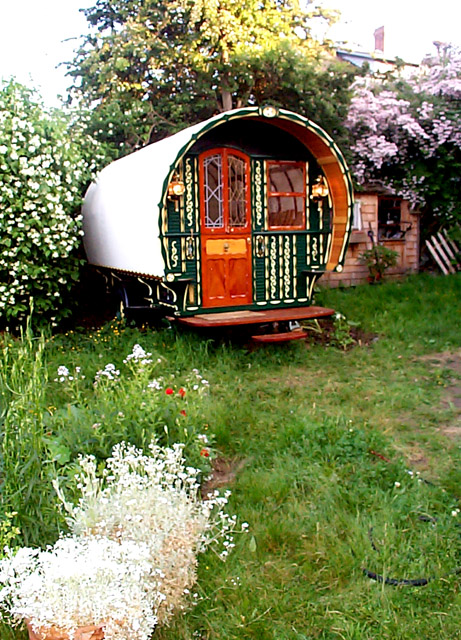
So he explored new avenues of woodworking. This included green woodworking, and building pitchforks and chairs with his friend, Dave Sawyer. “And then I got into this whole notion of building small boats,” he says. “I did a couple small boats and then I got into gypsy wagons.”
Yes. Gypsy wagons.
“That was a real challenge,” Jim says. “I didn’t have plans for building gypsy wagons. I did have some museum drawings but they didn’t show joinery. And I needed to do joinery for something that could travel on the highway. So I kind of did a lot of seat-of-the-pants engineering to build these things.” He built six.
It was during these years that Jim became a prolific writer. “I’m writing stuff down as I’m learning it,” he says. “So after I learned something and felt like I really had a handle on it I’d write a book about it. There’s a whole series of books that happened one after another and I slowly migrated from making a living woodworking to making a living writing about woodworking. I was really getting into a balance of journalism and doing the craft itself.”
And Jim loved that balance. He was living out Bud’s wisdom, engaging both his hands and his mind while also doing what he loved — woodworking along with constant learning.
“Most afternoons and evenings I’d be in the shop making stuff, testing things out, testing out some theories about the process,” he says. His mornings, when he says he was “freshest and not antsy,” were devoted to writing. “I was constantly discovering a different way of looking at all these processes and trying to really understand what’s really happening when we use a tool on wood in a certain way. What’s really going on from a physics point of view? And I’d do some analysis about that and experiment with that. I’m not a fast learner, by any means. I had to really experience it. I find that I have to work from my hands to understand something.”
With his books, Jim became a household name among woodworkers. With this fame came the reputation that he was, as he says, an absolutely fantastic woodworker. “I’m an OK woodworker,” Jim says. “I do pretty good woodworking.” But, he says, he’d never consider himself a fine woodworker, one who builds studio furniture. “I just basically became a good woodworker that does good stuff.” (I tell him he’s being humble.)
He admits to being a good teacher — it’s his passion. But he finds it interesting that people confuse the prolific writing he does with this idea that he’s an exceptional woodworker. “I’m much more interested in the process, in teaching the process than I am the product.”
He has no attachment to the things he makes, which likely stems from 25 years of cabinetmaking and spending a month on a project only to sell it to a client and never see it again. His joy, he says, came from the process of making them.
With a number of books under his belt Jim was approached by Tim Lawson at a neighborhood party. Tim thought Port Townsend was the perfect location for a woodworking school. “It’s a very rich learning environment here and there are so many masters of different trades here,” Jim says. “He just approached me and asked me if I’d think about it and I thought about it for about 30 seconds and said, ‘Yeah. Let’s see what we can do.’”
But Jim had one condition. “If I did teach I would only teach the hand tools because I was done with routers and tables saws,” he says. “Well, not exactly table saws but I was absolutely done with routers and power sanders. I gave them all away. I’d be happy to never see one for the rest of my life.”
For Jim this was a circling back to his time as a boat builder, which required lots of hand fitting with planes and chisels. This also meant a return to another love: learning. “I returned myself to studying and practicing and really developing my hand tool skills,” he says. And he now firmly believes that machines aren’t able to teach the same things as hand tools — an intimate connection with the wood is essential. “And for selfish reasons I just didn’t want to be around students and power tools,” he says. “They scare me, the tools scare me to death.”
Jim and Tim teamed up with John Marckworth, and the three founded the Port Townsend School of Woodworking. It officially opened its doors March 8, 2008. Today the school is considered to be one of the finest in the country.
In many ways, Jim has lived several lifetimes but his story, of course, doesn’t end here. About five years ago he attended a lecture about proportional systems and the influence of Grecian architecture in furniture at a Woodworking in America conference given by George Walker, a man he’d never met. And George attended Jim’s lecture on how our bodies inform the form and function of furniture, having never met. At the end of each lecture, Jim and George were asking each other questions the other had never considered. “And basically, we’ve been talking ever since,” Jim says. “He can’t shut up about it. Neither can I. We find there’s always something to learn about the ancient systems that have been in place for thousands of years about designing furniture and building.”
It was after those lectures, at a bar in Chicago, when Jim said to George, “You’ve got to write a book about this stuff.” George said, “I don’t know how to write a book.” But Jim, of course, did. “We just ended up in full collaboration mode,” Jim says.
The duo has formed their own company, By Hand & Eye, LLC, and occasionally meet up to give talks. Recently they both traveled to Los Angeles to give a 90-minute talk to Google’s design team. (And if you haven’t watched the “By Hand & Eye” animation made by Andrea Love, who also was the illustrator of “By Hound & Eye,” you must. You can see it here.)
These days a typical week in Jim’s life includes continuing program development for the Port Townsend School of Woodworking, working on projects for Lost Art Press, woodworking (the day we spoke he said he was headed over to a friend’s house that afternoon to help plank an 18-foot-long rowboat) as well as what he calls “reality maintenance chores.” He also goes to the school two to three times a week, visiting classes.
Since moving to Port Townsend Jim has remarried. His wife, recently retired, worked as a physician for more than 30 years. He has two grown children from his first marriage and now also has a grown son and a 15-year-old who lives at home.
Home is in uptown Port Townsend, an old Victorian town and one of the only Victorian seaports left in the United States. His house is one of the oldest in town. The design of his shop, which was completed a couple years ago, was informed by the existing house. Jim designed the shop and one of the school’s main instructors, a third-generation carpenter named Abel Isaac Dances, took the lead on it. Several graduates from the school’s foundation course spent a summer working as paid apprentices, and together they built 90 percent of the shop using only hand tools.
The town of Port Townsend is small and fairly quiet, except in the touristy summer months. And, it’s walkable. Jim and his wife can walk to the movie theater or down to the water in about 7 minutes. They visit farmers’ market and grow their own herbs and berries — lots of raspberries. “I feel like I’m living this charmed existence,” he says.
Jim says he can’t imagine ever leaving Port Townsend. It’s home. In the years ahead he expects growth in the woodworking school, with expanded programming. “And I always think that the book I’m working on now is the last book I’m ever going to write, and that was six books ago,” he says, laughing. “If I know I have something worthwhile to say I will probably keep writing.”
And ever the life-long learner, Jim plans to continue the role of student. “There are college courses I want to take online,” he says. “I may go back to college for all I know.” He tells the story of his uncle who, at 100 years old, went back to college to major in American history. “I talked to him when he went back to college, and he said, ‘I’m really cheating, actually.’ And I asked him, ‘Why are you cheating?’ And he said, ‘Well, I’m majoring in American history and I lived through half of that.’ He was a very funny guy. He was an inspiration to me. He had this love of learning his whole life.”
Jim’s love of learning shows up every day in his shop. “This is what happens to me: I’ll be doing something and I’ll just question, Why am I doing that? I was one of those really annoying students that always asked that question. I even asked why one and one equals two, because that made no sense to me. It turns out it’s a good question, by the way, in mathematics.”
Jim says he loves going back and revisiting things he had been taught, but this time with deeper meaning and explanation. “I want to know the intuitive reason why all these things work,” he says. “I mean, how long did it take me to realize why a plane is called a plane? It’s because it makes a plane. I should have known that. I should have known that 35 years ago. As soon as you say that to someone they whack their foreheads. It’s fun. It’s just really fun and that’s why I keep doing it.”
This constant questioning, thinking, experimenting and processing requires intense focus, which is why Jim enjoys working alone. His shop music is lyric-less: classical, Gaelic or electronica.
This intense focus also requires breaks. For fun, Jim enjoys making gliders. “I make wood that flies, basically,” he says. Made out of balsa, most without motors, Jim says they’re simply hand-launched things that play with the wind. It’s a passion that stems from his childhood, when he would make stick-and-tissue model airplanes.
He’s also keen on keeping himself physically fit, which means walking every day with his wife and rowing solo or with one person most every day in the warmer months. He goes to the gym almost every other day for basic conditioning, in order to continue rowing and working with hand tools as he is now. “When I do that stuff I’m not thinking about all the other stuff,” he says. “I’m just enjoying being outside, getting into nature and getting into the physical exertion of my body.”
The paths in Jim’s life have led him to unexpected places, and yet, the destination has always been the same: figuring out a process with his hands, and knowing and understanding it so deeply he can explain it, simply, to others. “I love being in the position of not knowing but maybe going to find out,” he says. He hopes to keep his eyes as wide open as possible, while not taking things personally and observing slowly. He encourages others, particularly longtime woodworkers, to do the same.
“Pass on what you know while you still can,” he says. “There are a lot of people out there who want to know this stuff. If you have an inclination to teach, do it. You’re not more than you think you know, so pass it on.”