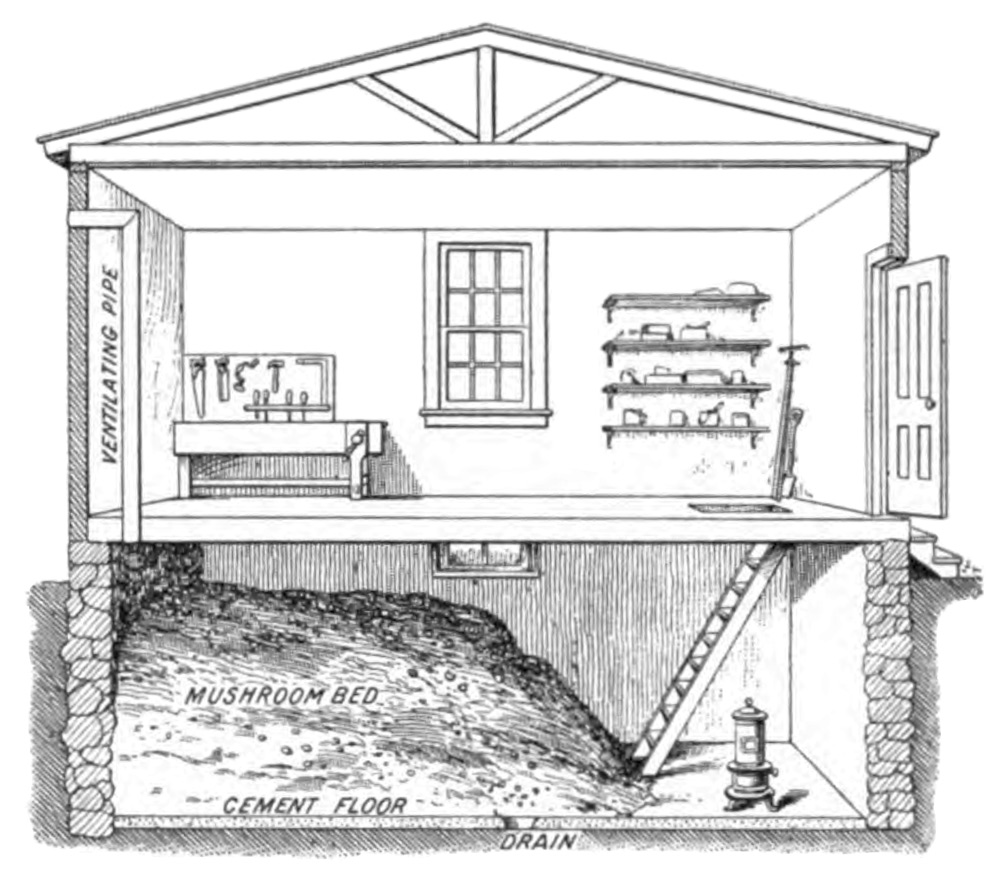
A combination mushroom cellar and workshop is a most useful adjunct to the farm or rural home where it is necessary and desirable to economize in space and material. The growing of mushrooms is quite common today on thousands of small county places, and those very fond of these edibles resort to all sorts of methods to raise sufficient for the home table. The cellar of the ordinary house is not a good place for mushroom culture, and very few barns are provided with a good cellar suitable for the work. (more…)
Sir – I have the honor of being in the receipt of your circular requesting information in relation to the effect which the introduction of the manufacturing of planes, in the prisons at Auburn and Sing-Sing, has had upon our business. In reply to which, it may not be deemed improper to state something of the rise and progress of this branch of business in this country.
At the close of the last war, the manufacture of planes was carried on to a very trifling extent in this country, we being chiefly supplied by those of foreign importation; about which time my father (our predecessor,) established this branch of business in the city of Albany; but the strong prejudice in favor of imported planes rendered it necessary to make very considerable sacrifices, to sustain the establishment of the business during its infancy; and for several years it was carried on with scarcely sufficient profit to cover expenses, and afford a livelihood. But, by patient perseverance, he was at last enabled to compete with planes from abroad, both in price and quality; and having gained an enviable reputation for his American planes, for a few years he was enabled to do a very good business, and gave employment to 20 or 30 hands, at good wages; and he looked forward to a reward for the toil and anxiety he had undergone, in aiding to establish a home manufacture for this important article of merchandise. (more…)
“By Hand & Eye” will ship from our printer on Tuesday, May 21. So if you would like to order the book with free domestic shipping, you should place your order before midnight Tuesday. After Tuesday, domestic shipping will be $7.
“By Hand & Eye” by George R. Walker and Jim Tolpin is $34 and can be ordered here.
We never discount our books, nor do our retailers. So this is the only special offer we will make on this title.
The book will be carried by Lee Valley Tools, Lie-Nielsen Toolworks and Tools for Working Wood. If other retailers agree to carry to title, we will announce it here.
As I mentioned earlier, we will offer 26 copies of “By Hand & Eye” bound in leather for $185 each. We will have details on those copies in June. We also will offer the book in ePub and Kindle format.
I’m sure you’ve heard this: What separates a good woodworker from a great one is his or her ability to hide mistakes.
Which is complete and utter crap in my opinion.
The really fantastic woodworkers I have worked with don’t make many mistakes at all. What they do encounter – like all of us – are times when the material fails. A weak spot in the grain breaks off or a tool encounters something unexpected in the wood.
These problems do require repair, and that is a good skill to have.
While there have been books and articles written about repairing woodwork, I’ve found them lacking. Usually the “mistake” was created by the person writing the article. So it usually requires a simple and straightforward fix.
And that is rare in the world of woodworking.
So here is a real-world repair I had to make last night on the campaign chest I’m building. After about 160 dovetails in the case and drawers, I was assembling the final joint when a corner of one of the tails disintegrated.
The joint was perfect enough. The wood was unexpectedly weak because of a resin pocket in the pine.
The bad news was that the part that crumbled went missing into the shavings. The good news is that I wouldn’t have wanted to use it anyway.
Step. 1. Stabilize the existing wood. I cut away anything that seemed loose or could be crumbled away with my thumb.
Step 2. Make a surface for joinery. Using a chisel, I cut the wounded wood until it was a regular rabbet. I measured the width of the rabbet at both its wide and narrow ends.
Step 3. Make a patch. Using the drawer’s pin board as a template, I drew in the shape of the patch I needed on a piece of scrap pine. Then I sawed out the patch and smoothed the part with a block plane.
Step 4. I glued up the drawer without the patch. Then I glued the patched in place, driving it in with a mallet. Finally I sawed and planed the patch flush. Right before I finish the piece I’ll draw in some grain lines to imitate the pitch – probably with a sharp permanent marker (orange ink).
Two big changes are afoot at Lost Art Press that are worth note.
1. Ty Black, my shop assistant, is moving to Jacksonville, Fla., with his wife and kids. They’ll be setting up shop down there is due time, and I hope that Ty will still be able to contribute to what we do here in the Midwest.
Ty’s been working in my shop three days a week since August and has made himself quite valuable. He volunteered to work here unpaid and could come and go as he pleased. As I never – ever – want to manage any employees, that’s the only arrangement I could bear.
However, I did hire him as a freelancer to work on several Lost Art Press projects. The biggest one – the one I cannot talk about – took him months of scanning and coding. When we announce that project (soon!), you will fully appreciate his skills and his time served here.
2. John Hoffman, my business partner at Lost Art Press, is leaving his day job with the government at the end of May to work full time for Lost Art Press.
I could not be more excited about this.
Though I am frequently the face and the name that goes with Lost Art Press, John is an equal partner in this business. Without his behind-the-scenes work on the business, Lost Art Press would still be puny. As it stands, we are growing fast enough to support our families and continue to publish four titles (or more) a year.
While I am sad to see Ty move (who will eat at Eli’s with me?), I cannot overstate how important it is that John is going to be working on Lost Art Press all day, every day.