We’re delighted our 24″ Joiner’s Rules got a mention in the April 2026 issue of Fine Woodworking magazine – thank you, FWW editorial staff!
We’re also happy that our brass-bound Joiner’s Rules are now back in stock for the first time since the holidays. All of us have pitched in over the last few days to scribe and ink the lines that help your eyes more easily see quarters and eighths. (And, er, one lucky person will get the special one I stamped yesterday with the Crucible logo between 10″ and 11, instead of our usual spot between 11″ and 12″. It’s sure to be a collector’s item!)
Also, Sunday is the last day to order for Christmas delivery.
We just released our Big Protractors in 1/8” Baltic birch and lowered the price to $45. They’re still made in the USA – they’re just less expensive and made of wood instead of plastic.
For years we used Trolase, a quality plastic product, for our Big Protractos and Bevel Monkeys. Trolase is good stuff, but we are eliminating as much plastic as possible from our products. And in this case, we were able to lower the price as well.
The Big Protractor is based on the oversized protractors that geometry teachers used to draw out things on the blackboard. I picked up one of these old tools years ago and was immediately struck by how useful it is for woodworking.
Because of its size, it is far more accurate than the tiny plastic protractors. With the little protractors, you can barely infer 1/2° when working. With the big protractors, it’s child’s play to infer down to 1/4° or less. And when it comes to designing chairs, a fraction of a degree makes a noticeable difference in a 20”-long chair leg or a 26”-long spindle.
I’ve long been interested in fish glues since reading about them in A.J. Roubo’s “l’Art du menuisier” from the 18th century. After two years of testing fish glue in our shop, we have decided to begin selling it.
Fish Stick Glue is a reversible adhesive with a long open time. It is ideal for complex assemblies and furniture that deserves to be repaired in the future.
Made from the skins of cod, Fish Stick flows nicely at room temperature, much like PVA. It has a long open time of 90 minutes, and it cleans up easily with hot water, even after it has dried.
It’s a little different than our liquid hide glue, Piggly No Wiggly. Here are the important differences.
Fish Stick Glue has a longer open time (about 90 minutes) compared to Piggly No Wiggly (about 20 minutes). We find that Fish Stick Glue needs more clamp time (about 12 hours) compared to Piggly No Wiggly (about four hours).
Fish Stick Glue doesn’t require heating before use, while Piggly No Wiggly needs a little gentle heat to flow nicely.
Fish Stick Glue is more easily reversible than Piggly No Wiggly, and it also is a little less water resistant.
Fish Stick Glue contains a bactericide, which makes it resistant to attack by microorganisms. The bactericide is an irritant, so the glue should not be swallowed. Piggly No Wiggly is made from only food-grade gelatin (from pigs), salt and water.
Both glues dry colorless and basically transparent. And both glues are made from by-products from the food industry that would otherwise be thrown away.
Finally, Fish Stick Glue is more expensive to make, so the price is a little higher.
Like all animal-based glues, you can expect Fish Stick to last at least a year in the bottle. If you keep it sealed in a cool, dry place, it will last much longer. It doesn’t smell like fish. Because of the bactericide, it smells a bit… minty. But I don’t think any mint plants were harmed in the making of the glue (can’t say that about the cods, however).
Fish Stick comes in 8-ounce bottles. Purchase two or three bottles, and you’ll receive a small discount. Made in Canada. Bottled in Covington. Product name by Megan Fitzpatrick.
— Christopher Schwarz
P.S. We have a small number of pinch rods in the store. More arrive tomorrow and Monday (in case we run out).
We just received new stock of the Bowen’s book, and it was charged a tariff.
First the good news: Tariffs aren’t yet affecting Lost Art Press books. We print entirely in the United States. But some of the raw materials, including some of the papers we use, come from Canada. We follow the issue closely, and our books might not see any price increases.
The bad news: metal prices are on the rise because of the tariffs. And the only book we import, “The Welsh Stick Chair: A Visual Record” by Tim and Betsan Bowen was just walloped by a tariff. We had to raise the price significantly.
This is a great book, and I hope we can carry it going forward. But no promises.
We just got the first batch of Crucible Curved Card Scrapers in from the machine shop. These have been out of stock for far too long. I bought the steel before all the tariffs went into effect, so the price is the same ($25). I have no idea what will happen to the price with the next batch (some steel components have doubled in price in the last month).
So buy them now while they are this price.
Finally, we have also restocked on “Doormaking and Window-Making.” There is no price change for this Michigan-printed book.
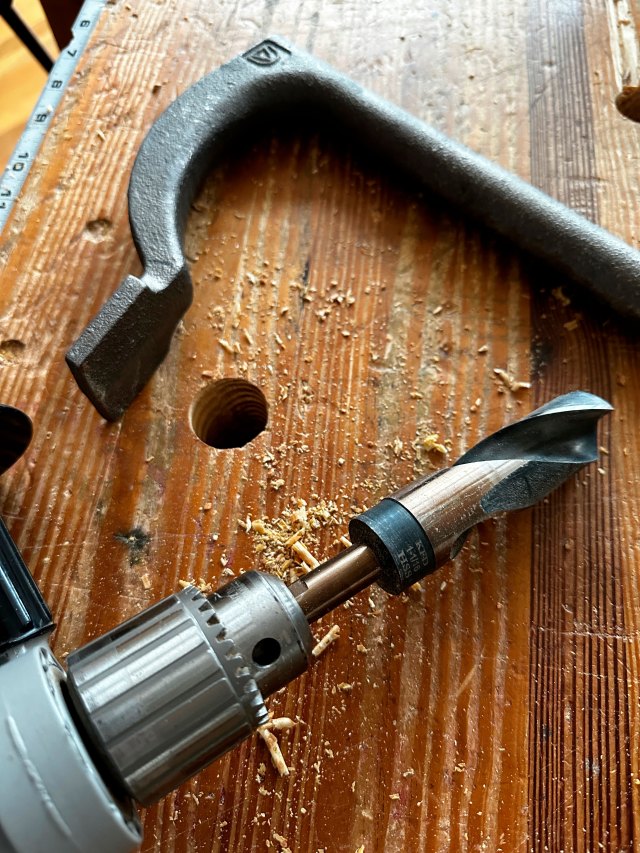
You can open up your holdfast holes a tad with a slightly oversized bit.
After a few years of drying, my workbench’s benchtop shrank a bit. It’s not a big deal, but the drying process also shrank my 1” holdfast holes. And with a few of the holes it became difficult to insert the holdfast’s shaft.
There are a few ways to open up the holes a bit. Reaming them out with a 1″ drill bit and “wallering a tad” works, but it can take some effort to get the middle section of the hole to size.
A second expensive-but-precise method is to use a tool called a “bridge reamer” or “car reamer.” These construction tools have a slight taper and are used to correct misaligned holes in steel construction and the like. These cost $100 or more, which is a lot for a single task.
The third option is to buy an inexpensive 1-1/16” drill bit such as this one. Before running this drill bit into your holes, I recommend you open up the top rim of the hole with a rasp so the bit won’t tear up your benchtop’s surface.
For drilling, use a corded drill with a side handle, especially if your benchtop is made of a hard wood. Yellow pine is especially tricky because of the differences in density between the earlywood and latewood. Take your time, don’t rush and you’ll get through it.
Holdfasts work best where there is a close fit between the shaft and the hole, so don’t over-do it.