I just finished up a stick chair inspired by old Welsh ones I study. This chair’s stretchers are particularly low and oval in cross section. The armbow is rounded throughout (using spokeshaves) and features elliptical coves on the ends of its shoe. Plus the stick arrangement is quite Welsh, with negative space between the short sticks and the long ones.
The chair is suited for lounging, with a slouchy 22° lean to the back sticks and a seat that’s tilted an additional 5° back. The comb is positioned just 10-3/4” above the arm to support the sitter’s shoulders as they lean into the back.
The chair’s seat and arm are red elm, which resists splitting, with the rest of the chair in straight-grained red oak, which is flexible and strong. All the joints are assembled with hide glue, which we make here, and are wedged for durability.
Slightly proud and burnished tenons.
The chair is finished with a soft wax (also made here). It offers a low luster and looks better the more you use the chair. The finish isn’t terribly durable, but it is easily repaired (just add more soft wax). The front legs have painted “socks” on the feet. This is a traditional touch that protects the feet from scuffs and knocks (and looks good).
Compact and comfortable.
How to Buy the Chair
The chair is $1,700. That price includes shipping and crating to anywhere in the lower 48. If you wish to buy the chair, send an email to [email protected] before 3 p.m. (Eastern) on Friday, May 16. Please use the subject line: “Elm chair.” In the email please include your:
U.S. shipping address
Daytime phone number (this is for the trucking quote only)
If you are the “winner,” the chair will be shipped to your door. The price includes the crate and all shipping charges. Alternatively, the chair can be picked up at our storefront. (I’m sorry but the chair cannot be shipped outside the U.S.)
My chairmaking efforts have been slowed this year by writing projects (“Build a Chair from Bulls%$t” and the revised edition of “The Anarchist’s Tool Chest”). But coming up I have a low Irish chair and a new chair design that is struggling to be born.
The spruce soundboard of the harpsichord built by John Brown, with wildflowers painted by Richard Platt.
Most of the readers on this blog know John Brown as a chairmaker and writer. But as I have gotten to know his family and friends, I’ve learned he was much more. I knew JB was a boatbuilder, and his cuttyhunks still fetch good money. He was also a jet pilot, a fine art painter and a man of letters. But I didn’t know that he ever built musical instruments. One of JB’s sons has to part with a harpsichord made by the late John Brown. If you are interested in Baroque-era instruments, please read on.
— Christopher Schwarz
Here’s a unique opportunity to own a harpsichord made by the great John Brown, decorated with British wildflowers by renowned artist and musicologist Richard Swaby Platt, a great friend of JB. Though JB was of course best known as a chairmaker, magazine columnist and author of the seminal book “Welsh Stick Chairs,” he built other things, too – including this Flemish-style harpsichord, which started out as a kit from harpsichord revolutionary Wolfgang Zuckermann (though JB made it his own).
The instrument is currently owned by JB’s son Ieuan Einion, a writer and musician who lives in France. “I don’t really want to part with it because of its sentimental value to me but I’m running out of space (it is one of seven keyboard instruments I have, including three harpsichords),” writes Ieuan. “I would be happy for it to go to someone who appreciated JB’s work and philosophy, and wanted part of his history; a serious musician who wanted a light, easily transportable instrument might be better advised to look elsewhere.”
I asked Ieuan to describe the instrument, as I know little about this form. “JB’s harpsichord was built from the kit that WZ produced after his move to England, not using the sides provided by Zuckermann, but replacing them with solid teak on the straight sides (15m thick) and laminated teak on the bent side (2 X 7mm glued). This has the effect of turning an Italian harpsichord into more like a Flemish one,” he writes. “Italian harpsichords were extremely light and were fitted into a heavier outside case from which they could be removed. The single most important development in Flemish instruments was that the soundboard was joined to the outer case.”
The teak, which had been destined for high-end boatbuilding, adds some heft; the JB harpsichord weighs 40-45kg, Ieuan estimates. It is 86 cm wide, 22 cm deep and 190 cm long.
“There are 54 keys BB – e” – with brown naturals (cherry?) and black accidentals (ebony or grenadilla?). It has two sets of strings (referred to as 2 x 8′), which can be engaged independently or together, and a lute stop. It can be tuned to A = 415 hz or A = 440 hz.”
“Zuckermann’s great achievement was making a hitherto specialist instrument into a project achievable by the home builder, which is probably what attracted JB to it, accompanied by his love of baroque music,” writes Ieuan. “We played one of JB’s favourite works, the Telemann viola concerto with the family band at his memorial event in 2008.
“The JB harpsichord has not been played since the 1990s and will require a good service from someone who knows what they’re doing, mostly fine tuning and replacing where necessary the plectra, checking the dampers etc (maybe two-three days work for someone who knows what they’re doing).”
Ieuan is asking U.S.$20,000. Interested parties, please click here to send him an email.
Editor’s note: Last month we launched our Mind Upon Mind series, a nod to a 1937 Chips from the Chisel column (also featured in “Honest Labour: The Charles H. Hayward Years”), in which Hayward wrote, “The influence of mind upon mind is extraordinary.” The idea being there’s often room for improvement. (You can read the entire Chips from the Chisel column here.)
To that end, we asked you: What else have you thought of, tried out and improved upon?
We’ve received some great submissions from LAP readers who have built projects from our books and had ideas on improving the design, construction or finishing of a project.
Here’s one of our favorites, from John R. Brauer in Lisle, Illinois.
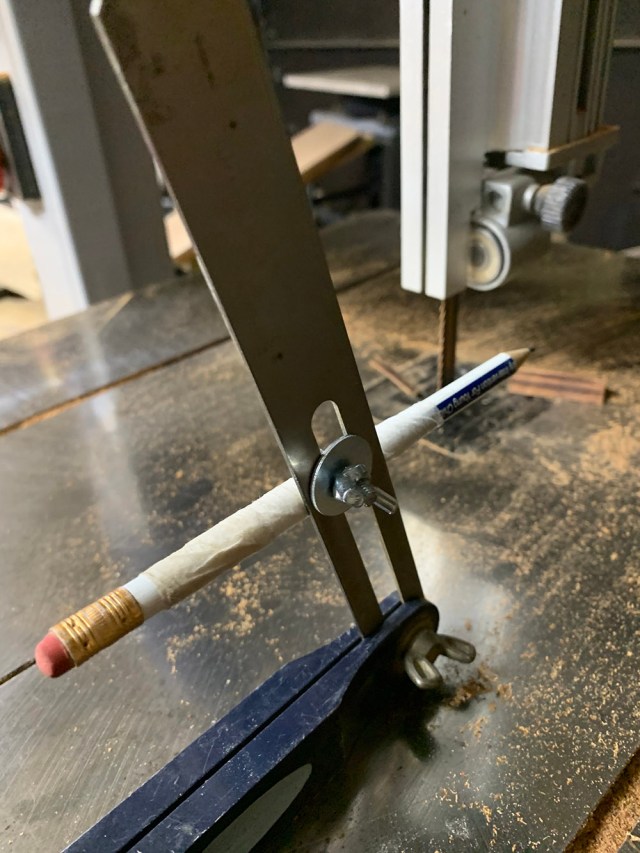
Leveling Legs
I don’t have the budget for a Fat Boy scribing tool, but I have a sliding bevel. I bent a machine bolt, cut the head off and used a wing nut to attach a pencil (wrapped with paper tape for friction). Adjust to height and tighten.
Do you have a clever idea for an improvement? Email [email protected]. You can read more about the submission process here.
Signed by the author, Christopher Schwarz. The first 500 customers get a free merit badge.
Our latest book.
The latest book from Lost Art Press shows you how to build a comfortable and sturdy chair using only materials and tools from the home center. No jigs. No specialty tools. Literally anyone can do it.
If that’s all you need to know, you can buy the book in our store here. It’s $21 and is made in the USA. (Or you can buy the complete set of our pocket-sized books – including this one – at a special price here.)
One of the seven chairs I built while writing the book.
Still unsure? Here’s how we did it. The chair’s legs are made from hickory tool handles. The spindles are 5/8” dowels. The arm is plywood and the seat and backrest are construction pine. Most of the cutting is done with a jigsaw or small tabletop band saw. All the mortises are made with a drill and home-center bits.
What about all the compound angles? Isn’t that difficult? Nope. We developed a way to drill all the mortises for the sticks with ease. You just clamp the arm and seat together like a sandwich and drill the mortises according to the patterns. (You can download free full-size patterns for the chair via this link.)
“Build a Chair from Bulls%$t” is short – just 112 pages, written by me and fully illustrated by Keith Mitchell. You can read the book in just a few hours.
The first 500 customers receive a free merit badge.
If you are intimidated by chairmaking, the materials or the tools, “Build a Chair from Bulls%$t” will remove any doubts, fears or excuses. And what if you can’t afford the $21 to buy the book? No problem. You can download the entire book for free here. (Don’t worry. You won’t have to register or give up your email. Just click and the book will download to your device.)
The physical book is nicely printed in the USA and is worth owning. “Build a Chair from Bulls%$t” is one of our “pocket books” – inexpensive but well-made books. It measures 4″ x 6.5″. The text is printed on #70 matte-coated paper (acid free). The book’s pages are gathered into signatures and then sewn together – a step few publishers bother with today. The book block is then glued and reinforced with fiber tape and covered with heavy cloth-covered boards. This is a permanent library-grade book – designed to last a couple centuries.
In a space of just 10” x 39” x 19-1/2”, H.O. Studley managed to arrange – with perfection – more than 250 of his tools into a dovetailed mahogany cabinet that has captivated tens of thousands of woodworkers since it was first unveiled in 1988 on the back cover of Fine Woodworking with a single shocking photograph.
After a brief stay at the Smithsonian, the cabinet was sold to a private collector and hadn’t been seen by the public for well over a decade. Studley’s workbench has never been on public view.
This book is an in-depth examination of one of the most beautiful woodworking tool chests ever constructed and presents the first-ever biography of Studley (1838-1925), a piano and organ builder in Quincy, Mass. It features measurements, details and photographs of all the tools in the cabinet. Every swinging frame, hinged panel and nook of this three-dimensional, multi-layered sculpture has been analyzed so you can understand how it folds in on itself like a giant piece of mahogany origami.
But most of all, you will see the cabinet in a way that only a handful of privileged people ever have. And you will realize that the magazine photograph that electrified the woodworking world in 1988 only scratches the surface of the cabinet’s complete magnificence.
The generation of Hardwicks who were Studley’s contemporaries included three brothers: Charles Henry Hardwick, Sr., Henry Everett Hardwick and Charles Theodore Hardwick. It was these men with whom Studley bought and sold real estate. Again, according to Hardwick family legend, somewhere along the path of these ventures was a loan from one or more of the Hardwick brothers to Henry O. Studley, a loan that was secured with his tool cabinet as collateral. It is unknown whether the loan was part of a specific real estate transaction or simply part of a larger portfolio of activities.
This scenario of the tool ensemble being collateral does make sense at some level. We know these basic facts: Studley was deeply engaged in real estate deals, including many with the Hardwick family; he possessed the tool cabinet preceding his retirement about 1919, as proved by the photographic portrait; about that time his wife had recently died after a lingering and debilitating illness; and Studley’s own health began to fail shortly thereafter. It is not a great leap to wonder if any of these events had financial implications, and the conveyance of the tool cabinet and workbench to the Hardwicks was a consequence of that circumstance.
At first, I arrived at that conclusion because it made sense. However, an examination of the public records surrounding the Stetson and Studley family finances does not support the idea that Studley’s disposal of the tool cabinet and workbench was financially driven. His wife was from a wealthy family, and he had become wealthy himself along with her during their long marriage. A Stetson family deposition from 1940 relating to the disposition of some family assets states that [Mrs. Studley] “died without leaving any estate as she was bedridden for six years prior to her death and had used all her savings for expenses.” This deposition, however, does not align with the facts of Abbie’s will and probate, which lists substantial assets.
Given the probability that Studley’s finances did not force him to relinquish his tool cabinet, an equally plausible possibility, and in fact my own inescapable conclusion, is that it was a simple gift from Studley to Mr. Hardwick as a gesture of friendship and generosity, especially given that Studley was retired from the workshop and that he had presumably prospered through his partnerships with the Hardwicks over many years.
This Hardwick family Christmas card, probably from the 1950s, presents an image of the four-story granite manse that served as home to several generations of the family and was perhaps the starting point for Henry Studley’s career as a skilled craftsman. (Image courtesy of Peter Hardwick)
There is of course at this point no way to know the circumstances of the transaction and transfer; there is no known documentary evidence for the change in ownership. Still, it makes for some fascinating contemplation to consider the series of events at the end of Studley’s life that led him to part with this treasure, an inspired product of his own genius and hands.
Whatever the cause, the responsibility for custody and care of the tool cabinet and workbench now rested with the Hardwicks. Were it not for this caprice, the Hardwicks might be best known for their granite quarry and a scandalous murder that occurred there on July 29, 1910. In this sensational crime, Henry E. Hardwick and Mrs. Marianna Restelli, among others, were killed by her son, a quarryman/stone cutter named Luigi (Louis) Restelli. The relationship between Mr. Hardwick and Mrs. Restelli is unknown, and their simultaneous murder may be entirely coincidental.
Luigi Restelli was known to associate with an anarchist cell in Quincy, and a contemporaneous account in The New York Times suggests that the Quincy cell was under instructions from anarchist headquarters in Barre, Vt., to “kill rich people.” Numerous contemporaneous sources affirm the same account. The consensus for the motive behind the attacks seems to be “Madness” brought on by debt, and Restelli’s body was found in a nearby quarry pit following his suicide.
Interestingly, those infamous events are the first solid reference for anything dealing even remotely with the provenance of the tool cabinet ensemble. Yet those events have nothing to do directly with Studley or his cabinet, and tell us nothing new about the circumstances of its creation, the particulars by which it changed hands, nor even why it changed hands. But the events of that fateful day did cast the die for the chain of custody of the cabinet to this very day. Again, we do not know precisely when nor why it came into the Hardwicks’ possession, but we know where it went from then on.
With the murder of Henry Everett Hardwick, his son Charles Henry Hardwick (the first), a bachelor, inherited the family fortune and assets. This fortune eventually included the tool cabinet and workbench.
The detail of Charles Henry Hardwick’s bachelor status is critical to the story. It meant that on his death the progression of the family properties moved into the lineage of his brother Robert A. Hardwick, then down through Robert’s only son Charles Henry Hardwick II, Peter’s father, and then to Charles Henry “Hank” Hardwick III, Peter’s older brother. Hank was the family heir as the oldest son of his generation, and so inherited everything including the Studley tool cabinet. The final Hardwick steward of the tool cabinet was Charles Henry Hardwick II’s younger son Peter (thus not a primary heir), who owned it from the 1970s into the end of the 1990s.
Peter’s father, Charles Henry Hardwick II, died tragically and unexpectedly at the age of 44, predeceasing his own father.
Peter Hardwick’s earliest memories of the tool cabinet were in the 1950s when he was visiting his great-grandfather’s giant stone house in Quincy. The tool chest was displayed in the second-floor hallway next to the law office of his great uncle Charles, the older, bachelor brother of Peter’s grandfather Robert. The tool chest was protected behind a plastic panel. There it remained throughout Peter’s youth, adolescence and early adulthood, and in profound understatement he says, “It was very interesting to a little boy.”
Peter also recalls the workbench first being used as a table in the “stable-boy’s quarters above the garage” in Quincy and then the base alone used as an elegant dressing table in the mansion without the slab workbench top attached.
The Family Moves to Maine Peter joined the military in the 1960s, went to Vietnam and, “A lot happened [with family activities] during that time.” During Peter’s military service, his grandfather Robert and brother Hank sold the big house in Quincy and moved to property the family owned in Maine. They took everything from the Quincy house to Maine, including the tool cabinet and workbench, plus as much of the fine Studley handiwork from the granite house as they could move, including a number of fireplace surrounds. Two of those wound up in the farmhouse where Peter lives; the remaining examples were installed in grandfather Robert’s nearby house.
Unfortunately the space inside Peter Hardwick’s house is not conducive to an overall image of this magnificent Studley-made architectural detail. The lower portion is included in Sandor Nagyszalanczy’s original image of the cabinet. The image was edited for clarity and privacy.
Peter returned from the military and moved to Maine about 1970 where he worked on the family farm. The three men, Peter, Robert and Hank, lived on adjacent family properties in Maine.
When Peter’s grandfather Robert died in 1976, “Hank,” Peter’s older brother by three years, inherited the family properties and possessions, including the tool chest and workbench. Hank’s interests lay in other directions so the tool cabinet and workbench remained in storage in a family barn. All the while, Peter never forgot the captivating collection he remembered as a boy visiting his great-uncle’s law offices in the family home in Quincy.
Once the collection passed to the ownership of his brother, Peter urged him to “take care” and preserve the tool cabinet and contents. In the early 1970s Peter offered to purchase the tool cabinet and related accouterments, including the workbench, and as part of the transaction the brothers retained an antiques dealer to appraise it. The dealer pronounced the tool cabinet and its contents as “something special” and appraised it at $500.
Always (and still) a car buff, Peter owned a pristine 1934 Ford four-door sedan that was dark blue with low original mileage. Fortunately for our story, Hank was very much interested in the car and a deal was struck between thetwo brothers. Peter promptly made the trade and took possession of the tool cabinet and displayed it in his parlor for more than a decade.
The only place Peter Hardwick had where the tool cabinet could be displayed was inside his unused fireplace surround in the cottage parlor. Appropriately, the surround was some of Studley’s handiwork from the Quincy house. (Photo courtesy of Sandor Nagyszalanczy)
The Fan Frenzy Begins In the late 1980s Peter installed a new chimney in his home, and, in doing what guys do on such a momentous occasion, invited a friend over to show off his newly completed project. This friend, an insurance agent, saw the tool cabinet, recognized its special-ness and encouraged Peter to insure it. This event, Peter said, “Opened a can of worms!”
Peter tried to figure out exactly what it was that he had and how much to insure it for, and so he turned to Fine Woodworking, the Smithsonian and an antiques appraiser for answers. At Fine Woodworking magazine, Senior Editor Sandor Nagyszalanczy took the call and carries the memories vividly.
In early 1988, Nagyszalanczy made arrangements to go visit it during another scouting trip to Maine. When he opened the chest, it was, and I am quoting him, “Jaw dropping to floor!” He set up to take the photographs that eventually entered directly into our collective consciousnesses via the backcover of that magazine.
At that moment, Peter’s life of stewardship of the tool cabinet changed forever. In an age before e-mail, the result of that single back-cover image – and the ensuing posters – was an onslaught of actual “fan mail” for the tool cabinet that overwhelmed him. He received so much mail that he rented a dedicated post office box just for the unsolicited correspondence being forwarded to him by Fine Woodworking. Peter’s only regret from this period was that he did not save the fan mail.
The Smithsonian One of the correspondents was the Smithsonian Institution’s National Museum of American History Curator David Shayt. While on vacation, Shayt visited Peter and they struck up a fast friendship based initially on their mutual interest in the tool collection, but it soon evolved to reflect the fact that both men were affable and genuinely good guys.
At the time, Peter had a dilemma. He owned a family heirloom that was also a monumental piece of Americana, and he was concerned about its security and preservation in a simple Maine farmhouse. Shayt proposed a temporary solution. What if Peter loaned the tool cabinet to the Smithsonian for a 10-year period, during which the Smithsonian would bear all the responsibility for it? Once again, Peter reached an agreement to foster the care and preservation of a genuine national treasure, a theme that has touched him throughout his life.
While at the Institution the cabinet was conserved and exhaustively documented, and included in a small vignette adjacent to the exhibit “Engines of Change: The American Industrial Revolution 1790-1860,” with several other tool chests and cabinets for various trades. Though the larger exhibit lasted almost 20 years (late 1986 to mid-2006), the Studley tool cabinet was included for perhaps only a third of that time, probably from about 1992-1999. No doubt seen by thousands of woodworkers there, the Internet has numerous accounts of woodworkers who were captivated by it. I spoke recently with one visitor, a woodworker, who recalls it “being displayed a long way back from the glass, and in the dark.”
During the time of the Smithsonian possession, the collection was photographed and documented, and underwent a thorough cleaning and some conservation treatment, as well as being included in the small exhibit. Meanwhile, the torrent of fan mail kept coming, becoming even more of an avalanche with the issuing of the poster, then a Fine Woodworking article, a second edition of a poster and finally a third. The maelstrom of mail led Peter to reconsider his continued ownership of the collection.
And it was one of those letters that again changed the course of the Studley tool cabinet’s history.
Enter Mister Stewart Among those letters Peter received in the late 1990s was a polite and understated letter from Mister Stewart that expressed admiration for and interest inthe tool cabinet. After subsequent correspondence and conversations, Peter decided that Mister Stewart was the right person to become the new ownerand caretaker for the treasure.