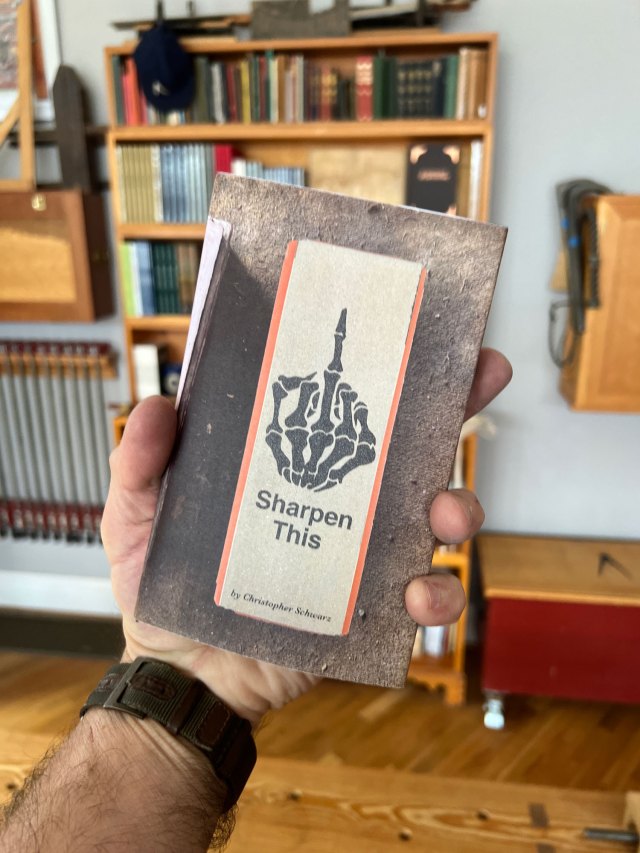
Had we used that image, which I adore, we would have faced complaints from some readers, and I suspect the image would have prevented some people from buying the book. As the book is supposed to remove your barriers to sharpening, an off-putting cover seemed a bad idea.
Or maybe I’m just a wuss.
In any case, Chair Chatter Rudy Everts suggested we offer a free downloadable dust jacket for the book that used the 2017 image. And so I made one today. It prints on 11” x 17” paper, which is easily found in most photocopiers. Or you can take it to your local print shop to print it out.
Then you just have to cut it out and wrap it around the book’s hardcover boards. And then – instantly – problem solved. Mischief achieved. And all that.
Another Video Tip
I am working on a few videos that will advertise the book and offer up some of the hard-earned sharpening knowledge and time-saving techniques I’ve learned through the years. You can see the latest video above.
I don’t spray finishes enough to feel confident doing it – that is especially true for “complicated” work such as stick chairs (not so complicated to make, but sort of complicated to paint, because there are many surfaces to be coated). I’ll bet I’m not the only one. So, I grabbed my camera as Christopher Schwarz got ready to spray the final coat on his most recent chair and shot the video below. It’s a bit of a dance, moving fluidly around the project… so apologies for the brief moments of Chris’ backside blocking the view.
The legs got good coverage on the first two coats (one coat with the chair flipped upside down, the next with it right-side up), which is why they’re skipped on this go-round. But the general order of operations is to spray all vertical surfaces (legs and sticks) with the fan pattern horizontal, then the horizontal surfaces with the spray pattern vertical.
A few additional notes:
• The paint is Tuscan Red General Finishes Milk Paint (which is actually an acrylic), thinned about 10 percent with water.
• The spray setup is the Apollo Sprayers HVLP ECO-5 5-Stage Turbine system.
• The picture above is the chair shown in the video, but with the addition of a coat of buffed Liberon Black Bison Wax in the color Dark Oak.
• Our spray booth is also the back patio/bier garden/barbecue area/catio. So, we don’t spray when it’s really humid, too hot, too cold, or raining/snowing. And we almost always bring the work inside immediately after spraying, so that it can dry in a controlled environment.
After Nancy Hiller’s death on Monday and the outpouring of grief, tributes and love from her friends, family and fans, I didn’t know if there was anything left to say about this remarkable woman. But I am willing to find out.
First, what you must know is that everything you’ve already read is true. Nancy was a true trailblazer. And her work will continue as an inspiration for woodworkers in general, and women in particular, for years to come.
My relationship with Nancy was a little different than most people’s. I was a fan, of course. But we were also business partners on three of her books: “Making Things Work,” “Kitchen Think” and “Shop Tails.” And so I got to see how she thought about her place in the woodworking world, including places she didn’t want to go.
As we were finishing up the Lost Art Press edition of “Making Things Work” (she published it first under her own imprint), she said she wanted to change the book’s dust jacket. The edition she printed had a tasteful arrangement of hand tools on the cover. She told me it was an homage to Peter Korn’s book “Why We Make Things and Why it Matters.”
Korn, however, didn’t take the compliment in kind. And he told me at a Lie-Nielsen Toolworks event that Nancy should change her book’s cover.
For those who knew Nancy, this misunderstanding was typical of her complex mind. Even if Nancy was making a statement by comparing her book (and work) to Korn’s book (and work), it came from a place of deep respect. If she commented on your work, it was because it was good in some important way. Or it was strong enough to elicit a serious and well-considered reaction. (If your work was uninteresting, she would just be polite.)
Nancy’s attention was never binary (i.e. I like you, or I don’t). Instead, when she talked about woodworkers she disagreed with, her words were chosen with care. She could love your work or (fill in the blank here) but dislike your (fill in the blank here). And if Nancy liked you, she never let you forget that.
Naturally, someone this wildly intelligent and honest was intensely interesting to others.
For me, what was interesting was trying to piece together what she thought of herself. After we got to know one another, Nancy asked for a high-resolution scan of a French postcard I had published on the blog. It was a photo of Juliette Caron, the first female compagnon carpenter in France. Caron, born in 1882, was such an unusual sight that people would show up on job sites just to watch her work. And there was a series of postcards printed up that showed her working: carrying a wooden beam up a ladder, using an enormous auger and carrying a bisaiguë like a Jedi knight.
We don’t know what Caron thought of her fame. But when I look at the postcards of Caron that I own, I suspect she didn’t give a damn about it.
Nancy thanked me for the image of Caron, printed it out and framed it for her shop’s bathroom. I didn’t give it much thought until years later when we began discussing how to promote her books.
Nancy was traditionally trained as a woodworker in England and received City & Guilds certificates as a result of her training. This certification is helpful in getting a job in a workshop in the U.K. In the United States the certification is solid fried gold marketing fodder.
American readers *love* a woodworker with Old World bona fides. America never had much of an apprentice system for furniture makers, so most of us train informally or are self-taught. So when someone whips out formal certificates of this or that, those papers are almost more important than the person’s work at the bench.
Nancy refused – flatly – to build her career off her training. I repeatedly tried to get her to discuss it. Or allow us to use it when marketing her work. She would have none of it.
She wanted to be judged by her work.
And that’s when I made the connection between Nancy and Juliette.
As an editor, her attitude was frustrating because I thought we could sell more books. But you learned to be frustrated when working with Nancy. And you even came to enjoy it.
When you worked with Nancy, she would do anything and everything to ensure that she was doing her part in the relationship. When I designed her “Kitchen Think” book, I would send her chapters for review at odd hours. Sunday. Maybe at 2 a.m. Maybe three chapters in a day.
It’s how I work. I always get consumed by the project at hand, and I work until I drop. But I don’t expect authors to respond in kind.
Nancy was the only author who has ever kept up with my stupid pace. And, in the case of “Kitchen Think,” she just about wore me out with her detailed notes and suggestions about layout, color and the way I was processing the photos in the book.
Her work ethic was, especially at the end, heartbreaking.
Her book “Shop Tails” has been a slow seller. From the outset, I knew it would be. But I also knew it would be a brilliant work, and so we threw ourselves into the tumultuous editor/writer/designer/publisher storm to get the book done before cancer was done with her.
And we succeeded. But after the first sales numbers for the book came in, Nancy called me, unannounced.
“I think we should do ‘Shop Tails’ as an audio book.”
“Well, OK,” I replied. “I’ll look into finding someone who can read the book for the recording.”
“No,” she said. “I’ll read it.”
I put up a little bit of a fight. “You are finishing chemo for a deadly cancer. Are you sure?” But I knew I would lose the skirmish. She said she would start looking for a studio to do the recording. Or she would figure out how to do the recording at her house.
Within a week, Nancy was behind a microphone where she managed to record hours and hours of emotionally difficult (but hilarious) material. She even recorded a bonus chapter for the audio book.
Juliette making it look easy.
All this wasn’t for Nancy’s ego. It was because she didn’t want Lost Art Press to lose money on her book.
I told her the book would eventually make money. And anyway, that’s not why we published it. We published it because it’s a great book, and the work deserved it.
Nancy would have none of that. She wrote me an email saying she wanted to discuss some ideas she had for finding the book’s audience.
I told her to call anytime.
She didn’t call. And that’s because there was only one thing in this world that could stop her. And it got to her in the early hours of Aug. 29.
Though we all knew Nancy’s death was coming, it still feels like she was ripped from our lives mid-sentence. And that’s because she was.
I think this is how I will set our relationship down here on the table. Just me, waiting for her to call with her latest backbreaking but brilliant scheme to uphold her end of our work together.
I’ve kept her number in the contact list in my phone. Because honestly, if anyone could figure out how to make that call, it’s Nancy.
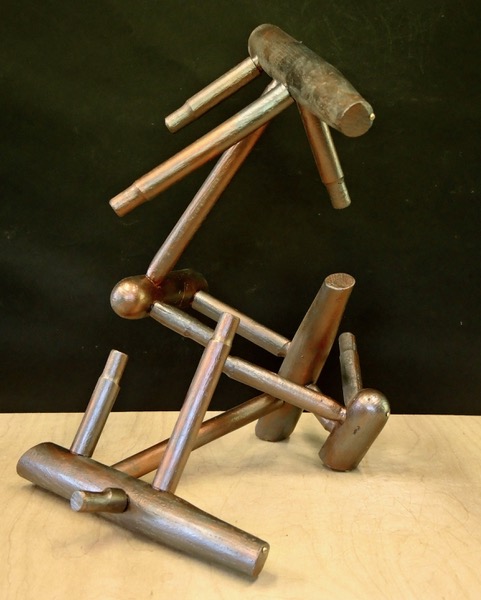
“This Is Not A Chair,” a sculpture exhibit by Drew Langsner, will be display September 30-October 2 at the studio/workshop of Jim Dillon, in Avodale Estates Georgia (just east of Atlanta).
“The 1999 Project”
Before becoming renowned for his country woodcraft, chairmaking and teaching, Langsner (author of “Country Woodcraft: Then & Now,” among other books), earned an MFA in sculpture. Recently, now that retirement from teaching has allowed him more time, Langsner has been sculpting with material ranging from twigs to entire lightning-struck trees. In 2020, he noticed intriguing shapes in wooden chairs – shapes that have nothing to do with the chairs’ function – and began liberating those shapes from old, damaged chairs, combining them into new forms. The result is the work on display in “This Is Not a Chair.”
“Embraceable You”
The exhibit is open Friday, Sep 30. from 5-8 p.m., Saturday, Oct 1. from 10 a.m.- 6 p.m. and Sunday, Oct 2 from 11 a.m.-5 p.m. The studio/shop is located at 2895 Washington St, Avondale Estates, Georgia.
If you order either of these titles before Oct. 1, you will receive a free pdf download of the book(s) at checkout. After Oct. 1, the pdf and book will cost more.
“Euclid’s Door” is Jim and George’s latest exploration of artisan geometry. In this new book they show you how to build a set of highly accurate and beautiful wooden layout tools using simple geometry and common bench tools. This practical application of geometry will train your hands and mind to use this ancient wisdom. And you’ll end up with a fantastic set of useful tools.
After editing all of George and Jim’s books, I thought I had a pretty good handle on the geometry stuff. I was wrong. This book blew my mind a few times with stuff I should have known. (And now I’m glad I do.)
The book is 8.5” x 11” and 120 pages. It is printed in the USA and is built to be a permanent book, with heavy cover boards and a binding that is glued and sewn.
‘Sharpen This’
My latest book, “Sharpen This,” is the book I wish I had when I was learning woodworking. It might have saved me hundreds of dollars of buying sharpening equipment I didn’t need. And saved me time in learning how to grind, hone and polish.
This book is a short and blunt treatise about common bench tools: chisels and planes mostly. (Exotic tools and saws need their own books, really.) It seeks to explain how sharpening really works and what you need to do the job well – and no more.
It is not about one sharpening system. It’s about all of them. It is not trying to sell you some stones or jigs or magic paper. Instead, it is trying to give you the foundational knowledge you need in sharpening so you can make good decisions and – perhaps more importantly – ignore the vast piles of sharpening crap that companies are trying to sell you.
The book is 4” x 6.5” and is 120 pages. The book is printed and bound in the USA using quality materials and a sewn binding. It is designed to last a lifetime. “Sharpen This” is the same trim size as “The Woodworker’s Pocket Book,” and easily fits in the slipcases made by Texas Heritage.