Lately I’ve been thinking that the spirit of Joseph Moxon isn’t so happy with me. Maybe Old Joe – a printer by trade – isn’t happy about being known by moderns as a vise sold at Woodcraft. Or he isn’t happy about being called out for stealing images from André Félibien.
This book was supposed to be out in February 2022. But it suffered every possible delay in the printing process. First a paper shortage. Then the printing plant was shut down due to COVID-19. Then the plant was held hostage by Russian ransomware. Then I honestly believe the pressroom forgot about the book sometime in early May.
When we finally received our printing in June, there was a significant mistake in it. Some of the pages were missing. And so, for the first time ever, we had to pulp (aka recycle) the entire print run. This was a $25,000 mistake.
We have now reprinted the book. And we are reaching out to everyone who bought the defective book to send them a free replacement. Because of all the problems above, I estimate we will break even on this project about the time my grandkids go to college (I don’t have any grandkids; my kids aren’t even married yet).
So if you want a gorgeous, not-entirely-cursed version of this very important woodworking book, order one here. I am still glad we did this book project. Moxon should always be in print. And it should be available as a durable hardcover that will last generations (20th century versions of Moxon are literally falling to pieces because of their cheap glued bindings).
Thanks for your patience with the process.
Hats Are Coming
In happier news, we have a run of so-called “dad hats” in the works that should arrive in two weeks. These are fashion-backward hats. Cotton khaki twill with an adjustable brass buckle. The embroidery is in black thread and is done here in Covington just a few blocks away.
We are also working on a special tool for Christmas. (It’s definitely not a Ouija board.)
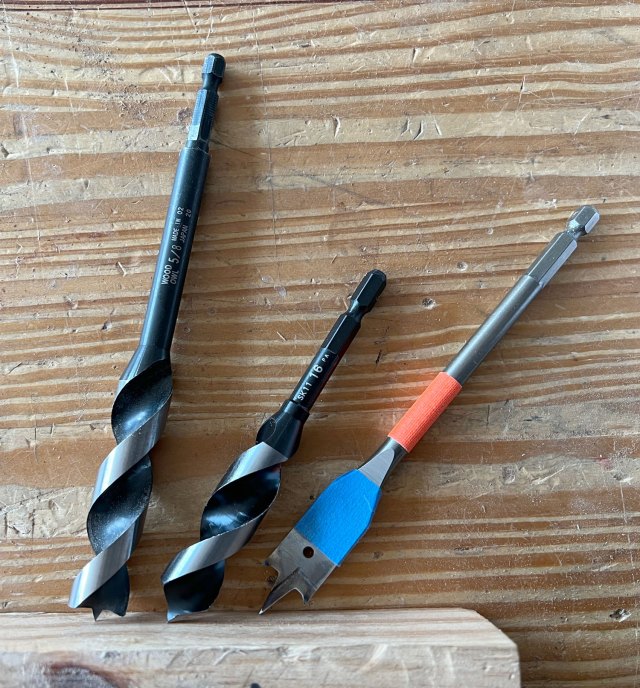
OverDrive bits (left) work for shallow angles. Bits with longer lead points can tilt much more.
One of the most common questions I get is why I don’t use Forstner bits much in chairmaking. The bits are readily available, make flat-bottomed holes and cut cleanly.
The answer is basically this: The Forstner’s lead point is too short*. That means if I want to drill anything other than a shallow angle I need to start the bit nearly vertical then tilt my drill to get to the desired angle. It’s do-able, but it’s easy to over- or under-shoot things.
So most of the bits I use in chairmaking have a long lead point. This long lead point allows me to tilt the bit to the right angle, lock my elbows then drill. Here are the three bits I use the most, with their advantages and disadvantages.
Star-M F-Style bit.
Star-M F-Type Bit, 16mm, by WoodOwl
This is my favorite bit, but good luck finding it. Most reliable sources are regularly sold out. This bit can handle just about any common chairmaking angle. I can tilt up to 30° off vertical if I make a small starter divot with an awl for the bit’s point.
Other advantages: It cuts clean holes without any splintering on the exit side. This makes drilling through the arm and seat a quick and painless operation.
Disadvantages: The side flutes are sharp. So if you move your drill sideways while boring, you will end up with an overly oval hole. The solution is to practice (sanding down the flutes doesn’t seem to help much).
The bit is metric and drills a 0.629”-diameter hole. So you’ll need to adjust your tenon-cutter to get a snug fit.
Finally, the bit seems to dull faster than my other WoodOwl bits. This is a problem with the other two bits discussed below. I get about five chairs out of one of these bits, and I haven’t found a way to sharpen them (yet).
WoodOwl’s OverDrive bit.
WoodOwl OverDrive Bit, 5/8”
This bit is much easier to find than the Star-M. So keep searching. Lots of little suppliers have them in stock. The bit makes a true 5/8” hole (0.625”). And it also leaves a clean exit hole.
So what’s the catch? The lead tip isn’t long, so you are limited in the chair angles you can bore. I can easily bore 11° off vertical. And 14° when I am pushing things (and if I make a small starter divot with an awl for the bit’s point). That range of angles will get you through most dining chairs without too much trouble.
Like the Star-M’s, the side flutes are sharp – so practice makes round. And the bit doesn’t last as long as its big auger cousins from WoodOwl, which seem to last forever.
WoodOwl’s spade bit.
WoodOwl 5/8” Spade Bit
Really, any spade bit will do. The WoodOwl just happens to come sharper than most cheap bits. Another good option is to look for vintage (meaning ye olde 2020) Irwin bits that have the rim cutters. Other people have had luck with Milwaukee and Makita bits. Basically, look for spades that look like the WoodOwls. The bit needs two rim cutters (the little cat ears). The bit’s faces need to be surface ground (otherwise the bit will fail to bore gouda). And the lead point should *not* be a screw. These lead-screw spades are a sin against the Chair Gods.
Spades can handle almost any angle – up to 34° off vertical with ease. They can be resharpened. You can adjust their diameter on a grinder in seconds. They are cheap and plentiful. And they don’t have the side-cutting problems that the two above bits do.
But they blow out the backside like an American tourist after 10 currywursts. So you need to clamp backing blocks below the arm and seat when you make through-mortises.
— Christopher Schwarz
*There are Forstners out there that have a long lead point – usually a replaceable brad-point bit. But they are hard to find. And expensive when you do.
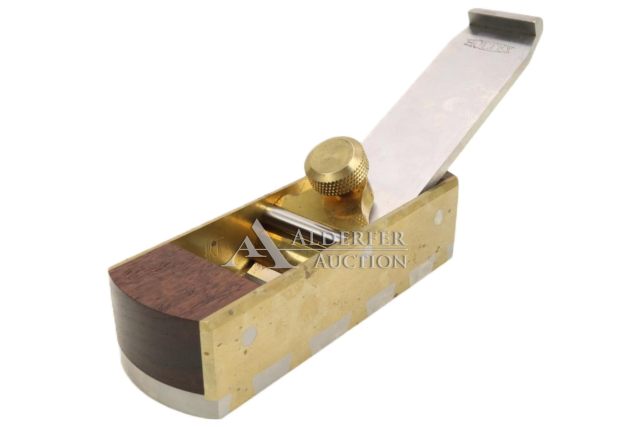
A Wayne Anderson miter plane commissioned by Fred West. Blackwood, damascus steel finish, marked and dated 2011, 11″ sole.
Fred West was a modern-day Medici when it came to hand tools – a true patron of the fine arts, and a driving force behind the hand-tool renaissance of the last two decades. If you were into hand tools before 2014 and attended any woodworking shows, you likely knew Fred – or at least heard him exclaiming over the inherent beauty of a fine tool, or talking about tools with his legion of friends. And if you were a maker of fine hand tools, well, you likely had Fred to thank for helping to keep you in business.
Fred loved using good tools – but he also loved supporting their makers and other users. He’d often buy multiples of new tools (and sometimes commission custom designs), then send them anonymously to woodworkers – mostly to those who couldn’t otherwise afford them – who he thought would appreciate working with them. His only request was that the tools be used.
William Marples Ultimatum Framed Brace, ebony wood and brass, marked, Sheffield, England.
I have two things that remind me of Fred every time I pick them up: a Vesper Tools sliding bevel (which he insisted I accept despite my vehement protestations – I’m terrible at accepting kindnesses), and the Deborah Harkness book “Shadow of Night” – he sent me his copy as soon as he’d finished reading it. (I might have liked talking popular fiction with Fred even more than discussing tools!)
Fred was one of the most gregarious and relentlessly positive people I’ve ever had the good fortune to know. Even when struggling with multiple health problems, he’d travel to hand tool conferences and events to talk tools and support toolmakers, and to hang out with his many friends. I feel lucky to have counted myself among them.
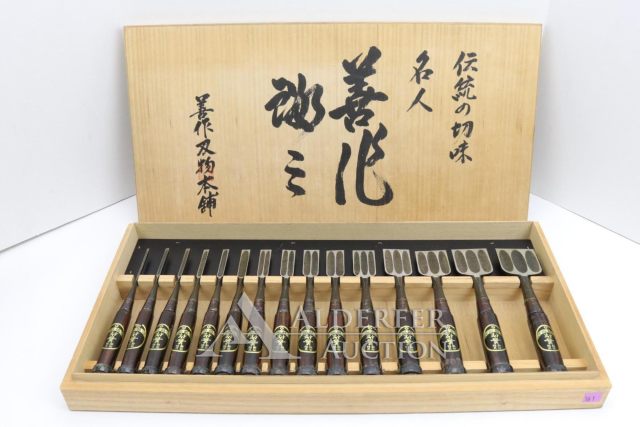
Japanese chisel/nomi 15 piece set, wood handles, marked and labeled, some wear, original box.
But what I didn’t quite realize was the sheer number of tools (both old and new) that Fred acquired in his all-too-short lifetime as a tool user and collector. A few weeks ago, I spoke with Susan, Fred’s former wife and mother of his daughter Eleanor, who has helped to organize an auction of Fred’s large collection. The family, she said, has realized it is time to let some things go, and to honor Fred’s work of getting tools into the hands of those who will use them. I got a preview of the auction catalog as it was in progress, and while I knew Fred bought a lot of tools, well…it turns out I had no idea quite how vast and diverse his collection was. I’m pretty sure there’s something in the collection for just about everyone – as Fred would have wished.
You can see the catalog for Day 1, November 8, here, and place bids online until the morning of November 8. From Alderfer Auction: “Auction is open for pre-bidding until Tuesday, November 8th at 10:00 AM, at which time pre-bidding will cease and the auction will go live online only at the auction center. When the auction goes live, lots will be sold one at a time, in numerical order, by a live auctioneer who will be taking bids from multiple online bidding platforms, absentee and phone bids. During pre-bidding you are able to submit a max (maximum) bid. The bidding platform or our auction staff will bid on your behalf up to the maximum bid that you have entered. Once the auction goes live if you wish to increase your bid you will have to wait until that lot opens for bidding and enter any additional bids manually.”
For more on how the auction works, and to register to bid, visit the Alderfer Auction site.
The catalog for Day 2 will be posted late this week or early next. We’ll announce it here, but you might also want to keep at eye on the site. I got a look at just some of what will be in the second catalog; you won’t want to miss it.
People who make things are the best people I know. And that’s why I’m a fierce believer that the best way to help our craft is to unlock or open doors for anyone – anyone – who wants to step through.
Recently a friend alerted me to a new Instagram account that highlights the work of transgender craftspeople – transcraftsociety. Even if you aren’t transgender, I encourage you to follow their efforts and add their feed to the images you consume every day. Embracing beauty in all forms will make you a better designer (and person).
Example: Though I’m a rabid advocate for vernacular furniture – peasant pieces – my feeds are filled with brutalist architecture, Soviet bus stops and decay aesthetics. I am a better woodworker and designer thanks to the unfamiliar.
One of the members of the Society of Trans Craftspeople explained their mission to me this way:
“The Society of Trans Craftspeople was started by a trans furniture maker who wanted to connect with fellow artisans who shared similar life experiences. What started as personal social project due to Covid isolation has grown into a project that promotes and supports Transgender and Non-Binary artists in craft and art media. We aim to increase visibility for queer craftspeople who are often forgotten or overlooked and strive for equity in the craft and art world. In addition to continuing bi weekly posts, class promotions and community building we hope to eventually grow into or work with equity based non-profit or non profit adjacent organizations (such as chairmakers toolbox – a workshop of our own, etc.) in order to provide funding, class seats and other financial, emotional, and communal support. That being said, our main goal is to remind people we exist and to show off some beautiful work.”
Check it out. The worst thing that can happen is you’ll see some things you haven’t seen before.
— Christopher Schwarz
P.S. Don’t bother posting hateful or negative comments. They will be deleted.
“I do not get your weird chairs,” exclaim about a dozen messages or comments every year.
I understand your bewilderment.
I remember being a prospective student at Northwestern University in 1985 where I had been paired up with freshmen journalism students. We were supposed to sleep in their dorm rooms and see what university life was like.
My two hosts sat me down on a bed and thrust a Budweiser in my hands.
“Drink it,” they said. “And you’re drinking 10 more. You are getting drunk. Maybe we’ll drag you outside naked.”
Up until that point in my life I had taken one sip of beer. It had been my dad’s Coors Light, which had been poured over ice at the beach during a vacation. It was memorably disgusting.
I took a sip of the Budweiser, and I can still remember the metallic and bitter liquid spreading through my mouth and snaking down my gullet.
Beer is objectively nasty stuff. It’s basically watery bread. Fermented starch. And flavored with a bitter plant (hops) or worse.
I did not “get” this weird drink, and I took about four sips of it that night, each one warmer and worse than the previous. I did not end up naked and drunk in the quad.
Now 37 years after that fall evening, I have changed my mind about beer. I am endlessly curious about the different forms of the drink and enjoy learning about its role in our culture and history. After listening to a podcast about beer in Biblical times, I was struck by the parallels between the history of the beverage and of the vernacular stick chairs I have been studying and building for many years.
I suppose these parallels shouldn’t have been a surprise. The stories of many good things in our world have a similar arc. And the turning point in the story’s third act is always the Industrial Revolution.
But it’s a good story, and it helps explain my love for both hops and these funky chairs that are “a smidgen off being ugly,” according to chairmaker Chris Williams.
A craft beer and a carving of a stick chair by Rudy Everts.
For most of human history, beer was something you made at home. Everyone was a brewer. Beer was a source of nutrition and hydration. But ancient beer was unlikely to taste like the stuff you buy today. For a long time the role of yeast wasn’t understood. And hops – the most common added flavor today – weren’t always used. Honey and other spices were common.
Commercial production of beer might have been an innovation of the Ancient Egyptians (you can read a history of beer and business here, which is where much of the following business data comes from). But up until the mid-19th century, most brewers were local businesses. There were no national or international brands of beer.
The rapid industrialization of the West allowed beer to be produced on a large scale and homogenized. Prohibition wiped out most of the local and regional brewers. And by the 1970s, 75 percent of all the beer in the United States was produced by only four monster corporations.
The product also kind of sucked. Coors Light over ice?
My kids, pretending to be drunk while in Germany.
And while those macro brewers still exist (and are still growing through acquisition and consolidation), there has been a remarkable renaissance in small- and mid-sized brewers. In 1980, there were only 92 breweries in the U.S. As of 2021, there were 9,247 breweries. A hundredfold increase.
Plus beer as a beverage is far more interesting and diverse these days.
The history of stick chairs is not as long as the history of brewing (as far as we know). But it also has some wild twists and turns.
The first image of a stick chair that I know of is from a Welsh book of laws from the 12th or 13th century called “Laws of Hywel Dda.” There are two images of stick chairs shown in this particular Latin translation. My favorite one shows a judge in the stick chair, and he’s pointing with one hand. His other hand holds what is likely a book (but which I prefer to think of as a cup of beer for the purposes of this story).
Stick chairs have been around for hundreds of years before mass manufacturing. We suspect that most were made by farmers in the off-season, so it was a household enterprise, much like making beer. Judging from the surviving examples, they were made by crafty individuals who likely made the chairs for their nuclear or extended family. Or for people in their village.
Because each stick chair is unique – I’ve never seen two that are identical – we can conclude that they were likely made one-by-one. Or in small sets at most. There are variations in the chairs that can place them in certain time periods or in certain regions. But there’s little to no evidence that these chairs were even a highly organized commercial endeavor. (Irish Gibson chairs might be the exception.)
These vernacular chairs show up in many countries throughout Scandinavia and the UK. And stick chairs could be the ancient ancestor of Forest chairs (aka Windsor chairs).
Danish stick chair.
Regardless of the shape or strength of that family tree, Windsor chairs appeared in the early 18th century and rapidly became a commercial enterprise that employed hundreds and then thousands of people. The city of High Wycombe became Britain’s primary chairmaking region. But the chairs were manufactured all over the UK and were a major export for the country.
The Windsor chair became so successful that today it is widely regarded as the most common form of chair.
“It’s been said that half of all wooden chairs on the planet are either Windsors or are directly descended from the style,” according to the Magazine Antiques.
An early Windsor (and a personal favorite).
While there are exceptions, most mass-produced Windsor chairs are unremarkable firewood and share little or nothing with their ancient ancestors – except for a name.
Evidence: All of the broken chairs that have been dragged across my doorstep have been factory-made Windsors. (I decline all chair-repair requests from customers – not because I am a jerk, but because chair repair could easily consume all of my waking hours.)
These factory-made Windsors are the Coors Light of the woodworking world.
Just like with the world of beer, however, things began to improve for the world of handmade chairs in the 1970s and 80s. Mike Dunbar and Dave Sawyer began exploring Windsor forms, and both began teaching others, planting the seeds for thousands of other chairmakers. John Brown self-published his “Welsh Stick Chairs” book, which began to sketch in the early history of chairs from his part of the world.
Mike Dunbar at work.
And now we have an embarrassment of riches when it comes to chairmaking instruction and tools. Well-made Windsor chairs and stick chairs are much easier to find. And the chairs are available at a variety of price points.
Plus there are now a lot of talented chairmakers out there that I have never heard of – and I try to keep up.
I get the same feeling when I visit my local beer store. The shelves are brimming with interesting beers from all over the country. I’ve heard of maybe 10 percent of them. There is so much good stuff out there to try.
It’s quite amazing, really. Well, that is until I look across the aisle of the store and see the mountains and mountains of Coors Light there, too.