About a month ago, I wrote about Martyn Owen, a filmmaker who was creating a mini-documentary about Nannau Hall, the Grade II* Georgian house that stands on the grounds where the Nannau Oak, featured in “Cadi & the Cursed Oak,” once stood.
“Within the Walls: Nannau,” directed and edited by Martyn I. Owen and performed by Keith Evans, is done and you can watch it in full at the link. The film shows Nannau, in its current state, in desperate need of repair. Thanks to many incredible shots by drone operator Rob Whittey, you’re also able to get a real sense of Nannau and its surroundings, including places featured in “Cadi,” such as a lovely aerial shot of Dolgellau and close-ups of more distinct locations such as Coed y Moch lodge. The film also delves into more of the history and folklore of Nannau, exploring eerie and ghostly tales that live on to this day.
These are some of the tools of the joiner shown in “Spons’ Mechanics’ Own Book” (1885).
The following is excerpted from Joel Moskowitz’s history of trades and explication of trades in England at the time “The Joiner and Cabinet Maker” was originally published (the full chapter is titled “England in 1839). The Lost Art Press edition of the book include not only the original text, but Joel’s fascinating chapter as well as how-to chapters by Christopher Schwarz on the construction of the three projects described in the original text: a Packing Box, a dovetailed Schoolbox and a Chest of Drawers – using hand tools.
Why collect stuff? Is there something in one’s DNA that suggests that picking up an extra thing or two just to have them is a good idea? Before you know it, you are sitting around with a lot of things that seem kind of similar: a collection. The game ends for some collectors right there, and for others it prompts more questions about what they’ve collected and what other items would make the collection perfect.
When I began studying woodworking formally in the 1980s, there were few new tools worth buying. Fortunately, my teacher, Maurice Fraser, taught us how to buy old tools that worked. I soon bought my first old tool, a Stanley Bedrock 604C, then some more stuff, and more stuff after that. At some point I realized that if I continued making rationalizations about the tools I was buying (that I needed all of them to do woodworking; if my 32 other smooth planes were to be destroyed in a fire, I’d be comforted to know that I had number 33 waiting in the wings), I would have to sharpen all the tools I bought. On the other hand, if I relaxed and admitted I was a collector, it would save a lot of work.
So that’s what I did. In the process, I joined a lot of interesting organizations (EAIA, MWTCA, TATHS, CRAFTS and others) and found an outlet for my continuing interest in social history. I had never been much interested in who had been king when whichever side had won the Indo-Franco-Prussian-Franco wars, but I was interested in things such as why the heck anyone in their right mind in 1790 would spend a king’s ransom on a miter plane when a good smoother could plane just as well. So like many tool collectors, I started studying up on tools and industrial history, and in the process I bought a lot of books.
At some point I ran out of interesting tools to buy. I just couldn’t afford what I wanted to collect. But books were cheap, so I continued to buy interesting books on tools, woodworking and industry in general. When I started collecting in the period before 1880, I hit a snag. There just isn’t all that much to collect from that period. Woodworkers as a group are not nearly as interested in writing stuff down as, say, theologians, politicians or poets. I collected the same pre-1880 material that other collectors did, and frankly most of it was turgid and just not all that interesting to read. Much to my pleasure, “The Joiner and Cabinet Maker” was different.
A lot of people have asked me how I found this book. The answer is: I didn’t. It found me. Here’s the secret to collecting a lot of stuff: If it’s cheap enough and you don’t have it, you buy it. I picked up tons of material that way. Most of it is just fun to have. Sometimes you actually learn something about woodworking in the book. Sometimes, as in this case, you acquire the book, poke through a few pages and shout “Eureka!” when you realize what a monumental find you have. And that is exactly what this book is.
After a few reads of “The Joiner and Cabinet Maker,” it became apparent that inside the text were the earliest descriptions of certain woodworking practices that answered a lot of questions we have today, and it put to rest some modern speculation.
Various editions of the book from the left: 1839 Knight edition, leather-bound Knight edition of several volumes in the series, 1883 Houlston edition, 1841 Houlston edition.
I started buying up other copies of the book to get a handle on how various editions differed. At some point, I called Christopher Schwarz and asked if he was interested in reading what I now considered to be the most important pre-1850 book on teaching woodworking. I sent him a copy of “The Joiner and Cabinet Maker” and he, like me, was charmed. We both thought this book needed to see the light of day once more. Chris wanted to build the projects and give the book relevance to beginners today. I was especially interested in its historical context and what it tells us about shop practice in the early 19th century.
Historical Context The earliest book on woodworking in English that tells us about basic technique is Joseph Moxon’s “Mechanick Exercises,” which was published from 1677-1680 by subscription in an edition of 500 copies. Its audience was educated gentlemen who wanted to learn a little about how things are done. Men such as the noted diarist Samuel Pepys (1633-1703), who was a subscriber. “Mechanick Exercises” is pretty spotty and contains no real sense of what needs to be learned in a training course. It’s more a summary of common woodworking operations. This in itself is interesting, and readers today could certainly learn much from a social and historical standpoint, but the book doesn’t tell us anything about training a tradesman.
A century later (1769-1774), a Frenchman named André Roubo wrote a giant tome, “L’Art du Menuisier,” on all aspects of advanced woodworking just before the French Revolution got rid of a lot of the luxury styles he describes. This book is also a wonderful addition to our knowledge of 18th-century French woodworking, but Roubo concentrates on advanced subjects; it isn’t a beginner’s course. In England and the United States, the only books on woodworking during this period are “builder’s dictionaries,” “pattern books” and “price books.”
Builder’s dictionaries are glossaries of woodworking and architectural terms that include some basic information on how much things cost, and in most cases, formulas and tables for calculating materials and dimensions. The main purpose of these books was to allow rich patrons to figure out what the joiner meant when he said, “I’ll need a crown to purchase the deals I need to make the barn siding, my lord.”
Pattern books, which are collections of drawings, were sold to designers and masters who wanted to show potential customers the latest styles. The most important of these pattern books was Thomas Chippendale’s “Gentleman and Cabinet-Maker’s Director” (1754). Pattern books don’t show much furniture anatomy, which would have been familiar to any skilled craftsman, but they show endless design variations that you could show a client.
Another type of book that appeared in this period is the price book, which explained to union and craft society members how much they should be paid for different kinds of woodwork. Price books usually are tied to a region, with London price books being the most common. But price books crop up in all the important cities, even in the United States – pretty much anywhere there was enough work for a journeyman working in a shop for wages. As the industry grew, labor relations became more complicated and societies of trades, or unions, began to form in the 18th century. Small shops could of course get away with paying what they wanted to, but larger shops followed the price books. Price books served as a last vestige of the medieval guild system, which regulated pay, among other functions.
In the 18th century, all books were still hand printed, with hand-set type on hand-laid paper. Books were expensive, so the shortage of popular, practical books for woodworking apprentices is understandable. “Mechanick Exercises” was far too expensive for a poor apprentice to afford. Of the few professional how-to books that exist from the early 18th century in English, one of the more noteworthy is “The Complete English Tradesman,” which was published in 1703 by none other than Daniel Defoe of “Robinson Crusoe” fame. The book is a guide to running a millinery shop. So there was a demand for “how to” books, but the hand-printed nature of the book would have kept circulation from all but the fairly well-off milliner.
I have a reference book from 1777 for ironmongers, “Mr. Hoppus’s Measurer.” It’s carefully inscribed, “George Barter His Book June 3, 1787.” The inscription suggests this was a treasured book that was purchased used 10 years after it was published. If a new, up-to-date copy could be afforded, certainly a used copy would not be so prized. Even if there had been a demand for an apprentice’s guide, the book would have been too expensive for apprentices to buy, and certainly many would think that there was no point in paying for a book about something you did every day anyway.
Technical books of all sorts began to appear in the late 18th and early 19th centuries as a booming industrial economy started to change everything. In general, the books addressed the cutting edge of technology, not basic skills. The audience for books on wood was comprised of professional builders and woodworkers who already knew all the basics. They were not interested in directions for cutting dovetails; that, they learned to do in their sleep during their apprenticeship. What they wanted were books on the finer points of their craft. Probably the most famous book in this class was Peter Nicholson’s “The New and Improved Practical Builder” (1809).
Nicholson wrote a whole series of books on various aspects of carpentry and construction. His books are the best-known of the early 19th-century books on woodworking, especially those on advanced architectural work. Nicholson explained the math and layout for all sorts of woodwork structures. While they are totally useless as training exercises, they are great books on applied geometry. They offer an engraving of the tools of the joiner and lots of information on layout and design, but almost nothing on how to use the tools. These books are different than the really limited-run volumes such as Roubo. Some of them were reprinted continuously for most of the 19th century. While all of these books are fascinating today to historians, and they tell us a lot about the practice of woodworking, there is almost nothing on basic technique from the period. But this is what we all want: A book that shows us and teaches us the lessons of apprentices from before the machine age.
A list of the topics covered in “The Guide to Service” and “The Guide to Trade” series from 1845.
By the early 19th century, steam-powered printing presses and machine-made paper made daily newspapers ubiquitous for the masses. Reading became a fundamental skill, and books, while still expensive, became affordable to the middle class. When first published in 1839 by Charles Knight and Co. “The Joiner and Cabinet Maker” was part of a series called “The Guide to Trade.” A few years later the series was re-titled “The Industrial Library” and was published variously under the “Houlston & Wright,” “Houlston & Stone,” and later just “Houlston” imprints. “Industrial” in this sense means hard working, not jobs in manufacturing.
Few of these books are preserved in research libraries around the world. These were titles for the masses, not for scholars. And unless a library was specifically collecting popular literature (which they mostly weren’t), there would be no reason to acquire these books.
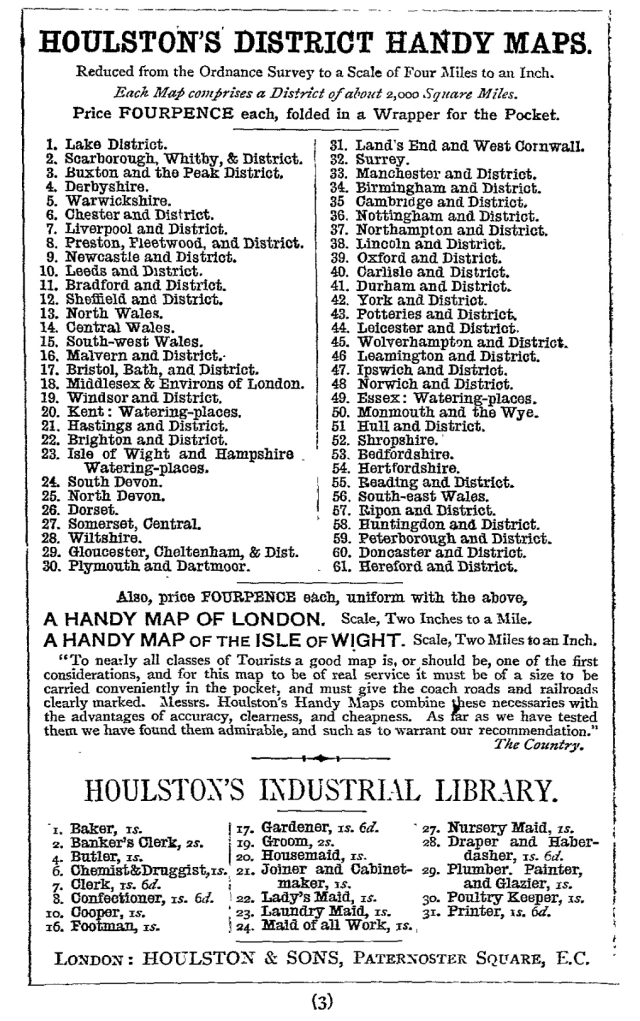
The goal of the “The Guide to Trade” series and its companion series, “The Guide to Service” series, was ambitious. It appeared to be a comprehensive group of nearly 100 books, printed as inexpensively as possible to serve as a overview of all sorts of vocations “to prepare young persons for the choice of an occupation.” Of all the books listed in the original series, only a few are marked as available. And the series was obviously not successful for Knight because only two years later, in 1841, the list was greatly pruned and was printed under the “Houlston” imprint. Thirty-six books made it into this new series now titled “The Industrial Library,” which was announced in a full-page advertisement in “The Joiner and Cabinet Maker.” By the time of the 1883 edition, 44 years later, the advertisement for the series has been reduced to a fraction of a page, and it competes with a bunch of other self-improvement series. There’s a lot to be learned about how England changed during the time this series ran. Of the 36 original titles of 1841, no less than seven deal with traditional agricultural jobs, and nine deal with domestic jobs.
In 1841, the series was greatly pruned and was printed under the “Houlston” imprint. Thirty-six books made it into this new series now titled “The Industrial Library,” which was announced in this full-page advertisement at the back of the book.
By the time of the 1883 edition, the advertisement for the series has been reduced to a fraction of a page, and it competes with a bunch of other self-improvement series and maps.
The prices of the books are largely the same, reflecting massive changes in book publishing. What is most interesting is the change in titles. The series numbering now has gaps, as only 20 books remain. The books that have been removed are almost all agricultural. I was able to locate only one agricultural title in a library, anywhere. Agricultural workers would have been the poorest and least literate of all the trades in the series, so it makes sense that they didn’t buy these books. But the deletions are also a testimony to the shift from a rural economy to a predominantly urban one.
The craft books that have vanished include “The Dressmaker and Milliner,” “The Tailor” and “The Shoemaker.” These are all trades that changed from real crafts in the early 19th century to brutal industrial manufacturing jobs by the latter half of the century; they didn’t require much training (except on the very high end) and certainly were not desirable jobs in the public imagination.
Two other new titles have been added: “The Butler” and “The Footman,” which are both domestic jobs. The large number of titles about domestic employment might be an indication of employers trying to train their hires, or it’s evidence of a rising middle class that hired domestic workers to emulate richer household practices. In addition, books such as these might help a young person get a domestic position – jobs that were hard to get and considered pretty good.
While both lists have “Clerk” and “Banker’s Clerk” on them, jobs that I would suppose are fairly prestigious, it’s interesting to see the titles (which I also could not locate copies of) intermixed with all these titles for domestic jobs. The urban office world, with its shift to “white collar” work, still hadn’t taken place on any great scale. That was a 20th-century innovation.
Some of the books in the series are credited to various authors but “The Joiner and Cabinet Maker” is not. This isn’t unusual for the time, but it is a shame that we don’t know more about who wrote it.
Of all the “Industrial Library” books that I’ve been able to locate, only “The Joiner and Cabinet Maker” is told in the form of a story. (The book on the housemaid has a limited narration.) The other books seem to be early attempts at writing how-to books, with limited success in condensing a complicated trade to a hundred or so pages. Various editions of “The Joiner and Cabinet Maker” have turned up, but it is not known if the book was continually available from its first publication in 1839 to the last in 1883, from which this facsimile was taken. The later edition was made from the same plates as the 1839 edition and is identical. An addendum about new modern tools was added to this later edition. It’s included here, but it’s not really worth much. We chose to scan the later edition of the book because it’s visually the same as the earlier edition but its binding was in better shape than the other copies in my collection.
The books themselves are a microcosm of invention, a window in how book publishing changed during the 19th century. (For more information about the books themselves, and the book technologies used in printing these books, see “Contextualizing ‘The Joiner and Cabinet Maker’” by Jeff Peachy, a noted bookbinder and book conservator, at the back of this book.) What is a shame, of course, is that the original Knight series was never completed. How wonderful would it be to have a copy of “Cutler” or “Watchmaker” today.
Last week I got to examine two Scandinavian workbenches, presumably from the 1600s, that were on display at the Skokloster Castle museum outside Stockholm. Both benches had some interesting details that I had never seen before on workbenches.
A Different Pinch Dog (& Bench Nipple)
The bigger workbench at Skokloster had a massive shoulder vise that has a curious round protrusion as part of the face vise. We got to calling it the “bench nipple.” It looked like a huge bead, and I strongly suspect it was purely decorative.
But you always wonder, did the owner find some use for the nipple? The thing had lost a lot of fights with a saw blade during its life. Though, to be fair, the entire bench was covered with tool marks. These woodworkers were not precious about marring their worksurface.
The other unusual feature of this bench was a forged metal dog that we came to call the “pinch dog.” It fit into the dog holes of the workbench, but it had two peculiar characteristics. It was much longer than the other dogs. And the metal spring of the dog went all the way to the top of the dog. When the dog was pushed into its dog hole, the leaves closed like the jaws of a vise. But they did not close all the way. I suspect the dog was used to pinch thin stock so it could be worked on its edge – planing it or grooving it, perhaps.
The dog could also be used like a standard metal bench dog. It was quite clever, and I might need to chat with a blacksmith about making one.
A Different End Vise
The second bench was much shorter than the first and was equipped with your standard stuff: shoulder vise, tail vise, tool well and a storage locker below.
The curious part of this bench was a third vise located up by the face vise. The vise had a small screw compared to the face vise and tail vise screws. It had a small chop that was fitted with a small dog hole. A matching small dog hole was mortised into the frame. Clearly a piece was missing from this vise that might have answered some questions.
After some thought, I suspect this vise could have been used to pinch wide boards between the small dogs for face planing. As I mentioned, the bench is shorter than I would like. So this would be a way to handle longer boards. Both of these benches were used primarily by joiners who were fitting up the castle with wooden hearths. Plus frame-and-panel trim throughout the structure.
If you have seen a vise like this on an old bench, leave a comment.
We will open our doors to the public on Saturday, July 29, from 10 a.m. to 5 p.m. at 837 Willard St. in Covington, Ky. We’ll be selling our complete line of products, signing books and – most of all – talking about woodworking.
I’ll display a bunch of the furniture I’m building for my next book, “The American Peasant.” Plus, I’ll be happy to demonstrate the grooving cutters I use to add spells and wards to the furniture.
We’ll also show off the Anthe building – the 1890s-era factory we are restoring to become our new headquarters. If you would like a tour of the Anthe building, we’ll lead walking tours that leave from Willard Street to 407 Madison Ave. The tours begin inside 837 Willard St. (our current building) at 1 p.m. and 3 p.m.
If it’s too hot for you to walk (or you have mobility concerns), you can drive your car the 0.7 miles to the Anthe building and meet us there.
Please keep in mind that Anthe is under construction, so be sure to wear comfortable shoes with good traction. There is, however, electricity, plumbing and HVAC there. Other than the two tours, the Anthe building will not be open to the public that Saturday. Our fulfillment employees don’t work on weekends. So if you show up there (outside of the tours mentioned above), you’ll find the doors locked.
One of the tool chest forms that has been on my list to explore is the Swedish chest, which I’ve encountered a few times both in the United States and Europe. It’s similar to the Dutch tool chest, with its slanting front lid. But the Swedish one is in many ways simpler.
The chest shown here came from the family of Johan Lyrfalk, who owns Rubank Vertygs AB, a woodworking supplier in Stockholm, Sweden. Last Saturday, he brought it out for us to inspect and measure during a visit to his store.
Note how the bent hasp holds the lid open and accessible.
The chest is most likely pine and it is assembled with through-dovetails at the corners. The top and bottom are screwed to the carcase. The slanted lid is kept flat with two battens that are neatly joined to the lid with blind sliding dovetails. The steel hinges are let into the carcase and are screwed through the lid and into the battens, increasing the reach and strength of the screws.
The interior of the chest is fairly open. There are openings for three drawers (this chest had only two of them remaining). The drawers are assembled with half-blind dovetails (two dovetails per corner). One nice detail of this chest is the top edges of the drawer sides are beveled to the inside. That reduces the number of corners you will bump into when you reach for a tool.
The middle drawer. Note the bevel on the drawer side.
The drawer frame and dividers appear nailed and screwed to the chest from the outside, keeping with the aesthetics of the chest.
The interior walls of the chest are lined with tool racks. And there’s a tool rack on the lid.
How the tool rack on the lid was used was a question among the woodworkers looking at the chest. The lid is propped open by its hasp, which allows the tool rack to be handy. But you’d have to remove the tools to shut the lid. Some speculated perhaps this chest was rarely closed and used mostly in a workshop environment.
Dimensions are: 32” wide, 18-1/2” high and 19-1/2” deep. The top is 11” wide, as is the drop lid. Most of the stock for the carcase is 7/8” thick.
The interior tool racks.
This chest is definitely one on my to-build list. We are always looking for tool chest classes that teach a variety of good lessons for classes (or for publication). The Anarchist’s Tool Chest is my personal favorite to work out of; but as a class, it is mostly about through-dovetails and nails. Even in a one-week class working flat out, it is difficult to get to making the lid, much less the rest of the interior bits.
The Dutch tool chest, as a class, is a more balanced experience. You get some dovetails, dados, rabbets, maybe some tongue-and-groove.
The Swedish tool chest could be a primer on through-dovetails and half-blinds, for the drawers.
I’ll have to build one to find out.
The tool chest at the Vasa.
After we spent an hour poring over Johan’s tool chest, he returned it to its resting place. The next day we went to see the Vasa exhibit. And there, right next to one of the workbenches from the Vasa, was an almost-identical chest (just a little longer). Perhaps the universe is sending me a message.