The facade of the Florida School of Woodwork in Tampa, Florida (not that I’m biased, but I’m teaching there in 2022).
I’ve been getting a lot of requests for gift certificates for our Covington Mechanicals woodworking classes at the storefront. But as I’ve written before, we’re not really a school, and we have so few classes (and so few spaces available) compared to actual woodworking schools that it’s not practicable for us to offer gift certificates for them. (Gift Certificates are available for Lost Art Press/Crucible Tools, but they aren’t usable for classes because those aren’t really associated with LAP. Chris just lets me hold them at the storefront because he’s a prince among men.)
There are surely many more woodworking schools that offer gift certificates; please list them in the comments (ideally with a link to the GC page), so that your fellow woodworkers may get a gift they’ll love: a weekend or week or more of woodworking.
– Fitz
p.s. I’m teaching at The Florida School of Woodwork next October…so that would be my choice 😉
The first section of my forthcoming book, “Backwoods Chairs,”documents my search for the dwindling ranks of Appalachian woven-bottom chairmakers who count(ed) chairmaking as a significant income. The income piece is essentially my only criteria for the makers: that chairmaking provides at least a part of their livelihood. I had no real idea what to expect when I started my search for ladderback chairmakers. Try as I might to dislodge the romantic vision of a mountain maker working wood on a secluded front porch of a cabin, that stereotype lingered in my brain as I started the search. At times, I found a maker shaving wood parts on the porch. Other times, the idyllic vision was incomplete – as when I visited a maker shaving parts next to a generator, which powered the lunchbox planer used to thickness his chair slats.
Appalachian post-and-rung chairmaking is far more complex than I initially imagined. For starters, the makers do not fit into simple categories. Some make all their income through chairmaking, and others a portion of it. Some do it seasonally, either working around their farm’s growing season or working in the shop during the summer months. One person did not consider himself a “chairmaker” at all, though chairmaking has been a constant in his life for five decades. The whole thing is squishy.
I also recommend readers put aside any tidy categories when considering the makers. The lines between “amateur” and “professional” blur to the point that they are no longer relevant. I found “part-time” and “full-time” categories to be pointless as well. At the end of the day, there are either chairs or no chairs.*
Chester Cornett’s Beatty Rocker.
I sought out makers of the basic post-and-rung form, though each maker creates distinctly different work. I think of it this way: Chester Cornett could only make a Cornett chair, and Brian Boggs could only make a Boggs chair (I know, that statement is so simple that it’s stupid). The chair is a reflection of the maker; the maker DNA is right there for all to see. The Cornett chair reveals the use of the knife, and Chester measured everything by his hands and thumbs. His approach helps create that magic in his work, and it’s a constant across his career, from his beautiful common chairs as a younger man to his bombastic late-career rockers.
Boggs’ chairs are refined and highly engineered. There is intention behind each detail, both in the design and the technique. Boggs’ ladderback chair was reimagined into a modern piece in his Berea Chair until it could not be improved upon. Brian took a form typically considered rustic and backwoods and reimagined it for a contemporary setting. He did that by making a chair with equal consideration toward comfort, technique and design. Cornett and Boggs – two chairmakers beginning at the same post-and-rung starting point, yet yielding wonderfully different results.
ABrian Boggs Berea Chair.
Whenever possible, I traveled to meet, interview and photograph the makers. I wanted the opportunity to explain by book in person and figured this was my best approach to record and reflect on the makers in the fullest light. The initial interview and meeting proved helpful, especially for photography, but the follow-up proved most fruitful. The makers could size me up and determine if they wanted to provide more to this project. One maker showed me the door after 20 minutes. That bruised my ego a little (was it something I said?) but most followed up by sending pictures and sharing additional stories and techniques. Like James Cooper, most wanted me to get this right. That meant educating me on all things chairmaking.
James Cooper rocker, spring 2021, on his porch with one of his dogs.
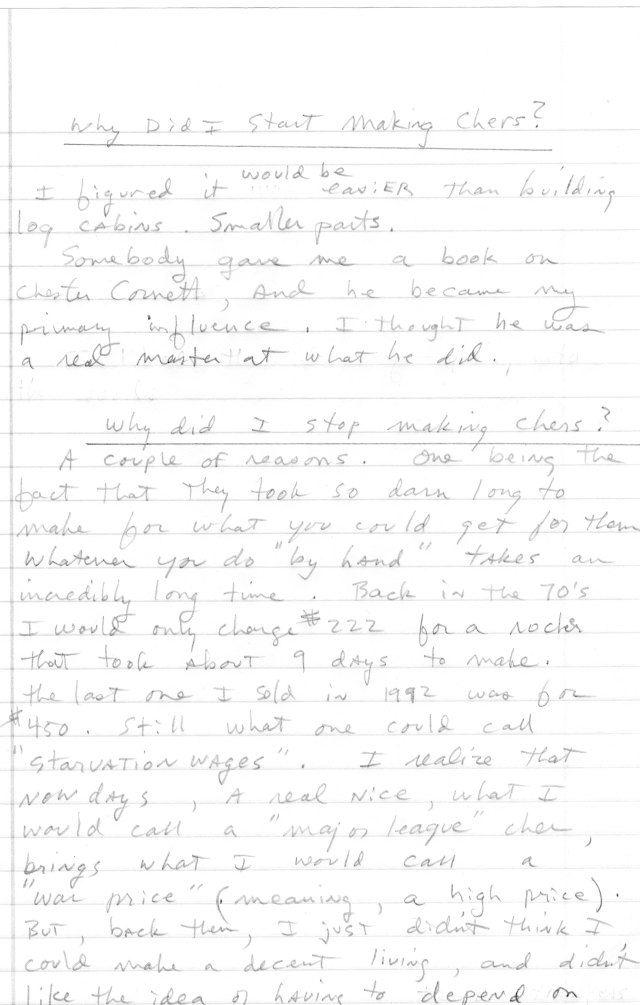
I met Cooper of Jackson County, Ky., earlier this year. We sat on his porch during an early spring downpour and discussed his approach to chairmaking. James crafted handmade chairs as his primary income source for three years in the late 1970s and early 1980s then decided to make a career change. He followed up our initial conversation by sending 10 pages of written notes and a collection of his early photography. With it, he opened my eyes to his reality of making chairs in Eastern Kentucky.
The notes are shared here with his permission.
– Andy Glenn
* A note about categories. I request that the reader does not overlay “morality” onto the chairmaker’s decisions (as in, one decision is morally superior to another). There is a tendency within woodworking circles to philosophically judge the work of others, where handwork can be judged of more value than machine approaches (and this, being a Lost Art Press publication, will likely reach those who appreciate handwork). I propose that an outsider has no say in the decisions of the maker. Decisions are purely personal choices made by the chairmaker.
One example: the chairmakers I met in the process of the book made the following decisions regarding their chair rungs; 1) split and shaved 2) turned from lumber 3) store-bought dowels 4) made on a dowel machine 5) handheld power planer to shape and taper them after using a brace to cut the tenon on the end. One choice is not philosophically superior than another – at least as far as an outsider can judge.
My goal is finding out why the maker decided upon an approach or technique. Is it because they work within an established tradition? Is it for speed and efficiency? Is their design target “old-timeyness” (which deserve the shaved rungs)? Regardless of the answer to those questions, I recommend the “handwork is more pure than machines” belief be suppressed when considering the work of others. Only the chairmaker gets to make that “moral” decision about their work.
The scholarship is open to “women and those who identify as female both nationally and internationally and is part of the school’s ongoing efforts to increase diversification in the craft.”
The school and woodworking community worked together, raising more than $7,000 via a raffle. Prizes included handmade furniture, equipment and a deluxe copy of “With All the Precision Possible: Roubo on Furniture”. Proceeds from the raffle will fund seven week-long class scholarships.
• Name and date of the class you’d like to attend (plus two alternates if your first choice is not available)
• 100-150 word description of why you’d like to attend
If selected, your scholarship will cover the full tuition of the class and, when deemed appropriate, a small travel stipend. Apply now through January 30. Scholarships will be awarded via email between December 31 and February 28. Check out all the details here.
To learn more about the Florida School of Woodwork and its founder, Kate Swann, check out Nancy Hiller’s two-part interview series here.
After four years of honest labor, I am happy to announce you can place a pre-publication order for our newest book: “Honest Labour: The Charles H. Hayward Years, 1936-1966.” This massive book (474 pages) compiles Hayward’s best columns about the craft during his tenure as editor of The Woodworker magazine in the United Kingdom.
The book is $34 and can be ordered here from our store.
Hayward’s columns cover an enormous swath of woodworking philosophy, from discussions of our insecurities about our skills to the regenerative power of time at the bench. Hayward writes from a unique perspective: He was a traditionally trained woodworker, World War I veteran, professional woodworker, draughtsman, photographer, writer and editor. He steered The Woodworker through World War II (without missing an issue) and was a comforting voice for woodworkers through the most tumultuous portion of the 20th century.
We’ve taken his best columns during the 30 years he was the editor and reprinted them in “Honest Labour” for you to enjoy and think about. Each column occupies a single spread in the book – just open the book to any page and you will find a complete column. And each is illustrated with drawings from that particular year of The Woodworker – many of the drawings from Hayward’s own hand.
“Honest Labour” is the fifth and final book in The Woodworker series, which was a multi-year, multinational project to preserve the hand tool knowledge that almost disappeared in the 20th century. “Honest Labour” is the same trim size as the other Woodworker books in the series, printed on the same paper and features the same tough binding. The only difference is the cotton cover cloth. We chose a deep scarlet instead of the green to differentiate this volume from the others.
The book is currently at the printer and should ship in early May 2020. We hope our retailers will carry this book, though we have no control (obviously) over their stock choices.
In the coming weeks we’ll publish an excerpt for those of you who are on the fence or unsure this book is worth your time and effort.
— Christopher Schwarz
P.S. I know we have been releasing a slew of stuff this week – pinch rods, linocut prints from “Good Work” and now this book. It was completely unplanned and is what happens when you run a publishing company with the “it’s done when it’s done philosophy.” Sometimes that means you have nothing. Sometimes it means you have too much.
Exekias’ signature (ΕΧΣΕΚΙΑΣ ΕΠΟΙΕΣΕ) as potter, rotated 90° anti-clockwise, detail from a scene representing Herakles and Geryon. Side A from an Attic black-figure amphora, ca. 550–540 BC.
I have often wondered what period of time must elapse before a good craftsman becomes an outstanding one. Was he born that way, needing only the requisite skill to develop his genius? Or did he evolve stage by stage like other men, but having the courage to take his work a stage further, perhaps many more stages than other men will venture.
Yet that may only imply the virtue of persistence, not that he is outstandingly gifted. What is the secret? We can add together the small perfections which make up the quality of a first-class man but, even so, something eludes us, something in the very essence of his work which defies analysis.
There is an old Breton proverb which says: “Qui aime son métier, son métier l’aime.” It may be this puts a finger right on the spot. That there has to be love between a man and his work, something which each gives to the other, which acts and interacts upon his skill before craftsmanship becomes the superlative thing that is created beauty.
Probably many more men than we can possibly estimate, working at the handicraft they enjoy, are producing work of this kind today, to be seen by few people, but to some of those few communicating that little thrill of pleasure which only superlative work can give. When we think of the amount of wastage there has always been right down through the ages by reason of material change and decay, the destructiveness of wars, accidents, sheer stupidity and thoughtlessness, the marvel is the amount of creative beauty which must have been produced by unknown men in every age for so much to have survived into our own, infinitesimal in comparison with what has been lost.
Furniture, of its nature, cannot date back many centuries, as much, perhaps more, through neglect due to changing fashion than from the perishability of wood. But ancient records and wall paintings have yielded up a great deal of information about the furnishing of kings’ palaces and the like, and many ancient craftsmen’s masterpiece has been described in meticulous detail, which still seems to retain the sense of wonder of those who had seen the work and the proud sense of possession of the monarch who had owned it. Very occasionally, by one of the freakish chances of history, the name of the craftsman will have survived while that of his noble patron is forgotten. A strange reversal in values.
In some cases, conscious that this work of his was good, the craftsman has inscribed his name on some obscure corner, to be discovered years afterwards by men who came to admire. It is not often the craftsman inscribes a friend’s name as well as his own, yet this is what happened when, between two to three thousand years ago, a Grecian artist wrote his signature in tiny, crabbed Greek script: “Exekias made it,” on the lovely vase he had made and painted, and then in a burst of pride and affection: “Handsome Onetorides.” And so the name of his handsome friend has been passed down through the ages in somewhat unsual confirmation of Keats’ “A thing of beauty is a joy for ever.”
Had the maker instinct of immortality when he inscribed his friend’s name on the lovely thing he had just completed? Exekias himself was known as the finest Athenian vase painter of his day, and the vase is the famous one painted with a panel in which with consummate skill he shows the two Homeric warriors, Ajax and Achilles, seated at an improvised table playing a dice game. The two figures, painted and incised in black upon a red ground, are bearded and every line of their bodies as they bend forward shows a kind of eager intensity, but there is nothing to suggest that the handsome Onetorides was a model for either. No, the inscription seems to have come out of the fullness of the artist’s creative joy, knowing this work of his hands to be good and wishing to associate with it the name of the friend he admired. Rarely has a dedication been made with such simplicty and rarely has any dedication lasted so long.
Probably when we come to the word “dedication” we come to the crux of the whole matter. The man who is going to do outstanding work in any craft has himself to be a dedicated man. He must be sensitive to beauty wherever he sees it and in whatever form and have the instinct to turn to beautiful accomplishment the handicraft he has made his own. He has to have skill so sure and informed that it will carry him faithfully through his undertakings, enabling him to tackle new kinds of work with the confidence of experience.
But all this the really good craftsman can have. If he wants to go further still, it can only be for the love of it, something which will bring an element into his work which no school can teach, a heightened degree of skill, a suavity, a finish, which can only happen when, as the Bretons say, the work loves him back.






 After four years of honest labor, I am happy to announce you can place a pre-publication order for our newest book: “