The ancient “geometers” believed that geometry was the key to comprehending the incomprehensible; that an understanding of its inherent truths was the key to unlocking the mystery of how the “Gods” created order from chaos. The development of geometric constructions (the truths rather than proofs) became the foundational tool of the artisans to create a built world of inherently sound, durable and pleasing forms.
And it all started from nothing:
Across the Ionian Sea, a gentle wind blows from the West with the fading of winter–the breath of the God Zephyr, a harbinger of spring and the bringer of light. A God whose name would, as we will see, appropriately evolve to produce the word “zero.” The geometers did not use or represent zero as a number, but rather as a notation to show the location of the focus of a circle. Like the true center of a wheel, it is the only place that does not rotate, for it is a place of no dimension. There is nothing to rise, nothing to fall. All revolves around it. And like Zephyr, the renewer of life, the zero of the ancient artisans served as the seed of all shape and form. website
— Jim Tolpin, reprinted from the byhandandeye.com website, which explores artisan geometry
Quarreling Carvers, 1520, Beverley Minster, Great Britain
Over the weekend I plowed through several thousand photos on my mission to gather together misericords featuring woodworkings. I found enough examples to split into two posts: today are the carvers and (perhaps) the carpenters will be posted by next weekend. The carvers and their tools are from France, Spain, Switzerland, Belgium and Great Britain.
Mallet, 1520-1525, St. Laurent Church, Estavayer-le-Lac, Switzerland.
There is a huge range of detail from one misericord to the next. From the simplicity of the mallet to a highly detailed scene of a carver at work on a statue. One carver might have been contracted, and paid by the day, to provide all the misericords in a church. In other instances a master carved was hired to plan all the carvings and oversee a crew of carvers.
Carver working on a figural piece, 1497-1503, Cathedral of Plasencia, Spain.
The misericord below was categorized as ‘Forestry’ but it looks like a woodworker is riving a block of wood for a misericord.
Riving, 1457-1470, Cathedral of Notre-Dame, Rouen, France.
In another French church two carvers are found working on a misericord.
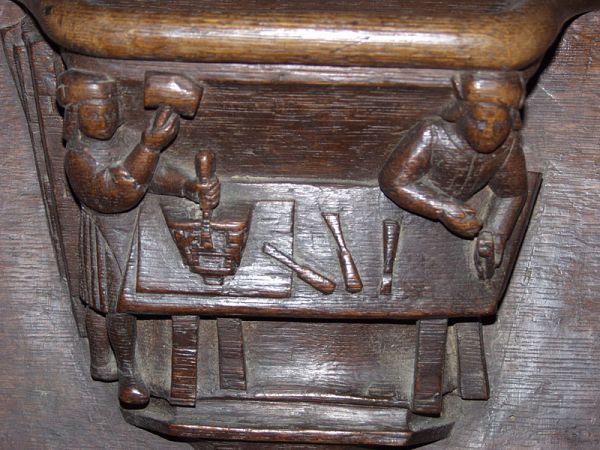
Misericord Workshop, 1413, Church of Notre-Dame des Grands-Andelys, France.
In the entries for two churches I found the same misericord listed. The lighting and angle of the photos are different but the missing piece on the carver’s face, his clothes, number of fingers and tools are the same. This misericord mystery is just a case of to which church in East-central France does it actually belong.
À gauche: 1490-1500, St. Paul, Bletterans, ou à droite: 15th c. St.-Thomas-de-Cantorbery, Cuiseaux ?
Some of the oldest misericords in Great Britain are in Exeter Cathedral. The elegant arms in the misercord below are dated 1220-1270. If you would like to read a short section (54 pages) about the Exeter misericords including a bit about their construction, how they were moved within the cathedral and some destructive ‘work’ here is a link to “The Misericords of Exeter Cathedral” written by Kate M. Clarke in 1920. Note: the remainder of the book is about other non-misericord sites in Devon
Possibly a gift of the Glovers Guild, 1220-1270, Exeter Cathedral, Great Britain.
If you have any confusion on the configuration of a seat in a choir stall and the location of the misericords the two figures below should help. In the photo the red arrow points to a seat that is down. At the front edge of the seat you can see a small ledge or bracket. The back row of choir stalls shows the seats up and the location of the misericords.
Seats down in front row, seats up in back row. Aren’t those stools in front of the choir stalls fabulous?
Another view of ‘Seats Up/Seats Down’ is from the delightful little book “Choir Stalls and Their Carvings – Examples of Misericords from English Cathedrals and Churches” written and illustrated by Emma Phipson in 1896. You can find it here.
From “Choir Stalls and Their Carvings” by Emma Phipson, 1896.
The gallery has several more carvers or ‘kervers’ for you to enjoy.
–Suzanne Ellison
Carver overview & detail, 14th c., All Hallows Church, Wellingborough, Great Britain.
Flying Carver, 13th-16th c., Priory, Christchurch, Great Britain.
Carver, 1425-1449, St.-Sauveur, Bruges, Belgium.
Carver, 1521, St.-Gal, Langeac, France.
Carver, 1457-1470, Cathedral Notre Dame, Rouen, France.
Carving a figural piece (armrest), after 1500, Abbey St.-Dennis, France.
Carver (armrest), 16th c., Castelnau-Bretenoux, Prudhomat, France.
Carvers? Maybe? 16th c., Church of Notre Dame, Lorris, France.
Bird on a Tree, late 15th c., Montemart, France.
Mallet, 1462-1464, St. Nicholas Cathedral, Fribourg, Switzerland.
Billhook, 1520-1525, St. Laurent Church, Estavayer-le-Lac, Switzerland.
Master Carver with Apprentices, ca. 1419, Kings Lynn (Victoria and Albert Museum).
After carving scenes from the Bible, parables, the local trades and a full range of human foibles a carver of misericords might turn his skills to a depiction of his craft. The Kings Lynn Master Carver is probably the most well-known and finely-carved misericord. In the space of about 10″ by 22″ (25:4 cm by 56 cm) the carver has the master at his bench, two apprentices at a bench to the left and a third figure approaches from the right with a jug. Their carving tools can easily be seen on each bench. Framing the workshop are the letter ‘W’ with a saw and the letter ‘V’ with a chisel. Remarkable work.
If you aren’t familiar with the misericord it is a carving on the underside of a seat in a choir stall. The top of the seat has a small ledge with the carving below. During religious services choir members had to stand for long periods. For relief they could lean back on the ledge. The modern equivalent is perching on your luggage as you wait at the departure gate because your flight has been delayed. The information sheet for the Kings Lynn misericord has excellent details on misericords and their history.
15th c., Martinkirk, Bolsward, Netherlands. Vandalised by soldiers in 1580.
There are thousands of misericords in churches across Europe and in museums worldwide. Many misericords were destroyed or vandalised for religious reasons, lost or stolen during restorations, or lost during wars. Today, misericords are extremely vulnerable due to their age and also to theft. In many you will see missing pieces: heads, arms, tools.
15th c., Musee de Cluny, originally from Beauvais (?), France.
Several groups have been working to accumulate photographs of misericords and organize them by location and country. Because of differences in descriptions, or a lack of description, it can be difficult to locate misericords that feature a particular subject. A woodworking scene might be described as ‘carpentry’ or ‘occupation’ or have no description at all. There are also plenty of books that are helping to preserve the record of misericords.
Another classic: Carver working on a rose, 15th c., St. Nicholas, Great Doddington, Northampshire.
I’ve been accumulating misericords that feature woodworkers and so far have found 17 from six countries. With each one there are usually tools to note, maybe a workbench to study, or a new body position to try.
15th c., Christopher Church, Baden Baden, Germany.
We can’t always see exactly what the carver is working on but at least one carver from Oude Kerk made sure we did.
Working a misericord, 1480, Oude Kerk, Amsterdam.
The Rigoley Brothers carved 26 choir stalls for La Collegiale Notre Dame in Montreal en Bourgogne, France. Larger carvings of the life of Christ were done at the end of each row. Atop a few of the end pieces are three dimensional scenes. Below is St. Joseph’s workshop.
1520, La Collegiale Notre Dame, Montreal en Bourgogne, France (portion).
Adorning the top you will notice a decidely non-biblical scene. The two men enjoying their wine are none other than the Brothers Rigoley toasting themselves.
The gallery has the rest of the roundup. If you happen to see more photos of a woodworking misericord please post a link in comments and include the location of the piece.
–Suzanne Ellison
A more complete photo of St. Joseph’s Workshop, La Collegiale Notre Dame.
The Brothers Rigoley, front and back, La Collegiale Notre Dame.
Die Schreiner, 1542-1548, Sint Catharina, Hoogsstrten, Antwerp, Belgium. This misericord may no long exist.
Sint Catharina, Hoogstraten, Antwerp, Belgium.
1480, Oude Kerk, Amsterdam.
Two carvers, 15th c., L’Eglise de L’Isle Adam, Val d’Oise, France.
15th c., Cathedral St. Etienne, Metz, France.
15th c., Sainte-Foy a Conques, Aveyon, France.
1475-1499, St. Martin, Venlo, Netherlands..
1497-1503, Cathedral of Plaseucia, Spain.
Two sides of carpenter on an armrest, 1523, St. Vincent Cathedral, Berne, Switzerland.
Left: by Martin Engelbrecht, 1721 (Wellcome Library). Right: Women’s Timber Corps, Scotland, WWII.
Just as the craft guilds continued to limit or eliminate woman from the home-based workshop a change was underway in defining the roles men and women play in society. As the nature of each sex was defined, under a more secular rather than religious view, the economic opportunities and standing of women deteriorated. Even in an age of more enlightened thought about the nature of humanity, the work a woman performed, in the home or outside, was not valued as equal to that of men. Records (when they were kept) of women working in the woodworking crafts are harder to find, and when found the numbers are low.
An example of the newer thinking about the sexes is in the Dutch physician Johan van Beverwijck’s “Van de Wtnementheyt des Vrouwelicken Geslacht” (The Excellence of the Female Sex) from 1639. Beverwijck confirmed that a woman’s brain was the same size as a man’s. In fact, women were not inferior to men, not equal, but superior!
(Universiteits Bibliotheek, Amsterdam).
Women had the benefit of coldness, which cooled their brains and thus prevented overheating. Cool blood led to greater intelligence, where as a man had warm blood giving him physical strength. The cool brain of the female gave her a longer life because it did not burn down as fast as the male brain. However excellent or cool women might be they were still best suited for the home as wife and mother. The illustration of the woman on the turtle is included in Beverwijck’s work and is expained as: “the praise of a woman mainly exists in the care she gives to her household. For the turtle is always at home, and carries its house along under all circumstances.” The two spheres of life had been defined: the home for the woman and work for the man.
In late 17th to early 18th century London there were about 80 guilds (or city livery companies) with some taking over 70 apprentices a year. Records show girls could be apprenticed, albeit in very small numbers. Most mistresses of a shop were widows of masters and were also small in number. For records covering the years 1600-1800 there is one identified woodworking craft that included women as masters and also took girls as apprentices, the turners. Of the 7,304 turners, 179 (2.5%) were led by a mistress and 21 apprentices were girls. Unfortunately, we don’t have numbers on how many wives and girls were actively involved in home shops prior to guild-mandated restrictions to compare with these later period records.
Advancing innovation and capitalism in the 18th century and the rethinking of human nature did not mean advances in women’s employment in the crafts. Although all humans were seen as equal the division was not fifty-fifty. Characteristics attributed to each sex were the foundation that helped exclude women from legal rights, education and work. As men began to work outside the home there was a greater separation between home (the world of women) and the place of work (the world of men). Even if a woman’s role was supervisory she was becoming more isolated from the craft she and her husband might have previously practiced together.
In Europe and America the 19th century saw the switch to factory-based economy and the rise of a middle class. Men worked outside the home and as a matter of survival so did single women. Single women could work in a factory but were paid one-third to one-half of a man’s pay, which barely paid the rent. Poorer women could go into domestic service or sell goods on the street. One of the common street vendors was the chair mender with women usually repairing the rush seats.
“Old Chairs to Mend” from two “Cries of London” from (left) 1795 and (right) 1821, (British Library).
The 19th century and the Victorians cemented the cult of domesticity for upper- and middle-class women that would persist well into the 20th century. Building on the idea of separate spheres for men and women much advice was handed out on how a woman should conduct herself and her relationships with men. Around 1845 Sarah Stickney Ellis wrote a very popular book, “The Daughters of England.” She wrote, “As a woman, then, the first thing of importance is to be content to be inferior to men – inferior in mental power, in the same proportion that you are in bodily strength.” Twenty years later John Ruskin, prominent art and social critic and a proponent for expanding women’s education, gave a lecture that continued the idea of the separate spheres of life for men and women: “The man’s power is active, progressive, defensive. He is eminently the doer, the creator, the discoverer…His intellect is for speculation and invention. The woman’s power is for rule, not for battle; and her intellect is not for invention or creation, but for sweet ordering, arrangement and decision.”
Well, now. Perhaps this explains why archery was a favorite pastime of Victorian women. And to both Ellis and Ruskin I say “My nose is in great indignation” (especially because we are celebrating Shakespeare this weekend).
Another Victorian pastime that became popular, for both men and women, was wood turning. “The Handbook of Turning” was published in 1842 by a Miss Gascoigne and is possibly the earliest woodworking publication by a woman. And it was creative!
If you want to take a look the book is available online here.
Other than woodworking pastimes such as turning or carving there were some Victorian women engaged as carpenters and joiners in the building trades. Prior to repeal legislation in 1814 there was the English parish apprentice system mandated by statute in 1562. Records show girl apprentices were in 51 occupations including carpenters, joiners and shipwrights. Between the 17th and 19th centuries in the southern counties 34 percent of apprentices were girls. After the 1814 repeal master’s associations and trade unions could control entry into their industries through the apprentice system. Census records started early in the 1800s but not until 1841 were occupations recorded by gender. From 1841 to 1891 the percentage of female carpenters and joiners compared to the total was no higher than 0.3 percent. The actual numbers ranged from 151 (1861) to 459 (1841). Even as overall employment rates increased the number of women in wood-related occupations continued to deteriorate into the early 1900s.
Toward the end of the Victorian era some of the cast iron separation of the sexes started to crack. Instruction in woodworking became part of the education of girls and boys. The Educational Sloyd System was started in Sweden in the 1870s. In 1880 it was introduced in the North Bennett Industrial School in Boston and also in New York. The Sloyd System is still mandatory in Sweden and Norway.
Educational Sloyd System class in Boston.
The Manual Training School became part of the University of Chicago in 1903. Woodworking classes for making furniture and were offered for both sexes.
Early 1900s, Special Collections, University of Chicago Library.
Another early 20th century bright spot was Juliette Caron the first female compagnon in France. In a recent feature on the Charente Libre website they gave her rate of pay at 2-3 francs per day compared to 6-10 francs for men. She worked on the featured construction site from 1910-1913. There are at least five different post cards of Juliette (Chris has a few of them). I always wonder how she felt about the postcards and if she received any of the profits.
The first wave of women in the woodworking trades in the 20th century was in World War I. Women filled in on the home front in many countries although there is a dearth of proper records and photographs. The photos here are from the Imperial War Museum and involve British women. Labor shortages were severe but employers and trade unions resisted recruiting for the building trades. Recruitment for munitions work seemed to be OK. Women were finally allowed into the building trades after a list of restrictions were drawn up. Women were to be kept in the semi-skilled jobs, paid less then men and were regarded as “dilutees.” Between 1914-1918 the number of women in the building trades rose to 31,400 from 7,000 .
Waring and Gillow factory in Hammersmith converted from furniture manufacturing to aircraft wings.Women making huts for a war contractor near the front in Calais, France.
After the war, employers and the trade unions helped to pass an act in 1919 to push women out of the war-effort jobs and back to their traditional female jobs.
In 1935 the United States started the National Youth Administration as part of the New Deal. The program was started to help keep kids in school and provide training for jobs through work study projects. Students were age 16-25 and were paid an hourly wage. Once the war broke out training was provided that could be used in the defense-related industries. Classes in carpentry and making furniture were included and offered to girls. The program ran until 1943.
National Youth Administration girls with chairs they made ready for shipping, 1943 (Library of Congress).
The next wave of women in the male-dominated building trades was, as you may have guessed, World War II. Women were once again allowed in the lower skilled jobs and paid less than men.
Somewhere in Britain building housing in 1941 (Imperial War Museum).
When the United States entered the war and more Allied troops were sent to Britain the need for more workers to build troop housing and airfields increased dramatically. Britain already had a Women’s Land Army and created the Women’s Timber Corp branch in 1942. Women were trained for 4-6 weeks and then sent to do forestry work using 6 lb. axes to cut down trees. Timber was processed for use as pit props in coal mines and as railroad sleepers. Their living conditions were often primitive and they worked in all kinds of weather. They became known as the Lumberjills. One Lumberjill based in Scotland said she was responsible for bringing out 60 trees a day with her team of horses. The Women’s Timber Corps was disbanded in 1946.
The Lumberjills of World War II (BBC-Scotland).
In the illustration at the very top “La Femme de Charpentier” uses tools as props for her fashion shoot. She is posed in elegant fashion to contrast her femininity with the masculine tools of her husband’s trade. The Lumberjill, on the other hand, was the real deal.
After the war women were expected to return to their homes or their more traditional jobs. Women that attempted to stay in the building trades were met with resistance, harassment and low wages. In the 21st century it is still a hard road for a woman to become a union carpenter and in the United States women represent only around 2% of the total.
A Medieval glass cutters guild didn’t allow women because they were too clumsy yet women were making lace and hand-spinning the finest silk thread. Centuries later women were working in munitions factories. Women were deemed too weak and frail for many jobs but could be found burning their hands processing silk cocoons. The poorest Victorian women worked in coal tunnels no higher than 18 inches pulling coal baskets harnessed to their foreheads, work no man or boy would do. In wartime they worked wherever they were needed and became known for the high quality of their work.
Today women can be found again in the home-based workshop and it just might be their own shop. They are carvers, turners, furniture makers and tool makers. They teach woodworking, write about it and one is the editor of a popular woodworking magazine! They are the daughters and granddaughters of woodworkers making their own tool chests and furniture. After work and on weekends they retreat to the shop and with their most excellent and cool brains they make something out of wood.
— Suzanne Ellison
Juliette Caron.
More Juliette.
A hut made by British women in WWI in Calais.
Stella Day, age 16 in 1941.
Lumberjills in training while their uniforms were still new and clean.
Lumberjill, WWII.
More Lumberjills.
Still more Lumberjills.
A Christmas ad from 1905. Of course she could buy it for herself.
Recruitment poster for the National Youth Administration.