I’m still in Germany, but Brendan Gaffney and Megan Fitzpatrick will open the Lost Art Press storefront to the public today from 10 a.m. to 5 p.m. The store is located at 837 Willard St. in Covington, Ky.
We’ll have our complete line-up of books available for sale, plus some blemished books (cash only on blems). As always, Brendan and Megan are happy to discuss any woodworking topic you might need help with, or to demonstrate a technique at the bench.
And if you want to talk smack about me, I won’t be there. So go nuts.
I’ll be back home on Sunday night and will definitely be in the store for the Nov. 10 and Dec. 8 open days. I hope you can visit.
I’ve always used octagonal legs on my stick chairs because the geometry makes sense to my modern head. Cut the four-sided leg from a plank. Then plane down the four corners to create an octagon.
But when you study old chairs, hexagonal legs are far more common than octagons. I’ve given a lot of thought about how to create hexagonal legs at the bench, but it seemed more complicated than it should be. After talking it over with chairmaker Chris Williams in Wales, he arranged for a day in the workshop with Gareth Irwin, a Welsh chairmaker, turner and green woodworker. (His Instagram feed is definitely worth following.)
We met at Hugh B. Haley’s workshop, Phoenix Conservation, which is where Chris works when he isn’t building chairs in his garage. After Hugh made us some much-needed coffee, Gareth pulled his tools from his van. And in about 10 minutes, he made the process seem effortless and obvious.
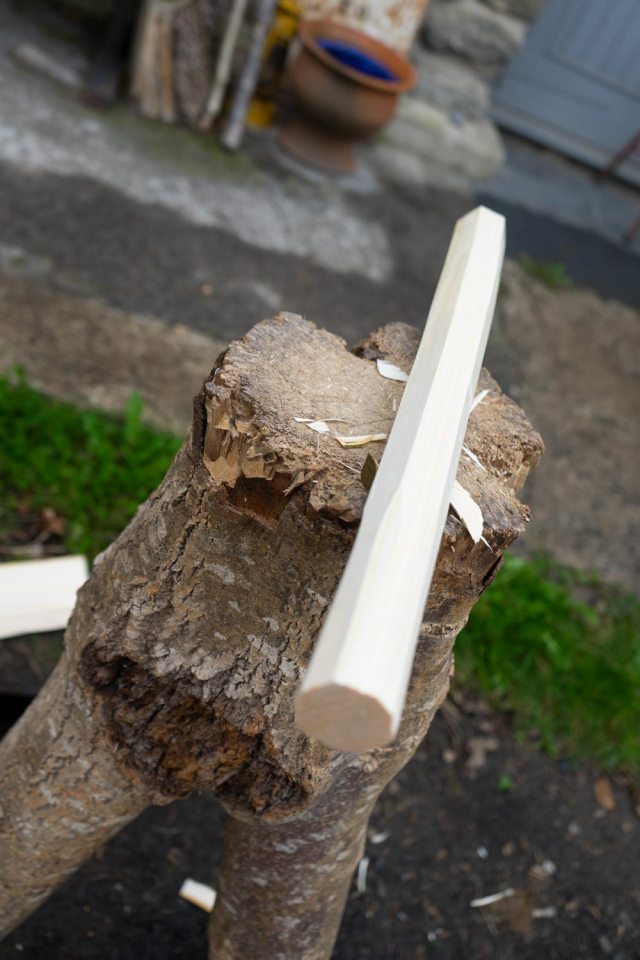
The key to make it easy is to work with wood split from the tree – not sawn stock. Gareth brought along a section of fresh young field maple to demonstrate. The hexagon is derived from the natural pie-shaped sections from the log. Here’s a quick photo essay that shows the process.
Here Gareth makes the first split across the pith of the log, splitting the log in half and then into fourths and eighths.
He splits off the pith and some other heartwood that could be used for something else, leaving a section of the tree that, after a little hewing, is roughly hexagonal.
At the shaving horse, Gareth refines this shape. Thanks to the hewing, there is always a flat section of the leg that rests on the stage of the shaving horse.
Gareth tapers the hexagonal leg with a drawknife and then starts to make the tenon at the top of the leg. He stops when the tenon is oversized. Then the leg gets dried for three or four weeks inside before he forms the finished tenon.
The demonstration was brief, and so we all got to chat a lot about the craft (and drink more coffee). Gareth brought one of his chairs along. It sits and looks fantastic. In fact, a local stopped by and purchased the chair from Gareth under our very noses.
Emyr Davies (left) and Chris Williams discuss a low-back chair at St Fagans.
When deciding what chairs to place in the historic buildings collected at the St Fagans National Museum of Wales, Emyr Davies says museum officials have to be careful.
If they place a high-style chair in a house or a room at the castle, no one will bother it, says Emyr, the senior conservator for furniture. But if they put one of the vernacular Welsh stick chairs on display, visitors are so drawn to them and curious that they will plop right down in them.
During my visit to St Fagans I felt that same urge to sit in every chair, but I resisted (perhaps because I was accompanied by museum officials). So instead I took 200 photographs of the 29 chairs that we inspected during the day. Some of the chairs were as familiar as old friends because I had studied them ad nauseam in John Brown’s “Welsh Stick Chairs.”
But about half of the chairs were new to me – chairs that had been in the storerooms of St Fagans or in their shop for repair. These chairs were a revelation and offered details I had not encountered before in books. One was green with yellow pinstripes. Another had a crest rail that resembled a cartoon dog bone. I believe I counted three seat shapes that were new to me. Plus, one that was painted with oxblood.
I also had the great privilege to listen to Emyr’s thoughts on the chairs after spending his career studying and repairing them. Here’s one detail to consider.
Emyr puts the chairs into two broad categories. The first category consists of chairs that have – for lack of a better word – Windsor-like qualities. Sticks that pass through an armbow and enter a crest rail (or comb) at the top of the chair. The second category of chairs are technically low-back chairs. The arm is usually quite massive and is obviously made from a branch that has either been trained into this shape while the tree was alive or was found in the wild.
Emyr has several names for these chairs that reflect the shape of the arm, including “hornback” and “rootback” chairs. They also are sometimes called Cardiganshire chairs because that area of Wales tends to produce lots of curved timber.
I’ve never built a chair from this second category because the arm always vexed me. The solution to that is, as Emyr put it: Get a dog and go for walks in the woods. You’ll see the arms in the branches.
Would that curved branch fit in my suitcase?
So just as I was placing a few of those chairs on my to-build list, we walked into one of the buildings open to the public, and I was struck dumb by a chair that is named in my notes as Chair 024. I took 19 photos of this chair. That’s a love affair in my world, and I’ll write about this beauty in my next entry.
“The Jointer … is the largest sort of Plains by them used, it is perfectly straight from end to end; its office is to follow the Fore-Plain…” Image Courtesy of the British Library
There are several sources we use to learn about a 17th-century joiner’s tool kit. The surviving furniture retains many tool marks left by the joiners. These marks can include those from riving and hewing, layout marks for stock dimensioning and joinery, and even the types of plane blades used in surfacing the stock.
The underside of a joined chest was never meant to be seen. Here, the joiner saved time and labor by leaving the riven and hewn surfaces as is. He laid out the joinery with an awl on the faces of the stock, presumably for transferring the layout from one piece to another.
The interior surface of this stool’s stretchers are not only wedge-shaped from riving, but show the torn surfaces typical of this process. They have been slightly worked with a plane.
Probate inventories taken at the time of a person’s death often itemize details of their household belongings. Many examples of inventories include a tradesman’s tools listed in detail. For example: John Thorp of Plymouth died in 1633, and his estate included the following tools:
1 Great gouge, 1 square, one hatchet, One Square, 1 short 2 handsaw, A broade Axe, An holdfast, A handsaw, 3 broade chisels, 2 gowges & 2 narrow chisels, 3 Augers, Inch & 1/2, 1 great auger, inboring plaines, 1 Joynter plaine, 1 foreplaine, A smoothing plaine, 1 halferound plaine, An Addes, a felling Axe
William Carpenter, Senior, died in Plymouth in 1659. He had many tools listed in his estate:
Smale tooles att 10s; one axe and a peece of Iron att 7s; 4 Iron wedges att 8s; a foot and an old axe att 1s; …one old axe…; the Lave and turning tools att 13s; 3 Crosscutt sawes 15s; smale working tooles 12s; smale sawes 8s; an adds and 2 turning tooles att 6s; three Joynters 3 hand plaines one fore plain 10s; one bucse a long borrer one great goughe 10s; Rabbeting plaines and hollowing plaines and one plow att (pounds)1; 3 Drawing knives att 7s; 2 spokeshaves att 3s; Chisells a gouge and an hammer and a Round shave att 19s; 2 adds att 8s; one vise… 2 beetles…; a grindstone 15s; 2 axes att 6s #
The above inventories are found in C.H. Simmons, Plymouth Colony Records: Wills and Inventories. The values are expressed in pounds, shillings (s), and pence, (d). At this point in 17th-century New England, a joiner usually could expect about 2 shillings 6 pence for a day’s wages, a farm laborer about half that. A day’s work would be 12 hours in summer, and eight in winter.
The inside surfaces of this stool’s aprons were only roughly worked. Riven and hewn textures are just as they came from the froe and hatchet, with only minimal planing. Careful examination of the stiles’ inner faces shows the mortise layout done with an awl.
Inventories can be enlightening and they can also be confounding. Some terminology is rather general. “Broad” and “narrow” are descriptive enough in some cases; yet in the same document the appraisers list the augers by size. The “inboring” planes Thorp had are moulding planes for decorating furniture and interior woodwork. William Carpenter’s planes were described better, hollows and rabbets among them, as well as the plow plane necessary for any panelled work. “Lave” is a phonetic spelling for a pronunciation of lathe.
Two detailed 17th-century English sources that are pivotal in the research concerning joiner’s tools are Joseph Moxon’s Mechanick Exercises; or the Doctrine of Handy-works Applied to the Arts of Smithing, Joinery, Carpentry, Turning, Bricklaying (1683) and Randle Holme’s Academie or Store house of Armory & Blazon (1688). Moxon’s book was published in serial form starting in 1678 in London, and it outlines the tools and techniques of several building trades. While these writings outline the tools used and some of the techniques, neither is strictly a “how-to” on the craft of joinery. It is important to remember that Moxon’s joinery section concerns itself with architectural joinery; making paneling, or “wainscot,” for rooms. He makes no mention of furniture at all. Holme’s work is more complicated. It is a guide for heraldic painters, detailing any images that can be found on coats of arms. However for our purposes it has a wealth of detail about all aspects of woodworking. Holme cites Moxon as one of his many sources, and both men probably also drew from Andre Felibien’s The Principles of Architecture, Sculpture, and Painting, and Other Related Arts. (Paris 1676). Like Moxon, Felibien’s work is concerned with architectural woodwork, not furniture.
If we saw this plane with no context, we would be certain it is Dutch. Its appearance in Randle Holme’s book raises questions about the transmission of craft techniques between England and the Continent during the 17th century. There were many hundreds of documented foreign craftsmen in and around London in the 16th and 17th centuries. Their effect on both furniture and tools is often understated. Image Courtesy of the British Library
Both Moxon and Holme illustrate and discuss the necessary tools for joinery, some in more detail than others. Planes get extensive treatment; both works describe the parts of the plane, their function and the features that distinguish one from another.
Randle Holme described a fore plane. “…called the fore-Plain, and of some the former, or the course Plain; because it is used to take off the roughness of the Timber before it be worked with the Joynter or smooth Plain; and for that end the edge of the Iron or Bit, is not ground upon a straight as other Plains are, but rises with a Convex Arch in the middle of it; and it is set also more Ranker and further out of the mouth in the Sole of the Stock, than any other Bits or Irons are.” (Author’s italics.)
Both authors identify the jack plane as being the carpenters’ version of a fore plane. Yet the term “jack plane” does not appear in any probate inventory we have seen, it is always listed as a fore plane.
James Krenov breaking down a large slab outside his home in Bromma, Sweden. Krenov possessed an incredible talent for predicting what kind of wood he might find inside a board – and I find myself looking across the details of his life with the same hope of gleaning what insights lie ahead as I break down his story and legacy.
I returned this morning from a week of researching, scanning and interviewing on the Mendocino Coast of Northern California, where James Krenov spent the last 25 years of his life. While there, I had the privilege of looking through and archiving a huge number of photos, drawings, writings, lectures and correspondences that span Krenov’s lifetime, a bounty of raw materials to work through in the coming months.
In going through the photos and organizing my notes from interviews and conversations with his family, friends, shopmates and coworkers, a complex and mutable portrait of Krenov and his many facets has begun to emerge. There is the poetic writer and gifted orator who inspired so many through his books and lectures; the mentor and teacher who provided the backbone for a craft school that continues to churn out inspiration and talent; a deliberate cabinetmaker, encouraging sensitivity and improvisation, while also practicing a deliberate process of design and iteration; the irascible old master who had little patience for uncaring work or needless invention; a loving husband, ever-thankful for the support of his partner; and a very human father, one whose children tip-toed around the house with caution while he glued up his next cabinet, but who took them fishing and adventuring in the northern wilderness of Sweden.
Krenov and his daughter, Tina, on her first fishing trip in the rural Härjedalen province of Sweden in 1964.
While I am still early in my development of his biography, these raw materials themselves provide a beautiful series of vignettes into Krenov’s vastly complex persona that I hope shed light on just why this cabinetmaker’s story is so worthy of sharing. I’m in the midst of organizing these materials, which will themselves be archived and housed by The Krenov Foundation, so that future researchers and interested parties might find and include Krenov in their work.
In the next few weeks, I’ll be posting these various sides of Krenov (or Jim, or “the Old Man,” or JK) as I dig through the archives. My aspiration in writing this biography is not simply to retell the “who, what, when” of his story, but to shed light on the lives he impacted and those ideas, moments and memories that shaped him as a mentor, writer and craftsperson.
I’ll leave you with the simple triptych below, a very narrow window into one side of Krenov that few outside of the municipal tennis courts of Fort Bragg ever saw. Yet it seems to sum up the competitive, mercurial, sensitive and generous personalities (and free-wheeling band saw usage) that made Krenov who he was. Krenov was an avid tennis player; stories abound in the community about his constant search for a good (but not too good) court mate and the perfect racket.
So I present to you one side among so many: James Krenov, the amateur tennis player.
Krenov at the school’s behemoth Oliver band saw, during school hours, shaping the handle of that month’s racket, in 1992. Photo by David Welter.Two years later, in 1994, and another racket is under the knife (or file, in this case) having its handle smoothed and reshaped. Photo by David Welter.Krenov in action at the Harold O. Bainbridge public tennis courts, just a few blocks away from the school in Fort Bragg, Calif.
P.S. I owe a great many thanks to those who hosted me and sat down for conversations during my stay: Tina Krenov; David and Laura Welter; Ron Hock and Linda Rosengarten; Laura and Thea Mays; Michael Burns; Ejler Hjorth-Westh and Karen Mathes; Jim Budlong; Greg Smith; Todd Sorenson; Crispin Hollinshead; and the current students at The Krenov School (who gracefully put up with my hovering, photographing and rusty volleyball skills). I’m lucky to have such a warm and welcoming community of people to work with over the course of writing this book – it makes all the difference.