Editor’s note: This is part of our series featuring some of our favorite columns from “Honest Labour: The Charles H. Hayward” years, along with a few sentences about why these particular columns hit the mark.
This column from 1942 speaks to the need to pass on our hard-earned skills, and as a teacher (and a member of the human race), that’s of utmost importance to me. What also strikes a chord is Hayward’s discussion in the opening paragraph of today’s work being divorced from creativity. While his “today” is more than half a century ago, I don’t think it’s changed much…except perhaps for the worse. I built a fair number of projects for Popular Woodworking (and for myself) before I became editor. After I was promoted, I spent all my time in meetings or at my desk. Editing involves some creativity – but it’s not the same as designing and building a tangible thing. And I missed sharing my own tangible work with others. I shouldn’t have let the long hours and employee reviews stop me.
Now, I’m happy to be back in the shop – and happier still when there are six to 10 others in there learning alongside me. But I think Hayward was wrong in saying kids today aren’t interested. Or maybe that was true in 1942. Now, almost every class I teach has “kids” in it. But the point is to teach – to pass it on. Woodworking is an art, but it shouldn’t be a mystery.
— Fitz
We have often discussed here that aspect of modern industrial life which has tended to divorce the work of many men from anything that is intelligently creative, because so much is done by machinery. Compensation comes in the increase of leisure which this allows, a leisure that does at least give a man an opportunity of finding his own interests or hobbies. But at the same time have come the counter-attractions of cinema and radio, offering an easy way of entertainment without effort to a man who is tired after his day’s work. So that, in spite of the increase of opportunity, he has every inducement to allow himself to drift. The older man usually knows how to strike the balance. Things were not so easy when he was a boy, he had to learn to amuse himself, and he grew up with all sorts of hobbies and enthusiasms, and learned to be a handy sort of fellow. If he is, say, a keen woodworker, or a keen gardener, there are times when nothing will tempt him away from the job in hand.
***
But for the younger generation it is different. They were born into the state of affairs where entertainment, like everything else, was made easy. And some of our Youth Leaders are now finding it difficult to get boys really doing things—boys in their teens with no particular hobbies, no particular interests, who simply want to be entertained, and that at a time when a boy should be so full of interests that no day is long enough to cram them all in. “I do not complain of growing old,” says John Buchan, “but I like to keep my faith that at one stage in our mortal existence nothing is impossible.” We feel that that should be so in youth, and yet here is the problem in our midst. “It gives you absolutely nothing to work on,” said one of their Leaders to me recently, a man who numbers photography, book-binding, carpentry and music among his own hobbies, and does them all extremely well. “They’ve no conception of taking the initiative themselves or doing a spot of work for the pleasure of it.”
***
What are we going to do about it? The gospel of “work for the pleasure of it” isn’t an easy gospel to preach to the young. You have got somehow to kindle the spark of enthusiasm in their minds first, that enthusiasm which can make everything seem well worth doing, even the hard bits, for the sake of the end in view. And it is the enthusiasm of the Youth Leaders from which the boys have got to catch their own tiny spark which, once alight, may well kindle into a flame. And it will be worth it. For they can learn more from intelligently working at a hobby than from almost anything else. It develops patience, ingenuity, alertness, self-mastery, helps them to discover their own hidden powers, teaches them the satisfaction of a good job done, widens their knowledge in a thoroughly practical way.
***
But we have no business to leave it all to the Youth Leaders. There is no easy time ahead for the boys of this generation and it is every man’s job to lend a hand where he can. The best place is in the home. If you are a keen woodworker, then try to interest your boy as well. Don’t just hustle him out of the way because you are in the middle of a job and don’t want to be interrupted, or are afraid he will meddle with your tools. Teach him how to use them; help him with some little constructive job of his own, if it is only to make a “safe”—as a small boy of my acquaintance did recently—to keep his secrets in! Small boys are usually keen enough. It is the older ones who grow apathetic. And who knows if the blame can be put entirely on the pictures? Mayn’t it be that we have hustled them out of our way rather too often? Dared them to touch our tools when they were simply longing to try them? The impulse to do and to make things is there right enough. But these are days when it needs to be fostered.
Editor’s note: This week’s Chair Chat with Rudy and Klaus tells the tale about how an imperfect chair with a displaced leg, a split seat and some crude repairs stands out as perfect in our eyes.
Also, Chris talks about Cincinnati Chili, how it looks like barf and how yummy it tastes. If you’re faint at heart and gets easily put off by three legged-chairs or food that looks like it’s been regurgitated, then please watch this to feel better.
As always: We don’t authenticate chairs – we just talk about what we like and don’t like.
We don’t know much about this chair. Its age, if the maker cried when he discovered that he messed up the splay or he had eaten a barf-like dinner before making the crest. It’s all unknown. What we do know is that the seller says this:
James Krenov digs through lumber in a Stockholm yard (but not the Forsberg brothers mentioned on page 8 of “Notebook”).
This post is a continuation from last week’s post, a “read-along” or book club of sorts. This week, I’ll be discussing the first section of “A Cabinetmaker’s Notebook” by James Krenov, up to page 23. Next week, we’ll be reading on from here up to page 51, and you can leave comments and questions about pages 23-51 in the comments section at the bottom of this post, which I’ll answer and incorporate into next week’s post.
Immediately upon opening, it’s clear that James Krenov’s first book, “A Cabinetmaker’s Notebook,” is not really a “how-to” in any sense. There’s no table of contents. The first writing past the acknowledgements is a poem by Chuang Tzu, a Taoist poet who wrote in the 4th and 3rd centuries B.C. The paragraphs are long and read like the spoken word. If you have the first edition, there’s an Old Testament quote on the copyright page, Sirach (or Ecclesiastes) 38:34.
Atypical though it was, this book was a huge success. Nancy Newman Green, Krenov’s editor at Van Nostrand Reinhold (with whom I had the pleasure of talking with recently), remembers that they had a saying around VNR about Krenov:
“If you hung up a sign in the middle of the woods that said ‘James Krenov will be here to speak at 3 o’clock,’ a few thousand people would be there to hear him talk.”
But I’m getting off track – suffice to say, the book was popular, and what made it popular were the words and philosophy Krenov detailed. So let’s get back to the text. The rest of all of this, the history, the lead-up, the legacy – for that, you can read my biography when it comes out.
One of the first things that strikes me about Jim’s writing is just how informal and stream-of-consciousness it is – in fact, you can practically hear Jim reading it out loud. If you haven’t heard Jim speak before, you’re missing out – say what you want about his philosophy, aesthetics or attitude, he was a remarkable lecturer, and he had a gift for elocution.
This book is, in fact, a collection of transcribed essays or lectures – in 1970, Einar and Kasja Telander (Einar is the silversmith for whom Jim built the veroola kitchen cabinet in 1976, which was photographed for “Worker in Wood”) gave him a voice recorder for his 50th birthday, and he took to it immediately, using it both for correspondence and for the dictation of his essays and books. He worked with both the tape recorder and his written notes at the workbench to write his books, bouncing between them to compose the writing.
The tapes for “A Cabinetmaker’s Notebook” were transcribed by Rochester Institute of Technology, as a favor to Jim – Craig McArt, the man responsible for recommending him as a teacher at RIT and the person who most encouraged him in the writing this first book, was by 1973 the chair of the Department of Industrial and Environmental Design at RIT. McArt had visited Jim in Stockholm back in 1966 and had carried back with him an essay written by Jim called “Wood: The Friendly Mystery,” which was published by Craft Horizons in 1967 (here’s a copy on the Craft Council’s archive website). If you’re interested, give that article a read and keep it in mind before you do next week’s reading.
So, once we know that the book was dictated, it puts the book in a different context – it might better be looked at as a series of lectures. Knowing that, let’s look more at the first passage, really just nine short pages, and pull a few important moments out.
Krenov in his workshop in Stockholm, with a few pieces on parade – in the background, you can see a few of Jim’s wall cabinets (and his tool cabinet at the back left), in the foreground is his “Writing table of Italian Walnut” made in 1977. You can see in the satin luster of the table’s surface that Jim didn’t heavily polish or build finishes on his work – he wanted to preserve the tactile impression of the wood, and even left a good many of his cabinets completely untreated.
The first half of the passage is, in effect, an ode to wood as a material. In the opening paragraph, ironically beginning with “It’s always a little difficult for me to begin talking about wood” right before he goes into a very eloquent missive about wood, he relates that he feels that wood, in his own way of thinking, really is alive. Krenov’s daughter remembers her father as being an animist of sorts, ascribing some kind of soul or inner life to the objects and plants around him – Krenov hints at the root of these beliefs in this essay, his childhood “in the North,” and in that context, the serious sensitivity and love he shows for wood as a medium only makes more sense.
The other thing that quickly becomes clear in the book is that it is not instructional – many of Jim’s visiting students, whom he hosted in his home workshop throughout the 1960s and 1970s, remember his advice as always being a bit vague, a trait that carries right through into his lectures from the 1990s and 2000s. Phrases such as “It is still possible to find a few good sources of wood” would, at time, frustrate his visiting students, but here in the book, they serve as anecdotes and a sort of fable about his life as a craftsperson, with their own morals and conclusions presented to the reader. He doesn’t give you a shopping list for the home center, but more of an idea of what has worked for him, and what could work for you, if you happen upon it or go in search of it.
There is a moment of Jim’s past that flashes across the page at one point. On page 13, Jim writes that “Expression in wood, if I may say so, is a bit heavy handed there [in the United States]; oversimplified. So often the emphasis in on form – as in sculpture.” This passage is certainly a reflection on Jim’s dissonant time in his first stint at RIT alongside Wendell Castle – they did not get along, and Jim would, for a number of years, relay his disappointment in the pursuit of furniture as sculpture and the indifference to wood as a medium he found in many of his colleague’s work. “A Cabinetmaker’s Notebook” largely stays out of the weeds of criticism, though, certainly in relation to the essay’s Jim wrote in Swedish magazines at the same time – articles with titles like “Is craftsmanship boring?” or “Do we care about wood art?” make it clear that Krenov was not always optimistic about the attitudes around him. When the language between the two different platforms is compared, it’s clear that this book is not aimed at the Swedish craft scene, or his colleagues and contemporaries (with whom he often had a strained relationship) – it’s aimed at a new generation, students or curious onlookers, and Jim often speaks using “we” rather than “I.”
Here’s a last selection to look at, before I get into a few questions and comments people posted from their own reading. I’m just going to pull a big quote, because it’s as close to a synoptic manifesto as you’ll get from Krenov.
“I think that what I would like to do before it is too late is to get this across to a few craftsmen-to-be who will work after me, and also to a public which will be there to receive them, because we are living in a time when, I believe, this is important. Fine things in wood are important, not only aesthetically, as oddities or rarities, but because we are becoming aware of the fact that much of our life is spent buying and discarding, and buying again, things that are not good. Some of us long to have at least something, somewhere, which will give us harmony and a sense of durability – I won’t say permanence, but durability– things that, through the years, become more and more beautiful, things we can leave our children. (page 15)
Krenov spent 11 years jumping between various educational institutions, and accepted at least three long-term teaching positions that he either quit within weeks of starting or was encouraged to leave after interpersonal difficulties arose with administrators or colleagues, often caused by his irascible and uncompromising attitude toward craft. This passage is his call for those students, a next generation of craftspeople that might be more sympathetic to his holistic and idealistic way of working, one that he hadn’t found academia or art schools to be sympathetic to. He also makes a form of plea to the public to change or be more aware of their attitudes to fine work (the main subject of his writing in Swedish magazines, though there he chose a decidedly less optimistic or charitable way of expressing it).
When he wrote this book, he wouldn’t have known it, but it was exactly the right step to take in the direction of the establishment of his own school, which would happen just a few years later in 1981.
On to a few comments and questions from the comments section on my post from last week, where I prompted you all to ask or comment away about this first passage. I responded to many comments directly, but there were a few I wanted to share and elaborate on in this post, in keeping with the idea that this might be more of a discussion or back-and-forth between you and me while we read through the book.
Ryan Stadt asked about the Chuang Tzu passage at the beginning of the book, translated by Thomas Merton. If you’ve got a minute, Merton is an amazing character to look into – he was a Christian mystic, and Ryan wondered if there was any deeper connection there.
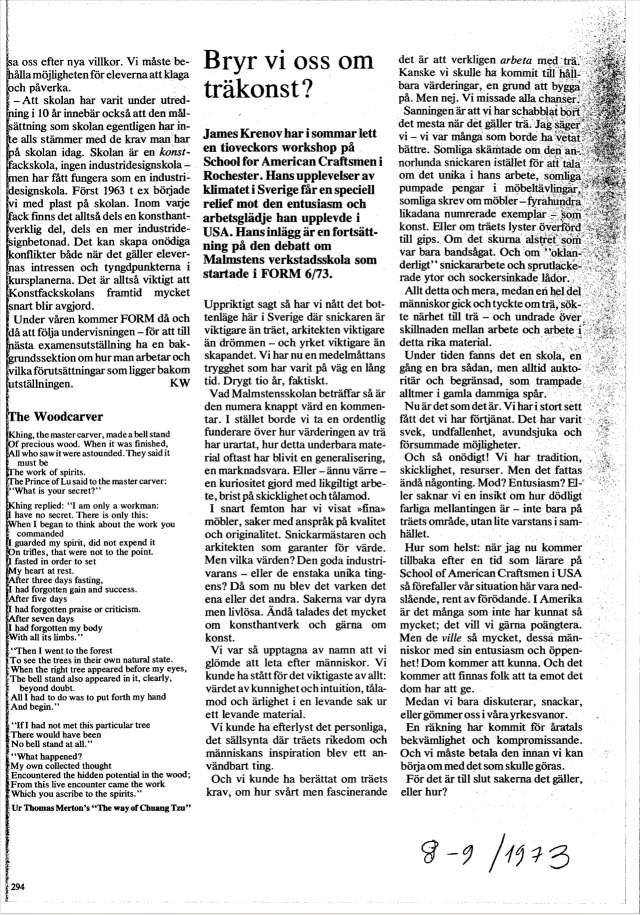
In fact, I think the first time Jim encountered this quote was in Form magazine, the Swedish design magazine Jim wrote for a number of times in the 1960s and 1970s. The passage appears as interstitial material between a preceding article and Jim’s essay for Form in 1973, but it doesn’t appear to have been at Jim’s request nor is it relevant to the subject of his article. The text is shrunk and oddly formatted and, to my eye (I was a managing editor for, like, six months!), it looks like it was included to make the line and page breaks neat and without white space. But, obviously the poem is well-suited to Jim’s sensitivities – perhaps it was a moment of poetic chance, or was included at his direction? It’s a detail I can’t confirm, and so it doesn’t go in the book, but if it did occur that way then it’s a lovely moment of happenstance. Perhaps even mystical?
Larry Barrett, a good friend who taught me to make greenwood chairs a few years back, wondered what Jim might’ve thought about greenwoodworking, especially the appreciation of materials and the similar thrills of splitting open a log and sawing it open. In fact, Jim Krenov and John Alexander did meet at one point in California – the story isn’t much, but I know that Jim was aware of greenwoodworking as a method and of Alexander’s work. Krenov certainly split open his fair share of wood, being an avid hiker and self-sufficient backpacker in the north of Sweden, and he did often split up slabs that were too wide to fit in the basement or had already begun splitting at their pith. But, perhaps his interest in woods from abroad and the backyard left him more likely to stick with the sawn stuff – though, he did use an Alaskan chainsaw mill quite a bit, and we were still learning to use them at his school when I was there.
Larry also pointed out that the Welsh concept of the “square mile” that Chris Williams wrote about in his new book fits neatly with the mention of Wharton Esherick’s idea that one could work with only the wood in your own backyard. Krenov was quite aware of John Brown – in Krenov’s papers and effects there are a few articles written by John Brown that Jim had saved, with highlighted notes in the margins. There are also definite connections to Slöjd in Wood (Wille Sundqvist, Jogge’s father, also went to Carl Malmsten’s school, and Jim’s reverence for carved pulls and knife-work has some of its roots in his exposure to Swedish crafts). Really, a sensitivity to wood as a material is a common thread through much of the craft, and when you start reading the more philosophic threads of Jim’s writing, it does echo through a number of methods and traditions that were not his. It makes sense that wood and woodworking are intertwined, no matter how many people try to melt clown wigs and pour them into the space between two live-edge slabs – but, did you know, Greg Klassen, who popularized the “river” tables (and made them in a much more interesting and durable way than the epoxy knock-offs that followed, in my opinion), was a student at Krenov’s school?
I really enjoyed the comments and questions that you all sent along for this reading – so, please do it again! Next week, I’ll be writing about the next few passages, up to page 51 of the book, and if you want to join in and read along, please do, and use the comments section below to ask any questions, highlight a passage or make a comment on the next section of the book. Also, I’d encourage you to read the two-page article “Wood: the Friendly Mystery” as well – here’s a copy from the Craft Council’s archive. You’ll understand why once you do the reading!
Ryan’s great grandfather’s tool chest, closed and ready for another storm.
Many critics of tool chests (on either the wall or the floor) say they prefer to have all their tools mounted on the walls where they can see them (and if they are missing) and be able to easily get them as they work.
When I see these shops I think the same thing when I see a wall of Hummel figurines: What a lot of crap to keep clean and safe.
One of the advantages of a tool chest is it protects your tools from dust and, if you are smart, rust. But a tool chest can’t do this job if you don’t close its lid (or doors) every night as you leave the shop.
Ryan’s chest, open. He modified the interior to have two trays that slide forward and back.
Before the catastrophe, Ryan closed his chest. And he’s glad he did.
“Always, ALWAYS close your tool chest before leaving the shop,” Ryan wrote in an email. “Thankfully I did, and the contents were bone dry, despite being rained on for hours.”
A survivor.
So though Ryan lost his workbench to the storm, it could have been a lot worse. His tool chest could have been converted into a rusty bathtub.
— Christopher Schwarz
Some of the tools that were protected by closing the lid.
Comfort, v. 1. To strengthen; to encourage; to support; to invigorate.
— The Shorter Oxford English Dictionary on Historical Principles
Had it not been for COVID-19, many of us would have been in southwestern Massachusetts this weekend for Fine Woodworking Live. Even as a hard-core loner I had a blast there last year, and while the news that this year’s event had been cancelled did not surprise me, I’m really missing the opportunity to reconnect with some people I met there. Among them is furniture maker Aspen Golann, whom I profile here as part of my “Comforting Soups” series* of interviews with woodworkers I find inspiring, especially in this current moment.
Aspen at North Bennet Street School
On April 6th Aspen Golann published a video on Instagram titled “One way to make a brush.” Knowing Aspen as I do (which is to say, not well — we’ve met just twice, but every contact I have with her is a riotous explosion of ideas and laughter and empathy), I anticipated a piece of work that would be thoughtful, as well as beautifully put together. But it was so much more: a detailed instructional video that takes viewers through every step of the process, from design to finishing, with hand-lettered instructions written in real time – and humor! – all sent out to the universe at no charge. Even better, Aspen includes instructions for improvising with tools and materials that most of us are likely to have on hand, knowing that we’re staying home in response to the current pandemic (and many folks have seen their income reduced, if not slashed to nothing). Even though I’m probably not going to make a brush, I’ve watched the video multiple times for fun, because (let’s be honest) even the loners among us are feeling isolated and could do with a bit of cheer.
Drafting brushes with integral erasers
Aspen, 33, is the Wood Studio Coordinator at Penland School of Craft near Asheville, North Carolina, where she has worked since May 2019. As with other schools and colleges across the country, the campus is currently shut down. So Aspen made the video in her garage, using an old desk reinforced with 2x4s, to which she bolted a vise.
“Hangon a sec,” I hear you thinking. “Collaborated with Peter Galbert?How did she make that happen?”
They met when she was a student in the two-year furniture program at North Bennet Street School in Boston, where Peter is a guest lecturer and instructor. “Pete’s an artsy nerd, and I think he saw some of that in me,” Aspen says with characteristic modesty. “He’s always excited to meet maker-weirdos even if they’re students – and I was so jazzed to connect with someone excited about styles outside of iconic period furniture. Pretty soon we were just regular friends.”
At Peter Galbert’s shop
After graduating from NBSS she received a commission she considered out of her league: to make a Windsor settee. Not just any Windsor settee, this one “needed to perfectly kiss the wall of the clients’ spiral staircase.” The designer Beata Heuman chose her to build it because she had made a table for her the year before. She pitched the collaboration to Peter: “We split the dough and make the chair.” He agreed. “In some ways, making that chair felt like a master class,” she says. “I got to ask every question and see him work through every problem and work through them with him and alone. It was really cool.”
For a creative fix while she was a student in the program at North Bennet Street, which is renowned for its focus on high traditional East Coast furniture techniques and forms, Aspen took classes in glass enameling and lost wax casting at Penland. She also co-taught a sculptural spoon carving class with Julian Watts during a residency at Anderson Ranch. “We were scheduled to teach an experimental carving course with him at Penland this summer,” she says, disappointed.
A few of Aspen’s spoons
Having seen a number of Aspen’s spoons online, I’ve been struck by their fine lines, so different from those of greenwood spoons. I wondered whether she makes them from kiln-dried wood. Yes, she answers, adding that some of the bowls are so thin “you can read the newspaper through them. The handles are three pieces of veneer thick; because they’re sandwiching a piece of shop-sawn ebonized maple veneer, they’re super strong.” To glue the material together she uses Titebond III.
Before her studies at North Bennet Street, Aspen spent six years teaching art and Russian literature at a couple of private high schools, The Cate School in Santa Barbara (“It wasn’t a great fit for me culturally – no jeans, no first names, water polo – but I loved my students; I still text with them”) and The Putney School in Vermont, which was more progressive; it had a full farm and strong focus on art and student independence. But this is Aspen Golann we’re talking about, so you won’t be surprised to hear there was more – in this case, a class called “From Sheep to Shawl,” in which students learned to shear a sheep, spin the wool and weave it into a shawl. And because color is important, there was also a dye garden, where they grew plants such as marigold and indigo to color the wool.
Aspen with her sheep
“I loved teaching,” Aspen says. “It wasn’t a ‘safety plan’; it was my whole plan, a big-kid job. I did it long enough that I could do it, leave it, go back to it. But [at 28 I realized] there was [still] time to do something really dumb” – here she’s indulging in her trademark self-deprecation – “and that was going to furniture school.”
“School is a place where people don’t mind if you’re terrible at things.” She had taken an ‘art with a function’ class as a student at Kenyon College in Gambier, Ohio. “I had always loved art, but it wasn’t as fulfilling as it needed to be for me to pursue it as a full-time job. Somehow, when you add functionality, it was like this now matters. It’s a sculpture you can read by. It’s a sculpture you can sit on, and even better, it’s comfortable.”
First chair
Now, at 28, she wanted to explore furniture. “I’ve taught myself to do a lot of things, but furniture…I couldn’t even imagine how I’d approach it. Furniture felt like the most inaccessible art form, both culturally and technically, for a young woman interested in art. I felt I had to go to school for those things. I knew that my gender meant that if I was going to make it, I needed the pedigree.”
While visiting her parents in Boston in 2016 she visited North Bennet Street School, and “it was like, everything they were teaching seemed completely and impossibly out of my league. This is what I should spend money on: the thing that I can’t teach myself. I consistently invest in things that play to my weaknesses. I like doing things that are too hard for me.”
As a student at NBSS Aspen adapted historic forms to a feminist perspective. As she puts it, “I was one of the only women in a shop with male furniture makers, learning from other male furniture makers. When I feel isolated, I look for ways to express myself. At NBSS I was surrounded by masters of period furniture forms, so I committed to learning as much as I could from them – while simultaneously looking for ways to incorporate my artistic background and to talk about my experience as a woman.” In Aspen’s rendering, an Eli Terry shelf clock that would historically have had a farm scene reverse-painted on the glass panel now had the lower half of a woman’s body. “I like to blur the line between furniture and figure sculpture. I literally inserted myself in my pieces.
“I really worked with my instructors,” she emphasizes, as someone who in no way takes the work of dedicated teachers for granted. “I respected them and committed myself 100 percent to their expertise and put my own interests on the back burner. Being creative with the furniture allowed me to strike a balance – between traditional and contemporary styles, and between the roles of student and designer.”
She follows this earnest testimonial with a flourish of self-deprecation. “I had prior training in fine art, and at that point I just wanted an old master to criticize my dovetails for two years – I definitely got that, and a lot more.”
“Window seat” (2017)
But before that…
Between college and teaching Aspen worked as a pig, turkey and apple farmer at a farm outside Austin, Texas. The property was run by a couple who needed help because the husband, a deep-water pipe layer, was gone for six weeks at a time. “And when he comes home, he’s a cross-dresser named Viviana La Tarte!” she exclaims. “The first time I saw him working, he had this really long red hair and looked about 6-1/2’ tall, with his hair blowing in the wind, and he was wearing a little secretarial outfit with a pencil skirt while chain-sawing posts for a pig fence to the same height. I woke up and came out of my cabin and thought ‘What is that beautiful being on the horizon in that beautiful outfit with that hair?’”
Not that her first sight of Viviana was any more unusual than her initial encounter upon arriving at the farm. She pulled up just as Viviana’s partner was attending to a pig in labor. Part of the pig’s uterus was stuck, and no sooner had Aspen emerged from her car than the partner shouted, “GO GET ME THE LUBE!”
“Where is it?” asked Aspen, a complete stranger to the place.
“IN THE BEDROOM, BY THE BED!”
“I ran into the house and retrieved an enormous pump bottle of personal lubricant. After I coated her entire arm in KY Jelly, she was able to get all of the piglets out safely.”
While living in the Austin area, Aspen also worked for the Haas Brothers. “They weren’t as well-known at that point,” she notes. “Their dad was looking for someone to work on a mosaic in glass, for minimum wage, for a client of his.” She worked on the project and they became friends, she and “this incredibly pleasant Austrian man who seems to appreciate my skills, affect and oddity.” He ended up commissioning her to make a painting for Leonardo DiCaprio, a friend of the Haas family.
Farm near Austin
Exploring yet another layer of Aspen’s history, we find her living on a sailboat in the Caribbean during a gap year between high school and college, where she earned her professional coastal navigation and sailing licenses through the American Sailing Association. “I knew it was a once-in-a-lifetime opportunity. As long as I have food and meaningful work to do, I can pursue whatever other opportunities I want.
“I was the only crew member small enough to be lowered into the bilge for cleaning, so I think it’s fair to say I earned my keep. I worked so I got fed and did correspondence classes in coastal navigation and marine biology, out of pure curiosity. Meanwhile, we sailed from tiny island to tiny island…delivering half-food and medical supplies, and half b.s. t-shirts and [other] American stuff.”
Family background
What accounts for Aspen’s relentless drive to challenge herself, to subject what is so often the self-indulgence of art to the discipline of function, to cement her ceaseless learning with so many types of accreditation? “On one level,” she answers, “I come from a long line of inventors. Things should work. On another level, some people’s creativity is sparked by having complete freedom, but most people’s is sparked by being asked to play within boundaries. When my sculptures became usable, I finally cared and saw a place for myself in the creative field.
“I’ve been trying to figure out where my set of interests came from. I don’t know anything about the women [in my family’s history], because that’s the way it goes. My mom’s parents were dairy farmers.” But her favorite possessions growing up were the small-scale pieces of furniture that her mother’s father, whom she regrets she never got to meet, had carved out of firewood. “If you’re a person who carves 15-drawer chests out of firewood, you’re a tender person, at least.
“I remember growing up in my paternal grandfather, Herbert Goldberg’s, shop. He was an inventor in a time before it was easy to commission custom hardware, plastic and glass so he knew how to make everything himself. I remember my grandmother got really mad because my brother and he snuck into the house to slump glass in the oven.” Herbert invented the refractometer and updated the pacemaker to make it more functional. Making functional things runs in the family, so Aspen says “credit where credit is due.”
Credit is also due to her paternal great-grandfather, Emanual Goldberg (1881-1970), whose inventions include microfilm and the first video camera. The first Jew to be kidnapped by the Nazi Party, he was held hostage until he handed over the rights to his inventions. He escaped to Israel; later her grandfather Herbert changed the family name to Golann, after the Golan Heights.
At her maternal grandparents’ dairy farm. Left to right: One very patient cow, Charles Hopkins, Jr. (Aspen’s maternal grandfather), Helaine S. Golann (Aspen’s mother), Charles “Butch” Hopkins (maternal uncle) and neighbor (name unknown).Emanuel Goldberg, Aspen’s paternal great-grandfather
Her father, Dwight Golann, spent his career in law. After practicing as a litigator for many years he turned to mediation, which he taught at Harvard. Her mother, Helaine, is a retired psychologist and currently teaches yoga; she has worked with people living with post-traumatic stress and Parkinson’s disease. Her older brother, David, designs and teaches maker-space classes for a STEAM program in New York City that offers art classes to schools that wouldn’t otherwise be able to offer art at all.
Aspen with her brother and parents, 1990
Back to today
The Penland campus is shut down through the summer of 2020. Although Aspen can’t get into her shop, she’s making pieces at home, some of which she sells through the Penland Gallery’s online store. She’s also doing some things she previously considered out of her league, such as electrical work and repairing small motors. In the past year she learned how to tune up all the machines in the shop. YouTube is invaluable, she says. “I’ve been watching kids’ videos about how small motors work and how electricity works, then working my way up.” I also highly recommend the book The Way Things Work!”
Addressing the strangeness of the current moment, she says: “It’s a good time to be patient with yourself, because you have time. The last time I remember having this kind of free time is when I was a kid on summer break. For the first time in my adult life, I have more time than anything else. I tell myself, ‘You have different resources, so you’ve got to do different things. The reason you’re feeling lost in all the time is…because normally time is our most limited resource. And now things are flipped. You don’t have money, but you do have time. So that’s why I made that video. Because I know people need support and distraction, and all it cost me was time.
Working in her studio at Penland (Photo: Chad Weeden)
“I’m making peace with what I have at hand. This hearkens back – some people are inspired by limitations and boundaries. What can I do when I only have these things? I’m using it as an opportunity to apply the skills I have to a completely different kind of work. If you’re a furniture maker you’re already excited by rules and boundaries. This is just an opportunity to dig deeper into that perspective on making.”
The book Emanuel Goldberg and His Knowledge Machine (2006; Libraries Unlimited) tells the story of Aspen’s paternal great-grandfather.
*This series is my version of all those recipes for comforting soups that have proliferated across the web in response to enforced isolation and anxiety.


 Editor’s note: This is part of our series featuring some of our favorite columns from “Honest Labour: The Charles H. Hayward” years, along with a few sentences about why these particular columns hit the mark.