To describe my recent interview with English chairmaker Lawrence Neal as unusual would qualify as my greatest understatement of 2021, albeit from the standpoint of just one month in. Despite the research I did a few years ago for my book “English Arts & Crafts Furniture,” I didn’t become aware of Lawrence until Peter Follansbee suggested him for this series of profiles. Had I known of him five years earlier, I would certainly have wanted to include him in the book, along with a few others who keep Arts & Crafts traditions alive in silver, glass and wood.
Lawrence is a practicing craftsman in an unbroken line stretching back to designer Ernest Gimson. While engaged in the process we today would call “finding himself,” Gimson had taken some lessons in chairmaking from Herefordshire chairmaker Philip Clissett in 1890. Later, having established his workshops at Daneway House in the Cotswolds, west of London, Gimson encouraged Edward Gardiner, a young man in a family of sawyers who lived nearby, to learn to make chairs. Gardiner later moved to Warwickshire, where Lawrence’s father, Neville Neal, began learning from him in 1939. So I imagined that Lawrence would be full of stories, perhaps even willing to talk about such abstract notions as the meaning he finds in his work.
Nope. Instead, he was more chill about his life and work than pretty much anyone I can recall having interviewed, ever. At first I found his “Just the facts, ma’am” responses disappointing – where was the personal stuff, the color?
But as I worked in my own shop yesterday, my strength, along with my hemoglobin level, temporarily reduced by chemotherapy, the well-intentioned comments from some readers about the healing comforts of “making sawdust” jostled less happily around my head. It hit me how familiar, in the end, I found Lawrence’s “Just the facts, ma’am, just the facts“; it brought so many of the people with whom I worked at small shops in England in the 1980s shooting right back. Look, this is my livelihood. Sure, it’s a gift to be able to turn a drawing into a practical three-dimensional object. But there’s no need to wax romantic. In my own woodworking-and-design-icon-deprived muddling way, I’ve spent most of my adult life as a cabinetmaker. It’s simply what I do. Yes, my work gives me great satisfaction, and it’s easy for me to go on (at length) about how wondrous it is to have any kind of practical skill. But on an hour-to-hour basis, I’ll tell you that spending a day amid the wood chips, whether I’m building a set of paint-grade bookcases or a solid walnut sideboard with hand-cut joinery throughout, is work, not something I’m inclined to romanticize. Amid my frustration at my reduced productivity, Lawrence’s low-key attitude quickly turned into balm for my soul.
Lawrence was born in Stockton, Warwickshire (pronounced “Warrick-shirr”), in 1951 and has spent most of his life firmly rooted there. His father, Neville Neal, was a chairmaker; his mother was a housewife. He has a younger sister, Janice.
When Lawrence was a boy, Neville spent his days working at Gardiner’s Warwickshire workshop, but he had a shop of his own in an outbuilding at the Neal family home, a “pretty brick cottage” built in 1843. The same outbuilding had housed Neville’s grandfather’s business, a barbershop. Lawrence went out to play with tools whenever his dad was there; he remembers a shavehorse and a lathe, a small bench and “a big sash cramp he’d put the chairs together with.”
After Gardiner died in 1958, Neville stayed on at his mentor’s shop for a couple of years. When another workshop became available in 1960, Neville took it over. It’s where Lawrence works today.
Neville and Victor Neal, Lawrence’s father and grandfather, respectively, in Edward Gardiner’s workshop during the 1950s.
Lawrence left school at 15, without taking GCSE or O-Level exams. He went straight into the chairmaking business, working with his father and a fellow who wove rush seats. “It was taken for granted that I would carry on with the chairmaking trade,” he says. Chairmaking had become part of the family; sometimes his granddad came over and joined them in the small workshop.
“I suppose I took the easy option,” he goes on, though he may be the only one alive who would call his life course “the easy option.”
“I’ve always enjoyed working with wood and any tools, really, so it wasn’t a problem going into the family business. My parents had to keep an eye on me when I was a kid, because I was forever getting into the tools and modifying the furniture in the house if I got half a chance!” One day his mother caught him “sandpapering the Welsh dresser, which didn’t please her too much.”
Lawrence in the ’70s, on a ferry from Harwich (pronounced “Harritch”) to Hook of Holland.
Lawrence takes the making of a chair through the entire process, from tree to finished seat. Early on, he felled his own trees, though he has not personally cut down any trees for chairmaking in many years. He and his father had an arrangement with the owner of a nearby woodlot; they’d choose a tree, fell it and take it to be sawn and dried. He still gets ash from woods near his home and has several people he calls on as additional sources. Sometimes he goes farther afield, within a radius of about 50 miles – to the Cotswolds in one direction, the Malvern Hills another. In addition to ash, he builds chairs in English brown oak, which he buys from a local timberyard.
He’ll select a tree and the sawmill will slice it into planks. Starting with green planks, Lawrence breaks the material down with a circular saw, then cuts it into smaller blanks. He turns the back legs, boils them, then leaves them in the bending frames for around a week. Next he saws the wood for slats; he planes the slats to thickness, boils and bends them, then mortises the back legs to accept the slats. He starts by drilling a row of holes, then trims them by hand with a chisel. Next he might do the spars (stretchers) and seat rails. He turns the former on the lathe and shaves the seat rails on the shavehorse, then dries them “properly” over the stove until he has the chair ready to assemble.
Lawrence used hide glue when he first started out; there was always a glue pot on the stove. Now he uses PVA. (This is the kind of disclosure that warms my heart.) He finishes the chairs and weaves the seats himself. Most chairs get a wax polish; Lawrence and his father used to make their own, from beeswax and turpentine, but he says “it was sticky, to be honest, and particularly ash chairs, which are light colored, tends to [collect] dust and dirt, which makes them look a bit grubby.” Today he uses a commercially produced wax made by Myland’s. Some customers want their chairs stained to match other furniture; recently, some have asked him to paint them grey. He prefers to leave the wood natural with a clear finish.
Rush for seat weaving.
He gathers rush from local rivers, mainly the Avon, harvesting between mid-June and mid-August. I asked whether he had to get permission from local government authorities. “We just ask the farmer,” he replied. “The river authorities and all that don’t seem to bother with us at all. You’re not really doing any harm, because [the rush] just grows back the following year.” He twists the strands of rush for the seat’s top side and edges, then weaves them around and around the frame “until there’s a seat.” Like you do.
Lawrence has spent the last 30 years with his partner, Alwyn. She worked at a solicitor’s firm (a law office) until she retired. “She likes life in the village,” Lawrence says, “the various clubs, things like ‘Knit and Natter’ (known in the States as ‘Stich ‘n’ Bitch’), the Women’s’ Institute, walking clubs and so on. There’s quite a lot going on, really, but COVID has put a stop to that.” Stockton’s population is about 1,000; its economy was long based on a combination of farming and two cement works, which took advantage of the plentiful area limestone. Many of the village houses were originally built for cement factory workers.
Lawrence and Alwyn have “quite a lot” of his chairs “scattered about the house.” He considers the chairs “very comfortable,” not least thanks to their woven rush seats.
None of Lawrence’s children is interested in going into chairmaking, though he says his middle son, Daniel, who works in digital marketing, has been getting into woodwork of late. Lawrence’s daughter, Laura, works at the solicitor’s office where Alwyn used to work. His eldest child, Joe, was a musician; Joe died in 2018.
Even Lawrence, who wants the craft to continue, describes his career in chairmaking as “almost more by accident.” The craft, he says, “could easily have died out at some point. A lot of [credit for its survival] is down to Edward Gardiner. He struggled to find work in the ’20s and ’30s. He’d started with Ernest Gimson in the late 1890s. He went back to [his] family sawmill during the First World War, then returned to chairmaking following Gimson’s death.” Neville, Lawrence’s dad, started with Gardiner in 1939, left when conscripted, but went back after his time in the army. “Since my dad took over in 1960, there’s been plenty of work,” Lawrence says. “There was a bit of a craft revival in the ’60s, and from there on it’s not been difficult to find work really, at all.”
Neville Neal in the 1980s.
Lawrence has trained a couple of apprentices, Sam Cooper and Richard Platt. That project began when a friend, Hugo Burge, offered to sponsor two apprentices; he paid them while Lawrence trained them to build chairs for his customers. Hugo lives at Marchmont House near the village of Greenlaw in Berwickshire (“Berrick-shirr”), Scotland; his property has several outbuildings that he has turned into creative spaces. When Richard and Sam left following the onset of the pandemic in the spring of 2020, they opened their own workshops, so they’ve been in business nearly a year. While Lawrence appreciated the opportunity to pass his skills on, he missed building chairs himself while training his apprentices – all he had time for was prepping and planning. “It was a bit strange, really,” he remarks about that time.
Lawrence has no plan to take on other full-time apprentices; he’s unwilling to commit another two or three years. Instead, he says, “I’m enjoying working by myself.” He gets by on a government pension and doesn’t “desperately need” to make a lot of chairs, so once again he’s enjoying the process of making.
He and Alwyn live in a modern house, built in the ’70s. They sold the family cottage – neither he nor his sister wanted to live there.
These days Lawrence gets a lot of repeat orders from families who bought chairs in the past. Other orders come from parents who want to buy chairs as a wedding gift for their children. In recent years, he’s also received plentiful work through interior designers, a phenomenon he attributes in large part to the internet. Then again, it’s a nice echo of how those we now know as luminaries of Arts & Crafts design – the Voyseys, Barnsleys, Gimson and their peers – sent prospective patrons or clients who had attended their lectures or seen their work published in magazines to trusted workshops.
To learn more about Lawrence’s chairmaking, see this video and this one. Also check him on Instagram, where he shares images of covet-able chairs, along with some amazing historical photos of his forebears at work.
Neville Neal weaving a seat in 1971. Lawrence is in the background.
This is a picture from the December locals-only blem sale…there are not this many left.
As you likely already know, we sell “blems” (books that are lightly damaged, but still utterly readable) only at the storefront, and we always say, “sorry – we can’t ship these.” But given that we won’t have an open house this year until autumn at the earliest, and that we’ve already tapped out the local market, and that we can’t sell these through the online store…
On Monday, Feb. 1, at 10 a.m. Eastern, we will post a rare offer for purchase of one of the 30 or so blemished copies of “The Book of Plates” that are in the basement at the storefront, and we will mail them out in USPS large flat-rate boxes. The cost – $70 – includes the boxing and shipping. I’ll respond to the first 30 or so people who email at 10 a.m. Monday and not before (as many people, in order of emails received, as there are books available) to collect shipping and payment information. Payment will be via PayPal (though you don’t need a PayPal account). All sales are final. No exchanges or returns.
Please note: We can only ship these books to a U.S. mailing address. We cannot send them outside the country. Wir versenden nur in die USA. Nous expédions uniquement aux États-Unis. Біз тек Америка Құрама Штаттарына жеткіземіз.
These books will be available on a first-come, first-served basis, via an email to me – and I will not entertain any offers that arrive in my in box before 10 a.m. Eastern on Monday morning. I’m letting y’all know ahead of time in case you want to be waiting by your computer when they go on sale.
The book features all of the drawings (called “plates”) from André Roubo’s masterpiece “l’Art du menuisier.” There are detailed drawings of every kind of furniture form, plus tools, interior trim and architectural woodwork, carriage making, marquetry and garden furniture. It’s a fascinating and illustrated look into the 18th century world of material culture and woodwork.
This is a huge book – 11″ x 17″. Printed in the United States on #100 Mohawk paper. Sewn and bound in Michigan. Beautifully made. And it will not be reprinted. The damage to these copies could include a crushed edge or two or a warped cover. Or both. But all the pages are there, and all the pictures are pretty.
— Fitz
p.s. My email is in the “via an email to me” in the link above – but it’s fitz@lostartpress.com. Again, though, don’t email me about this until Monday at 10 a.m.
I’ve been inundated with questions for the live stream Q&A that Chris and I are doing on Saturday at 11 a.m. Eastern on January 30, so I’m afraid we won’t be able to answer all of them before it’s time for our weekly Saturday lunch at Crafts & Vines (outside and socially distanced, of course). So, I’ll be tackling some of them on the blog. Here’s the first.
Q: Where would you recommend for purchasing nails for period pieces?
A: This is an easy one, because as far as I know, there are only two possible answers, and the appropriate one depends on what is meant by period.
From the early 19th-century until the late 19th-century, cut nails were easily available (more easily the later one gets into the century). Today, as far as I know there is but one maker of cut nails: Tremont Nail (now owned by Acorn Manufacturing). So barring reclaimed nails from a salvage place, that’s the only supplier (I think). Tremont nails can be ordered direct from the company, but are available in smaller quantities from some retailers (Lee Valley Tools and Tools for Working Wood among them).
On the left are Rivierre square-shanked nails; on the right are blacksmith-made iron nails.
For period work prior to the early 19th-century, the only truly appropriate choice is blacksmith-made nails. But they are not cheap…so I would use those only when I’m wholly committed to authenticity. For these, make friends with your local blacksmith, and expect to pay anywhere from $1 to $3 per nail.
If, like me, your wallet isn’t quite so well-stocked, consider using Rivierre square-shanked nails. These have the look and shape of blacksmith-made nails but at a far more affordable price. They are available in the U.S. from Lee Valley Tools. Another option is Tremont “wrought head” nails. These are tapered, cut nails, but the heads look kind of handmade (and they’re available in a black oxide finish).
Tremont “decorative wrought head” nails.
— Fitz
p.s. If you want to read a lot more about cut nails and square-shanked nails, and how to use them, I wrote about them at length on the Fine Woodworking blog.
It was November 13, 1942, and his mother was living with another woman and her small child in Los Angeles, California, while his father was working as a psychiatric social worker in the army, stationed in Texas. After the war his parents divorced, and his mom remarried.
Drew’s stepfather was a classical violinist and his mother was a serious pianist. Drew also spent many afternoons with his father, an art historian, visiting artist studios, galleries and museums.
Drew with his good friend Mike, the neighbor’s dog. Photo taken around 1948.
He and his half-brother, who was 8 years younger, spent their childhood in West L.A., which Drew says was then a nice place to grow up in. A self-described quiet and shy child, Drew struggled with rote memorization at school and never yearned for a paper route in order to buy things like most of his friends. He preferred making things, and his parents always made sure he had access to art supplies.
“Nobody had much money in our family at the time so I was always encouraged to do art things and try making stuff,” he says.
Instead of having him study for his bar mitzvah, Drew’s parents signed him up for weekly art lessons with Adalaide Fogg and Mary Gordon, liberal progressives who painted, made jewelry and prints, and supplemented their income by opening up their studio to provide lessons for children.
After high school, Drew enrolled at San Fernando Valley State College (now California State University, Northridge) to study anthropology. He had always been interested in the topic and while the school wasn’t his first choice the anthropology department there had recently hired Dorothy Lee, “a really brilliant woman who was fed up with teaching at Harvard to be the department head,” Drew says. Lee was interesting, connected easily with young people and eschewed standardized, formal education. Drew thrived and in two years took enough courses minus one to satisfy an anthropology degree.
Drew disliked the San Fernando Valley and was falling in love with San Francisco. (This was San Francisco in the 1960s after all.) So he transferred to San Francisco State, which he loved – except for the anthropology department. In one class Drew stated an ethical objection to a field method used by anthropologists. The instructor, who was the department head, suggested that it would be a good idea for Drew to consider work in a different field. Drew managed to pass the course and earned his bachelor’s degree in anthropology in 1964.
While at San Francisco State, Drew had fallen in love with the university’s dark room and ceramic studios. And in 1966, he earned a master’s degree in painting and sculpture. Although there was a woodshop on campus, there were no instructions on how to use the tools, Drew said. And while Charles Haywood was writing in the U.K. at the time, Drew had never heard of him and publications like Fine Woodworkingdidn’t exist.
“Interestingly, while I was in the art department at the graduate level at San Francisco State University, I had no idea that they had an industrial arts department,” he says. “I literally didn’t know it existed.” Turns out John Kassay, who later went on to write “The Book of Shaker Furniture” in 1980 and “The Book of American Windsor Furniture: Styles and Technologies” in 1998, was teaching on campus at the same time Drew was a student. “It wasn’t until 30 years later while on the phone with him one day that I found out he was teaching right where I was,” Drew says. “For me it was all learning on one’s own and sometimes woodworking was part of it and sometimes it was not.”
In graduate school Drew became friends with a guy who grew up in a “real all-American middle-class kind of family,” he says, which was quite different from the way Drew grew up. The dad in this family had a little woodworking shop, complete with a table saw, and together, father and son were building a boat. Drew would visit this family often, and says he learned a lot about woodworking while helping build the boat.
1960s San Francisco
After graduation Drew, who at this point owned a small table saw, started a small business making stretched canvasses for professional and more well-off artists. He also started to make some sculptures and, as funds would allow, would occasionally buy a new tool from Sears.
Drew loved living in San Francisco in the 1960s, and that decade proved formative.
“It’s part of my story,” he says.
He was involved in civil rights and anti-Vietnam war demonstrations, and drawn to people who were producing the Whole Earth Catalog.
“Back then we would walk everywhere,” he says. “We would walk across San Francisco. I lived in a neighborhood, it was pretty much a slum, and we would walk to China Town and say, ‘We have $3 for dinner. What can you make us?’ And they would make us dinner. It would show up. And there were all kinds of stuff happening in various arts and it was all accessible. It wasn’t a pricey play to live like it’s become.”
“At our wedding, April, 1971,” Drew says. “Sonoma County, Calif. Photo by Jalaladin, a friend in the Bay area Sufi community.”
Around this time Drew met his wife, Louise. He had heard about a woman named Ann Halprin who ran a modern dance studio. He and Louise met at one of the studio’s summer workshops on experimental dance theater. “A couple years later we were living together and then a couple years after that we were getting married,” he says.
“Adventure playground built with partner Jay Beckwith,” Drew says. “We used new exhaust pipe seconds and recycled parts of the existing playground.” This playground was located at a Bay area daycare center. If you look closely in the background you can see Drew and Louise’s 1952 Chevy Travelall, which they drove across country several times. Photo is from 1969/1970.
Around this time Drew and his friend, Jay Beckwith, began building adventure playgrounds for kids, essentially sculptures for kids to climb on. “We were using our art-school mentality to cut up existing structures with funny angles and put it all back together in a totally different configuration,” he says.
One night, while watching a friend of a friend’s slideshow from a trip to Nepal, Drew says he felt an attachment to the landscape and Nepalese people, and how closely they were living to an outdoors life. At the time, a lot of young people were traveling to India and Nepal, and Drew and Louise decided they wanted to do the same. Drew, a fan of Bernard Rudofsky’s “Architecture Without Architects,” wanted to take photographs of people and write a book about the vernacular architecture they found along the way. Louise also became interested in the book, with a focus on finding out more about the people they met and how they lived their lives.
“I was a little kid who marveled at the building of the Hollywood Freeway and I even thought I’d be an industrial designer someday but somewhere in my teenage years I became more interested with what you could make with your hands without a bunch of machines and big bucks and spending a lot of money,” he says.
The two saved a little money, “way too little,” Drew says, and began driving east. Along the way they spent a summer at the Lama Foundation in New Mexico, then continued on, visiting Louise’s parents in Chicago and dropping off their old Chevy truck in New Jersey on a farm owned by an artist friend of Drew’s father. And then they flew to England, intent on reaching Nepal.
A Year in Europe + an Apprenticeship in Coopering
Drew’s passport photo for his 1971-1972 trip overseas. “I packed a suit and tie, ‘just in case,’ but never used it,” Drew says. “There isn’t a single photo of me during that adventuresome year.” Film was valuable, and Drew and Louise saved it for photos for their book, “Handmade: Vanishing Cultures Of Europe And The Near East” (Harmony Books).
Initially Drew and Louise wanted to do their entire trip on public transportation and by hitchhiking, thinking that would put them closer to the people they wanted to meet.
“But we found out we were lousy hitchhikers,” Drew says, laughing.
So they traveled by bus and train. Their first big stop was Greece – winter was coming, so they decided to stay put. Drew took a train back to Munich, bought a used police motorcycle and brought it back to Greece. The motorcycle, it turns out, was a lemon and although Drew says they spent half their winter in Greece trying to fix it they enjoyed their time in places they were stuck.
Once the weather began to warm they took a ferry to Turkey but soon they realized their motorcycle wasn’t going to make it. Back to Munich they went (tax regulations made it impossible to sell or even give away the motorcycle in Turkey) where they found some American soldiers willing to buy it. They saw a “for sale” sign on a Volkswagen Beetle, “a really good one,” Drew says, and they bought it. By now they had given up on Nepal and instead had their eye on Scandinavia. “We thought we could explore some rural parts of Western Europe, starting with the Swiss Alps,” Drew says. And that’s where they met Kufermeister Ruedi Kohler.
This is a 1980 photo of Ruedi Kohler, the master cooper Drew apprenticed with in 1972. To watch a documentary about Ruedi, check out “Swiss Cooperage: Two Days in the Workshop of Ruedi Kohler” (Country Workshops/Image and Word) here.
Ruedi was one of the last traditionally trained Swiss coopers and he made wooden, open buckets for use in Alpine dairies. “They were really quite beautiful and very specialized to the area where he lived,” Drew says. Drew and Louise bought a bucket and put it in the back seat of their Volkswagen. Every day, as they headed up to Norway and Sweden, Drew looked at that bucket and wondered how Ruedi made it. “I knew enough about making stuff to realize I couldn’t do it,” Drew says. “And I had no idea how he did it with his tools.”
Drew and Louise drove around for several weeks, considering a permanent move to Norway. Ultimately they decided against it but before moving back they had an idea: Maybe Drew could apprentice with Ruedi. “Ruedi seemed to be really kind and definitely very skillful and he lived in this beautiful log chalet in a kind of obscure corner of the Alps,” Drew says. “And I thought maybe he would take on a student.”
Ruedi agreed and Drew began a 10-week apprenticeship in single-bottom coopering, working six days a week. Because of the language barrier, Ruedi would simply show Drew how to do something, Drew would try, then Ruedi would show him again, over and over, until Drew improved. Drew wrote down questions on a little pad of paper and every once in a while a local schoolteacher who knew rudimentary English would come by and translate Drew’s questions and Ruedi’s responses.
“I still have never found anyone as skillful as Ruedi,” Drew says. “And he turned out to be even nicer than we had thought – his wife and family also.”
Planting Roots in North Carolina
Once Drew’s apprenticeship ended, he and Louise were ready to move back to the U.S. Although they loved the San Francisco Bay area they wanted to experience a different kind of environment, something less urban – but they weren’t sure where. So they picked up their old Chevy at the farm in New Jersey and began driving it back across the country.
While in Greece a publisher from Harmony Books, a division of the Crown Publishing Group, who Drew and Louise meet at the Lama Foundation, sent them a letter stating interest in publishing their book. So once back in San Francisco Drew began writing, processing film, making prints and even working on the book’s layout. Louise worked on it, too.
It was the beginning of the Foxfire books era and having spent a year traveling in rural Europe, both Drew and Louise knew they wanted to live in a less material world. They considered Vermont, but didn’t want to be involved with its winters. Other places they deemed nice were too expensive.
While at the Lama Foundation they had met a guy who owned 100 acres in North Carolina who had the intention of starting a craft community. Drew and Louise happened to run into this guy again and he said they were welcome to stay in a small house on the property while they looked for a place to live. So, they did.
“We got everything done with the book,” Drew says. “Winter was over and we took that old Chevy truck back across the U.S. to exactly where I’m sitting right now.”
Drew and Louise lived in this double-board cabin from 1974 to 1980.
The guy’s plans fell through, and Drew and Louise, who had fallen in love with the seclusion and beauty of the southern Appalachian mountains, bought his 100 acres. And although they eventually built a new house, they’ve never moved off the property.
Initially they had no idea how they were going to earn a living but they were confident they’d figure it out. “We always figured things out,” Drew says.
While they never wanted to farm for a living they were interested in small-scale farming and making a bit of income off of it. Drew was interested in farming using draft animals, and they wanted to grow their own food. “We just wanted to experience it,” he says. “We wondered what the possibilities were, what we could do.”
Drew shaping a bucket stave.
In 1977, Wille Sundqvist visited which, in part, prompted Drew and Louise to start a craft school focused on traditional woodworking. “But I don’t want to talk about Country Workshops,” Drew says. “Too much has already been written about Country Workshops.”
That’s fair. Still folks equate the name “Drew Langsner” with two things: “Country Woodcraft,” the book he first released in 1978 completely reviving hand-tool woodworking in the modern world, and Country Workshops. In 1978 Drew and Louise opened their home and farm to students to learn about traditional woodworking. Instructors at Country Workshops included Wille Sundqvist, Jögge Sundqvist, Jennie Alexander and John Brown. Peter Follansbee, who spent time learning and teaching there, had this to say on his blog when he learned Drew and Louise were closing it down, 40 years after they opened: “Many green woodworkers in America and beyond can trace their roots to Drew & Louise, even if they don’t know it …”.
Country Workshops took place in the building on the left. Drew and Louise still live in the house on the right.
Although it may seem like it, Drew says it’s not always easy for him to connect with other people. “I’m not that gregarious or maybe kind,” he says. “But I’ve always been attracted to that kind of thing. One of the best things that ever happened during the 40 years of Country Workshops had to do with meeting the people who came as students and as teachers.”
During the last 20 years of Country Workshops Drew organized and hosted 17 international craft tours where people not only looked at craft work but met craft people – in their homes. “It seems to be something that Americans want to do but a lot of other people don’t understand that attraction at all,” Drew says. “They don’t particularly care if this potter has three kids who all play musical instruments or they’re just cuter than hell. They just want to get in that guy’s studio, buy some stuff and go. People like myself and a lot of the people that I took on those craft tours, we wanted to spend the day with the potter and meet his wife and see what his house was like and check out their neighborhood and have a meal with them. And we often succeeded in doing something like. It was my love of anthropology pasted into craft.”
Country Workshops shut down for good in 2017.
“During a lot of years Country Workshops, particularly, was a struggle but because of the people we were dealing with it was a pleasure,” Drew says. “A really good ride. And we survived. We did five years longer than I had ever thought and we were able to put together enough savings so that we’re able to live out here and not worry much. Instead we worry about the country and the world.”
A Love of Learning – And Sculpture
Today a typical day for Drew starts with a shower then reading, first some news and then 20 to 30 minutes of something more serious. “I’ve become much more interested in what I sometimes think of as getting the education I should have been paying attention to in high school and college,” he says. “I’ve been doing some, not heavy-duty, but definitely serious reading the last 10 years – philosophy and various things to do with the arts and history and thinking and stuff like that. I’m liking that a whole lot.”
Next comes exercise, something he’s been doing for years but given some recent health setbacks he’s now more focused.
“I make my own breakfast,” he says. “Then I take a walk, which is something that Louise has been encouraging forever but is more important now that the cardiologist has prescribed it.” He typically walks around their property for an hour, including down to the mailbox and back, which is two miles.
“Then I usually fool around for a while and we have lunch,” he says. “And then I try to do some outdoor work on something and usually there’s chores or things that need to be fixed and then before supper I try to get in a couple hours in the shop working on my sculpture projects. I have a hard time working on that stuff until I’ve cleared my mind of what needs to be done around this place which is too big.”
When the weather’s good Drew spends time working with the young forest that’s developing on the edge of their fields – lots of pruning, thinning and weeding. And then there’s always firewood work and work on the driveway and other light farm work.
“I just don’t worry about what I can’t do anymore,” he says. “Louise, she hasn’t made peace yet with the fact that she can’t keep up with getting rid of the bittersweet and the poison ivy. I do what I can, I get help when I can and I don’t let that bother me.”
In the evening he does more reading.
Prior to the pandemic Drew would try to sail one day a week on a nearby lake. He and Louise also enjoyed spending time with their neighbors, and visiting their daughter, son-in-law and grandson in California. Now those visits are FaceTime.
Bhuto Dancer II – Drew recently finished the painting and next will work on the base.
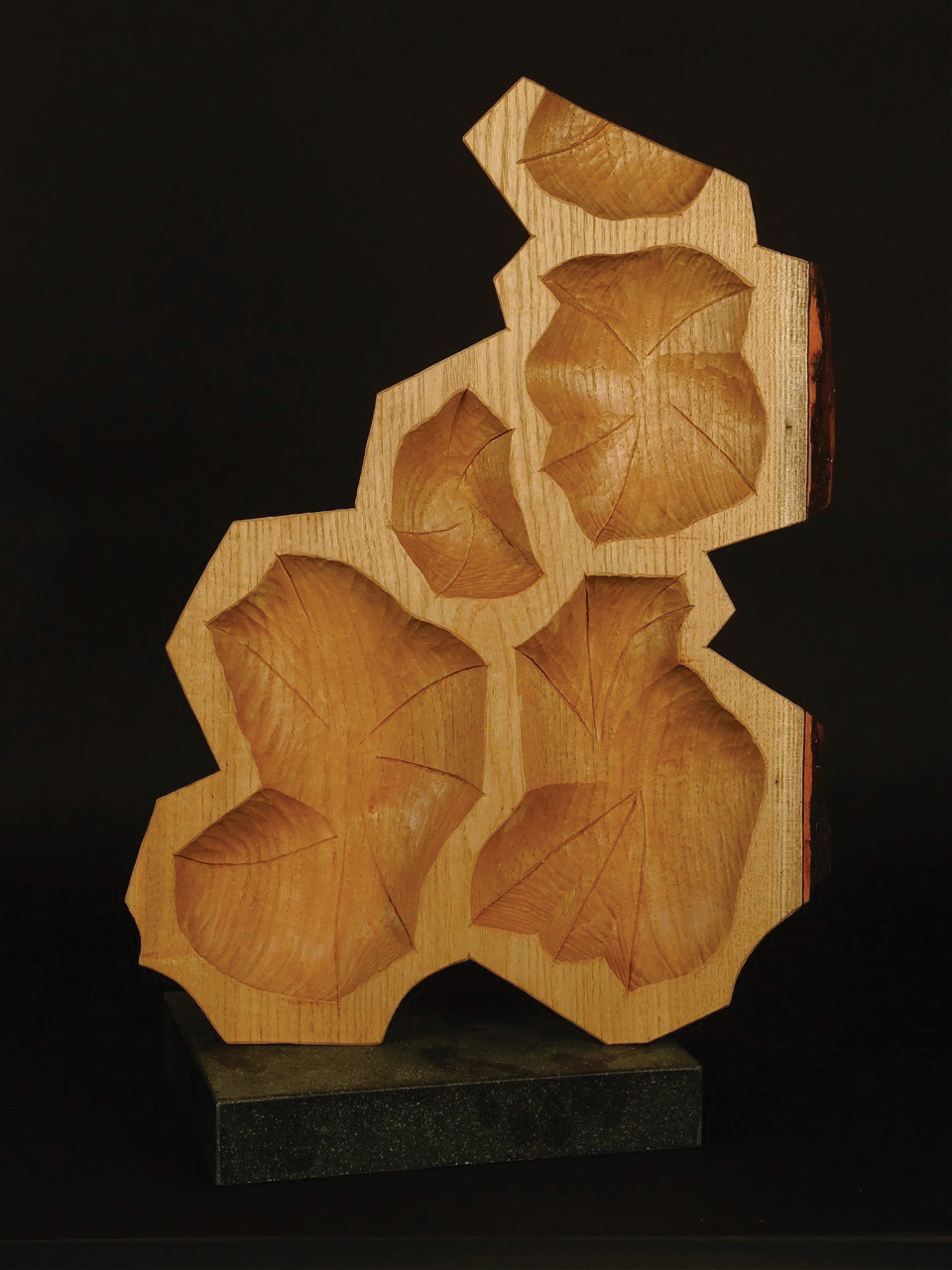
Drew has been spending a lot of time with his “Bhuto Dancer II” (which he talks about in “Country Woodcraft: Then & Now”), a sculpture made from a fallen remnant of a scrub apple tree.
“Right now I’m involved with the real painting on it,” he says. “It’s no longer just flat white and it’s been a really tough one to paint to get things right. I didn’t have an exact vision at all how it’s going to be once painted. I’m getting there, I’m almost there. And then I have some other old pieces of wood that were hollowed out that I’m saving. There are some that are real easy to work on but the one I want to do next is another one that is very unique. It’s a hollow log with dried fungus all over the surface which I’ve stabilized with lots of glue and epoxy. I have a form and what I’m trying to do is work with it to the point where the observer doesn’t think it’s a piece of a tree anymore. It’s an experience that you have visually and tactilely that has actually nothing to do with how it started as a tree except that it can only be thought of as that as it is a tree that grew that way. And that’s that.”
Drew has made many small sculptures, including bowls, and several big outdoor ones.
“My hope for the future is that I get some kind of exposure and success with these things,” he says. “And so far I’ve had absolutely none. And I’m unwilling to try to market myself as an artist. I’m hoping to be discovered.”
‘I Like Life When it’s Good’
When talking about a life philosophy, Drew says he simply tries to be honest and fair.
“Just the golden rule,” he says. “I don’t like to see people get cheated and I don’t want to have anything to do with that kind of thing. And I want to participate as much as I can and try to feel. I like life when it’s good. It’s a struggle. This year, of course, was an extra tough one with two big medical things plus America and Covid. But I’ve done pretty well.”
Drew dealt with both prostate cancer and quadruple bypass surgery this year. His bloodwork has been very promising where the cancer is concerned. Heart health, he says, never ends. Drew’s father died from a heart attack at age 56. And while Drew has lived a pretty heart-healthy lifestyle the last 30 years, he knows he carries those genes.
“A phone conference with my doctor ended with him saying I want you go and get a stress test this afternoon,” Drew says. “I foolishly put it off for a week but I did it. And at the end of the test the evaluating doctor said, ‘I have some bad news for you. You flunked the stress test. The doctor and I want you to go to the hospital right now.’ By the next morning I was getting woken up from four bypasses. So that’s something.”
Living 50 miles from the nearest hospital, Drew says he was very fortunate the doctors ordered him to go to the hospital when they did.
For years Drew says he was involved in organizations trying to change politics in their area, environmental pursuits and peace pursuits.
“I still support those things as much as I can but now I just want to live,” he says.
In the meantime Drew is approaching life with the same anthropologic curiosity he’s had since he was a college student.
Right now he’s reading a 500-page biography of Francisco Goya, the painter. He’s excited to finish “Bhuto Dancer II.” He loves listening to music late at night – mostly jazz, but also some blues and rock-and-roll – often with headphones.
“It’s so easy for me and Louise,” he says. “There’s so many things that we’re interested in that are so fascinating to learn about. Just seeing how plants grow, what goes on. Did you see the popular movie ‘My Teacher the Octopus?’ Our world is just full of that fabulous kind of stuff. I don’t want to get dragged down by the things that are dragging us down.”
You can order “Country Woodcraft: Then & Now” (Lost Art Press) here. “Green Woodworking” and “The Chairmaker’s Workshop” are available from Drew personally, here. Simply include a note with the title(s) you wish to buy, and your mailing address. Payment is accepted via PayPal.
When we teach people to cut dovetails for the first time, I like to say that everyone on the planet is born with a certain number of sets of bad dovetails in their hands. And the only way to get rid of those bad dovetails is to make them. Eventually, you run out of bad dovetails, and you’re set for life.
The same is true with writing a book. Every time I start writing, there are at least three or four bad chapters that I have to write in order to get to the good ones.
When I say “bad” I don’t mean they consist of dirty Esperanto limericks or are written from the point of view of the wood (“Oh Reginald, plunge your chisel into my lignin and make my mortise walls tremble”). Usually the chapter is fine in the noun and verb department. It simply doesn’t fit in the book. Square-peg-round-hole stuff.
This week I finished up one of these orphan chapters. As I wrote its last few paragraphs, I realized it was going to be recycled. The tone is wrong. Part of the tone problem is that I’ve come up with a better title for the book, and the chapter’s meta devices (there are three points of view) are just wrong.
So here it is. Note that I threw a few placeholder images into the text to break up the grey scrolling. Normally a chapter like this would have 15-20 images.
— Christopher Schwarz
Read other posts from the “Making Book” series here.
How to Build Any Kind of Chair
We had an intern in our workshop who was an odd duck. He was – by the numbers – smarter than anyone I’d met. But when it came to the real world, he had difficulty dressing himself each morning or making sure there wasn’t a piece of scrambled egg on his mouth.
I’ll call him John.
We always insisted our interns build furniture during their summers with us, and the interns sat in our planning meetings each week and were told: Come up with an idea for something to build. You can build it, write a magazine article about the process and end up with a nice piece of furniture and an article with your name at the top. A good deal.
At his first editorial meeting as an intern, John had an idea.
“Have you ever thought about doing an article on how to build a chair?” he asked everyone assembled around the table.
I stifled an immense snort. I asked him: “What sort of chair?”
“Any kind of chair,” he replied.
There was an awkward silence. What John proposed was like writing a bi-fold pamphlet on building a nuclear weapon, or publishing the IKEA directions for ending world hunger. The topic of chairmaking is so huge and complex that writing a 2,000-word magazine article on how to build “any kind of chair” was the most ridiculous proposal I’d ever heard.
And that’s why, more than 20 years later, I can’t stop thinking about it. So, with all apologies to John, I present a magazine article submission titled: “How to Build Any Kind of Chair.”
<hed> How to Build Any Kind of Chair
<body copy> A chair is a platform for your butt that also offers support for your back. It may or may not offer support for your arms. That’s all there is – that’s the end of the definition of a chair.
Though the idea of a chair is simple, the thought of building one intimidates many woodworkers.
Once you understand how chairs work – there’s zero voodoo in it – I think you’ll find making any sort of chair to be straightforward. First you need to understand the numbers that make a good chair. Then the materials that make it durable. And finally, the joinery (if the chair has any – it doesn’t have to).
(Ed: No joinery? Are you not going to explain?)
Before we start talking about this stuff, here’s a trick that will help you remember these lessons. Find the most comfortable wooden chair in your house and fetch a tape measure, sliding bevel and protractor. As we talk about the numbers, the wood and the joinery, measure and examine the chair so you can compare it to your “ideal.” You will learn a lot.
<subhed> Chair by the Numbers
The seat should be between 15” to 18” from the floor. While 18” is the modern standard, that’s too high for short people. It pinches off the blood supply to the thighs. A height between 16-1/2” and 17” suits a wider range of people without making the chair uncomfortable for the gangly bunch.
(Ed: Need to attribute to “Human Dimension and Interior Space” by Julius Panero and Martin Zelnik)
A chair that’s too low can be difficult to pull yourself out of (which is not always a bad thing). And a low seat can encourage the sitter to kick out her heels. That posture might not feel as stable as when you have your feet flat on the floor. But I think that a too-low seat is better than a too-high seat. So, I always err on side of making the chair a little lower than a little taller.
The size – width and depth – of the seat is important. The seat should be about 16” deep, from front to back. Deeper seats stop the blood flow behind your knees. Shallow seats are not as big a problem as deep seats. I have made chairs with seats that are 13”-14” deep that sit just fine. Shoot for 16”. A little less than 16” is fine; a little more is not.
The width of the seat should be between 20” and 24”, unless the sitter is a pencil or an entire package of magic markers. If you make an armchair too wide, then the armrests will be too far apart to be comfortable. If you make an armchair too skinny, then the sitter might get wedged into the chair. This happens.
The seat should not be parallel to the floor, when measured from front to back. Instead, it should pitch backward a bit to encourage the body to slide backward against the backrest of the chair. If the chair is intended for typing or eating – where an upright posture is preferred – pitch the seat so it falls 3/4” from front to back.
(Ed: Are you sure that seats should never be parallel to the floor? What about stools? Swing-out seats? Might want to qualify your statement.)
If you want the chair for reading or conversation, double the pitch so it’s 1-1/2” from front to back.
If you make the seat parallel to the floor, the sitter might feel like he is being pitched forward. On the other hand, if you make the seat so it slopes 2” (or more) toward the back, you can force the sitter’s back into some unnatural positions, depending on the shape of the chair’s backrest.
I do not expect you to believe that such small changes make a huge difference. So do an experiment. Take a wooden chair in your house and prop up the front feet on 3/4″-thick blocks. Sit in the chair for about 15 minutes. Move the blocks to the back feet and sit for another 15 minutes – if you can stand it.
Oh, while we are putting blocks of wood under the legs, what about the angles of the legs? Aren’t they important? Yes and no. They can be straight up and down and still work, depending on the chair. Think about it this way: The footprint of the chair is what’s important. Think about the sitter and where her feet are and where her back is. If the front legs jut out forward of the seat, her feet might get tangled up in them. Or she might snag a leg as she walks by the chair.
For the back legs, you have to look at the backrest (more on those numbers shortly). If the chair’s backrest leans out a lot past the back of the seat, but the legs do not, then the chair will be tippy. Put another way, the feet of the back legs should be roughly under the shoulder blades of the sitter.
So, the angles of the legs are important. But mostly they control how the chair looks.
(Ed: But can’t you give a range as to what’s acceptable? What’s too much? 20° 25°? And don’t you need to say these angles don’t apply to ladderback chairs?)
The seat of a chair – what we call the saddle – can be scooped out so it’s curvy like the human buttocks or it can be as flat as a board. A little curvature improves comfort. A lot of curvature turns the chair into a Jell-O mold, which is uncomfortable. I aim to scoop out 3/8” to 1/2″ of the seat. But I don’t have a lot of cushion on my pelvis. You might want more or less scooping.
In the end, I err on a shallow saddle as it’s called. You can always add a cushion or sheepskin to a seat to make it more comfortable. A deep saddle cannot be fixed with fluffy accessories.
(Ed: Again, shouldn’t we mention ladderbacks here? The seat is neither flat nor “scooped.” It has some give to it because of the material. Might want to add something about this.)
Now let’s move to the backrest. Every chair has one, otherwise it’s just a stool. The backrest can be as simple as a flat board or a steam-bent slat. Or it can be as complex as a curve of bent and shaped spindles. In general, the backrest is designed to touch the back at one or two places: the lumbar (or lower back) and the shoulders. There is no rule that says which arrangement is best. As a chairmaker, I say that it’s easier to make a chair comfortable when it supports the shoulders. Chairs that support the lumbar only are trickier to make.
The backrest is rarely at 90° to the seat – thank goodness. The backrest should angle back. I think 10°-15° is a good place to start for chairs made for eating or typing. For chairs designed for lounging, try 20° to 25°.
(Ed: Are you saying that ladderback chairs with 90° backs are uncomfortable? You are going to catch flack for that.)
For chairs that support the lumbar, the sitter’s back should encounter the backrest about 9” or 10” above the seat. For chairs that support the shoulders, the sitter should encounter the backrest between 16” and 22” above the seat. How they encounter the backrest is up to you. It can be an array of spindles, a curved piece of wood or even a cushion.
The armrests (if your chair has them) should be about 8” to 10” above the seat. Luckily this height is similar to where the lumbar is, so you can make the backrest and arms as one piece that does two jobs.
<subhed> Wood for Chairs
It’s easy to become a fundamentalist about how the wood in a chair must be perfect and straight and strong. Not every chairmaker works this way. If a batch of wood is weak for some reason, you can overcome this by using thicker stock. If, on the other hand, you have perfectly rived stock, you can make it pencil thin and the parts will flex but not break.
The goal of all chairmakers is to avoid “short grain,” which is where the grain doesn’t follow the shape of the part. Short grain makes the part prone to splitting. You can avoid short grain lots of ways. The bottom line is to pay attention to the wood and adapt your plans to suit it.
Let’s talk about the different parts of a chair and the kind of wood that’s ideal for each.
For the legs, spindles and stretchers, the grain should be as straight as possible. Ideally, the wood fibers should run dead straight through every piece. That’s why many chairmakers prefer rived wood, where the wood is split along the fibers.
Not everyone can get rived wood with ease. The (not always mentioned) alternative is to saw the wood along the grain to get the straightest grain possible. This produces excellent results. For these straight components, many chairmakers prefer oak, ash or hickory. You can use other species, such as walnut, beech or cherry, but you should consider beefing them up in size.
(Ed: Can you say how much you should beef up the spindles when they are walnut etc.? Maybe 1/8” in diameter? Or is there a test? Maybe striking them with a small sledgehammer?)
For a solid plank seat, it’s best to use a species that doesn’t split easily. Pine and poplar are popular choices in the United States. The elms are excellent seat material. But really, anything will do for a plank seat. You can also make a seat by creating a joined frame and wrapping it in a fibrous material (such as bark or cloth). Or upholstery.
(Ed: Really, pine? White pine? Aren’t you worried about a lawsuit here?)
The arms and other curved components can be sawn out of solid wood or steambent to shape. You also can use a modern cold-bend hardwood (which works a lot like steambent wood without requiring heat).
(Ed: Can we give a source for this “cold-bend” stuff? A search turns up “Pure Timber LLC” in Washington.)
If you saw a curved component out of solid stock, you definitely risk it splitting because of short grain. You can get around this problem by laminating three or four pieces together to reinforce the short grain. Yup, just like plywood. This is an old trick.
A lot of would-be chairmakers get worked up about the sizes of all the components. How thick should each component be so the chair is strong enough to hold a person without breaking? Just like with casework, chairmakers use woods in fairly standard thicknesses.
Legs, stretchers and seats are made from 8/4 stock (which is 2” thick in the rough and finishes off at 1-5/8” to 1-7/8”). Arms are typically made from 5/4 (1-1/4” in the rough that can finish out at 1” to 1-1/8”). Sticks or spindles are usually 3/4” at their thickest and taper to 5/8” at the seat and maybe 1/2″ at the top of a tall chair. However, sticks are usually cut from thicker stock (such as 8/4) so you can straighten the grain and get a strong component.
In the end, almost any wood can be used to make a chair. It might have to be a little thicker than what you see in the woodworking magazines. You might have to glue up a few thicknesses of wood to avoid short grain. And the wood might be so ugly that you have to paint it. But know that even construction lumber can make a good chair. I’ve done it. You just have to be smart about it.
<subhed> Chair Joinery
There are three (no four) kinds of chair joints:
A squared-off mortise-and-tenon joint – the same joint used in casework. The only notable difference is that chairs require better-quality fits than casework. Unlike a cabinet, chairs are tortured by children and won’t hang on the wall in peace.
Cylindrical joints. The mortise is round, as is the tenon. The fit needs to be snug. And there are tricks to make a wet mortise tighten up on a dry tenon. Truth: Dowels are cylindrical joints, though they are often used poorly.
Conical joints. These joints are typically used where the legs enter a plank seat. They tighten the more you sit on the seat, but they require special tools to ream the hole to the conical shape.
Mechanical fasteners. Some chairs – particularly commercial ones – are joined by screws, nails or fancier hardware that provides a mechanical lock. To be honest, if you throw enough wood and metal fasteners at any object you can make it sturdy. But it is unlikely to be graceful. In general, metal fasteners play a limited role in traditional chairmaking. Except to repair old chairs, which is where they often make things worse.
No matter what sort of joint you use in chairmaking, the fit between the components is the key to the joint lasting a long time. Tenons should require effort to enter the mortise. Wedges or pegs should be used whenever possible to reinforce the joint. And use glue. Some purists insist you don’t need it. While that might be true, glue is dirt cheap and doesn’t hurt the strength of the joint. So why not paint some on during assembly?
<ED: Rough transition here. Can you add something that eases readers into the final grafs?)
Of course, none of the above information tells you how to make a chair that is attractive. That is the hard part. And unfortunately, there isn’t a magazine article out there with the headline “How to Make Any Chair Look Good” to help you.
(Ed: Maybe this is a possible article for the June issue?)
So how do you make a good-looking chair? The answer might be right in front of you. If you took my advice above and examined the best chair in your house while you read this article, then you took an important first step. To design nice chairs, you need to look at lot of chairs – old, new, ugly and gorgeous. Find out what separates the fantastic from the flatpack. Measure the angles – your eye can be easily deceived. Make sketches of the chairs you like the most.
But most of all, build chairs. The next one will be better.
<bio>
Christopher Schwarz is a woodworker and writer in Covington, Ky. He is currently at work on his next chair, which really will be beautiful this time.