If you’re traveling through Covington for the holiday weekend and planning to stop in at the Lost Art Press storefront, please do – on Friday between 10 a.m.-2 p.m. We’ll be closed on Monday, Sept. 1, for Labor Day.
Regular hours resume on Wednesday, Sept. 3 (M-W-F 10 a.m.-2 p.m.). The storefront is located at 407 Madison Ave., Covington, Kentucky.
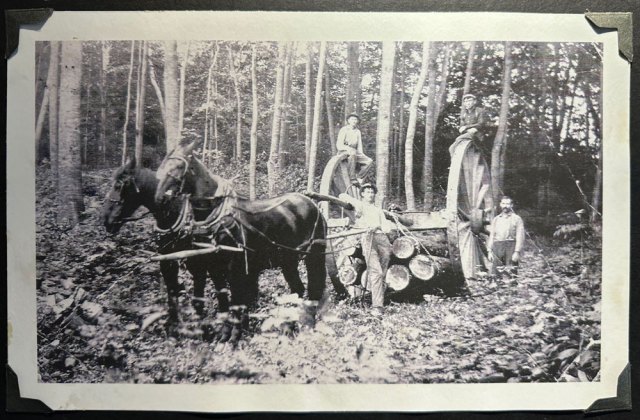
A great exhibit on early Michigan logging I found recently during a trip.
Almost every week – especially during the summer – we get messages from readers who want help with an upcoming trip. They are headed to Kalamazoo, Michigan, and would like a list of woodworking stuff in the area that they can visit.
For me, answering these questions is time-consuming. I have to go back and consult my notes, my blog and my photo library. Then I have to find the websites for these places and write a sentence or two about why this place is important.
Well, I’m not going to answer these questions anymore. Instead, I’m going to send readers to the blog entry you are reading that explains how I research an area for woodworking sites before I visit it.
And we’re also not going to publish a woodworking travel guide. Most published travel guides are for people who are too lazy/clueless/disconnected to do a little research themselves. And we don’t have the resources (or desire) to publish such a guide.
(Apologies if I sound salty. I’m not.)
Note that my woodworking interests are different than yours. I don’t get goo-goo eyes for veneer mills, ornate palace furniture or places that sell only exotic hardwoods. I like to look at furniture made for normal people, old workshops, factories and museums that specialize in vernacular furniture and architecture.
Anyway, here’s what I do before I travel.
Many open-air museums have relaxed rules about examining the furniture.
House Museums, History Museums & Open-air Museums
This should be obvious. Seach for the name of the place you are going, <place name>, plus the word “museum.” Remember that Americans tend to think of cities as places. Other cultures might think in terms of provinces or regions. Usually this sort of search will call up a lot of the high-class places that feature oil paintings and sculpture. If they have any furniture, it’s likely to be fancy.
And that’s why my next search is <place name> plus “history museum.” Every little town with more than 100 people is bound to have a local history museum. And these hidden gems almost always have furniture pieces that were owned by the founders or made in the area. Plus, the volunteers who work there are almost always a fire hose of information about the area. Searches on the internet don’t always turn up every museum or installation because some of them are too obscure.
Next search: <place name> plus “open-air museum.” Or start here. This list is huge, but most of the open-air museums I have visited are not on it. What’s an “open-air museum?” Typically it’s a place where a bunch of buildings from different eras have been gathered. (Usually the buildings were going to be torn down.) Most times, these building are filled with furniture and wooden decorative objects – spoons, plates, goblets, racks, buckets and on and on.
You get to see pieces in context. A visit to one of these museums can fuel a lifetime of research.
If I’m headed to a big city, I’ll try <place name> plus “decorative arts.” Some museums lower themselves to have a decorative arts wing. And one of the decorative arts is furniture.
Or I’ll look for museums of “farm life” or agriculture.” You might have no interest in farming, but the exhibits will be filled with handmade woodwork. I think you need to see handmade hayrakes and pig benches and dough bowls.
Finally, I’ll look for “house museums.” Sometimes the words “house museums” don’t call up what you want. These places might be called the “Aiken-Rhett House” or the “Nathanial Russell House” (two of my favorites in Charleston, S.C.). Sometimes these house museums are masquerading as a history museum or a museum about a person, such as the Harriet Beecher Stowe House in Cincinnati, Ohio. So when you look for <place name> plus “museum,” scan the list for museums that are the “Fancy Lord & Lass House.” They’ll have furniture. It might be fancy. But they probably also had servants. And their furniture can be quite compelling.
Craft Fairs & Craft Galleries
Most towns and cities have craft fairs and farmer’s markets on the weekends. There you will find woodworkers: carvers, turners and furniture makers. You might also find a blacksmith or two (for hinges, hooks and nails). Go to Germany during November and December, and you’ll find endless amounts of woodworking at each town’s Christmas market. And you’ll find woodworkers to talk to as well.
Antique Malls & Galleries
I love antique malls when I’m looking for tools and oddball furniture ideas. And I love antique galleries when I want to see expensive stuff (even if it is expensive vernacular stuff, like at Robert Young Antiques). Also, if you are going to Europe, look for “folk art” galleries or “art brut” galleries. Over there, “folk art” is not just “art,” it also encompasses furniture and decorative objects. And Europe has a ton of it.
Factories Old & New
I love visiting factories that make furniture, tools and almost anything else (paper, paint etc.). While visiting Holland, Michigan, a few years ago Lucy and I found a lot of old Arts & Crafts factories in the area. Plus the corporate headquarters for Herman Miller. What, they don’t offer tours on the website? Don’t be shy. It doesn’t hurt to walk in, be nice and ask if someone could give you a quick tour. (I’m always happy to give a warehouse tour to visitors who ask.)
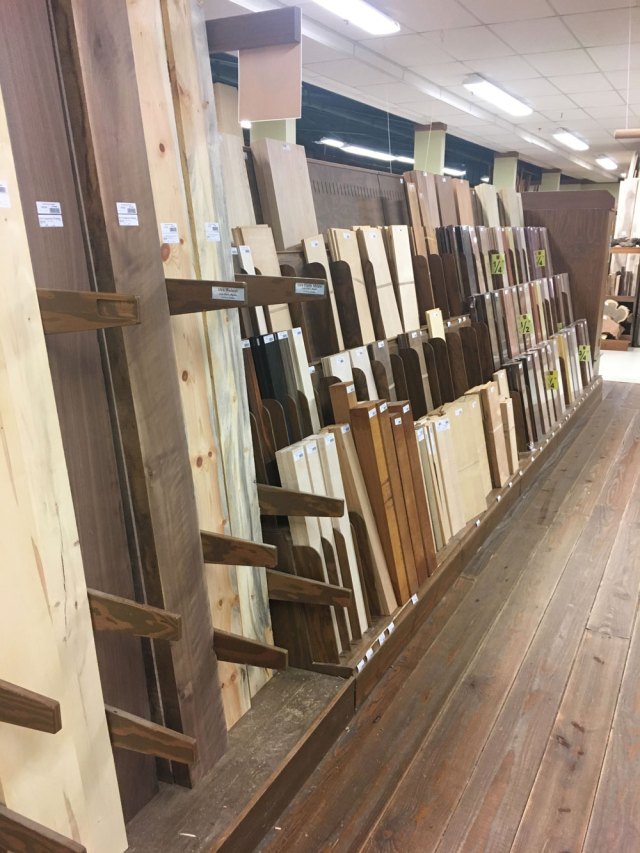
A crazy selection at Keim.
Lumberyards & Mills
Another obvious one. If there are interesting lumberyards or mills in the area, I’m going to pay them a visit. And if it’s a mill or a kiln, I’m going to ask nicely for a quick peek or tour. Plus, I just love looking at wood. While at Keim Lumber in Millersburg, Ohio (Amish country), I spent an hour looking at their wood selection. They specialize in domestic species that other mills won’t cut, dry or sell. Have you ever seen Tree of Heaven for sale? They have it.
Silviculture & Forestry
If <place name> has trees or public forests, those are a great way to connect with an area. What sort of trees live here? (I use my “Picture This” app on my phone to explore the different species if they aren’t labeled). Botanical gardens can be awesome, or they can be all about flowers.
If you don’t like walking amongst the trees, you probably haven’t tried it.
Curiosity on the Ground
Most of all, talk to people while you’re at <place name>. Tell them you make furniture. Most people will be fascinated and helpful in your search for things relating to furniture, tools and wood.
I think that the internet is incredibly lacking when it comes to exploring the real world. A smile and an honest question can go a long way.
This comb-back chair is based on the chair on the cover of “The Stick Chair Book,” with some modifications detailed below. The finish is fresh milk paint (a recipe from a forthcoming book) tinted with a French mineral pigment called “saffron.”
This particular chair is set up for lounging. This summer, I have been tweaking this design to make it more suitable for reading by the fire. The back is pitched at 20°, and the seat (about 16-3/4″ high) has some additional pitch. The chair is quite comfortable, and I wasn’t keen on selling it (which is rare for me).
The seat, legs and stretchers are in red elm, which is tenacious and lightweight. The arm and comb are white oak, which bends well. And the sticks are fast-growth hickory, which is flexible and strong. All the joints are assembled with hide glue, which we make from scratch here.
In addition to changing the seating geometry, I made some small design changes to this chair that I’m happy with. The stretchers are now oval/rectangular octagons, which makes them a little lighter (visually) but just as strong as equilateral octagons. Above the seat, I omitted two of the short sticks to create some negative space between the back sticks and the short sticks. This gives the chair a bit more of a Welsh feel and breaks up the solid wall of sticks presented in the original design.
The arm has the most changes. It’s steambent, like the original design, but is now fully shaped with spokeshaves. The original design had chamfers. The hands taper to a bit of a point (an old shape that I love), and the tapers lean toward the outside of the chair, giving it a welcoming look. All these design changes will be discussed and explained in the forthcoming revised edition of “The Stick Chair Book.”
The finish is a durable milk paint we make here at the shop. It has a low sheen, unlike the chalky look of commercial milk paint. No topcoat is necessary. The paint, applied by Megan Fitzpatrick, shows some subtle variations of color in places — it’s not an automotive finish. The chair as a whole was shaped entirely by hand, so there are subtle tool marks evident. These are the by-products of handwork.
How to Buy the Chair
The chair is $2,300. That price includes shipping and crating to anywhere in the lower 48. If you wish to buy the chair, send an email to [email protected] before 3 p.m. (Eastern) on Wednesday, August 27. Please use the subject line: “Saffron chair.” In the email please include your:
U.S. shipping address
Daytime phone number (this is for the trucking quote only)
If you are the “winner,” the chair will be shipped to your door. The price includes the crate and all shipping charges. Alternatively, the chair can be picked up at our storefront. (I’m sorry but the chair cannot be shipped outside the U.S.)
Editor’s note: Our Mind Upon Mind series is a nod to a 1937 Chips from the Chisel column (also featured in “Honest Labour: The Charles H. Hayward Years”), in which Hayward wrote, “The influence of mind upon mind is extraordinary.” The idea being there’s often room for improvement.To that end, we’ve asked you what else you have thought of, tried out and improved upon after building projects from our books.
Send us your own ideas! Email [email protected]. You can read more about the submission process here.
I used a wire brush all over the chair to wear down the softer earlywood, to give it some texture.
Then a lot of burnishing with a deer antler and a smooth rock, especially near the hands and at the back of the head rest.
Then, a mix of BLO (boiled linseed oil) with some earth pigments, more like a wash than a paint, just to get a consistent deep color underneath.
Then I made a thick mix of Old Fashioned Milk Paint in Lexington Green, and globbed it on and wiped it off, mostly around sticks. The oil was dry, but I didn’t want it to cure because I wanted to be able to wipe some of the paint off.
John Porritt uses a heat gun to get the paint to peel, but I didn’t want to light mine on fire yet (with the layer of BLO underneath), so I just tried to let it dry a bit before rubbing it off. That helped it come off in patches.
Then I did the same with Real Milk Paint Co. Arabian Night on the top. I had to use a 3M pad with a little water in places where the paint needed to be blended better.
Then, I mixed a little burnt sienna pigment with BLO again on the top (like a wash), rubbed that in, then some Liberon Black Bison wax in dark oak.
The following is excerpted from “The Intelligent Hand,” by David Binnington Savage. It’s a peek into a woodworking life that’s at a level that most of us can barely imagine. The customers are wealthy and eccentric. The designs have to leap off the page. And the craftsmanship has to be utterly, utterly flawless.
Personally, this book makes me want to draw and create every time I pick it up. It is a reliable source of inspiration to me, a reminder that creative time is not wasted time. And David’s writing is just fun to get wrapped up in.
I was fortunate; I was not destined for the production line. I was lucky enough to go to the wonderful art school at the University of Oxford that was set up by John Ruskin, the great theorist at the centre of the Arts & Craft Movement. Ruskin believed that art should be taught at places of great learning, that art students would benefit from being at the centre, right in the hum of the academic process, and that in turn those universities would be enriched by their presence.
Ruskin set up three art colleges: The Ruskin School at Oxford, The Fitz William at Cambridge and The Slade College at London University. Although The Slade has since prospered and gone on to become one of the greatest post-graduate art schools, I don’t believe that all three were universally welcomed by “the Dons.” The Fitz William is no more, and my own experience at Oxford suggested that The Ruskin School was not entirely loved by the University. We were always damned by the idea that as art students we could not be given a proper degree because we were “not academic enough.” The intelligence that we displayed daily was of the wrong kind for the Dons (the professors).
William Morris and his buddy Edward Burne-Jones were at Oxford at Exeter College. They shared lodging in the same street as me, but many years earlier and probably in much greater comfort. My time at Oxford was the late 1960s, concurrent with the brand-new contraceptive pills, very, very short skirts, the very beginnings of feminism and all the fun that entailed.
The Ruskin School was then situated in a wing of The Ashmolean Museum. We had three large studios, one of which was devoted entirely to life drawing and painting. Before you were allowed to draw from the nude you needed to serve a full term’s apprenticeship in drawing plaster casts of Greek statuary, mostly from the Parthenon. This was mind-numbingly dull, but it gave you great discipline in the simple task of looking very, very hard.
We were in a gallery in Walton Street about 200 yards from the Ashmolean. An ancient but much loved and respected tutor named Geoffrey Rhodes would slowly, very slowly, make his way from the school to the cast gallery. He was a small man who took tiny, painful steps. I was the only student diligent enough to be drawing at three in the afternoon. It was silent in the gallery. The outside door opened; I could hear Mr. Rhodes’ approaching footsteps. Tap, tap, tap. It took ages.
“Ah, there you are David,” he said. Slowly, he looked at my drawings, then put his whiskery head next to mine to see what I was looking at. To see exactly what I was looking at. “Ah well, not much I can help you with there, carry on.” He then turned and tapped his way back to tea and cakes in the staff room. Drawing is like that; there are times when words just don’t do it. Mr. Rhodes knew that, which is why he was universally loved and respected.
This was at the time of “The Hornsea Art School Revolt.” The school’s studios in London were being filled with dry ice, smoke and writhing naked bodies. “Happenings,” laced with LSD and weed, were “what we did now.” If you painted, it had to be a kind of Mid- Atlantic Expressionism: big vacuous canvases, lots of sloshing about and full-on freedom of expression.
I didn’t work this out until much later, but all these developments were about de-skilling young creative minds. The Conceptual Art that won the “Salon” and that has become the Official Art of my generation needs no skill – just ideas. For it, skill is a restriction and inhibition to creative expression. Which is, of course, nonsense.
What I came to learn at art school was how to draw, how to look, how to think visually. This was slowly, gradually being devalued and removed from the curriculum. All the skills were being chucked out of the art school window to the point that now, a generation later, we have few capable teachers left to teach the basic drawing skills.
I had come to learn to draw; I felt this in my waters. I loved the daftness of all this at Hornsea, especially the writhing nakedness, but something within me wanted to have the skill to draw and draw well, which meant practice. Ten thousand hours, they say, to achieve any skill or competence. Like a pianist, I knew that it was necessary to practice.
I had come to learn to draw, I felt this in my waters. I loved the daftness of all this at Hornsea, especially the writhing nakedness, but something within me wanted to have the skill to draw and draw well.
The Ashmolean Museum is a wonderful place for a young, visual mind to explore. In it, there’s everything from Egyptian sarcophagi to Samurai armour, from Minoan figurines to Classical Greek statues. The classical Greek dudes were a big deal for me. They were in a long gallery between the drawing studio and the front door. A small ragged group of us would gather at the front for a cigarette every time the model took a break. We sat on the stone walls outside the main doors, got piles (hemorrhoids) and had monumental snowball fights. We really were a scruffy nuisance to have in a museum, but it was the best place to be. I absorbed the Ashmolean though the pores of my skin. In three wonderful, full years I knew what the artefacts of world culture felt and looked like. My eyes had wrapped around and embraced everything, whilst probably I knew very little. What I did know, however, included a small collection of Raphael and Michelangelo drawings of which I devoured every line and every nuance. It was BBBBBBBbrill. Did I tell you I had a stammer?
Stammering was an affliction I carried with me throughout childhood and school into my middle years. It was an invisible affliction. I didn’t look like I was crippled in any way, but to a large degree, it stopped me from speaking. My mouth would jam up with words beginning with “B” or “M.” I could see them coming up ahead in the sentence. It was like lockjaw – I was left humming, buzzing and dribbling, trying to push out a word that had jammed in my mouth. The more effort I put into getting the word out, the tighter the lockjaw.
To say this affected my life would be an understatement. Think what your life would be like if you couldn’t talk. That’s unfair. I could talk – it’s that I chose to not talk very much. It was irritating when it came to girls and no doubt restricted my sex life when I could have had much more fun. But isn’t that always the case? We all could have had much more fun when looking back. Much later, I was able to get past this obstacle, but that is another story for later.
I wonder if Burne-Jones and Morris got piles from sitting on the same stone walls outside the Ashmolean? They certainly inhabited the same space. For Morris, brotherhood and comradeship was a big deal. He gathered about him members of a group of young painters who were to become the rather pompously titled Pre-Raphaelite Brotherhood. They later went on to paint up a storm. Then, they painted with startling lack of success, the walls of the Oxford Union.
Morris was always wrapping fellow artists and writers about him like a warm cloak. Blessed with a background that meant a few shillings were not a problem, he could focus on ideas and ideals. Here, Ruskin came to influence both Morris and his group. “The Stones of Venice” was a powerful and popular thesis published in three volumes between 1851 and 1853. The books examine Venetian architecture in detail. In “The Nature of Gothic,” a chapter in book two, Ruskin gives his view on how society should be organised:
“We want one man to be always thinking, and another man to be always working, and we call one man a gentleman, and the other an operative; whereas the workman ought often to be thinking, and the thinker often to be working, and both should be gentlemen, in the best sense. As it is, we make both ungentle, the one envying, the other despising his brother: and the mass of society is made up of morbid thinkers and miserable workers. Now it is only by labour that thought can be made healthy, and only by thought that labour can be made happy, and the two cannot be separated with impunity.”
Wow. Tell that to Henry Ford.
I have worked night shifts at Black & Decker. I worked a machine that bored a part of the casing for an electric drill. These were the industrial “top of the range” drills. Learning to do this well took about two shifts. After that, what could I do to keep my mind occupied? I had a total number of casings to do in a shift; too few and I had the charge hand on my neck. Do more than this, however, and the union guy was going to give me earache. So you play: How fast can I go for an hour? Then how slow? How few could I make in the next hour? I needed the money but after a while, when I had paid my bills, I joined the 863.
Morris picked up Ruskin’s social ideas and ran with them. Known initially for his poetry, Morris again assembled a group of trusty creatives to create William Morris and Company. The goal was to create, improve, make, have made and sell stylish artefacts for the burgeoning middle-class home.
The Muse came to Morris and found him working. (The muse has always got to find you working!) His inspiration was the English countryside, not just the generality but the very core of how nature fits together. I believe this is why the movement has so much resonance for us now. Not what Morris did – his shapes and forms, the wallpaper and fabrics – but why he did it, and the way he was looking at nature. Morris gave us a Victorian response. Why can we not look at nature and give a 21st-century response?
Morris rented Kelmscott House near Oxford – a beautiful, warm, stone house with a mature garden full of perfumed summer. During his time there he developed something that touches the essence of nature herself. His drawings were cleverly arranged into repeated images that could become wallpapers or woven tapestries.
It was typical of Morris to spend a part of the week “in the doing” – weaving, drawing, printing. The making was important to him, and he was not afraid to bring back old techniques. His textiles needed skills, looms and processes that could be found abroad and recovered from obsolescence.
The Arts & Crafts Exhibition Society poster below shows in part the ideas that were evolving – the artist and the maker shaking hands as equals, with mutual respect.
“Let you have nothing in your home that is not both beautiful and useful.” That was the strap line of Morris and Co.
Oscar Wilde answered that with: “The definition of Art is that it is useless.”
First-class, Oscar. His argument (which has little historical validity) in the following years won the day. The creative force of the 20th century has very largely created an art that defines itself as useless.
Leaving this battle (yet to be lost), the Arts & Crafts movement encouraged a new generation of makers, often young men and women with sufficient resources, to set up small workshops outside the cities that were close to nature. These were jewelry makers, potters, weavers, silversmiths. The new railways would take their product back for Morris and others to sell, and they could live the rural idyll.
It was the furniture makers who particularly affected me. They were part of a small group that settled near Cheltenham. Each year, I take a group of Rowden students to see their work at the Wilson Museum in Cheltenham. I do this to show them the freshness of the workmanship and to remind myself of the essence from which Rowden has come.
Rowden students examine a table base by Ernest Gimson at The Wilson Art Gallery in Cheltenham.
For me, their move to the countryside was most important. It was the closeness to nature, having it around you every day when walking the dog, seeing the changes in the hedgerow as season followed season. Remembered changes from last year become marked in your work. You get closer to the raw bones of nature, and your work benefits. You bring home bits of hedge and draw, not knowing why, but feeling that it is part of the process – and you trust your feelings.
Two brothers, Sidney and Ernest Barnsley, and a good friend, Ernest Gimson, all young, all recently trained as architects, took to this idea of living and making out in the sticks. They came to the quiet Cotswold village of Sapperton (not far from Cheltenham) and set up small workshops. Sidney Barnsley worked alone, always. Ernest Barnsley spent a little time with Gimson, but soon gathered a commission for work at Rodmarton Manor and became engrossed in that. Gimson is my hero. He worked not alone but with the help of both local and imported craftsmen. Probably learning as he went, Gimson, with his assistants, created a place that turned out extraordinary furniture.
The table shown above is made in solid English walnut with black Macassar ebony and pale green holly detailing. The boards of the tabletop are secured with a decorative dovetailed key. The hide glue would probably have secured the joint, but these were joints to express, to show off the workmanship.
Each year I delight in showing the freshness of the workmanship displayed in the wide chamfers worked in the hard black ebony. Tool marks are evident; they could only come clean off the spokeshave or drawknife. This is stunning work.
The goal of this small group was to make pieces with integrity, very largely by hand. There is almost no veneer from the early Gimson workshop; what you saw was what you got, all the way through. Gimson worked with local craftsmen, notably Henry Clissett and Edward Gardiner, who were skilled chairmakers. Clissett was notable for aiming to make chair a day and rush the seat in an evening. Gimson aimed to take these traditional chairs and improve the product, using his design skills in conjunction with the craft skills of Clissett and Gardiner.
The Edward Gardiner chair, also at The Wilson.
Here is an example that blows me away (above). This is a chair reworked by Gimson but made by Gardiner. Look at the chair back. Look at the arrangement of the back splats. Five of them all different, each getting larger as our eye climbs up that back. This chair is aspirational – it seeks to pull the eye up, a positive upward movement. Look at the chair legs. They can’t outward toward the top, welcoming the body into the chair. See how the back splats are arranged on the chair. Look hard. The centres are each wider, one from the next. The ends are each wider, one from the next. The splats are fixed with a negative space that is wider, one from the next. But look at the centre. The top of each splat is the same distance from the splat above. It’s as if all is upward energy, every element is up – but this is like a string in the centre of the chair back that pulls down. You don’t see it until you hunt – but it’s there.
This is what a good chair design does; it teases the eye to find the hidden logic. It is just there. You could not change one element without binning the whole lot. Gimson must have driven Gardiner mad (until the orders came in and the money followed).
It was not so much the work that grabbed me by the throat, it was the activity. These men and women were contrarian counter-culture beings, and I liked that. They set themselves up in the wilds of rural England when transport and communications were ridiculously hard. The move to the country was a serious decision and one I support, working at Rowden in the heart of rural Devon, with a lake to chuck the dog in and fields to walk.
The library at the Bedales School, which involved the talents of several great designers and woodworkers.
Although Gimson is my role model, it was the other guy, Sidney Barnsley, the guy who worked alone, who had another most serious effect. He had a son, Edward Barnsley, who, confusingly, also became a furniture maker. Edward Barnsley came to work at and later own a workshop at Petersfield in Hampshire. The man who founded the Petersfield workshop was Geoffrey Lupton, a former apprentice of Gimson’s who was largely responsible for the library at the nearby Bedales School (above). The building was designed by Gimson, the tables in it are by Sidney Barnsley and the chairs are by Gimson. The building was started by Lupton but was completed by the workshop under the direction of Edward Barnsley.
I nearly wrote “finished by Edward Barnsley,” when really it was the team that he led – a group of clever intelligent makers, probably capable of telling the lad, “No boss, it’s got to be this way.” Our culture doesn’t allow us to name everyone; it’s bad enough to acknowledge they are even present – but they damn well are there. And it’s this presence, a team working together, with different skills pulling together, that makes something extraordinary.
The Edward Barnsley Workshop continues to the present day. In 1950 they took on apprentice Alan Peters, who went on to open his own workshops at Cullompton in Devon. It was this man who gave me a model to follow. I admired him so much. With a lovely Devon long house, the barns converted to workshops, the stacks of English hardwood drying in the sheds, and his two skilled assistant makers, he made beautiful, saleable modern furniture. He was the man I wanted to become. But that’s another story.