Art Deco inspiration. “I love Art Deco design,” writes JoJo Wood. “I have always had a great fondness for it — one of the many reasons I love visiting the States: such inspiring architecture. When Sean & I got married we made our own wedding rings out of old silver spoon handles, with Art Deco designs on them. My Art Deco spoons started with inspiration taken from our wedding rings, and have evolved from there… I take a lot of pictures of cool buildings, amongst other things, to translate into spoon designs.”
In the late 1990s, when JoJo Wood was just a few years old, her parents moved from the county of Essex, northeast of London, to Edale in the Peak District of Derbyshire, between the industrial cities of Sheffield and Manchester. A tiny village in a remote corner of north-central England, Edale attracted hikers, especially during late summer and fall, when its hills were cloaked in purple heather. Many of these visitors also turned out to be interested in another local offering: spoon carving courses taught by JoJo’s parents, Robin and Nicola. When JoJo was about 13, the family moved from a stone cottage “in the middle of nowhere – the last house on the Pennine Way” – to the village center, where they taught their craft in the village hall. “Rob would do all the axing and rough carving, and then Nic would finish them. She has a design background and eye for aesthetics.”
They often roped their daughter into helping. JoJo can’t recall exactly when she started using a knife, but she knows it was when she was “definitely very young. I had quite a short attention span,” she continues, “so I never really made objects. It was mostly swords and spears to fight my brother with.” (That’s her younger brother, Ollie, now 24.) People would come for the courses and stay in the village, carving spoons during the day, then tack on a couple of days to go walking in the hills.
Start them young. Nicola showing JoJo how to work at a shavehorse.
A quick study. JoJo at the shavehorse, working on her own.
Robin’s teaching wasn’t limited to the village hall in Edale. He taught in other parts of England, as well as internationally, and always tried to take the family with him when he traveled. That’s how JoJo came to meet famed Swedish woodcarver Wille Sundqvist, whom many consider one of the fathers of green woodworking, when she was just 8 or 9. While she appreciates the honor of having met Wille in person, she admits that as a kid, “all the talk about knives got boring.” Still, when their hosts brought out knives as gifts for her and her brother, she accepted hers graciously and says “That was my first knife of my own.”
JoJo and Ollie with Wille Sundqvist.
Fast forward a few years. “Every teen-ager goes through a stage where everything their parents do is the least cool and they want nothing to do with it.” So she explored other things. JoJo took the GCSEs (General Certificate of Secondary Education) at 16, then went to what Brits call college – usually what’s known as technical or community college in the States – in Chesterfield to study art. “I struggled a lot with my mental health,” she says, acknowledging a challenge faced by many at the transition to adulthood. As a result, she didn’t get far before dropping out. The following year she tried A-level studies (roughly equivalent to junior and senior high in the States) but dropped out at the start of her second year due to depression and anxiety.
“I was later, in my early 20s, diagnosed as autistic,” she explains. “That probably has a lot to do with my struggling…. This undiagnosed autism made me not fit in very well. It helps me be kinder to myself about some things, because I really struggle in a lot of situations. I remind myself that it’s not my fault; it’s just the way my brain works.”
At 18 or 19 she dropped out the second time. “I spent time in my depression hole,” she continues. While JoJo was growing up, her mother attended graduate school, where she earned a doctorate designing multimedia resources for teaching craft skills. She always spoke about how great it was to go back to university as a mature student. Thanks to her mother’s perspective, JoJo understood that she could return to the world of formal education someday if she needed a qualification. “That was a different opinion,” she says, from the prevailing assumption that anyone who did not complete a degree straight after high school was something of a failure. “It’s kind of sad that that’s how everybody viewed me when I didn’t go to university.”
Weaving a chair seat at Mike Abbott’s, here with “Danish cord,” a paper-based material, in a wavy twill pattern adapted for chair seats from the world of weaving. “I spent a lot of time seat-weaving during my time at Mike’s, and adapted quite a few patterns,” writes JoJo. The chair is a Mike Abbott-designed “lath-back.”
She spent a summer assisting Mike Abbott, who teaches chairmaking in Herefordshire, southwest of Birmingham. “You’d spend a week living in the woods, cooking on wood fires, sitting around the campfire, and you’d make a chair. Assistants help with projects, make tea, and so on. There I spent more time doing woodworking and also my first big teaching, although informally.” After helping people to make chairs and understand how wood “works,” she showed them how to carve spoons in the evenings.
When her dad was organizing the first Spoonfest with his friend Barn, she found herself once again roped in to help. She’d carved a few spoons by that time but “nothing that seriously.” One of her jobs was to put together the festival T-shirt, which had to list the instructors. “They’re all men,” she noted. It struck her as odd – those who’d attended her parents’ courses were fairly evenly mixed by gender. But there didn’t seem to be any women carving spoons professionally at that time, she says. “So…in a fit of feminist stubbornness, [I] decided that by the following year I would be good enough to teach.”
New and improved instructor line-up.
She spent the year practicing, and sure enough, was teaching that following year, 2013. “I was hooked,” she says. “Couldn’t put it down.”
If it seems a stretch to go from a remote village in the countryside of northern England to teaching internationally, all without the benefit of conventional higher education, JoJo’s trajectory is a little easier to comprehend when you go beyond her parents’ example and how they immersed their daughter in craft from her earliest years to consider the passionate interest and ambition her father demonstrated in researching and reviving a branch of woodcraft that might otherwise have been lost to history. Google Robin Wood and you’ll find he has “MBE” (Member of the Order of the British Empire) appended to his name, a great public honor recognizing his contributions to the survival of traditional British craft. For much of his life, Robin has made a living by turning bowls. No ordinary bowls, these; Robin revived the craft of pole-lathe turning last practiced by George Lailey six decades earlier. After Lailey died in 1958, his workshop was moved to the Museum of English Rural Life. Robin studied Lailey’s lathe and tools and reverse-engineered them, in effect teaching himself from scratch. He took his foot-powered lathe with him to craft fairs to demonstrate the process. The power of such an example, as well as the opportunities Robin shared with his family, should not be underestimated.
Going farther afield
Forage your material, in this case birch bark for a canoe.
JoJo at work on the canoe.
Robin and JoJo enjoy the fruits of their labor.
JoJo stayed in Herefordshire during her early 20s. By that point she was teaching internationally; one year she taught courses in England, France, Germany and Sweden, in addition to the United States, where she was one of the instructors at the first Greenwood Fest in Plymouth, Mass. She’d visited the States a couple of years before with her dad; they spent a few weeks with Jarrod Dahl in Wisconsin, building a birch bark canoe, an experience she describes as “amazing! Really cool.” They also traveled to a spoon gathering in Milan, a tiny town “in the middle-of-nowhere Minnesota and to Northhouse, where Robin taught a course. Peter Follansbee took that course. “In the evenings we did spoon carving,” JoJo goes on. “Peter’s spoon carving background is from the Swedish bent-branch world; at Northhouse, he was carving from a straight piece of wood. “I probably said something fairly unflattering – I can show you a better way to do that.” Instead of being insulted, he was impressed, she says. “We got on great.” So when he was organizing Greenwood Fest, he invited her to teach spoon carving.
Faceted backs of spoons.
The spoon carving world is quite a small one, JoJo says, though it’s getting bigger. “Everybody seems to know everybody. We were all on Facebook and Instagram, posting about our various things.”
“I’ve been very lucky. I grew up around amazing craftspeople and have been lucky to get to know everybody. A lot of the woodworking community is dominated by old men. When people are looking to book some people to change the demographics a bit, I bring the age significantly down. And I don’t have a beard, which is a change,” she laughs – “ticking two boxes at once!”
JoJo in instructor mode with a student named Julie, before “Spoon Day” in 2019.
Pathcarvers: enhancing mental health through making
With her partner, Sean, she operates Pathcarvers in Birmingham, where she moved in 2017. Pathcarvers teaches woodcarving as a way to help people with mental and physical health challenges – “a tool for positive social change.” Through Pathcarvers, they set up events that give people access to craft. “The act of making is intrinsically human,” JoJo points out. “A lot of people don’t have creative outlets that can really help. Jobs are becoming more screen-oriented. People get home and put the telly on or Netflix because we’re so tired. Making is something that can be beneficial in so many ways.”
They work with groups as well as individuals, bringing together people from diverse backgrounds. “You sit down and do some carving. It helps you talk about things. You have to concentrate on that sharp thing in your hand because you don’t want to hurt yourself. It gives you space to quiet your brain down.”
When she was teaching elsewhere, she says, she’d notice that there always came a point where “everybody goes silent because they’re so focused on what they’re doing. The world disappears. At the end of the course, they’ve got this thing in their hands that they’ve made. They can go away and use that in their kitchen and be reminded of this experience. So many people never get to experience that. They don’t even know it’s an option. Pathcarvers is about making this as accessible as we can, and making it affordable. With craft courses there are endless [opportunities] to go away in the woods, but there’s not that much in the cities. [Thanks to Pathcarvers], people who wouldn’t otherwise be able to afford to do it can do it.”
They are a social enterprise (known in the United States as a non-profit). Until now, they’ve been self-funded. Course fees have made it possible for them to subsidize training for those who can’t pay. After woodworker, author and lawyerKieran Binnie took his life in April 2021, Christopher Schwarz, Megan Fitzpatrick and Rachel Moss (Kieran’s spouse) wanted to do something to memorialize him and create a positive legacy. “He’d brought so much to so many people in his life,” JoJo comments, “and we wanted to continue that. Kieran lived in Birmingham, too. It seemed a good fit. He, too, thought about community.” Chris and Megan put her and Sean in touch with Rachel Moss, Kieran’s wife. “It’s been really amazing, the amount of support,” JoJo says of the contributions brought in following a post about Pathcarvers and the Kieran Binnie Memorial Fund for Craft. The fund will enable them to do more work free of charge, and to work with other organizations to help people with their mental health.
The illustration we used for the diestamp for “The Handcrafted Life of Dick Proenneke” is fitting in myriad ways, the most important being it was created by Elan Robinson.
In 2000, Elan, who was 11 years old at the time, traveled with Monroe to Dick’s cabin.
“I knew I was traveling with a young and impressionable child and I wanted to create a meaningful experience in everything we did,” Monroe says.
By this time Dick had left his cabin to live with his brother in California. The National Park Service had contacted Monroe to restore the roofs on Dick’s cabin and woodshed.
“I wanted Elan to understand that their dad would do this work exactly as Dick’s original work, allowing future visitors to see Dick’s life and craft as it was, with as few changes as possible,” Monroe says. “I wanted Elan to understand the importance I placed on the impressive craftsmanship of the Civilian Conservation Corporation workers during the Great Depression at Chiricahua National Monument where my father worked during my youth.”
Meeting Dick Proenneke
While Elan would spend many summers between elementary school and college graduation with their father at Dick’s cabin, that first summer was particularly memorable.
Elan’s childhood journal entry about chinking Dick’s cabin.
“The cabin and the surrounding trails were like a wonderland for a kid my age,” Elan says. “Dick never threw anything away, and I remember being really impressed by the stacks and stacks of empty ink jars stashed in Dick’s outhouse. I wanted to write and document my time there like he did. My journal from that first year is funny to read now because of how much I complained about missing my friends, craving different foods, being bitten by mosquitoes, and doing manual tasks like carrying water or putting oakum between the cabin logs to keep the cold out. My memories of that first summer are much more positive than my journal entries!”
Dick made his final visit to his cabin in 2000.
“I was thrilled that Elan would meet him,” Monroe says.
Elan Robinson, Monroe Robinson, K. Schubeck, Dick Proenneke and Leon Alsworth, Dick’s cabin, Twin Lakes, 2000
Elan, Monroe and Dick, Twin Lakes, 2000
Dick and Monroe exchanged many letters after their first meeting in 1982, and Monroe says Dick always included Elan in his letters. Elan and Dick meeting in person for the first time was a significant moment for both Elan and Monroe. And they were thrilled to accompany Dick on the float plane that took him back to the National Park headquarters where he stayed a few days with Leon Alsworth.
Elan shaking hands with Dick, 2000
“I only met Dick one time, for just an hour or so, when he visited his cabin for the last time,” Elan says. “I wish I had a better memory of what that was like. But I have a photo, and in my journal from that first summer my pre-teen complaining is interrupted with my entries about how excited I was to meet him. I feel pretty honored to have been there that day.”
On Hikes and Observation
Monroe spent 19 summers at Twin Looks and says many of the more memorable moments centered around the camping trips and hikes he took with Elan around Twin Lakes. They would regularly see dall sheep, brown bear, moose and caribou. Together, Monroe and Elan observed the behaviors of these animals, and Elan spent a significant amount of time sketching them.
Monroe and Elan departing for their 10-mile kayak trip against the wind before embarking on the hike described below.
Monroe remembers one hike that began with the two of them kayaking from Dick’s cabin 10 miles west before embarking on the hike.
“That night a wind came up so fierce that our tent flattened to the shape of our sleeping bags,” Monroe says. “Since sleep was impossible I opened the tent zipper at 2 a.m. to look out in the orange glow of the ‘midnight sun’ below the northern horizon. Elan set the mood by springing forth with, ‘Oh! What a Beautiful Morning’ as we both gripped our nylon tent before it blew away.”
Elan and K. at Dick’s bridge across Hope Creek. While they crossed the bridge the year this picture was taken, by the next spring the bridge had broken apart. A few pieces still rest on the side of the creek.
One summer, Elan, Monroe and Monroe’s wife, K. Schubeck, spent nine days hiking a loop, beginning at Dick’s cabin and then moving west, around the Volcanic Mountains and into Big Valley through Low Pass and back to Dick’s – about 30-plus miles. Early in the trip Elan spotted a fox den that would be a significant site in the course of K. and Monroe’s wildlife observations over the next 15 years.
“We spent several hours sitting in the rain watching one red kit and three black color phase kits fight and play, including a dramatic display of kit competition when the vixen brought in a dead ground squirrel,” Monroe says. “Later on this trip Elan sat motionless next to me as a lone wolf trotted toward us. We watched as the wolf chased, lost, and then caught and gulped a ground squirrel.”
Elan
Most children have memories of sitting quietly and listening to adults who don’t realize they’re being so astutely observed. Elan vividly remembers a time when a number of folks from Port Alsworth were visiting Twin Lakes.
“They had all come over to Spike’s Cabin and were sitting in folding chairs in the tight space, talking about Dick, sharing memories, and even arguing about what Dick had thought or felt about this or that,” Elan says. “I was watching all of this from under the bug net on the top bunk. I think I was too young to take part in the conversation, but not too young to be impressed by the intensity everyone was expressing around their memories of Dick, and their strong feelings around his legacy. At school, we had been talking about heroes and legends, and about how stories around real people grow and transform as they are told and retold, and I was aware that I was watching that happen.”
On Illustration
“I did a lot of drawing out at Twin Lakes over the summers I spent there,” Elan says. “I recently dug up my journal from my first visit there, when I turned 12, and it’s full of drawings of animals, scenery and little scenes from our everyday life that summer.”
Elan next to good-sized bull moose skull from a wolf kill the previous winter.
a sampling of Elan’s illustrations as a child while at Twin Lakes
Monroe remembers an 11-day hike he and Elan took across the lake from Dick’s cabin over the mountains and west to Sheep Lick mountain. They watched caribou, dall sheep, brown bears, black bears and a wolverine, and they even found two fox dens.
“Their journal on that hike included many illustrations including flowers, plants, the skull cap of a young caribou left at one of the fox dens when the fox den had been used by wolves years earlier, the partial skull of duck that the foxes had not bitten apart and an illustration of Dick’s cabin,” Monroe says. “Each time I look at this journal I am impressed with Elan’s art and the skill in creating a written narrative that holds my attention whenever I read it.”
One year Elan kept a nature journal as an independent study project for high school credit.
“I was really interested in botany at the time (I still am) and was really inspired by some of the detailed botanical drawings in the field guides we had at the cabin,” Elan says. “I learned from that summer that sketching the plants we found in detail was a really good way to commit the characteristics of each plant to memory.”
Monroe says Elan drew many illustrations of the Alaskan plants around Dick’s cabin, not only the physical plant but also how the Alaskan Native Peoples use the plants.
K. and Elan in front of Dick’s cabin
“After an injury to K.’s hip, Elan made a poultice of wormwood to relieve the pain and lessen the swelling,” Monroe says. “I was delighted with Elan’s interest and encouraged their efforts as an artist.”
Elan says they have had an on-and-off relationship with illustrating for most of their life.
“I drew a lot in elementary and middle school, but got a little more serious about it in high school,” Elan says. “I really liked the fine lines in the work of M.C. Escher and the moody inkwork of Edward Gorey, and I consumed any manga and anime I could get my hands on.”
Like many artists, there have been times that Elan has struggled with perfectionism.
“I’ve definitely had periods where that gets in the way of me being able to just have fun making art,” Elan says. “I got back into it again about five years ago when I was going through a really rough time with my mental health. I started buying cheap notebooks and drawing with ballpoint pen; the paper meant I didn’t feel so bad about ‘wasting’ nice paper on a drawing I wasn’t completely happy with, and the pen meant I couldn’t spend hours drawing, erasing and redrawing like I tended to do with pencil. I was doing it to try to express some of the stuff I was going through, but couldn’t express with words. I got to where I was drawing every day, often multiple times a day, without thinking at all about the final result, just about how it made me feel. As time went by, when I went back to things I’d drawn a year ago, I was surprised by not just how much I’d ‘improved,’ but how much I’d started to embrace my own style and feel confident about being able to produce something kind of consistent. I guess I needed to let go of meeting some standard of quality in order to feel more comfortable.”
Partnering Together for this Book
Elan says their dad’s work has been a huge influence in their work in the creative field.
Elan and Monroe on Elan’s 12th birthday, celebrated at Dick’s cabin
“I’ve always wanted to be like my dad when I grew up (again, I still do),” Elan says. “I sometimes wish I had made more of an effort to learn woodworking from him, but even though my carpentry skills pretty much end with tightening screws and assembling IKEA furniture, I’m positive that growing up with my dad and around his artist and craftspeople friends meant that I always felt very supported and encouraged in all of my creative pursuits. I also think I learned a lot from my dad when it comes to attention to detail, and that shows up in the subjects I’m most interested in and the way I like to draw.”
These days Elan works as the community engagement operations manager at Pride Foundation, an LGBTQ+ community foundation supporting transformational work in five states in the Northwest, including Alaska.
“Graphic design has become an increasingly significant part of my role, and I do occasionally get to contribute illustrations to a design project,” Elan says. “I’m really lucky to have a day job that I feel passionate about and where my passions are supported. Outside of work, I write zines, including The Queer Language of Flowers, and occasionally do freelance illustration. I feel like I have a lot of learning to do still as an artist, but it’s been really fun and validating to find more outlets for my work in recent years.”
(You can find Elan’s work online here and on Instagram here.)
As a child and teenager, Elan says they were a little intimidated by the level of detail at Dick’s cabin.
“I tried to draw some of the objects around the cabin, and once spent hours trying to draw the cabin, and although I was pretty happy with how it came out, I knew it wasn’t accurate – I had trouble getting the number of logs and the other proportions right.”
So Elan was excited to revisit Dick’s cabin for their father’s book many years later.
An illustration of Dick’s cabin Elan drew once Monroe began work on his book.
Monroe says having Elan’s art as the cover for his book is deeply meaningful in that it symbolizes Elan’s presence in his care of Dick Proenneke’s legacy.
“It’s really special to me to be able to be a part of this book,” Elan says. “I think that the time I got to spend at Twin Lakes has had a big influence on me – on my relationship with craft, with nature, and with myself and my own sense of what I’m capable of accomplishing, so being a part of the ongoing legacy of Dick Proenneke is meaningful to me personally in that way. More than that, though, contributing an illustration to a book that I know my dad poured so much of himself into, and that I really believe only he could have written, makes me feel so proud.”
“The Handcrafted Life of Dick Proenneke” should ship before the year’s end.
Tell someone you’re working on a children’s book, and you can anticipate a few common responses – expressions of delight, followed by a short list of favorite titles and hope-filled questions such as “Will there be pictures?” People generally assume that books intended for children will be simple affairs, often with some type of moral instruction on the importance of kindness, taking responsibility when things go wrong, or learning about such hard-to-face topics as pimples and poop. Odds are, you won’t get a lot of questions about research.
But when author and editor Kara Gebhart Uhl sent me a PDF of her forthcoming book as a personal preview, the most compelling questions I wanted to ask concerned the research that underlay the work. How had she come up with the topic, a tale centered around an ancient tree in Wales, a place that Kara herself has not (yet) even visited? How had she found an illustrator whose work may well make this book a contender for a Caldecott Medal? And is it OK to have scary stuff in a book meant for kids?
Perfect for this spooky time of year
Let’s start with the last question, which struck me as I was reading the part of the book about witch trials that took place beneath the tree:
“Witch hunters strapped suspected witches to an oak armchair and dunked it into the water,” reads the story a few pages in. “If the woman survived, she was deemed a witch and executed.”
“And if she was innocent?” asks Cadi, the story’s young protagonist.
“She drowned.”
It’s one thing to terrorize kids with images of cackling, bony-fingered witches in pointy hats (even though most of us beyond the age of, say, 5, recognize those depictions as cartoon stereotypes). Far more disturbing is the historical reality of witch trials, in which women suspected of practicing sorcery were “tried” by what we today would call torture. If they were innocent, they died, thereby proving that they lacked a witch’s superpowers; if guilty, they lived, only to be put to death. I can think of few things more disturbing than the absolute injustice of being damned whether you’re innocent or guilty. And at 62, I’m far from a child.
Knowing Kara as I do, I felt confident that she’d done the necessary research.
“As I think back to the stories I connected to as a child, there was some deepness to them,” she began in response. “I think of ‘Charlotte’s Web.’ I remember when Sophie [Kara’s 13-year-old daughter] was reading it…she was getting to the end and she started crying. And yet she loved the book, and I loved the book. But it is sad. But also not, in many ways!” Sounds like life to me – endlessly faceted, with meanings that shift according to your perspective. How is this not a valuable lesson for children?
It’s also helpful to note that Kara plans to pitch this book to “older children” – say, age 8 and above, though Kara hesitates even to state an age range, aware that the tolerance for sad or scary content varies from one child to another. She sent a list of articles and essays she’d consulted on the advisability of telling kids sad and scary stories:
She’d done the research. As Cadi’s grandmother says, echoing one of DiCamillo’s points, “There will always be sad stories. Scary stories. Heavy stories you wish had never happened. Sometimes the only way to lighten the load is to share them.”
Kara also sent more than a page of information about other aspects of the book, with illustrative references. Some of this material makes for an intriguing read in its own right. Take this excerpt, for example, which is full of references to idiosyncratic features of Welsh culture:
“Detailed images and descriptions of the plasterwork scene(and the restaurant) can be found in this Standing Building Report commissioned by the Snowdonia National Park Authority here and also in an article here. Legend states that frieze depicts the Nannau oak and even features actual branches, but this is almost certainly not true. It is likely the armorial was constructed as late as the 19th century, perhaps when it was used by the Dolgellau Cricket and Reading Club, and the tree was constructed as part of the 1758 restoration of the hall, as the subject’s clothing matches that time period. Y Sospan is still an operating restaurant located in Dolgellau – pictures can be found on their Facebook page here. Breaded chicken goujons [are] on the children’s menu.
“A gaol is a jail. According to the Standing Building Report this building was first built in 1606 as Shire Hall with House of Corrections (gaol) below. Images of a ducking (sometimes called cucking) stool.”
Why the Nannau Oak?
Kara was thrilled to find a copy of this original magazine from 1832.
For years, Kara had wanted to write a children’s book. Like many of us, she started writing long before she got a contract, coming up with ideas, and then developing them as she could make time around the edges of her regular work. Most readers will know her as a managing editor at Lost Art Press, but she freelance writes and edits for other clients, including magazines, universities, ad agencies and companies. A wife and mother of three kids – her twin sons, Owen and James, are 11 – she shares the diverse demands of family with her husband, Andy, and has little time for personal creative endeavors. As she points out, “It’s hard to find the time for something you’re not getting paid for unless it ends up happening.” You have to go out on a limb, balancing your passion and determination to see a project through against the energy required to honor the responsibilities and opportunities of everyday life. Even with a contract, there’s no guarantee that your project will become anything more than a bunch of words in an electronic file, perhaps to be printed out and read to your own family someday. (In fact, many – perhaps most – publishing contracts state that the contract does not guarantee the piece of writing will be published, though most of the time that is what happens.)
But Kara kept writing. At one point she had a literary agent. These days you pretty much have to have an agent to break into the world of big-time publishing, and just finding an experienced agent willing to represent you can be its own challenge. Kara’s agent got the manuscript for one of her books all the way to the acquisitions department with HarperCollins, but the finance department said no.
“You get rejections,” she acknowledges. And how. “Agents and others are so overworked. Rejections come at all times.” She recalls one particular occasion, when Sophie was having a piano lesson. In came the email. Kara ran to the bathroom, where she stuck her face in a towel and cried. Then she went downstairs and “carried on mothering.”
Kara’s parents gave her this linocut print by Nicola Barsaleau after her rejection by HarperCollins.It reads “She loved books, yet she knew the search for the right book at the right time was a sacred affair.”
The idea for “The Curse of the Nannau Oak” grew out of Kara’s work on “Honest Labour,” a collection of essays by Charles Hayward published in TheWoodworker magazine, which Hayward edited from 1936 to 1966. She looked through every page of every issue, collecting the “enticing tidbits” that Hayward scattered around the pages – fun information related to woodworking, such as “The Diary” that took her into deep, fanciful rabbit holes. “In one of them he talked about the Nannau Oak, the story of it being haunted,” she said. “I immediately thought, that could make a really cool children’s book.” She made a note and started doing research whenever she could make the time. After six months she mustered the nerve to pitch the idea to Christopher Schwarz by email. She was relieved when he responded, “Hell yes this is cool.”
They set up a meeting, several weeks later. By the end of the discussion they agreed that the germ of the tale would require elaboration. She dug back in with research and writing for another five months.
Once she had a rough draft, she got a contract.
She says she “broke about every single rule” when it comes to writing a picture book for children. As the former managing editor for Writer’s Digest magazine (and currently a contributing editor), she’s familiar with publishers’ expectations. The book publishing industry generally prefers picture books for children to be no longer than 1,000 words, with around 500 words being preferred, which translates roughly to one full page of single-spaced text on a standard sheet of 8-1/2” x 11” paper. (By comparison, a manuscript for a nonfiction work aimed at adults is typically a minimum of 60,000 words.) At the end of her rough draft, she was at 2,000 words. Another publisher would likely have turned it down, or told her to take a buzz saw to it. Not Chris Schwarz. Instead, he told her, “Don’t be afraid to flesh this out,” based on readers’ responses to “Grandpa’s Workshop.” “He doesn’t care what the traditional publishing world thinks,” Kara says. Instead, he told her, “We should make this what it needs to be.” By the time Kara’s manuscript was finished, it came in at around 4,000 words.
The unusual subject brought with it other challenges. Children’s books are usually written to be read aloud, typically by a parent to a child. But so many of the words in “The Curse of the Nannau Oak” are Welsh, which Kara doesn’t speak. There would have to be a glossary. (Those working on the book are hoping to add a guide to pronunciation.)
As she got deeper into the writing and received feedback from others – she specifically cites the value of constructive criticism from researcher Suzanne Ellison – the story became more complex and layered. Storytelling itself, which is integral to Welsh culture, became part of the story. Her original draft hadn’t even mentioned “The Mabinogion,” a classic of Welsh literature that popularized mythical tales such as those about King Arthur and Merlin. “I think it was while in the process of fleshing the story out, I decided to dive deeper into one of the central themes of the book which is the concept of ‘story,’ given that storytelling is so important to Welsh culture. And over and again I kept going back to ‘The Mabinogion’ in my research, or it would pop up on its own. While complex in nature, I felt like it was an important piece to include.”
The illustrations
It’s common knowledge that children’s books are among the most gorgeously illustrated literary genres, and this book is no exception. The illustrations by Elin Manon Cooper are fluid and lush, with layered detail. Nothing here is dumbed down for kids. Rather, the illustrations pull you in, inviting you to explore. Not only is this dimension of the book appropriate for adult readers whose children are long gone from home (or who never had them in the first place); it also expresses a respect for children’s potential to sense vastly more complexity and nuance than adults sometimes give them credit for, in addition to elevating the standard of what we think of as “child-appropriate artwork.”
Finding an illustrator proved more difficult than Kara anticipated. “It was important to me that my partner in this be Welsh,” she says. Even though Wales is a small country, she spent a lot of time searching online for an artist who would be a good fit. Instagram proved helpful; she searched hashtags such as #welshart, #welshillustrator and #welshfolkart. Adding to the challenge, she found that hashtag searches in Welsh turned up many more hits, so she tried a few of those as well. She contacted a few artists, among them Elin Manon Cooper. “Elin seemed so perfect for the book, with her fondness for trees and folktales,” Kara explains. “She even worked at St Fagans,” Wales’s National Museum of History. And she speaks Welsh. Things looked promising until Google published Elin’s Google Doodle commemorating St. David’s Day on March 1, 2021, prompting Kara to worry that Elin would be beyond the reach of a publisher such as Lost Art Press. Google Doodles don’t just happen; the internet search engine giant commissions them well in advance, and they’re seen by millions across the globe who use Google to search for anything on a given day, from paper clips to insulin syringes, translation tools from English to Latvian or what to do if you find a deer in your car. (For real.) “Oh my goodness, she’s going to be too popular!” Kara thought. “She’ll never say yes!” They talked about schedules, which initially posed a challenge. So Kara was extra-thrilled when Elin signed a contract in May to illustrate the book. “She’s worked so quickly,” Kara adds. “She thought she could finish the illustrations by the end of October and she’s well on her way.”
In the meantime, Elin has sent her illustrations-in-progress to Chris, who is designing the book. He takes each set and flows the text onto the pages, hugging the illustrations’ contours, then sends Elin and Kara an updated PDF.
The sophistication of Elin’s work is all the more striking considering that she’s just 23. (Then again, she is Welsh, and the Welsh are known to have special powers.)
Although this is Kara’s first book, it’s worth mentioning that “A Lesson I Hold Dear,” “This I Believe,” was published in the book by the same name. Kara graduated with a B.S. in magazine journalism from the Ohio University. After starting out in environmental pre-law and taking a variety of courses, she found she loved to write. She eventually switched majors to magazine journalism. She wrote a personal essay column for the college paper and has been writing ever since.
Kara’s dining room table, January 16 2021. Research materials for “The Curse of the Nannau Oak.”(By the way, nice figure!)
The shelves in Kara’s home office hold lots of illustrated books, along with books published by Lost Art Press. To this day, she says, she’ll come into the room after being away for a while “and there will be picture books scattered around. I don’t yell at [the kids] for not putting them away, because I’m intrigued by the ones they chose. It gives me insight into what’s going on in their world.”
A place to get lost for days. When Kara says she has a lot of illustrated books for children, she means it.
It’s easy to imagine young readers returning time and again to “The Curse of the Nannau Oak” for reassurance that trees, which provide us and our fellow creatures with so much – from oxygen and shade to edible nuts and fruits, not to mention the primary material for woodworking – can live a very long time. During its long life, a tree may witness tragic events and terrible acts; sometimes the tree itself may even be used in those acts’ commission. But the same world that visits pain and injustice on so many holds hope for something kinder, better and more lovely, a truth that young Cadi shares through her own story, which forms the book’s conclusion.
Derek (right) and his business partner, Nick, posing for some promo pics for a magazine article circa1996. “I was best man at his wedding,” notes Derek. “We were just reminiscing the other day.”
Most woodworkers familiar with Derek Jones know him as longtime editor of the UK periodical Furniture & Cabinetmaking, a position he held for ten years. Those who follow Derek on Instagram will also know him as a maker of hardwood marking gauges and occasional instructor of furniture making and French polishing, most notably at Robinson House Studio in southeast England. But few of those who aren’t personally close to Derek are aware that, had he not gone into woodworking, he might well have become a chef.
There are many parallels between the kitchen and the workshop, he notes. Both are workspaces filled with dedicated tools, many of them sharp. Both require a commitment to cultivate deep, embodied knowledge of materials and processes while keeping your wits about you lest you curdle a custard or find you’ve created a drawer shaped like the letter Z.
Derek’s culinary interest sprang from his experience as a teenager, when he worked in pubs and restaurants managed by his father, but his dad advised him not to go into the hospitality field because of its “unsociable hours.” He chuckles at his dad’s caveat today; being a self-employed woodworker often comes with similar encroachments on what might otherwise be personal time.
After Derek left school at the age of 17, he took off for the south of France, where he spent a couple of years. There he developed an interest in French peasant food – “good, wholesome stuff,” such as a casserole he still makes today with pork belly or sausage (“quite robust sausage, such as chorizo”), butter beans, cabbage, mushrooms and leeks. “The cabbage goes on last. As soon as it goes to a vibrant green, out it comes, and you’ve got this steaming-hot plate of goodness. It’s heaven. I’d eat it all day every day,” though the rest of his family – his longtime partner, Tracey, and younger daughter, Mahli, who still lives at home – don’t share his enthusiasm for the dish.
“Me and my mum somewhere in the south of France in 1984.”
While in France he worked in bars, restaurants and camp sites – and also as a tour guide on coaches (buses, in the States) bound for Monaco and St. Tropez: “You’d have this little script you’d read out” while pointing out landmarks.
The mansion block in Widley Road, Maida Vale, London W9, where Derek was born in 1964.
Derek was born in greater Paddington, West London, in 1964. His mother has always been a dancer; she spent years on stage as a chorus girl in theaters on London’s West End. Early on, his father worked in property management for a private landlord who had mansion blocks around Maida Vale, north of Paddington. The family left London for Brighton, a city on the coast in southeast England, when Derek was still young. His parents split when he was 10 or 11.
Derek had this “battered and bruised 6-string on loan… [I]t looked like [*&^] but sounded better than any acoustic I’ve played.”
That was when his father got into the business of managing pubs and restaurants. Today, management is widely considered a hardcore skill taught by business schools. But Derek understands that what really makes a good manager is the ability to relate to other people – to understand what matters to them, and provide it in the most satisfying way. Far from being primarily a number cruncher, Derek says, “my dad’s a wandering minstrel, really. Very congenial,” which made him invaluable to the owners of pubs and restaurants where he worked. He’d optimize each operation, then turn it over to other managers. Derek lived with his mother and worked part-time for his dad.
Derek’s father on Derek’s 21st birthday, in one of the restaurants he managed. “Hardly ever saw him without a shirt and tie,” says Derek. “We celebrated his 90th last month and he’s just as dapper now.”
Derek on his 21st birthday.
Today, Derek and Tracey live in the port town of Newhaven, about 12 miles east of Brighton. When they started to look for a place to buy, they couldn’t find anything in Lewes (pronounced “Lewis”), where they were living at the time. But in Newhaven, which Derek calls “the poor relation to Brighton,” they found a 1930s house with a garden and parking for two cars. He has a “tiny little shed” in back that serves as a shop. He insulated the structure, added electrical wiring and moved in his Roubo bench, along with hand tools, a drill press, router and Festool Domino. It’s a set-up that works well; while his “little workshop” is at the end of the garden, he has access to a full suite of tools “at the school.”
Derek with his eldest daughter circa 1990. He was doing more French polishing than furniture making back then, which is how he came to meet Paul Richardson.
“The school” he’s referring to is the London Design & Engineering University Technical College, which operates in partnership with the University of East London Design and Technical College. Although Derek’s teaching currently focuses on engineering, rather than woodworking, his career as an instructor grew out of a venture when he was working as editor of Furniture & Cabinetmaking. In 2014 Derek arranged to bring Chris Schwarz to the U.K. to deliver two classes, the Anarchist’s Toolchest and Dutch Toolchest, at Warwickshire College. The classes were structured to allow young students to take part in sessions that would otherwise be beyond their means. The pieces made by the instructor were filled with hand tools donated by makers from both sides of the pond, including Lee Valley, Sterling Tool Works, Bad Axe, Texas Heritage Tool Works, Walke Moore Tools and Karl Holtey. The fully equipped chests were then auctioned off with the proceeds going back to the host college to support their full-time students. The following year the lineup included Roy Underhill, Tom Fidgen, Peter Follansbee and David Barron and covered two locations over two weeks.
An attendee at one of these classes, Geoffrey Fowler, approached Derek to run and teach at a similar event at a school he was planning to build in London. Derek wasn’t enthusiastic, in part because he was working full-time as editor of the magazine, but the two of them struck up a friendship. Instead of organizing more such classes and events, Derek offered his services to spec out the woodworking shops with tools and equipment that reflected those found in a professional shop. Changes at the magazine coincided with circumstances at the school which meant that Derek was able “come and lend a hand” for one day a week. He’d stand back and watch instructors who, he says, were doing a fine job of teaching but hadn’t necessarily had much, if any, experience in commercial work – i.e., earning a living from work in the field, as distinct from delivering what we know today as “content.” “D’you know what?” he wanted to say; “that’s not actually how we do it commercially.” He realized that he had real-world experience he could contribute to the curriculum. One thing led to another, and before long he was doing a lot more teaching.
Gradually, his teaching shifted to the subject of engineering: the principles of marking things out and making components to fit. The methodology is similar, whether you’re working in wood or metal, and these days he’s teaching more metalwork than woodwork. “It’s not a huge leap, is it, really?” he asks. “We’re still taking small amounts of material off. The vocabulary is very similar; the necessary skills to be able to generate drawings that other people can read, they’re identical.” And even though it’s 2021, he’s still teaching students to draw by hand. “They hate it!” he says. “But I won’t let them go anywhere near software until they can draw on paper. It’s the same with hand tools. I don’t let them go anywhere near a machine unless they can use a file and a saw.” Here he takes a moment to share an anecdote about a student who recently asked if he could use “the long metal sandpaper,” to which Derek replied, “You mean the file?”
Early days
20 Church Street, Brighton. This is where Derek worked as a “Saturday boy” from the age of 15, then on and off for the next four years. “I still have lunch with my old boss, John Hartnett, now,” he adds.
Derek got his start in the trade as a “Saturday boy” around the age of 15, when he had a job restoring antiques. In those relatively dark days, restoration meant stripping, followed by French polishing; there was still scant respect for the patina that develops with use. He also learned to repair furniture, which entailed replicating parts. “I don’t think there’s a better training ground…than to take things apart to find out how all the parts go together,” he remarks. “You learn about joints intimately. You learn about proportions – without realizing you’re soaking up all this information.” His boss, John, taught him to look closely at the subtle differences between Victorian and Georgian furniture. You’d expect Georgian, being older, to be more clunky, he thinks. But it was just the opposite. Anyone familiar with the history of furniture will appreciate why.
“An early morning window cleaning round financed the purchase of a lot of my tools in the early ’80s,” Derek writes. “That’s my mate Steve’s dad’s Morris Marina.” (A Morris Marina is a make and model of car.)
On completion of his “French Sabbatical” in his later teens, Derek returned to John’s emporium to complete his training as a cabinetmaker, supplementing his income with an early-morning window cleaning round in the city center so he could save up money to buy woodworking tools. He got his own shop, a garage behind Hove Station, at “the posher end of Brighton,” and restored pieces to ship by the container-load to the North American market. Brighton is full of antique dealers, he notes, and he was constantly hunting through secondhand shops and auctions for pieces with potential. The city was also home to a thriving furniture making trade; in one square mile he could find French polishers, upholsterers, gilders, carvers and more – all the areas of specialization that make up the traditional furniture industry. An American dealer purchased everything Derek made or had bought for resale, then arranged to receive the container when it reached the United States.
“The first workshop I shared with Paul Richardson and Anthony Bailey early ’90s. It was a wooden hut built for temporary hospital accommodation during the war. Boiling hot in the summer, freezing in the winter.” (Note the v-shapred arm supporting a sliding table on the tablesaw, a standard feature in English shops in the early 1980s.)
After a couple of years, the booming interest in “brown furniture,” as Victorian, Georgian and Regency furniture is often disparagingly known, waned. So Derek turned to smaller items, producing one-off pieces and sometimes replicating others, such as when he bought a pair of chairs and made two more to match, then sold them as a set.
Derek and his Corolla outside his workshop behind Hove station.(Someone pick up that crisp packet, please.)
Derek says he loved this van. The business was A & D because A appears first in the Yellow Pages. “All that antiquing in the ’80s came in handy in the ’90s” is Derek’s understated caption for this grand set of bedroom furniture.
Reception desks were the bread and butter of Derek’s work in the ’90s
In his late 20s Derek embarked on a two-year degree in 3-D design at Northbrook College in the coastal town of Worthing. After graduating, he rented workshop space, this time with a couple of other craftspersons, Paul Richardson (who became editor of The Woodworker magazine and would go on to launch Furniture & Cabinetmaking magazine) and Anthony Bailey (editor of Woodworking Crafts magazine). By now he’d expanded his knowledge from period to contemporary furniture, in addition to having learned to draw and design. He built up the business, which grew to seven people. They built conference tables and other high-end office furniture for corporate clients based in London, such as the Bank of Canada. But “two events you’d never think would impact a rural Sussex shop” dealt his business a critical blow – first, 9/11, then the Enron scandal. Both events “just wiped our business out,” he says – their work was for the kind of clients who’d been based in the Twin Towers and operated internationally. And after Enron, shareholders became a lot more cautious about how the businesses they invested in were spending money.
A boardroom table for the KPMG and Microsoft headquarters, installed in the mid ’90s.
“It was a disaster,” he remembers. To stay afloat, he and his partners had to turn on a dime. But pivot they did, this time to the custom kitchen market, a potentially lucrative business at a time when property values were rising dramatically, particularly in the south of England. Here, though, Derek found, “clients faff about over the color, the handles, everything. All the successful bespoke kitchen makers had a swanky brochure and showroom.” He and his partners couldn’t effectively break into the market, so they sold their business.
Derek calls this “a Regency-esque chaise.” It was part of a suite of furniture for a villa in Portugal.
One of Derek’s kitchen jobs.
Another kitchen.
And…third time’s a charm.
Furniture & Cabinetmaking
This time, Derek turned to drawing and drafting. “I was a freelancer, carrying out site surveys for high-end bespoke fit-outs [installations, in the U.S.], drawing up designs and running the project.” Every now and then he’d rent space in a workshop run by Marc Fish of Robinson House Studio in Newhaven, to build the odd project. Marc showed him a copy of Furniture & Cabinetmaking magazine. “I was horrified,” Derek says. “Good grief, what’s going on here?” he wondered; nothing in the publication related to his real-world experience. “Everything seemed so twee and out of step with current trends and processes. I was used to having my work represented in a magazine format where the style, layout and content compl[e]mented each other. Woodworking magazines at that time were lacking in all respects.” Marc mentioned that the publishers were on the hunt for a new editor. Derek briefly considered applying, then dismissed the idea. A year later the publishers were still looking for an editor, so he applied. “I’d never written anything longer than a postcard before then,” he adds. He told them that while he had no background in publishing, he knew the topic well. Between his appointment to the post and starting at the magazine, Paul Richardson, the founder of F&C and onetime bench mate, had been killed in a traffic accident. “Paul had moved away from F&C by this time to launch several other titles. We hadn’t spoken in years but I was really looking forward to working with him again. It wasn’t to be, though, and as we hadn’t exactly parted on good terms. I felt that maybe I owed him one last favor to restore his creation back to its former self.”
This stationery box by Derek was featured on the cover of The Woodworker in 1995. It was one of the first of a few articles hehad published in that long-running periodical.
He ended up staying in that position for ten years. Throughout that time, the world of print publishing was in trouble. Circulation was in decline; the length of the magazine was getting shorter. When he first took the job as editor, Derek and his colleagues had access to a workshop the publishers provided, which allowed them to generate significant content of their own, but after about 6 years the publishers decided to pay outsiders to produce content instead. The decision grated on Derek. “If you’re teaching, it feels wrong to be teaching a subject you’re not actively pursuing. I teach, and I make stuff. If you’re editing a woodworking magazine, not to be doing any woodworking is just wrong.” In addition, as a seasoned professional woodworker, Derek knew that writing an article and getting the photos and other illustrations took a lot of time, and what the publishers were willing to pay professional woodworkers was far from fair compensation. He had a hard time breaking the low rate to woodworkers who were interested in writing for the magazine – so hard that this challenge, above all others, finally convinced him to change course, which is how he came to his current teaching position.
Marking gauges and cricket tables
Marking gauges.
Derek started making marking gauges when he was editor at Furniture & Cabinetmaking. During his professional career he’d always made things in batches, so he did the same with marking gauges, gradually developing processes that minimized the need for handwork, which took far more time. “I’m at that point now where I’ve refined them and can do a batch of 20 or 30 quite quickly,” he says. “Quickly is a relative term, I rarely have consistent back-to-back days to work on any project these days so I don’t really count the hours. As long as it’s quicker than the time before, I know I’m making progress.” Finishing is the slowest part. “I start off using a couple brush coats of diluted shellac, not to fill the grain (although that’s a happy coincidence), but to raise it so that when I apply a shop-made hard wax paste, the surface is dead smooth. I aim to have the best finish with the least amount of product. It’s a long way from my French polishing background but something I probably wouldn’t have thought about without that knowledge.” He figures once he’s got the process so streamlined that it’s profitable, he’ll lose interest.
Cricket table.
His current focus outside of teaching engineering is on cricket tables. Having started out with antiques in the laissez-faire Wild West that was England in the 1980s, he understood that the cognoscenti looked down on Victorian furniture, much of which had been manufactured in factories for a mass market. Back then, the pieces of greatest interest were Georgian (dating from the early 18th through early-19th centuries) and Regency (a short period in the early-19th century that followed directly afterward). But “you could take Victorian furniture and convert it with different hardware to change its style.” Sic transit gloria mundi. He apologizes for the deceit but acknowledges “that was the market.”
No one here but us crickets.
At the time, he had no interest in anything earlier than Georgian furniture. So it should come as no surprise that years later, when he saw Peter Follansbee and others making traditional English furniture from the 17th century, “I thought it was a bit wacky, not proper.” His opinion about these earlier furniture forms changed when he went to an auction a few years ago and saw “a cute little table” – symmetrical from one angle, but not from others. It was “so different to anything usually on my radar, it stuck out.” He loved it – and put in a maximum bid of £90. It eventually went to another bidder for £900. So began his obsession with the cricket table.
Along with marking gauges, cricket tables have been the focus of his production ever since. Explaining their development, he says “they go right back to being stick tables, and at some point they go over to being joined furniture.” He started with a couple that were “quite rough” but kept at it, learning from each one. The clamps we use today didn’t exist when cricket tables were originally made, he points out, but the tables still hold together. “That blows my mind.” These days he’s perfecting the techniques and familiarizing himself with the geometry. “I spent so many years making square boxes. You suddenly think, oh my god, I’ve got to make something that’s 60 degrees!”
His interest in cricket tables led to a book contract with Lost Art Press. He anticipates it will likely be published early in 2023.
These days Derek teaches engineering in London four days a week. On Fridays he works from home – grading, planning lessons, etc. – “terribly dull stuff that goes with being a teacher.” He spends most weekends and evenings on the book, though the last couple of weeks he’s been making some chopping boards, a tray, cutlery inserts and spice racks for a bespoke kitchen company, stuff he calls “bread and butter work.”
I asked Derek what advice he’d give to a would-be furniture maker. “I’d probably advise them to have an interest in something niche,” he replied. “If you’re doing something niche, it’s a small market, but the people in it will be loyal and tend to value what you can deliver, because they find it hard to find people who do what you can do.”
Many of Derek’s clients come to him because they can’t find anyone else to do what he does well, or within their time frame, a situation that helps make it possible for him to charge what he needs to for his work. Three of his customers have been with him for 30 years; they even stayed with him through a strange period during the late ’80s when he chucked woodworking for a job at Gatwick Airport, where he worked in the Dispatch Office coordinating the turnround of civil aircraft and calculating optimal weight and balance so that planes could take off when they reached the end of the runway. But even that professional diversion contributes to what he does now – it taught him about timekeeping, which is essential in the business of aviation.
He expands on his point. These longstanding customers “never query your price. They’re happy with your lead times. They never question your ability to do stuff. They pay on time. In the commercial world, you send someone an invoice and they pay you in 30 days, maybe 60 days. They may go bust [in which case you may not get paid at all]. You learn the value in those relationships. It’s a business relationship, but it goes deeper. You need to nurture those relationships and those customers because they’re the ones keeping the roof over your head, ultimately.”
Why Lowfat Roubo?
Finally, those familiar with Derek’s Instagram account may wonder why he goes by @lowfatroubo. Here’s the backstory.
When I was at [Furniture & Cabinetmaking], I commissioned a series of articles from David Barron about benches that were scheduled to run back to back. The first was a Scandinavian bench, the second a Roubo. We trailered the Roubo at the end of the first article – standard practice. David submitted his copy and pics on time, then left for the U.S. to attended Handwerks. We subbed the text, paid an illustrator for the plans and started work on the layout. Unfortunately David had sent all low-res images – totally useless for print. He’d erased the high-res files from his camera. With just two weeks in the schedule I decided to ‘reconstruct’ the bench with pine 2x4s (not the solid beech he used). I only intended making a short bench top and maybe two legs just for the photo sequence, but it was going so well I made the full version. The coverline was something like ‘Avoid the heavy lifting and build a Lowfat Roubo.’ About a week after it went on sale, I needed a name for my online accounts in a hurry and liked the sound of Lowfat Roubo. It fits in well with my ethos – trimming down the excess but keeping things authentic.
When the magazine closed the workshop, I brought the bench home, cut a foot off each end and installed it in my home shop. It’s what I work on now. I’ll never part with it.
Screwing around with the vise screw (U.S. spelling) for his Lowfat Roubo.
Australian woodworker Carol Russell’s carvings of animals are a visual form of haiku. With a few judicious swipes of the knife, she transforms small chunks of wood into figures so evocative that it’s a challenge to avoid reading into them distinct personalities and tales of adventure. The curious cock to a dog’s ear, the satisfied curl of a cat’s tail – these and other details bring her animals to life. So when Christopher Schwarz asked whether I had any ideas for the dustjacket of “Shop Tails” (which we anticipate receiving from the printer in early October), an image of Carol’s animals was one of my three suggestions. As it turned out, Chris, Megan Fitzpatrick and Kara Gebhart Uhl are also fans of Carol’s work. So Lost Art Press commissioned her to carve a dog and a cat. She surprised us all by adding a second cat, this one orange; we instantly named him Tony.
Cat in tiger myrtle.
Huon pine boat.
Scattered among the animals in Carol’s Instagram feed you’ll also find the occasional rowboat. Carol grew up in Tasmania, a small island off the south coast of Australia known for its pristine wilderness and endemic timber species. Tasmania has one rare native species, Huon pine, that has been traditionally used in boatbuilding and high-quality furniture making; its high methyl eugenol content makes it resistant to marine borers. Carol says “it’s very rare now, and a protected species; there is definitely romance attached to it, partly due to its beauty and the fact that it stands as a monument to the amazing forests it grows in.” She finds a special charm in Huon pine boats – they evoke “that daydreaming aspect, that [English children’s book writer] Enid Blyton [thing] of [children] floating away for a day of adventure without their parents. And usually as a kid you’re accompanied by a scruffy dog that’s up for anything. That’s the dog I’m always trying to capture.”
Early Life
Carol at six, after she’d cut her own hair.
“We always had animals,” Carol says. In the 1960s, when she was a child, her family lived on the edge of Launceston, right next to open fields. The area where they lived was far from prosperous. Many people couldn’t afford to have their animals spayed or neutered, so there were always stray, injured and abandoned animals around. Her family took in most of those who showed up at their house. In addition to dogs and cats, her brothers occasionally found other animals to rescue. One time they brought a little kangaroo home, where it joined the other animals in the house and curled up by the fire. “At one stage we had 13 cats, three dogs, a kangaroo and a sheep,” though the sheep had to stay outside. “It was completely mad! We just had a little suburban house with a veggie garden.”
It was another time, she points out. “We’re not encouraged to keep wildlife now, and many groups work hard to re-house animals back into the wild. It was a lovely way to grow up, though.”
Carol’s father and four brothers, Norman, Peter, Kerry and Patrick, around 1958. She and her sister, Linda, had not yet been born.
Her father, Len, worked on telegraph lines for the postmaster general. One day, before Carol was born, he fell from a telegraph pole onto his back. The injury left him in terrible pain that became chronic. Although he was able to walk, he couldn’t walk far. Nor could he drive. In response to his dramatically changed condition, he planted a vegetable garden and grew most of the food for his family of eight – he and his wife had six kids, of whom Carol is the youngest. “He was enormously methodical,” Carol says. “The garden was the focus of his life. He couldn’t do a lot. A bit each day, though, mounted up. I grew up with the most amazing food.” All of his friends had served in the Second World War. He hadn’t gone because he’d had a double dose of the smallpox vaccination by mistake and had become so sick that he was repatriated home. Survivor’s guilt led him to drink heavily in the early years, though he eventually got that under control. “I never knew him to work [at a job], but he was a very wise, very gentle person, a lovely man. He adored my mother and would sing old love songs to her. It drove me mad, but now I can see how sweet it was.”
Although her dad received a disability pension, it was modest. “Which is why my mother was always coming up with schemes to make more money. She would send us door to door, selling cakes. We’d have big trays of lamingtons (a sponge cake rolled in chocolate and coconut) and highly decorated cupcakes and slices. They looked amazing; no one would refuse when confronted with these delicious goodies.” At Christmastime her mother sold dozens of her Christmas cakes and puddings; people would order them months ahead, and storing them took all the available cupboard space.
Carol’s mother, Valerie, had been born in Dublin. As a young woman, her grandmother had fallen in love and married an Irishman, who was “quite a devilish man.” The family emigrated to Tasmania, where Carol’s grandfather left them and went to Sri Lanka (then Ceylon) to grow tea. He never contacted them again. Valerie was largely raised by her grandparents and was a voracious reader, as she remains today at the age of 92. Carol’s father was born in Tasmania of Welsh ancestry. He and her mother met in Launceston around 1950; each brought children to the marriage, and they had three more together.
“My mother was enormously resourceful and enthusiastic about everything,” says Carol. “Always making and growing things.” None of this was unusual where they lived during the ’60s and early ’70s, she points out. Lots of people made what they could and bartered their work for that of others. “The lady who made clothes made clothes to swap for homegrown vegetables or preserves. That was just what people had to do to get by.” Her mother, to this day, sometimes says, “’I think I should go and get a job.’ She hates idleness.”
Valerie, Carol’s mother.
Early Career
Given her love of animals, Carol wanted to be a veterinarian. Throughout high school she had a weekend job working with a local vet, a Scotsman “who distilled whiskey in the tearoom out the back of the consultation room” because his wife wouldn’t let him do it in the house. “I’d sit next to it drinking my tea and hear it gurgling away. I learned so much from him; he was so generous to people and animals and was never too busy to teach me what he could.” When they delivered puppies by caesarian section, the vet would hand them to her and she’d rub them to get them warmed up. “I loved it,” she says of this work. “It was just a delight, but it could be sad, too.”
As a child, Carol had been a huge reader and one of those kids who could pick up almost anything. She was particularly interested in drama, English and art and adds, “I had a healthy opinion of myself as well!” When she was 17, the Australian Broadcasting Commission (ABC) offered her a cadetship as a journalist, a type of internship that involved research and writing articles. All was going well until the day she was flicking through a newspaper and happened on an ad for a crew to sail a 35′ trimaran to New Guinea. She applied to be a crew member, forwent the cadetship and left Tasmania “on a little red yacht sailing off into the sunset in winter.” She quickly adds: “If my son tried to do [the same thing] now, I’d lock him in a room!”
She and her crewmates had a wonderful time. The Bass Strait between Tasmania and Australia has beautiful islands with bird rookeries and seal colonies; they saw “a lot of amazing things over the course of two months while sailing around photographing wildlife.” It was July, the middle of winter in the southern hemisphere. Unlike the other crew members, Carol had no previous sailing experience and found even the most mundane aspects of the trip rewarding. One of her jobs was to cook for the crew. There was also a routine in which each crew member spent two hours at the tiller while the others rested. They were on the water in what felt like “the middle of nowhere. I’ve never forgotten it, that solitary sense,” she recalls today. “You could see the phosphorescence in the water, and sometimes, dolphins would whiz past leaving a silver trail behind them. I think that’s why the boat thing is strongly ingrained in me. I’ve never forgotten that feeling of freedom.”
But it wasn’t all idyllic. The man who owned the boat was insufferable. If he lost at chess, he’d go to his bunk and sulk for days. “After four months or so I got really fed up with it.” By the time they arrived at Mooloolaba Beach in Queensland, she’d been in a quarrel with the captain. She got her backpack of clothes and said she was done, so he rowed her to shore and left her there. It was nearly 40 years ago, long before the widespread availability of cell phones. She had only just turned 18. “I watched the boat sail off and thought ‘What am I going to do now?’”
Her sense of pride kicked in. She couldn’t go home just four months after leaving, so she made up her mind to head for Brisbane, the nearest big town. She met some people on the beach who offered her a ride. “I didn’t choose Brisbane,” she says of the city where she’s spent most of the intervening 30-plus years. “It just happened. At that stage I was a blank slate with a little bag of clothes and no money, but lots of enthusiasm and self-confidence. It’s amazing how you can rebuild a life. I often think back to that little bag of clothes…” – quite a contrast with the many possessions and responsibilities that she, like many of us, has collected over the years.
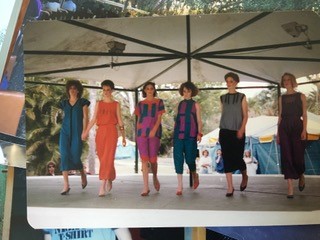
Carol, far left, working as a model “with too much makeup, at an open-air fashion show.”
Carol (far right) with her father and a bridesmaid at her sister’s wedding.She thinks her expression reflects her displeasure at having to wear the dress.
For income in Brisbane she worked at Aroma’s Café, one of the first places there to roast and blend its own coffee. Sometimes she worked as a model – it was a great time for emerging clothing and jewelry designers. In time she met new friends, one of whom, Wayne Crotty, was a musician/furnituremaker. “That was it,” she remembers. “I saw what he was making and was so astounded that you could make a table. I’d never thought about how things were made before.” She asked him to teach her. He did. She worked with him for 10 years.
Carol foraging in the wood pile during her 20s.
Her first job was a Shaker table with a tripod base. She learned about mortise-and-tenon joinery, dovetails, sharpening and setting up machines. “Wayne was not a fine woodworker. He was a good ‘practical’ woodworker. He knew a lot of people. He took me to meet people that owned areas of forest.” They would selectively choose and mill particular trees, being careful not to take too many. They also salvaged a lot of logs from forestry clearing, so she saw the whole process and developed a deep understanding of wood as a material. Of the men she worked with, she says “some of them appeared quite gruff and very blokey, not the sort of people I thought would take a young woman very seriously. I discovered, though, they loved the fact I was so keen. If you’re interested and you listen, the world opens up to you.”
She also ventured into the world of building theater sets. While working for a company that made stage sets for big events, she learned about what she calls “practical construction” – nothing precious or fine, but more “how to turn a ballroom in a grand hotel into a fantasyland or forest for a particular event or conference. You all worked together really hard on tight deadlines and drank a lot of cheap coffee.” The comradery was fabulous.
Large cabinet with camphor laurel drawers and etched glass.
By her late 20s Carol was ready “to make things that were really special and would mean something to people.” She began to design her own pieces and developed her own customer base; people would come to her with an idea that she would sketch, then build for them. For about seven years she did one-off pieces, working in Wayne’s shop, with the occasional exhibition of work that was more creative. “I started reading all the [issues of] Fine Woodworking magazine I could get my hands on,” as well as books by James Krenov and George Nakashima. She was especially interested in Japanese design. Unfortunately, she has few photographs of her work from that time.
In her early 30s, when she was running her custom furniture business, Brisbane furniture maker Simon Hooper, whom she calls “a real hero of mine,” asked if she would come to work with him at Bell Brothers, an old Brisbane furniture making institution. Carol leapt at the chance. The company also owned a funeral parlor; the shop was next to the coffin makers, and they often needed extra people to help with funerals. Carol would have to change out of her shop clothes into a black suit and drive an old Mercedes hearse. After the funeral it was back to the bench. “It gave you this crazy perspective on life,” she remarks. “If this board was twisted, well… It’s not the end of the world; it can be straightened. Everything is really about people,” she realized. “It’s not about stuff. People have been very generous to me with their knowledge and I have encountered mostly kindness.”
Box in Australian red cedar.
“I’ve not had formal training at all,” she continues. “We have some amazing woodworking schools [in Australia] now, and I think I would just love an opportunity to dedicate two or three years to learning.” Lacking that option at the time, she traded labor for instruction. There were no apprenticeships available in the kind of work she wanted to do; it was the 1990s, the dark age of particleboard and MDF. She wanted to work with solid wood. She picked up any new skills she could. As a result, she calls herself “a bit of a Frankenstein woodworker.”
Carol had met her husband, Nick, in 1996 through a mutual friend. They met at a country pub, The Dugandan Hotel in Boonah – “a pub in a paddock,” she calls it. Nick was working as a consultant for an IT company and had just returned from an assignment in Sydney. It was unlikely they would ever have met, but their friend was celebrating a birthday at that particular pub that day. They married in 1998.
The year before, she’d taken a job working in the showroom of Carbatec, a woodworking supply company that had recently begun importing the kind of high-quality tools no one else was selling. They also imported traditional woodworking tools made in Japan. “It was a wonderful place full of beautiful tools and enthusiastic people,” she notes, explaining why she left her own furniture-making business for a job in retail. “The prospect of a steady job was pretty enticing, too.”
When her employers announced they wanted to offer classes, she decided to teach joinery. She went to night classes to learn teaching skills and her work shifted to teaching and writing. Carbatec also had a fabulous catalog that required Carol to write a lot of copy. The owner of the business, Geoff Lowe, had sons-in-law who were American and worked in the business; the new American-made tools were quite an attraction. “Geoff was very generous,” she recalls, “always giving me the new tools and beautiful pieces of wood to try [them on].”
Carol continued to read woodworking publications while working for Carbatec and was inspired by examples of work done by other women. She traveled with the company to Japan, where she met craftspeople and learned about Japanese woodworking tools, which prompted her interest in hand-tool woodworking. For years she’d worked with tools made by Stanley, Record and Marples, good solid stuff made in England of Sheffield steel. But “to pick up a Lie-Nielsen plane or a Japanese chisel…there was real poetry in that.”
Carol started to write for Australian Wood Review, published by Linda and Raf Nathan. She was thrilled to be the first woman on the cover – around 1999, she thinks. Australia had other woodworking magazines that she says were full of “more practical” stuff, but Wood Review was different – it published work of fine quality and cutting-edge design. The Nathans employed her part-time as an editor for a while, and it struck her that she’d returned, in a way, to the world of journalism where she’d started at the age of 17.
Carol, with two of her pieces, on the cover of Australian Wood Review magazine.
Animals & Life
When Carol was 38, she was sharing a workshop with two renowned Australian makers, Roy Schack and Robert Howard, as well as a few others. It was an inspiring environment with a lot of creative energy.
One day, 32 weeks pregnant, she had a brain hemorrhage. Fortunately, she survived, and her son, Hugo, was born without damage. But recovery took a long time and has changed Carol in so many ways that she now thinks of her life as “before” and “after” the aneurysm. Although she’s loath to use those changes as an “excuse” (her word), she hasn’t made much furniture since. The hemorrhage left her painfully sensitive to noise – routers, shapers, thickness planers and other machines all became unbearable. Her sense of sight was also affected. She tried to go back to furniture, “but it just wouldn’t come together.” Four years later, after Nick completed a doctorate, he was offered a post-doctoral position in the Netherlands and they lived there for two years. Carol didn’t make anything during that time; instead, she worked as what she calls a handywoman for the local school. But there’s a great tradition of carving in the Netherlands, which sparked her interest in that field.
After Carol and her family returned to Australia, Carbatec hired her back. One day she made a spoon in a class with Australian woodcarver Gary Field. “It was the first thing I’d really done in all that time [since the aneurysm]. The idea [is] that you start with a whole, and you take away. What you’re left with is the object.” After being wowed by the process of building a Shaker table in her 20s, she experienced a second epiphany in the spoon carving class. She decided to become a wood carver. “You’re going along and all of a sudden your life’s completely derailed,” she explains. “You have this partner who’s trying to make things right, but you can only make things right to a certain point. I was a furniture maker. But I wasn’t a great furniture maker, I never felt completely at home, I had moments where things were quite good. But [carving] was something I felt quite passionate about. It felt like coming home. Other than a band saw, I don’t use machines anymore.”
Huon pine twist spoon charred and finished in beeswax.
A wombat finished in natural rock pigments.
Whether you’re building furniture or carving a cat, she says, the work is “so much about people,” and never more so than when you’re teaching others to build or carve, as Carol does these days. “[Teaching is a skill] that you get to share with people. It literally saves people. It’s saving people now, in these really difficult times.” She refers specifically to Australia’s latest wave of lockdowns, which have filled many with a sense of foreboding. “That little bit of peace of mind people get from making something or growing something with their own hands can just keep them going. It’s the one part of their week that they can rely on.” They come to class and can – well, must – really focus on the work, because it’s so intense.
Carol reaching in her former workshop, an old cottage. (Photo: Yan Chen Photography.)
“I always look at animals,” Carol tells me. “I stare at them constantly. Nothing has ever brought me so much joy as creating these animal forms and trying to distill the essence into this little block of wood.” She compares the intensity of packing so much into a tiny form to the Japanese art of netsuke; it’s “an implosion instead of an explosion, an exercise in not overusing your skill – a couple of cuts in the right place.” In terms of her work, she says, “the world is shrinking into something small, but I’ve needed all the bigness of everything I’ve ever done to be able to distill it down into this small gesture.”
A bird carved in charred King William pine.
Carol and Nick have no animals of their own at present, which only enhances her appreciation for those other creatures who share many of our lives. There’s an Australian tradition of observing Anzac Day every April 25 to honor members of the Australian and New Zealand Army Corps who participated in the Gallipoli Campaign early in the First World War, and all the wars where Australians have served since. It’s a national day of remembrance when people go to a cenotaph and listen to speakers and pay their respects. “We have a lovely local service that we go to, but it can be hard to hear because the PA system isn’t so great,” she laughs. What prompts her to mention the occasion is that “many people take their dogs, it’s in a park close by our home.”
Lucy and Claudia. “They tolerated each other,” writes Carol. “They’d join forces when it was dinner time. We lost them both last year. Claudia was 18, Lucy only 8-1/2. I miss them every day.”
This year she really noticed the dogs, “looking at their body language and how they’re looking at each other, wagging their tails, then looking up at their humans and waiting so patiently. There was this whole canine world below people’s knees. Watching them, I just felt that unadulterated joy that animals give us and we seem to give them – it’s like your heart is going to burst.”
Hugo is heading to university in Melbourne. Carol and Nick plan to move back to Tasmania. Both are looking forward to having four seasons, a pleasure Nick recalls from his native England, after so many years in Queensland’s tropical climate. And Carol’s looking forward to living with animals again, as well as developing her carving practice further.
Carol’s current shop is in a shared space at Botanick Nursery.
In the meantime Carol has a beautiful workspace in Brisbane she shares with fine leather workers Blue and Grae and Andrea and Gary Fitzpatrick, who have transformed an industrial space into the beautiful Botanick Nursery. It’s a space where she can carve and teach. “It has an incredible atmosphere, I feel so fortunate to be there. About 35 regular students come through each week and carve, chat, drink coffee and share their stories. Life is good.”
Family photo on Hugo’s 18th birthday, with his first beer.