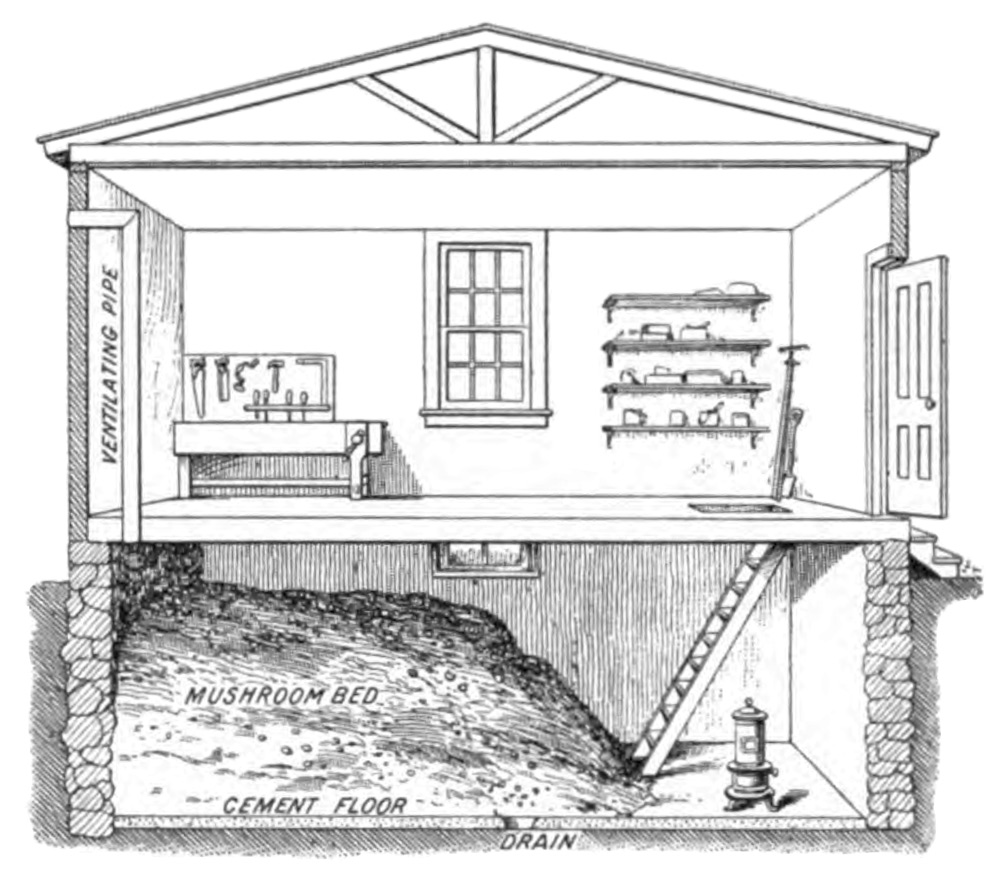
A combination mushroom cellar and workshop is a most useful adjunct to the farm or rural home where it is necessary and desirable to economize in space and material. The growing of mushrooms is quite common today on thousands of small county places, and those very fond of these edibles resort to all sorts of methods to raise sufficient for the home table. The cellar of the ordinary house is not a good place for mushroom culture, and very few barns are provided with a good cellar suitable for the work. (more…)
Sir – I have the honor of being in the receipt of your circular requesting information in relation to the effect which the introduction of the manufacturing of planes, in the prisons at Auburn and Sing-Sing, has had upon our business. In reply to which, it may not be deemed improper to state something of the rise and progress of this branch of business in this country.
At the close of the last war, the manufacture of planes was carried on to a very trifling extent in this country, we being chiefly supplied by those of foreign importation; about which time my father (our predecessor,) established this branch of business in the city of Albany; but the strong prejudice in favor of imported planes rendered it necessary to make very considerable sacrifices, to sustain the establishment of the business during its infancy; and for several years it was carried on with scarcely sufficient profit to cover expenses, and afford a livelihood. But, by patient perseverance, he was at last enabled to compete with planes from abroad, both in price and quality; and having gained an enviable reputation for his American planes, for a few years he was enabled to do a very good business, and gave employment to 20 or 30 hands, at good wages; and he looked forward to a reward for the toil and anxiety he had undergone, in aiding to establish a home manufacture for this important article of merchandise. (more…)
Many of the best mechanics prefer the Wood Bench Planes to the Iron and combination iron and wood planes, but have been compelled to use the latter, owing to the poor quality of the wood bench planes commonly sold.
The fact is that the majority of Wood Plane makers for several years past have been trying so hard to find out how cheaply they could make planes, that they have forgotten all about what a good plane means, and the result is that 90 per cent of the wood planes sold in the stores are almost good for nothing, and the other 10 per cent are but little better. The wood is unseasoned and spongy, and the irons so poor that they hardly hold an edge from the oilstone to the work.
It is a positive fact that a first-class double Plane Iron cannot be made and sold at the price that many of the so-called first quality planes are sold at complete.
We have before us a catalogue just issued by a firm who deal quite extensively in mechanics’ tools. In this catalogue the net selling price of a so-called first-class Smooth Plane with 2 ¼ inch double iron, is $0.56. We quote from the description of these planes, “The irons are guaranteed to be the best in the world.” Turning over a page or two we come to Plane Irons priced separately, and find that 2 ¼ inch double plane irons are sold at $0.58. Quoting again from the description of the Plane Irons, “These Plane Irons are guaranteed to be the best made.” It seems a little funny that the “Best irons in the world” should sell at $0.56 with the balance of the plane thrown in, while the “best made” plane iron only, is held at a price of about 4 per cent higher.
The brand of Plane Irons referred to is of excellent quality; in past years we have sold quantities of them, but, in our judgment, they are very far from being the “Best made,” and will not compare favorably with the Plane Irons made by any of the better class of English makers—say Moulson Bros., I. Sorby, Spear & Jackson, or Ward & Payne, French plane irons made by Peugeot Freres, or American plane irons made by Buck Bros.
Our Bench Planes
As we could find no Bench Planes in the market that are suitable for our class of trade, we are compelled to have these planes made to our special order. All of our planes are made of well-seasoned Eastern Beech, are oiled, polished and shellaced; they have steel starts, and the jack, fore and jointer planes have bolted handles. The plane irons used are the Ward & Payne (Sheffield) brand, and if these irons are not the “Best in the world,”they are certainly equal to any, and are the best we have ever been able to find. Every plane is stamped with our name, and we do not believe that the equal of these planes can be found elsewhere.
Chas. A. Strelinger & Co. – Detroit, Michigan 1897
A Minnesota inventor, Andrew Anderson of Crookston, Minn., has devised a portable tool chest which also serves as a workbench. It consists of two parts which can be hinged together, side by side or back to back. If the chest is to be used as a workbench, the two parts, securely fastened together, are raised to the proper height by foldable, firmly braced supports. These legs are hinged to the body of the chest and give sufficient stability to the bench for any ordinary work, like sawing, planing or sandpapering.
One of the parts has two large drawers for saws, planes, and other large tools. The other has three drawers for smaller tools, sandpaper, and light hardware, including screws, nails, brads, hinges, staples, etc. (more…)
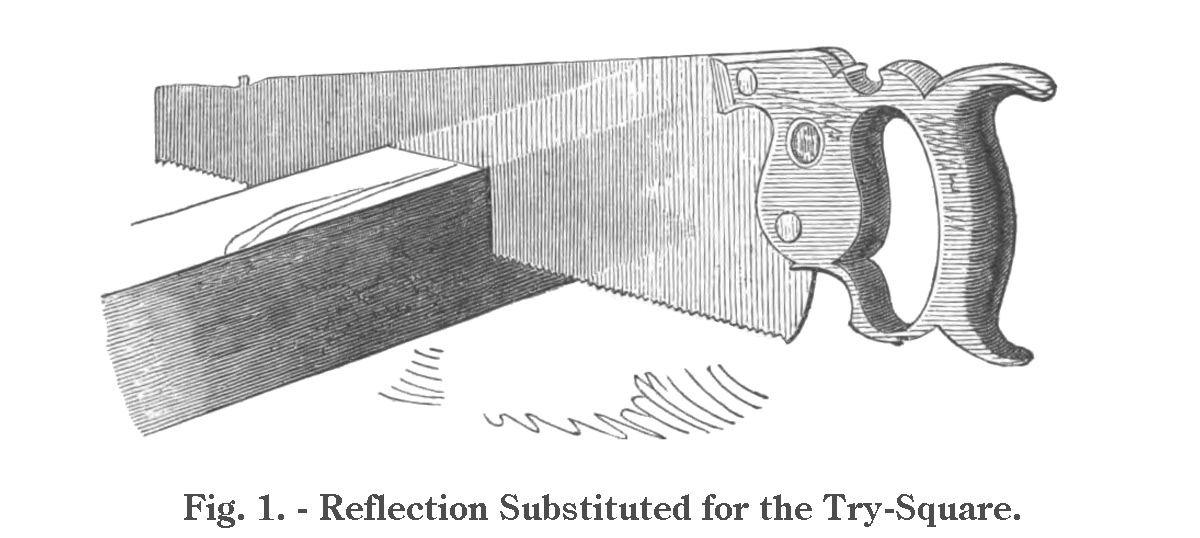
A try-square is not always at hand when it is desired to saw a stick, and when it is handy some mechanics prefer to work by “guess” than otherwise. When a bright, straight saw is placed upon a stick or on the edge of a board, the reflection of the stick or board in the saw
is sufficiently well defined to permit of placing the saw so that the reflected image coincides with the object reflected, forming a continuous straight line. If the sawing is done while the image and the stick are in line, the stick will be cut at right angles.
It is obvious that a line may be drawn at right angles to the stick by arranging the saw as shown in Fig 2. If, after forming this line, the saw be placed across the stick so that the line and its reflected image and the stick and its reflected image form a square, with the
reflected image and the stick lying in the same plane, as shown in Fig. 3, the stick may be sawed at an angle of forty-five degrees, provided the saw is held in the same position relative to the stick.