Two comb-backs in red elm on my workbench this morning.
I’m back in Covington after a two-week trip to Scandinavia. So after a couple weeks of guest hosts at the Open Wire (thanks, Monroe and Joel), I’m here today to answer your questions about woodworking or stuff that is going on at Lost Art Press.
Warning: My head is full of cheese. I arrived in America with a bad head cold and an unusual case of Traveling West Jetlag. So I might be a little slow on the uptake
Despite all that, I am happy to be home and back at the LAP HQ.
Here’s how it works: Type your question in the comment field. I will attempt to answer it. It is that simple.
So here we go…. Note that comments for this entry will close about 5 p.m. Eastern.
About a month ago, I wrote about Martyn Owen, a filmmaker who was creating a mini-documentary about Nannau Hall, the Grade II* Georgian house that stands on the grounds where the Nannau Oak, featured in “Cadi & the Cursed Oak,” once stood.
“Within the Walls: Nannau,” directed and edited by Martyn I. Owen and performed by Keith Evans, is done and you can watch it in full at the link. The film shows Nannau, in its current state, in desperate need of repair. Thanks to many incredible shots by drone operator Rob Whittey, you’re also able to get a real sense of Nannau and its surroundings, including places featured in “Cadi,” such as a lovely aerial shot of Dolgellau and close-ups of more distinct locations such as Coed y Moch lodge. The film also delves into more of the history and folklore of Nannau, exploring eerie and ghostly tales that live on to this day.
The spinning carbide took a chunk out of the metal jointer guard when it fell on the blades – now imagine the mess those blades can make of flesh. Or rather don’t – it’s not pretty.
The following is by Steve Latta. Steve makes contemporary and traditional furniture, and teaches woodworking at Thaddeus Stevens College of Technology and Millersville University in Lancaster County, Pa. He’s a contributing editor to Fine Woodworking magazine, and is working on a project for Lost Art Press.His Instagram is @steve_latta_woodworking.
About 30 years ago, I took a turning class from the late Rude Osolnik in Akron, Ohio. At that time, Rude was teaching at Berea College and was a master at his craft. It was my first turning class and I had never chucked anything on a lathe prior to it. As Rude was prepping for a demo on spindle turning, he pushed the blank into the tail stock and with the lathe running, he slowly engaged the drive center. With a little finesse of tightening and loosening the stock as it spun, he ended up with the blank humming nicely.
Feeling confident with what I’d observed, I went back to my station, attempted the same technique on the Powermatic #90 assigned to me and promptly launched my blank, leaving a divot in the ceiling. While rubbing the emerging bruise on my hand (not to mention on my ego), a classmate doing his best to suppress a laugh explained that Rude does it that way because he’s been doing it for 40 years. He recommended that I load my blank with the lathe turned off. Despite my stupidity, I survived the self-inflicted forces of natural selection.
That same experience occurred when I started teaching woodworking at a technical college in Lancaster, Penn. I had 16 years in the trade and was a pretty decent cabinetmaker at that point. I even considered myself a “safe” cabinetmaker – until I observed my bright-eyed and bushy-tailed students doing things on the table saw that made me turn white with fear. When asked “Where in the hell did you learn that!?”, the answer was more often than not, “From watching you.” Ouch! That hurt, but it impressed upon me the urgency and necessity of starting with the basics and the essential safe practices for operating a tool, whatever it is.
I love my students. I love their raw energy. Most are between 18 and 25 years of age, male, driven by hormones and with a brain that is far from fully developed. That is not a criticism, just a fact. Their typical solution to most problems is to push it or hit it harder. They do not fully grasp the consequences of a bad choice. They don’t know what the tools really do and certainly do not yet how to use them properly. At that age, most have yet to learn that they themselves are breakable.
Mishaps with hand and power tools can change a life or end a career in a millisecond. Back in the early ’80s, a fellow apprentice was ripping wide, heavy boards on a table saw while wearing gloves. In a blink of the eye, there were four leather fingers resting on the table detached from the glove. They weren’t empty and his career in woodworking was done. Over my 40 years in the trade, I have picked up, scraped up or cleaned up more human tissue than one should. The most recent incident involved small chunks of bone and flesh from the dust chute on a jointer. And, yes, it was gross.
“Bandosawrus” (used with permission of Chris Vesper, Vesper Tools).
Some folks name their tools. An acquaintance of mine named his 36” bandsaw “Bandosawrus” because of its size and power. I know of a 9-horsepower shaper named “Shredder.” I do not know of any named “Daisy.” Despite that sense of attachment we can get to our tools, I guarantee the emotional bond is strictly one way. There is not a part of my body, any part, that will make the power tools in my shop bog down even a single rpm. The edge of a sharp chisel will pay no mind to the calluses on my hands. The destruction these tools can cause to a body happens in an instance without love nor malice. Although it is easy to blame the tool, “operator error” is often the real problem expressing itself as a lack of diligence or understanding.
These days I often bristle watching videos of various woodworking operations on Instagram or YouTube. I recall a well-known internet personality demonstrate how he cut the dovetailed slot on the bottom of the column for a three-leg pedestal table. Using a shaper with an industrial-size dovetail bit, he ran the first pass right down the center of the mortise, requiring an additional pass on each side of the first to obtain the proper width. He did not show the second cut but skipped to the final pass furthest from the fence. He finished his video sliding the dovetailed foot easily into the column. He was smiling ear-to-ear. I am quite certain that anyone who attempted what had been demonstrated did not smile. The omitted second cut was a climb cut, and a particularly dangerous one at that. I suspect the author discovered that little nightmare making his video. I also suspect that is why he left it out.
Sometimes the videographer even states, “this one will drive the safety police nuts!” In our “rugged sense of individualism” culture, we admire those who break the rules. But sometimes the outcome is ugly. If something isn’t safe, don’t post it. Take a look at your motives for making the video. Is the purpose to relay solid information or rather, out of vanity flavored with ignorance, say “Look at me. Look at me.” Does the number of “likes” and “followers” trump basic safety? Sure, it is possible to turn a short spindle on a table saw combined with a drill. The fact that it’s possible and may even look “cool” garnering thousands of hits does not make it a valid technique and certainly not a safe one. Just because something can be done doesn’t mean that it should be. In my mind, promoting such practices is a crime.
Deviating from accepted safety norms should only come after mastery. Stepping out of what is considered safe should be a conscious choice based on years of experience with a full understanding of what the negative consequences may be. The undefined nuances of what a tradesperson knows are rarely expressed in articles or videos. The subtleties are so ingrained that they are unwittingly taken for granted and hence are inaccessible to the observer. A certain technique might work 99 times out of 100 but the one time it doesn’t might be a bloodbath, literally. In this trade, we are not working with knitting needles but an endless assortment of sharp objects, some of them moving at incredible speeds. Out of respect and concern for viewers in our online ventures, safety rather than sensationalism, should be gold standard, not the number of likes.
– Steve Latta
Editor’s note: If you do get hurt (we sure hope you don’t), make sure you have a well-stocked first-aid kit at hand, and that you know how to use it. And that you know when to seek professional help. Reading “Workshop Wound Care,” by Dr. Jeffery Hill, is a good first step.
These are some of the tools of the joiner shown in “Spons’ Mechanics’ Own Book” (1885).
The following is excerpted from Joel Moskowitz’s history of trades and explication of trades in England at the time “The Joiner and Cabinet Maker” was originally published (the full chapter is titled “England in 1839). The Lost Art Press edition of the book include not only the original text, but Joel’s fascinating chapter as well as how-to chapters by Christopher Schwarz on the construction of the three projects described in the original text: a Packing Box, a dovetailed Schoolbox and a Chest of Drawers – using hand tools.
Why collect stuff? Is there something in one’s DNA that suggests that picking up an extra thing or two just to have them is a good idea? Before you know it, you are sitting around with a lot of things that seem kind of similar: a collection. The game ends for some collectors right there, and for others it prompts more questions about what they’ve collected and what other items would make the collection perfect.
When I began studying woodworking formally in the 1980s, there were few new tools worth buying. Fortunately, my teacher, Maurice Fraser, taught us how to buy old tools that worked. I soon bought my first old tool, a Stanley Bedrock 604C, then some more stuff, and more stuff after that. At some point I realized that if I continued making rationalizations about the tools I was buying (that I needed all of them to do woodworking; if my 32 other smooth planes were to be destroyed in a fire, I’d be comforted to know that I had number 33 waiting in the wings), I would have to sharpen all the tools I bought. On the other hand, if I relaxed and admitted I was a collector, it would save a lot of work.
So that’s what I did. In the process, I joined a lot of interesting organizations (EAIA, MWTCA, TATHS, CRAFTS and others) and found an outlet for my continuing interest in social history. I had never been much interested in who had been king when whichever side had won the Indo-Franco-Prussian-Franco wars, but I was interested in things such as why the heck anyone in their right mind in 1790 would spend a king’s ransom on a miter plane when a good smoother could plane just as well. So like many tool collectors, I started studying up on tools and industrial history, and in the process I bought a lot of books.
At some point I ran out of interesting tools to buy. I just couldn’t afford what I wanted to collect. But books were cheap, so I continued to buy interesting books on tools, woodworking and industry in general. When I started collecting in the period before 1880, I hit a snag. There just isn’t all that much to collect from that period. Woodworkers as a group are not nearly as interested in writing stuff down as, say, theologians, politicians or poets. I collected the same pre-1880 material that other collectors did, and frankly most of it was turgid and just not all that interesting to read. Much to my pleasure, “The Joiner and Cabinet Maker” was different.
A lot of people have asked me how I found this book. The answer is: I didn’t. It found me. Here’s the secret to collecting a lot of stuff: If it’s cheap enough and you don’t have it, you buy it. I picked up tons of material that way. Most of it is just fun to have. Sometimes you actually learn something about woodworking in the book. Sometimes, as in this case, you acquire the book, poke through a few pages and shout “Eureka!” when you realize what a monumental find you have. And that is exactly what this book is.
After a few reads of “The Joiner and Cabinet Maker,” it became apparent that inside the text were the earliest descriptions of certain woodworking practices that answered a lot of questions we have today, and it put to rest some modern speculation.
Various editions of the book from the left: 1839 Knight edition, leather-bound Knight edition of several volumes in the series, 1883 Houlston edition, 1841 Houlston edition.
I started buying up other copies of the book to get a handle on how various editions differed. At some point, I called Christopher Schwarz and asked if he was interested in reading what I now considered to be the most important pre-1850 book on teaching woodworking. I sent him a copy of “The Joiner and Cabinet Maker” and he, like me, was charmed. We both thought this book needed to see the light of day once more. Chris wanted to build the projects and give the book relevance to beginners today. I was especially interested in its historical context and what it tells us about shop practice in the early 19th century.
Historical Context The earliest book on woodworking in English that tells us about basic technique is Joseph Moxon’s “Mechanick Exercises,” which was published from 1677-1680 by subscription in an edition of 500 copies. Its audience was educated gentlemen who wanted to learn a little about how things are done. Men such as the noted diarist Samuel Pepys (1633-1703), who was a subscriber. “Mechanick Exercises” is pretty spotty and contains no real sense of what needs to be learned in a training course. It’s more a summary of common woodworking operations. This in itself is interesting, and readers today could certainly learn much from a social and historical standpoint, but the book doesn’t tell us anything about training a tradesman.
A century later (1769-1774), a Frenchman named André Roubo wrote a giant tome, “L’Art du Menuisier,” on all aspects of advanced woodworking just before the French Revolution got rid of a lot of the luxury styles he describes. This book is also a wonderful addition to our knowledge of 18th-century French woodworking, but Roubo concentrates on advanced subjects; it isn’t a beginner’s course. In England and the United States, the only books on woodworking during this period are “builder’s dictionaries,” “pattern books” and “price books.”
Builder’s dictionaries are glossaries of woodworking and architectural terms that include some basic information on how much things cost, and in most cases, formulas and tables for calculating materials and dimensions. The main purpose of these books was to allow rich patrons to figure out what the joiner meant when he said, “I’ll need a crown to purchase the deals I need to make the barn siding, my lord.”
Pattern books, which are collections of drawings, were sold to designers and masters who wanted to show potential customers the latest styles. The most important of these pattern books was Thomas Chippendale’s “Gentleman and Cabinet-Maker’s Director” (1754). Pattern books don’t show much furniture anatomy, which would have been familiar to any skilled craftsman, but they show endless design variations that you could show a client.
Another type of book that appeared in this period is the price book, which explained to union and craft society members how much they should be paid for different kinds of woodwork. Price books usually are tied to a region, with London price books being the most common. But price books crop up in all the important cities, even in the United States – pretty much anywhere there was enough work for a journeyman working in a shop for wages. As the industry grew, labor relations became more complicated and societies of trades, or unions, began to form in the 18th century. Small shops could of course get away with paying what they wanted to, but larger shops followed the price books. Price books served as a last vestige of the medieval guild system, which regulated pay, among other functions.
In the 18th century, all books were still hand printed, with hand-set type on hand-laid paper. Books were expensive, so the shortage of popular, practical books for woodworking apprentices is understandable. “Mechanick Exercises” was far too expensive for a poor apprentice to afford. Of the few professional how-to books that exist from the early 18th century in English, one of the more noteworthy is “The Complete English Tradesman,” which was published in 1703 by none other than Daniel Defoe of “Robinson Crusoe” fame. The book is a guide to running a millinery shop. So there was a demand for “how to” books, but the hand-printed nature of the book would have kept circulation from all but the fairly well-off milliner.
I have a reference book from 1777 for ironmongers, “Mr. Hoppus’s Measurer.” It’s carefully inscribed, “George Barter His Book June 3, 1787.” The inscription suggests this was a treasured book that was purchased used 10 years after it was published. If a new, up-to-date copy could be afforded, certainly a used copy would not be so prized. Even if there had been a demand for an apprentice’s guide, the book would have been too expensive for apprentices to buy, and certainly many would think that there was no point in paying for a book about something you did every day anyway.
Technical books of all sorts began to appear in the late 18th and early 19th centuries as a booming industrial economy started to change everything. In general, the books addressed the cutting edge of technology, not basic skills. The audience for books on wood was comprised of professional builders and woodworkers who already knew all the basics. They were not interested in directions for cutting dovetails; that, they learned to do in their sleep during their apprenticeship. What they wanted were books on the finer points of their craft. Probably the most famous book in this class was Peter Nicholson’s “The New and Improved Practical Builder” (1809).
Nicholson wrote a whole series of books on various aspects of carpentry and construction. His books are the best-known of the early 19th-century books on woodworking, especially those on advanced architectural work. Nicholson explained the math and layout for all sorts of woodwork structures. While they are totally useless as training exercises, they are great books on applied geometry. They offer an engraving of the tools of the joiner and lots of information on layout and design, but almost nothing on how to use the tools. These books are different than the really limited-run volumes such as Roubo. Some of them were reprinted continuously for most of the 19th century. While all of these books are fascinating today to historians, and they tell us a lot about the practice of woodworking, there is almost nothing on basic technique from the period. But this is what we all want: A book that shows us and teaches us the lessons of apprentices from before the machine age.
A list of the topics covered in “The Guide to Service” and “The Guide to Trade” series from 1845.
By the early 19th century, steam-powered printing presses and machine-made paper made daily newspapers ubiquitous for the masses. Reading became a fundamental skill, and books, while still expensive, became affordable to the middle class. When first published in 1839 by Charles Knight and Co. “The Joiner and Cabinet Maker” was part of a series called “The Guide to Trade.” A few years later the series was re-titled “The Industrial Library” and was published variously under the “Houlston & Wright,” “Houlston & Stone,” and later just “Houlston” imprints. “Industrial” in this sense means hard working, not jobs in manufacturing.
Few of these books are preserved in research libraries around the world. These were titles for the masses, not for scholars. And unless a library was specifically collecting popular literature (which they mostly weren’t), there would be no reason to acquire these books.
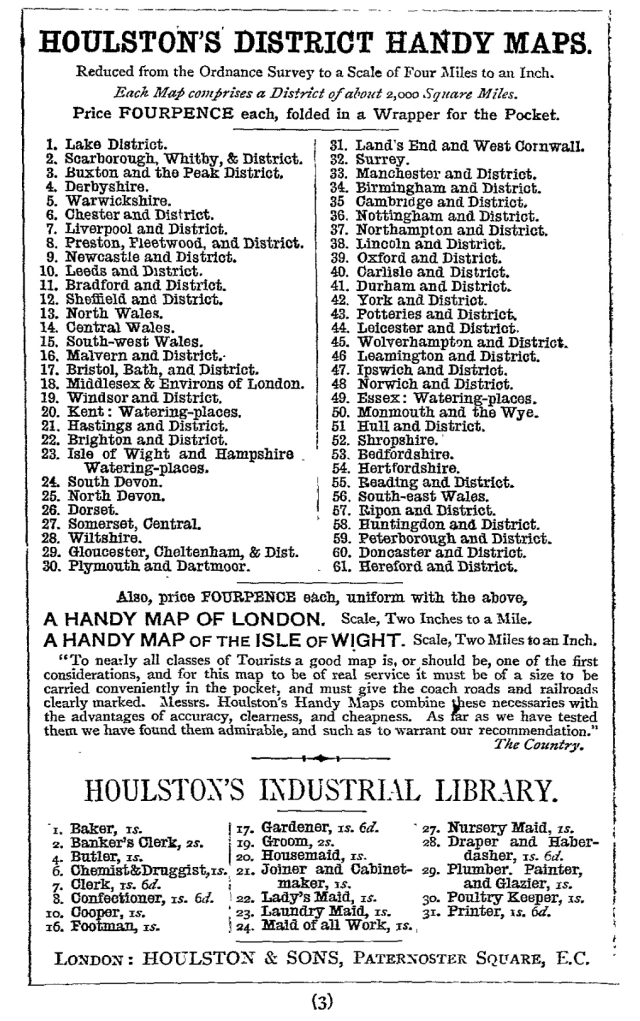
The goal of the “The Guide to Trade” series and its companion series, “The Guide to Service” series, was ambitious. It appeared to be a comprehensive group of nearly 100 books, printed as inexpensively as possible to serve as a overview of all sorts of vocations “to prepare young persons for the choice of an occupation.” Of all the books listed in the original series, only a few are marked as available. And the series was obviously not successful for Knight because only two years later, in 1841, the list was greatly pruned and was printed under the “Houlston” imprint. Thirty-six books made it into this new series now titled “The Industrial Library,” which was announced in a full-page advertisement in “The Joiner and Cabinet Maker.” By the time of the 1883 edition, 44 years later, the advertisement for the series has been reduced to a fraction of a page, and it competes with a bunch of other self-improvement series. There’s a lot to be learned about how England changed during the time this series ran. Of the 36 original titles of 1841, no less than seven deal with traditional agricultural jobs, and nine deal with domestic jobs.
In 1841, the series was greatly pruned and was printed under the “Houlston” imprint. Thirty-six books made it into this new series now titled “The Industrial Library,” which was announced in this full-page advertisement at the back of the book.
By the time of the 1883 edition, the advertisement for the series has been reduced to a fraction of a page, and it competes with a bunch of other self-improvement series and maps.
The prices of the books are largely the same, reflecting massive changes in book publishing. What is most interesting is the change in titles. The series numbering now has gaps, as only 20 books remain. The books that have been removed are almost all agricultural. I was able to locate only one agricultural title in a library, anywhere. Agricultural workers would have been the poorest and least literate of all the trades in the series, so it makes sense that they didn’t buy these books. But the deletions are also a testimony to the shift from a rural economy to a predominantly urban one.
The craft books that have vanished include “The Dressmaker and Milliner,” “The Tailor” and “The Shoemaker.” These are all trades that changed from real crafts in the early 19th century to brutal industrial manufacturing jobs by the latter half of the century; they didn’t require much training (except on the very high end) and certainly were not desirable jobs in the public imagination.
Two other new titles have been added: “The Butler” and “The Footman,” which are both domestic jobs. The large number of titles about domestic employment might be an indication of employers trying to train their hires, or it’s evidence of a rising middle class that hired domestic workers to emulate richer household practices. In addition, books such as these might help a young person get a domestic position – jobs that were hard to get and considered pretty good.
While both lists have “Clerk” and “Banker’s Clerk” on them, jobs that I would suppose are fairly prestigious, it’s interesting to see the titles (which I also could not locate copies of) intermixed with all these titles for domestic jobs. The urban office world, with its shift to “white collar” work, still hadn’t taken place on any great scale. That was a 20th-century innovation.
Some of the books in the series are credited to various authors but “The Joiner and Cabinet Maker” is not. This isn’t unusual for the time, but it is a shame that we don’t know more about who wrote it.
Of all the “Industrial Library” books that I’ve been able to locate, only “The Joiner and Cabinet Maker” is told in the form of a story. (The book on the housemaid has a limited narration.) The other books seem to be early attempts at writing how-to books, with limited success in condensing a complicated trade to a hundred or so pages. Various editions of “The Joiner and Cabinet Maker” have turned up, but it is not known if the book was continually available from its first publication in 1839 to the last in 1883, from which this facsimile was taken. The later edition was made from the same plates as the 1839 edition and is identical. An addendum about new modern tools was added to this later edition. It’s included here, but it’s not really worth much. We chose to scan the later edition of the book because it’s visually the same as the earlier edition but its binding was in better shape than the other copies in my collection.
The books themselves are a microcosm of invention, a window in how book publishing changed during the 19th century. (For more information about the books themselves, and the book technologies used in printing these books, see “Contextualizing ‘The Joiner and Cabinet Maker’” by Jeff Peachy, a noted bookbinder and book conservator, at the back of this book.) What is a shame, of course, is that the original Knight series was never completed. How wonderful would it be to have a copy of “Cutler” or “Watchmaker” today.
Funky Winkerbean is expressing concerned we won’t correctly interpret our architect’s approved drawings for Phase 1 of the Anthe Building restoration. (Photo by Lucy May)
I’m not sure what counts as an update in Christopher lexicon – but this is the fourth numbered update on what’s been happening at what will become the new Lost Art Press headquarters, so we’ll go with No. 4! (You can read an FAQ about plans for the new space in this June 28 post.)
The view from the back, looking forward to what will eventually become a retail space (on the far side of the framing). In the foreground is the bathroom.
We received the stamp of approval from the county last week to proceed with the plans as drawn by our Cincinnati-based architect and friend, Trenton Bradford (whom we first met as a student in an ATC class, and we’re awfully glad we did!). Our general contractor, Bill Kreidler (BK Remodeling), has been working at warp speed on framing the walls to replace the old and falling-down ones (and salvaging the old beadboard for re-use) and get all the subcontractors in for the drywall, plumbing, electric, painting….
The Floor Chris and I sprayed the floor with two heavy coats of shellac to encapsulate some residual machine oil odor after multiple floor scrubbings, and to offer a modicum of protection for the original floorboards (and the new patches that were installed where necessary).
TheBathroom We got the OK on the bathroom framing two weeks ago – so that’s the most visible and functional change to report: We have a functioning bathroom, complete with tile (that you cannot see much of it in the picture below because it’s currently protected with cardboard). The bathroom is ADA compliant, or will be, as soon as we get the grab bars on the walls. Oh – and we need to get the door installed.
The interior of the new bathroom. I am fond of the exposed brick around the window, with its vestiges of decades-old (possibly a century-old, but probably not) paint.
The bathroom exterior is clad in beadboard that has been painted and glazed to look like the 100-year-old beadboard that was salvaged from the “front of house” (we’ll be using that salvaged stuff on the interior of what will some day become the storefront). The interior is white painted-and-glazed beadboard. I’m fairly certain the end of the rafter tails will be left unpainted (this is, after all, a warehouse!). Atop the bathroom, we’ll be storing boxes and other packing materials.
We couldn’t resist the vintage look of this sink and faucet set. I am particularly fond of the sprayer and soap pedestal.
The Slop Sink I love our Watermark Fixtures slop sink. In a fit of moving too quickly, we initially got it for the bathroom – but of course it would be impossible to get a wheelchair up to it, so we chose a different one to use in that space. Instead, we have an awfully fancy utility sink hanging on the outside back of the bathroom. In hindsight, that’s a better place for it anyway – it’s more visible. Most important though, we now have easy access to running water!
The Framing BK and his tireless employee, Eric, are done with the first-floor framing and are getting started in the basement on Monday. I just have to find some not-ugly fire doors to install in the two openings that will lead to the stairwell before we get the drywallers in to add two layers of type X drywall to the walls and type C to the ceilings up front. For the basement, an ugly door will do. (If anyone can point me toward a not-butt-ugly Shaker, Craftsman, or otherwise plain-but-not-flat-slab pre-hung 90-minute fire rated door, 32″ or 36″ wide, I’d greatly appreciate it. Finding doors that meet requirements at which we can also bear to look has proven to be a difficult challenge!)
In order the apply for temporary occupancy, we have to have the safety requirements in place in at least the basement and first floor, so we’re trying to move as quickly as possible on these fronts.
The shelving, and dwindling pile of beadboard as seen from the front of the first floor (with a glimpse at what will be the fire-rated wall along the stairwell).
The Shelving We are allowed to use the space for storage for now; all the shipping work we’ve been doing in Covington has been out of the editorial offices and machine room at Willard. And it’s been getting awfully crowded with the necessary packing materials and tools, so our new employees, Gabe and Mark, erected some shelving (out of the way of BK’s work) to provide some much-needed storage. And when they need more boxes, the Anthe building is less than a mile away.
And that’s about it for now – but stay tuned: If we can get the fire doors in place and the drywallers in quickly, we should be able to move all shipping operations to Anthe soon!