A friend of mine who has lately begun to keep bees is finding them a great source of new interest. He steals down to his garden to have a look at them whenever he can snatch a moment from his work. It is like peeping into another world, he says, and it sends him back to his work feeling refreshed and stimulated. There are worlds within worlds in this complex universe of ours, and so much of the time we go on our way ignoring everything but our own particular little one. It seemed to me when I was first introduced to his hive on a lovely day in June that his garden must be a bees’ paradise. It stretches away down a hillside, a great part of it left as much as possible in its natural state. This part shimmered with the blossom of late flowering thorn trees, while underfoot were blossoming wild strawberries, trefoil and wild thyme, and through and over it all was the contented hum of bees, little master craftsmen with an amplitude of good material at hand.
•••
It made me feel how much we all need other worlds in times like these, each man according to his own needs or tastes, whether we find it in study, or in some special activity, like woodwork, or like my friend who chanced upon a little world of Nature’s, to find that it lifted him right out of the worries and anxieties of the present. We let so much remain a closed book to us when we come to adult life, whereas as children we found the whole world fascinating. It would be good for us all if we could do so still.
— Charles Hayward, The Woodworker magazine, 1941, excerpted from “Honest Labour“
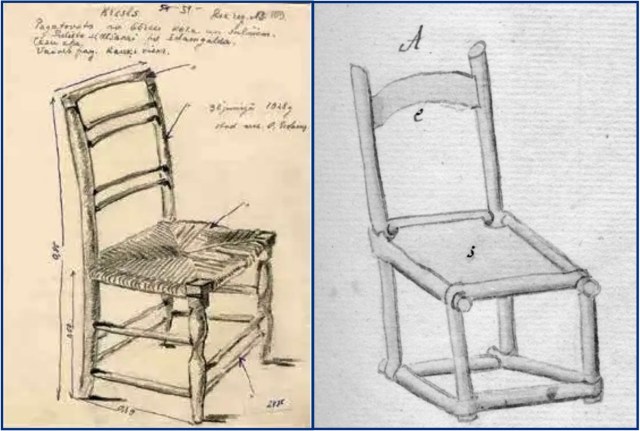
Left: Joined chair from Vaive Parish in Cesis District, 19th c., drawing done in 1928 by Olgerts Erdmanis, collection of the Latvian National History Museum. Right: Bentwood chair drawn by Johann Christoph Brotze, late 18th c., collection of the University of Latvia Academic Library.
The Turned & Joined Chair
Production of the joined chair began as a cottage industry in the last quarter of the 18th century in Briezi and Striki (western Latvia). The start of chair making as a main source of income was likely due to the shortage of land suitable for farming. Chair making spread to other areas and it is estimated that each year a family could make 70-100 dozen (840-1200) chairs for sale in Kurzeme, Estonia and parts of Russia.
Left: Chairs for sale at a Limbazi market (northeast of Riga), 1920s, Limbazi Museum. Photo from “Folk Art 1840-1890” by Inese Sirica in “Art History of Latvia, vol. 3, Book 1, ed. Eduards Klavins. Right: Limbazi chair, dated 1773, collection of the Ethnographic Open-Air Museum of Latvia.
In the Home Industry section of “Woodworking in Estonia” Ants Viires wrote, “As regards chairs, the Latvian product sold at all the fairs was predominant in Estonia for many years.” He described the chair as “mostly of turned wood with a straw seat, later also a wooden seat.” The estimated annual output by Latvian craftsmen was 12,000 chairs.
As you can see, the biggest difference between the Latvian chair and many American examples are the thin back sticks instead of back slats. The seat of the chair was woven from reeds gathered from lakes near the chair making areas. The weaving was done in various patterns and usually by women. This chair is still made today both by hand and in factories.
Left: Birch chair, early 20th c., collection of the Ethnographic Open-Air Museum of Latvia. Right: More recent examples of the chair.
In 1980 the BDM (Ethnographic Open-Air Museum of Latvia) asked chairmaker Eduards Tanne (born 1897) to make one of the traditional turned and joined chairs. Tanne, age 82, gamely took up the request. The video was digitized and subtitled and you can watch this wonderful craftsman make a chair, from chopping down a tree to weaving the seat, here.
Eduards Tanne, Chairmaker.
The Bentwood Chair
This is an odd duck of a chair. The first documentation of the chair was by Johann Christoph Brotze late in the 18th century. Brotze (Johans Kristofs Broce in Latvian) was German and after completing his studies arrived in Riga in 1768 to teach at the Riga Imperial Lyceum. For the next 46 years, until his death in 1823, he traveled the country documenting, drawing and painting all that he saw. His trove of everyday life is in the University of Latvia Academic Library. One page dedicated to the bentwood chair.
Brotze’s (Broce’s) page describing the bentwood chair.
I can barely read Brotze’s handwriting and relied on the description of the chair in “Latvie Tautes Dzives Pieminekli” written by Saulvedis Cimermanis and published in 1969. According to Cimermanis, four pieces of ash or hazel, each no more than 5 centimeters in diameter, are used (the length of each piece is not provided). Each piece is notched where it will be bent. The ends must be carved to a conical shape so that after clamping into the appropriate notch (or bend) the end does not slip out. Brotze’s letter-sequenced diagram shows how the four bent pieces fit together. As for the bending process, we know that steam bending had long been used by coopers, wheelwrights and shipbuilders and to make sled runners. I imagine Brotze saw this bentwood chair as very unusual compared to the joined and staked chairs with which he would have been familiar. Fortunately, he not only wrote about it, he drew it.
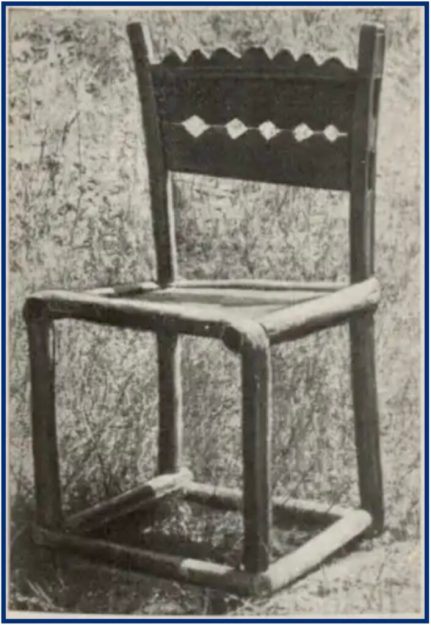
When I first found the diagram of this chair I sent it to Chris Schwarz for his opinion. His answer was he would love to see a surviving example of a chair made in this manner. It turns out a bentwood chair from Rucava (far southwest corner of Latvia) marked with the year “1890” on the back was in the collection of the Ethnographic Open-Air Museum. This proved the chair was still being made late in the 19th century and had been made as shown in Brotze’s diagram. Chris’ response: “Oh wow. Just wow.” And, how.
We don’t know how far back this method of chair construction goes. Also, I don’t know if the chair in the photograph (Cimermanis’s book was published in 1969) is still intact. Cimermanis noted one other example of this type of chair construction and cited the work of Polish ethnographer Kazimierz Moszynski. In Volume 1 of ”Kultura Ludowa Slowian” Moszynski had a drawing of a bentwood stool that originated in west central Russia, approximately 800 miles east of Moscow.
OK, I have to add one more chair. There are thousands of brettstuhls in museums in Europe and North America. The backs often have intricate piercings and carvings and they have never appealed to me. However, I have taken a fancy to a 19th-century Latvian chicken-backed brettstuhl.
We are delighted to announce that “Euclid’s Door: Building the Tools of ‘By Hand & Eye’“ – the latest artisan geometry offering from George Walker and Jim Tolpin – is now at the printer. We’ve made the order page live in our store so that you can sign up to be notified when it’s available. (Just click the “notify me” button on the book’s page – Christopher Schwarz has written more about that new feature here, should you wish to read more about it.)
“Euclid’s Door” is an illustrated how-to journey through building eight wooden tools (tools that have been around since ancient times) that should be in every furniture maker’s toolbox. As you work your way through the making, you’ll also learn how to tune each tool to an incredibly high level – lessons that will be useful in all your work. (And the geometry really is easy to follow – even I, a mathphobic – had no trouble with it.)
As are all Lost Art Press books, “Euclid’s Door” is being printed in the United States. It will be a cloth-covered hardbound 115-page book, with a sewn and glued binding for durability.
Photo taken late May 2022 in Annapolis, Maryland. You might spot the undercarriage of several sparrows in the branches.
Tulip Poplars Are Blooming
After the showy early spring blossoms have come and gone the tulip poplar, Liriodendrontulipifera, comes into its own with yellow and orange flowers. The flowers can be hard to see as they are higher in the canopy and well above head-height.
Left: photo by Nancy Magnusson, Maryland Biodiversity Project. Right: photo by Stan Cressler, Lady Bird John Wildflower Center.
The flowers have abundant nectar and attract bees and hummingbirds. In the autumn the leaves turn golden and the seeds are food for squirrels and songbirds. The leaves have four lobes and to some they resemble mittens.
The tulip poplar, also known as the American poplar, yellow poplar and bois-jaune, is found in the eastern portion of North America. It ranges north to Ontario, south to Florida and west to Missouri. The tree is fast growing and one of the largest of the native hardwoods often growing 90-120 feet (27-37 m) high. One gardening site warned homeowners with small yards not to plant this tree as it will get too big.
The Native American name for the tree is rakiock. The bark was used for medicinal purposes and the long straight logs were used for dugout canoes. The tulip poplar was described in the account of the 1585-1586 voyage to Virginia carried out in the name of Sir Walter Raleigh:
Early European settlers used the logs for cabins, furniture and household utensils. Today, the wood is still used for furniture and flooring.
The tulip poplar is not a true poplar, but is a member of the Magnolia family. The illustration below shows the relationship of L.tulipifera to other members of the family, many of which are also in bloom (except the Steel Magnolia).
Illustration by John Mijers, copyright Flora of North America Association.
Tree Ring Labs
Dendrochronology is much more than counting tree rings to determine a tree’s age. It is a dynamic field of study revealing much about our environment. Gordon Jacoby, co-founder of the Lamont-Doherty Earth Observatory (LDOE) at Columbia University describes old-growth trees as ”…like ancient scribes long-lived trees can sensitively record the environmental history of a given place and time.”
With no old-growth forests remaining on the Eastern Seaboard where do LDOE dendrochronologists go to find their samples? The best source is urban areas that are undergoing conservation, renovation or are slated for demolition. An article from August 2021 describes the work the LDOE Tree Ring Labs does with timbers from old New York buildings. You can read the article here.
There are dendrochronology laboratories around the world and many of them post current research projects. The Dendro Hub maintains a directory of labs and you can find the list here.
Pando Problems
Pando in autumn. U.S. Forest Service.
Pando is a huge quaking aspen (Populistremuloides) clone in the Fishlake National Forest in Utah. The clone covers an area of 106 acres (43 ha), has over 40,000 individual trees (ramets) and is likely thousands of years old. It is the largest living organism that has been genetically analyzed, meaning there may be bigger clones elsewhere. While aspens can reproduce when a female and a male tree swap genetic material (so to speak) they can also reproduce asexually by sending up new shoots from the underground root mass. Clones are either male or female (Pando is male) with all trees in the clone genetically identical. Trees within a clone are synchronized as to when the leaves will turn color in the autumn, when flowers bloom in the spring and when leaves begin to regrow.
Quaking aspens are unique in that they have a bark layer that carries out photosynthesis. When other tree species overshadow a stand of aspens the bark photosynthesis can be disrupted and the tree is weakened. Aspens rely on disturbances such as fires to destroy over-story trees and prompt new aspen growth. Because of its resistance to fire aspen wood has been used for flooring, but is not a wood suitable for building.
Aspens are wide-spread throughout North America. In warmer climates they thrive in higher elevations. The European quaking aspen is Populustremula.
Pando is having problems regenerating. It is not currently known if this has to do with age, grazing animals, insects, fungus or a combination of factors. The U.S. Forest Service is monitoring Pando and you can watch a short video about their efforts here.