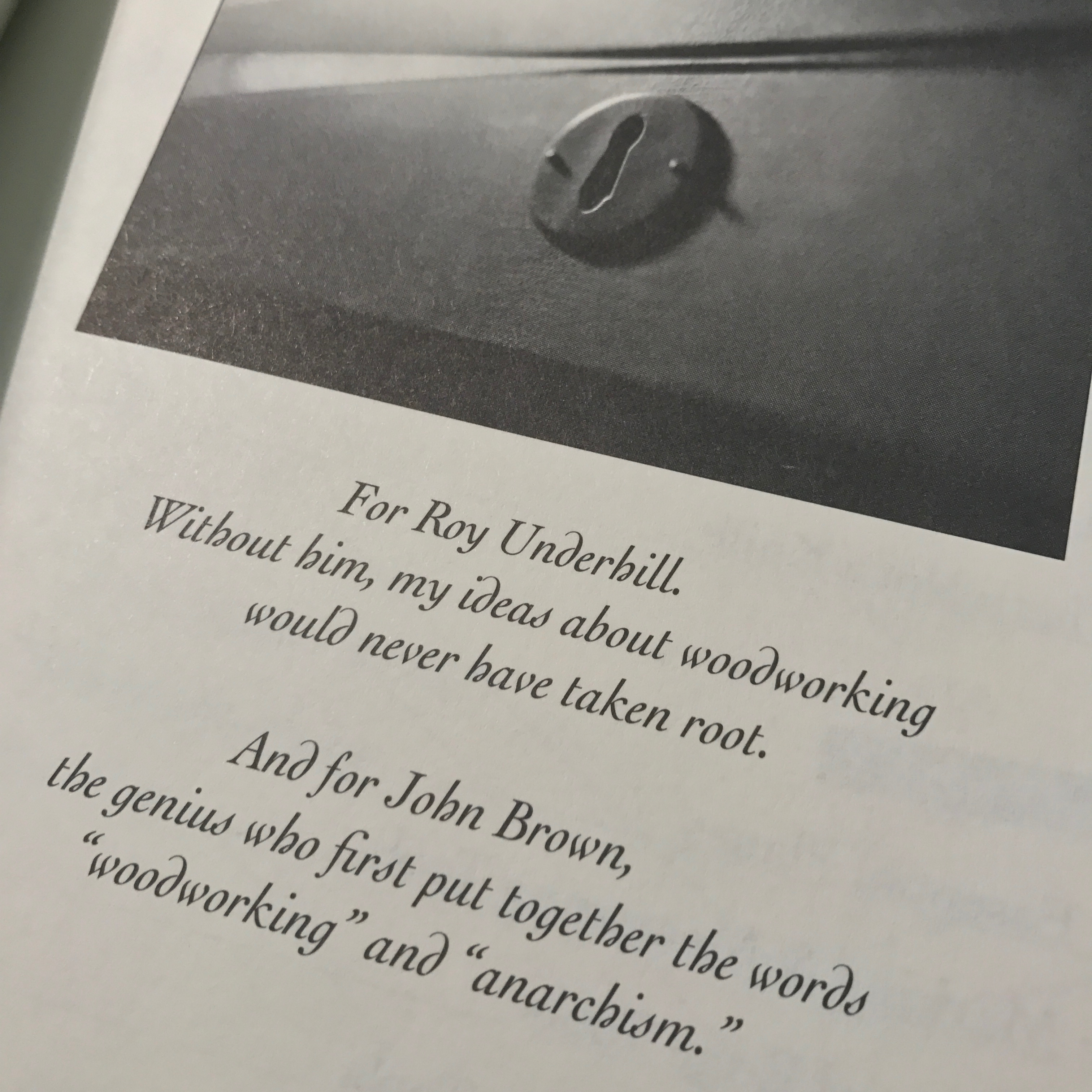
Robert Wearing’s “The Essential Woodworker” was the second Lost Art Press book, and it was a lesson for us in how badly publishers treat authors. First, let me say that Wearing’s book is one of the most important books on out there on hand-tool woodworking (read about my first encounter with it here).
The original publisher of the book had let it go out of print. When that happened, they were supposed to return the photos or drawings to the author. But they didn’t. And then they claimed they had lost all the original materials – breaking one of the essential covenants of publishing. Wearing, in the meantime, was living on a fixed income in an assisted-living facility.
So John and I went to work. We wrested rights from the original publisher and set about to rebuild the book without any of the original materials. We typed the entire book back into the computer, scanned and edited every illustration and recreated all the photos that had been lost. And we created an entirely new layout.
The process took a couple years, but we are proud to say that Wearing then received a royalty for every one of the 37,000 copies we’ve printed since 2010. And his estate now receives these royalties.
For me, “The Essential Woodworker” was the landmark book that connected all the dots about hand-tool woodworking into a cohesive explanation as to how the craft works. You can read it in an afternoon, but its lessons will stick with you for the rest of your life. The illustrations are brilliant.
Bringing Wearing’s book back into print led us into our first massive republishing project: The Woodworker series by Charles H. Hayward. You can read more about that series of important books here.
The following step-by-step instructions on how to hinge a door are perfectly indicative of Wearing’s clear instructions and illustrations. We miss Robert, but we are happy that his book lives on to help others.
— Christopher Schwarz
Hingeing a door
The majority of doors are fitted with butt hinges (Fig 434) – for best-quality work they should be solid drawn brass not folded or merely plated. The illustration shows the two styles: the manufactured, broad suite (B) and the narrow suite (A), the second being more commonly used for furniture. The broad suite type is useful when a door is slightly outset, because in this case if a narrow suite hinge is used, the screws are liable to come too close to the carcase edge.
Three gauge settings will be used in the marking out (Fig 435, A, B and C). Three separate gauges, though not essential, save time and re-setting. Note that in setting A the gauge point should be just short of the hinge pin centre; 1mm (1/32in.) is about right.
The location of the hinges is important, particularly for their appearance. On a framed door the hinge lines up with the inside edge of the rail (Fig 436A). On a flush door the hinge is generally placed at its own length from the end (Fig 436B). The same rules apply to the hinges on a planted door (Fig 437). Hinges let into both door and carcase (Fig 438A) interrupt the straight line between door and carcase. In Fig 438B the hinge is let into the door only, preserving the continuous line, a more pleasing effect.
Mark the door first (Fig 439). The length is taken from the hinge itself and marked with a knife and square. Gauge the hinge width, A, on the edge and from the outside, i.e. the true face. Gauge the thickness, B, on the face. It is vital that this size is not exceeded otherwise the door will not close fully; if it is slightly undersize, the lesser evil, there will be a gap between the door and carcase which can be corrected. An overdeep socket will need packing up with veneer or card, or filling in and a fresh start, all unsightly.
The socket is formed by making a number of sawcuts (Fig 440) then removing the waste with a broad chisel (Fig 441). Notice that the socket reduces in depth towards the back where it finishes to a depth C, the thickness of the hinge leaf. Obviously this cannot be gauged, it must be found by trying the hinge. A socket too deep here will not affect the door closing but only its appearance. However the knuckle end is most critical as has already been mentioned. A block cramped to the door will prevent the chisel from accidentally bursting through.
Brass hinges need brass screws. With very hard woods it is easier to insert steel ones first, preferably one gauge smaller; these are replaced by brass when the hingeing is completed. Hinges sometimes need extra countersinking to ensure that the head does not stand proud. Provisionally fit the hinges to the door with only one screw in place.
The door with its hinges is located in the carcase, standing on one thickness of the packing card. Mark the hinge position on the carcase and remove the door. Square these marks onto the inside and gauge the hinge width, A (Fig 442). Chop a chisel lightly across the grain in the manner of the sawcuts in Fig 440, remove the bulk of the waste and trim back the socket carefully to the lines. The maximum depth (Fig 443B) is the total hinge leaf thickness (Fig 435B). Again slight excess will not harm the fitting. Nothing must be removed at the carcase edge. Fix the hinge with one screw. Note that pilot holes for the screws must be drilled at right angles to the sloping bottoms of the sockets not to the face of the carcase.
Try the door for fit; a strip of thin paper should just pass down between the hinge stile and the carcase. The closing stile may now need easing, at a slight angle. The odd shaving may still be needed elsewhere but with accurate marking and careful working this should be minimal.
For the best-quality work the hinges should now be unscrewed and rough scratches removed from the knuckles with successively finer grades of emery cloth, then metal polish. At the final screwing on, use brass screws and line up all their slots the same way.
If a stop is needed it can be made in the same manner as a drawer stop.
Common faults when fitting doors are that either the door is ‘screw bound’ where protruding screw heads prevent the hinge from closing, or ‘hinge bound’ where the socket has been cut deeper than the total hinge thickness.
Australian woodworker Carol Russell’s carvings of animals are a visual form of haiku. With a few judicious swipes of the knife, she transforms small chunks of wood into figures so evocative that it’s a challenge to avoid reading into them distinct personalities and tales of adventure. The curious cock to a dog’s ear, the satisfied curl of a cat’s tail – these and other details bring her animals to life. So when Christopher Schwarz asked whether I had any ideas for the dustjacket of “Shop Tails” (which we anticipate receiving from the printer in early October), an image of Carol’s animals was one of my three suggestions. As it turned out, Chris, Megan Fitzpatrick and Kara Gebhart Uhl are also fans of Carol’s work. So Lost Art Press commissioned her to carve a dog and a cat. She surprised us all by adding a second cat, this one orange; we instantly named him Tony.
Cat in tiger myrtle.
Huon pine boat.
Scattered among the animals in Carol’s Instagram feed you’ll also find the occasional rowboat. Carol grew up in Tasmania, a small island off the south coast of Australia known for its pristine wilderness and endemic timber species. Tasmania has one rare native species, Huon pine, that has been traditionally used in boatbuilding and high-quality furniture making; its high methyl eugenol content makes it resistant to marine borers. Carol says “it’s very rare now, and a protected species; there is definitely romance attached to it, partly due to its beauty and the fact that it stands as a monument to the amazing forests it grows in.” She finds a special charm in Huon pine boats – they evoke “that daydreaming aspect, that [English children’s book writer] Enid Blyton [thing] of [children] floating away for a day of adventure without their parents. And usually as a kid you’re accompanied by a scruffy dog that’s up for anything. That’s the dog I’m always trying to capture.”
Early Life
Carol at six, after she’d cut her own hair.
“We always had animals,” Carol says. In the 1960s, when she was a child, her family lived on the edge of Launceston, right next to open fields. The area where they lived was far from prosperous. Many people couldn’t afford to have their animals spayed or neutered, so there were always stray, injured and abandoned animals around. Her family took in most of those who showed up at their house. In addition to dogs and cats, her brothers occasionally found other animals to rescue. One time they brought a little kangaroo home, where it joined the other animals in the house and curled up by the fire. “At one stage we had 13 cats, three dogs, a kangaroo and a sheep,” though the sheep had to stay outside. “It was completely mad! We just had a little suburban house with a veggie garden.”
It was another time, she points out. “We’re not encouraged to keep wildlife now, and many groups work hard to re-house animals back into the wild. It was a lovely way to grow up, though.”
Carol’s father and four brothers, Norman, Peter, Kerry and Patrick, around 1958. She and her sister, Linda, had not yet been born.
Her father, Len, worked on telegraph lines for the postmaster general. One day, before Carol was born, he fell from a telegraph pole onto his back. The injury left him in terrible pain that became chronic. Although he was able to walk, he couldn’t walk far. Nor could he drive. In response to his dramatically changed condition, he planted a vegetable garden and grew most of the food for his family of eight – he and his wife had six kids, of whom Carol is the youngest. “He was enormously methodical,” Carol says. “The garden was the focus of his life. He couldn’t do a lot. A bit each day, though, mounted up. I grew up with the most amazing food.” All of his friends had served in the Second World War. He hadn’t gone because he’d had a double dose of the smallpox vaccination by mistake and had become so sick that he was repatriated home. Survivor’s guilt led him to drink heavily in the early years, though he eventually got that under control. “I never knew him to work [at a job], but he was a very wise, very gentle person, a lovely man. He adored my mother and would sing old love songs to her. It drove me mad, but now I can see how sweet it was.”
Although her dad received a disability pension, it was modest. “Which is why my mother was always coming up with schemes to make more money. She would send us door to door, selling cakes. We’d have big trays of lamingtons (a sponge cake rolled in chocolate and coconut) and highly decorated cupcakes and slices. They looked amazing; no one would refuse when confronted with these delicious goodies.” At Christmastime her mother sold dozens of her Christmas cakes and puddings; people would order them months ahead, and storing them took all the available cupboard space.
Carol’s mother, Valerie, had been born in Dublin. As a young woman, her grandmother had fallen in love and married an Irishman, who was “quite a devilish man.” The family emigrated to Tasmania, where Carol’s grandfather left them and went to Sri Lanka (then Ceylon) to grow tea. He never contacted them again. Valerie was largely raised by her grandparents and was a voracious reader, as she remains today at the age of 92. Carol’s father was born in Tasmania of Welsh ancestry. He and her mother met in Launceston around 1950; each brought children to the marriage, and they had three more together.
“My mother was enormously resourceful and enthusiastic about everything,” says Carol. “Always making and growing things.” None of this was unusual where they lived during the ’60s and early ’70s, she points out. Lots of people made what they could and bartered their work for that of others. “The lady who made clothes made clothes to swap for homegrown vegetables or preserves. That was just what people had to do to get by.” Her mother, to this day, sometimes says, “’I think I should go and get a job.’ She hates idleness.”
Valerie, Carol’s mother.
Early Career
Given her love of animals, Carol wanted to be a veterinarian. Throughout high school she had a weekend job working with a local vet, a Scotsman “who distilled whiskey in the tearoom out the back of the consultation room” because his wife wouldn’t let him do it in the house. “I’d sit next to it drinking my tea and hear it gurgling away. I learned so much from him; he was so generous to people and animals and was never too busy to teach me what he could.” When they delivered puppies by caesarian section, the vet would hand them to her and she’d rub them to get them warmed up. “I loved it,” she says of this work. “It was just a delight, but it could be sad, too.”
As a child, Carol had been a huge reader and one of those kids who could pick up almost anything. She was particularly interested in drama, English and art and adds, “I had a healthy opinion of myself as well!” When she was 17, the Australian Broadcasting Commission (ABC) offered her a cadetship as a journalist, a type of internship that involved research and writing articles. All was going well until the day she was flicking through a newspaper and happened on an ad for a crew to sail a 35′ trimaran to New Guinea. She applied to be a crew member, forwent the cadetship and left Tasmania “on a little red yacht sailing off into the sunset in winter.” She quickly adds: “If my son tried to do [the same thing] now, I’d lock him in a room!”
She and her crewmates had a wonderful time. The Bass Strait between Tasmania and Australia has beautiful islands with bird rookeries and seal colonies; they saw “a lot of amazing things over the course of two months while sailing around photographing wildlife.” It was July, the middle of winter in the southern hemisphere. Unlike the other crew members, Carol had no previous sailing experience and found even the most mundane aspects of the trip rewarding. One of her jobs was to cook for the crew. There was also a routine in which each crew member spent two hours at the tiller while the others rested. They were on the water in what felt like “the middle of nowhere. I’ve never forgotten it, that solitary sense,” she recalls today. “You could see the phosphorescence in the water, and sometimes, dolphins would whiz past leaving a silver trail behind them. I think that’s why the boat thing is strongly ingrained in me. I’ve never forgotten that feeling of freedom.”
But it wasn’t all idyllic. The man who owned the boat was insufferable. If he lost at chess, he’d go to his bunk and sulk for days. “After four months or so I got really fed up with it.” By the time they arrived at Mooloolaba Beach in Queensland, she’d been in a quarrel with the captain. She got her backpack of clothes and said she was done, so he rowed her to shore and left her there. It was nearly 40 years ago, long before the widespread availability of cell phones. She had only just turned 18. “I watched the boat sail off and thought ‘What am I going to do now?’”
Her sense of pride kicked in. She couldn’t go home just four months after leaving, so she made up her mind to head for Brisbane, the nearest big town. She met some people on the beach who offered her a ride. “I didn’t choose Brisbane,” she says of the city where she’s spent most of the intervening 30-plus years. “It just happened. At that stage I was a blank slate with a little bag of clothes and no money, but lots of enthusiasm and self-confidence. It’s amazing how you can rebuild a life. I often think back to that little bag of clothes…” – quite a contrast with the many possessions and responsibilities that she, like many of us, has collected over the years.
Carol, far left, working as a model “with too much makeup, at an open-air fashion show.”
Carol (far right) with her father and a bridesmaid at her sister’s wedding.She thinks her expression reflects her displeasure at having to wear the dress.
For income in Brisbane she worked at Aroma’s Café, one of the first places there to roast and blend its own coffee. Sometimes she worked as a model – it was a great time for emerging clothing and jewelry designers. In time she met new friends, one of whom, Wayne Crotty, was a musician/furnituremaker. “That was it,” she remembers. “I saw what he was making and was so astounded that you could make a table. I’d never thought about how things were made before.” She asked him to teach her. He did. She worked with him for 10 years.
Carol foraging in the wood pile during her 20s.
Her first job was a Shaker table with a tripod base. She learned about mortise-and-tenon joinery, dovetails, sharpening and setting up machines. “Wayne was not a fine woodworker. He was a good ‘practical’ woodworker. He knew a lot of people. He took me to meet people that owned areas of forest.” They would selectively choose and mill particular trees, being careful not to take too many. They also salvaged a lot of logs from forestry clearing, so she saw the whole process and developed a deep understanding of wood as a material. Of the men she worked with, she says “some of them appeared quite gruff and very blokey, not the sort of people I thought would take a young woman very seriously. I discovered, though, they loved the fact I was so keen. If you’re interested and you listen, the world opens up to you.”
She also ventured into the world of building theater sets. While working for a company that made stage sets for big events, she learned about what she calls “practical construction” – nothing precious or fine, but more “how to turn a ballroom in a grand hotel into a fantasyland or forest for a particular event or conference. You all worked together really hard on tight deadlines and drank a lot of cheap coffee.” The comradery was fabulous.
Large cabinet with camphor laurel drawers and etched glass.
By her late 20s Carol was ready “to make things that were really special and would mean something to people.” She began to design her own pieces and developed her own customer base; people would come to her with an idea that she would sketch, then build for them. For about seven years she did one-off pieces, working in Wayne’s shop, with the occasional exhibition of work that was more creative. “I started reading all the [issues of] Fine Woodworking magazine I could get my hands on,” as well as books by James Krenov and George Nakashima. She was especially interested in Japanese design. Unfortunately, she has few photographs of her work from that time.
In her early 30s, when she was running her custom furniture business, Brisbane furniture maker Simon Hooper, whom she calls “a real hero of mine,” asked if she would come to work with him at Bell Brothers, an old Brisbane furniture making institution. Carol leapt at the chance. The company also owned a funeral parlor; the shop was next to the coffin makers, and they often needed extra people to help with funerals. Carol would have to change out of her shop clothes into a black suit and drive an old Mercedes hearse. After the funeral it was back to the bench. “It gave you this crazy perspective on life,” she remarks. “If this board was twisted, well… It’s not the end of the world; it can be straightened. Everything is really about people,” she realized. “It’s not about stuff. People have been very generous to me with their knowledge and I have encountered mostly kindness.”
Box in Australian red cedar.
“I’ve not had formal training at all,” she continues. “We have some amazing woodworking schools [in Australia] now, and I think I would just love an opportunity to dedicate two or three years to learning.” Lacking that option at the time, she traded labor for instruction. There were no apprenticeships available in the kind of work she wanted to do; it was the 1990s, the dark age of particleboard and MDF. She wanted to work with solid wood. She picked up any new skills she could. As a result, she calls herself “a bit of a Frankenstein woodworker.”
Carol had met her husband, Nick, in 1996 through a mutual friend. They met at a country pub, The Dugandan Hotel in Boonah – “a pub in a paddock,” she calls it. Nick was working as a consultant for an IT company and had just returned from an assignment in Sydney. It was unlikely they would ever have met, but their friend was celebrating a birthday at that particular pub that day. They married in 1998.
The year before, she’d taken a job working in the showroom of Carbatec, a woodworking supply company that had recently begun importing the kind of high-quality tools no one else was selling. They also imported traditional woodworking tools made in Japan. “It was a wonderful place full of beautiful tools and enthusiastic people,” she notes, explaining why she left her own furniture-making business for a job in retail. “The prospect of a steady job was pretty enticing, too.”
When her employers announced they wanted to offer classes, she decided to teach joinery. She went to night classes to learn teaching skills and her work shifted to teaching and writing. Carbatec also had a fabulous catalog that required Carol to write a lot of copy. The owner of the business, Geoff Lowe, had sons-in-law who were American and worked in the business; the new American-made tools were quite an attraction. “Geoff was very generous,” she recalls, “always giving me the new tools and beautiful pieces of wood to try [them on].”
Carol continued to read woodworking publications while working for Carbatec and was inspired by examples of work done by other women. She traveled with the company to Japan, where she met craftspeople and learned about Japanese woodworking tools, which prompted her interest in hand-tool woodworking. For years she’d worked with tools made by Stanley, Record and Marples, good solid stuff made in England of Sheffield steel. But “to pick up a Lie-Nielsen plane or a Japanese chisel…there was real poetry in that.”
Carol started to write for Australian Wood Review, published by Linda and Raf Nathan. She was thrilled to be the first woman on the cover – around 1999, she thinks. Australia had other woodworking magazines that she says were full of “more practical” stuff, but Wood Review was different – it published work of fine quality and cutting-edge design. The Nathans employed her part-time as an editor for a while, and it struck her that she’d returned, in a way, to the world of journalism where she’d started at the age of 17.
Carol, with two of her pieces, on the cover of Australian Wood Review magazine.
Animals & Life
When Carol was 38, she was sharing a workshop with two renowned Australian makers, Roy Schack and Robert Howard, as well as a few others. It was an inspiring environment with a lot of creative energy.
One day, 32 weeks pregnant, she had a brain hemorrhage. Fortunately, she survived, and her son, Hugo, was born without damage. But recovery took a long time and has changed Carol in so many ways that she now thinks of her life as “before” and “after” the aneurysm. Although she’s loath to use those changes as an “excuse” (her word), she hasn’t made much furniture since. The hemorrhage left her painfully sensitive to noise – routers, shapers, thickness planers and other machines all became unbearable. Her sense of sight was also affected. She tried to go back to furniture, “but it just wouldn’t come together.” Four years later, after Nick completed a doctorate, he was offered a post-doctoral position in the Netherlands and they lived there for two years. Carol didn’t make anything during that time; instead, she worked as what she calls a handywoman for the local school. But there’s a great tradition of carving in the Netherlands, which sparked her interest in that field.
After Carol and her family returned to Australia, Carbatec hired her back. One day she made a spoon in a class with Australian woodcarver Gary Field. “It was the first thing I’d really done in all that time [since the aneurysm]. The idea [is] that you start with a whole, and you take away. What you’re left with is the object.” After being wowed by the process of building a Shaker table in her 20s, she experienced a second epiphany in the spoon carving class. She decided to become a wood carver. “You’re going along and all of a sudden your life’s completely derailed,” she explains. “You have this partner who’s trying to make things right, but you can only make things right to a certain point. I was a furniture maker. But I wasn’t a great furniture maker, I never felt completely at home, I had moments where things were quite good. But [carving] was something I felt quite passionate about. It felt like coming home. Other than a band saw, I don’t use machines anymore.”
Huon pine twist spoon charred and finished in beeswax.
A wombat finished in natural rock pigments.
Whether you’re building furniture or carving a cat, she says, the work is “so much about people,” and never more so than when you’re teaching others to build or carve, as Carol does these days. “[Teaching is a skill] that you get to share with people. It literally saves people. It’s saving people now, in these really difficult times.” She refers specifically to Australia’s latest wave of lockdowns, which have filled many with a sense of foreboding. “That little bit of peace of mind people get from making something or growing something with their own hands can just keep them going. It’s the one part of their week that they can rely on.” They come to class and can – well, must – really focus on the work, because it’s so intense.
Carol reaching in her former workshop, an old cottage. (Photo: Yan Chen Photography.)
“I always look at animals,” Carol tells me. “I stare at them constantly. Nothing has ever brought me so much joy as creating these animal forms and trying to distill the essence into this little block of wood.” She compares the intensity of packing so much into a tiny form to the Japanese art of netsuke; it’s “an implosion instead of an explosion, an exercise in not overusing your skill – a couple of cuts in the right place.” In terms of her work, she says, “the world is shrinking into something small, but I’ve needed all the bigness of everything I’ve ever done to be able to distill it down into this small gesture.”
A bird carved in charred King William pine.
Carol and Nick have no animals of their own at present, which only enhances her appreciation for those other creatures who share many of our lives. There’s an Australian tradition of observing Anzac Day every April 25 to honor members of the Australian and New Zealand Army Corps who participated in the Gallipoli Campaign early in the First World War, and all the wars where Australians have served since. It’s a national day of remembrance when people go to a cenotaph and listen to speakers and pay their respects. “We have a lovely local service that we go to, but it can be hard to hear because the PA system isn’t so great,” she laughs. What prompts her to mention the occasion is that “many people take their dogs, it’s in a park close by our home.”
Lucy and Claudia. “They tolerated each other,” writes Carol. “They’d join forces when it was dinner time. We lost them both last year. Claudia was 18, Lucy only 8-1/2. I miss them every day.”
This year she really noticed the dogs, “looking at their body language and how they’re looking at each other, wagging their tails, then looking up at their humans and waiting so patiently. There was this whole canine world below people’s knees. Watching them, I just felt that unadulterated joy that animals give us and we seem to give them – it’s like your heart is going to burst.”
Hugo is heading to university in Melbourne. Carol and Nick plan to move back to Tasmania. Both are looking forward to having four seasons, a pleasure Nick recalls from his native England, after so many years in Queensland’s tropical climate. And Carol’s looking forward to living with animals again, as well as developing her carving practice further.
Carol’s current shop is in a shared space at Botanick Nursery.
In the meantime Carol has a beautiful workspace in Brisbane she shares with fine leather workers Blue and Grae and Andrea and Gary Fitzpatrick, who have transformed an industrial space into the beautiful Botanick Nursery. It’s a space where she can carve and teach. “It has an incredible atmosphere, I feel so fortunate to be there. About 35 regular students come through each week and carve, chat, drink coffee and share their stories. Life is good.”
Family photo on Hugo’s 18th birthday, with his first beer.
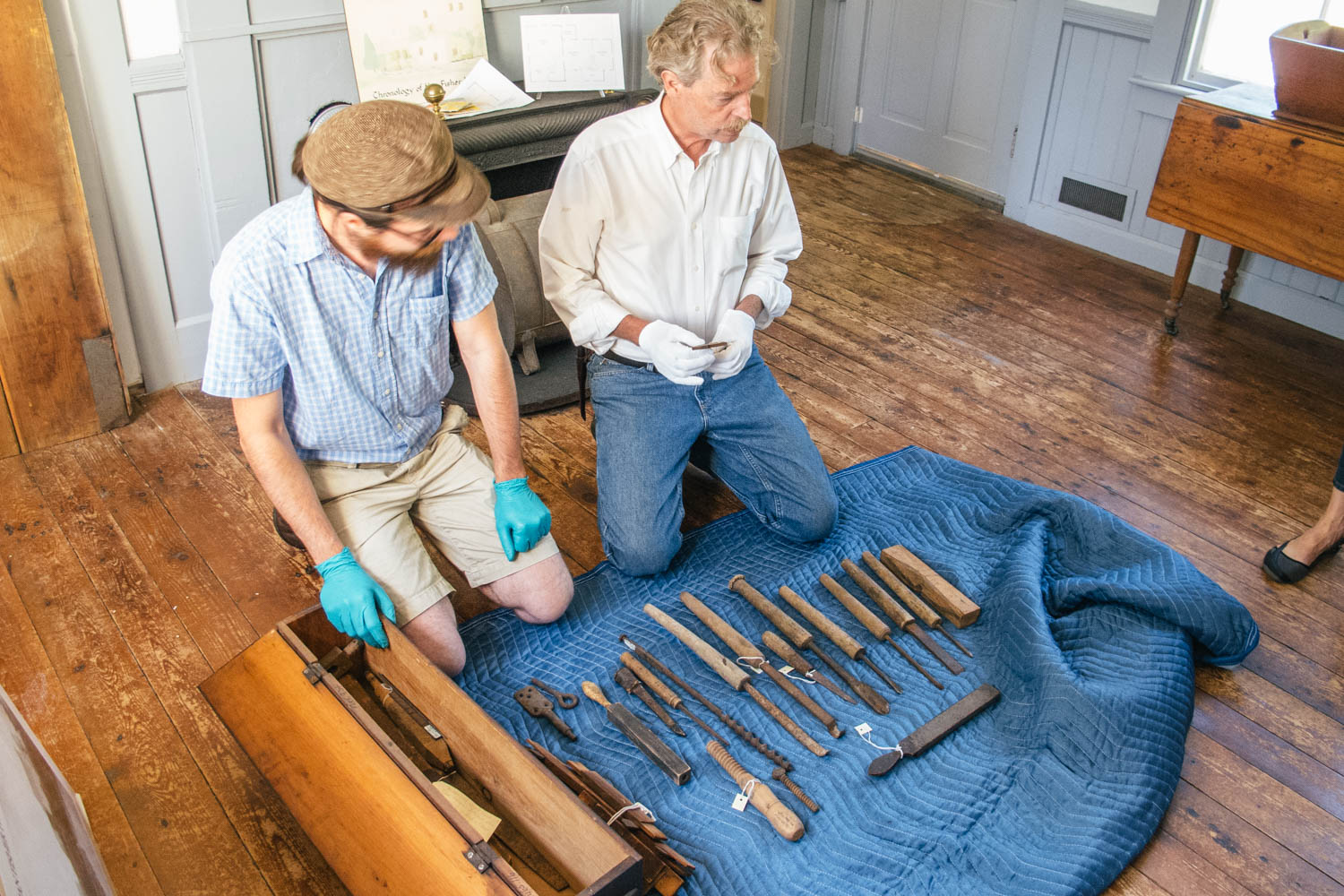
I’m looking forward to the upcoming open house at Lost Art Press on August 7th. It’s a chance to share a project Jim Tolpin and I have been working on. Yes, we are at it again – exploring the world of design and artisan geometry. This latest adventure began after looking at a number of historic tool chests and tools used by pre-industrial woodworkers. Most of the tools like hand planes, saws and chisels were typically acquired from specialty toolmakers. Yet there was a group of tools that were often user made, including straight edges, try squares and miter squares. This grouping of tools had a few things in common. Generally, they are used for design and layout and they all embody the geometry that lies beneath everything. They provide that physical link between our designer’s eye and the work at hand.
After Jim and I made some of these tools and began using them, we both came to realize there is something deeper going on. Yes they are highly functional and a pleasure to use. More than that, these tools are teachers. Turns out that building a set of traditional layout tools is a class in advanced hand-tool techniques as well as a master class in artisan geometry. All these tool builds use geometry to generate the tool, but also utilize geometry to dial in each tool to a high level of perfection.
A simple tool exploration on our part blossomed as we looked at historic examples and built one tool after another. To our delight we learned that each build and each tool contains insights that deepens the connection between hand and eye. Jim won’t be able to attend the open house, but I’ll be there with a pile of these “Tools of By Hand & Eye” for you to handle and see for yourself. I look forward to hearing from you and perhaps gaining insights from your questions and perspective. These tools have a way of sparking the imagination.
P.S. I also will be bringing along a special surprise for anyone interested in the nautical history of the Ohio River Valley.
The Peggy Shepherd Pottery Collection (at least, most of it) now lives in Nancy Hiller’s office. The whisk brush was made by Aspen Golann.
After a small flurry of emails this past weekend related to the dust jacket in which Nancy, Christopher, Megan and I discussed word choice, the number of lines, the space between “Shop” and “Tails” and more, “Shop Tails” is now at the printer.
Makers, whether of a dust jacket, a book, a spoon or a kitchen, tend to eschew materialism, or, at least certain types of materialism. And yet we make material goods. As Nancy writes below, the “things vs people” dichotomy can be false and destructive, and that holds true whether you’re talking about a person on a factory production line or someone working in a one-person workshop.
In this excerpt from Chapter 11, Winnie (1996-2010), Nancy addresses the concept of materialism, and suggests considering a new way of looking at objects – appreciating how things embody important characteristics of their makers, as well as memorialize others.
— Kara Gebhart Uhl
When Winnie, William, Lizzie, Tom and I officially moved into the house next to my shop in the winter of 2004-2005, I kept the dogs confined to the laundry room and kitchen instead of giving them free run of the house. Not only was I loath to see any repeat of the destruction at my bungalow in town; I had begun laying the hickory floors in my spare time, and it was an unimaginably slow job, done on my hands and knees.
Alan had kindly loaned me a flooring nailer. It was the manual type you whack with a dead-blow mallet. I tried it repeatedly, but the hickory was so hard it just bent the nails. Once a nail was bent, it was far more time-consuming to remove from the dense wood than it would have been to drive by hand. A pneumatic nailer might have done the trick, but I didn’t have one, so I bought several pounds of large finish nails and recalibrated my expectations. I had to pre-drill the tongue of each board about every 18 inches along its length to keep it from splitting. I drove the nails with a hammer and finished with a nail set. It took a week of spare time to lay the floor in the 13 x 18-foot living room, but as I watched the hickory spread slowly across the OSB subfloor, I was thrilled by the transformation in my surroundings.
After the living room I moved down the hall to the bedrooms, then hired my friend John Hewett to sand the floors. I applied two coats of Waterlox Original tung oil just before driving to Florida with a kitchen full of cabinets for Maggie and her husband – the tung oil was so heavy on the solvent that I didn’t want to be in the house while it cured.
Considering how much work the floors took, I was not about to see them scratched up by the dogs’ claws, so I decided to confine them to the kitchen and laundry room, rather than allowing them the run of the house.
***
Every so often someone complains that I’m too protective of material artifacts, whether the floors in my house, the top of our kitchen table or the quilt made by our friend Kim, a gift when Mark and I were married – “Use the delicate cycle! Those are Kim’s hand-sewn stitches!” These criticisms, which are often veiled, pit things against people (or things against dogs, in the case of my floors), implying that I value the former over the latter.
I get it. When I was around 10, Esse, gave me a melodica, a hybrid between a wind instrument and a keyboard. You blew into a mouthpiece, pressing keys to produce different notes. The resulting sound struck me as artificial, and the instrument itself was mostly made of plastic. It didn’t seem like a serious instrument. I had no idea back then that the melodica was good enough for the coolest of professional musicians, like Jon Batiste on “The Late Show with Stephen Colbert.” I was touched that she’d bought it for me, but not that interested in learning to play it.
The gift of the melodica coincided with the influx of hippies living in our yard. From them I learned that attachment to material things was bad. “You gotta let it go, man. Free yourself,” they’d say – not about my melodica, but about other, grown-up things. Their happiness living with few possessions impressed me. I wanted to follow their example. So one Saturday morning, when a couple mentioned they were going to a swap meet to divest themselves of still more possessions, I asked if I could join them. It would be an exercise in renunciation.
I set the melodica down with a bunch of other people’s stuff on a fold-up table in a dusty parking lot cooked by the Florida sun. I think I priced it at $25. Eventually someone haggled me down to $8. The money wasn’t important; what mattered was that I was letting go of another object I didn’t use. I was training myself to avoid attachments. I overrode the pang of guilt as I took the cash – my dear grandma had given the instrument to me – and told myself to grow up. When I told my grandma, she was hurt. “I bought that for you,” she said. “It was a gift.” She wasn’t trying to make me feel bad; she was expressing how she felt. I’ve been troubled by my superficial take on the melodica ever since.
As I thought about that experience over subsequent years, I came to see “things versus people” as a dichotomy that’s false and destructive. You can’t even have things without people; we’re interdependent. People make things, whether they do so on a factory production line or in a one-person workshop. Then other people put them to use. Beyond this, things are more than mute material; they express their makers’ dreams and values. This connection between maker and made object is most visible in artifacts crafted by individual makers to their own designs, or designs they’ve adapted significantly – think Megan Fitzpatrick’s Dutch toolchests, or Danielle Rose Byrd’s bowls. But even anonymous workers on the production line at Toyota or General Electric are expressing their dreams of a good life, albeit less directly, as they cut, weld or assemble parts to other peoples’ designs using tools and equipment they don’t own.
Material artifacts are also repositories of memory. They keep people and places alive. In my office I have a Victorian bamboo étagère, its shelves filled with antique ceramics. The stand and all of its contents – a Dutch urn resembling an antique from Greece; two sugar-and-cream sets from Japan; pitchers and vases from Germany, Romania, England – once stood in the entryway of my friend Peggy’s house, a converted timber-frame barn. She’d bought the barn in pieces and made it into a home filled with character and natural light. I always coveted the pottery collection (and kicked myself for doing so, because it was hers). After Peggy died, her daughter held a barn sale. I bought the shelf and the ceramics – not only because I loved them, but to keep those things together as the Peggy Shepherd Pottery Collection. Peggy lives on in these artifacts, as well as many others in our home: the curvy black metal chair she gave me at Christmas in 1998, the funky painted cabinet a former boyfriend of hers had cobbled together, the beautifully upholstered chair she gave me after I built cabinets for her barn-house kitchen. “You didn’t charge me enough,” she said. “I want you to have this.”
The World War II-era sofa in our living room, which I bought from Peggy many years ago, reminds me to be thankful that we’re not hiding in bomb shelters while subsisting on tinned meat, chicory “coffee” and other rations. The salvaged leaded-glass window I built into our bathroom wall carries forward the legacy of a client’s family home that was demolished as part of an airport expansion. The ceramic model of a terraced house on my office bookshelves reminds me of my first woodworking boss, Raymond, who gave it to me when Patrick and I were married, adding “You’ve always said you want a house of your own.”
When we buy things from those who make them, we not only support those craftspeople, we also do our part to keep craft traditions alive. In the factory-made Arts & Crafts-style cabinet I bought tenth-hand from a back room in a Bloomington grocery store in 1995 lies a silver cheese knife made by Hart Silversmiths in Chipping Campden, England, the lone surviving enterprise from Charles Robert Ashbee’s Guild and School of Handicraft. Mixed in with blue-green ceramics bought at yard sales and junk shops is a vase bought for me by my former husband, Kent, and his wife, Mary, on a visit to the Van Briggle Pottery & Tile. There are small pieces by Ephraim Faience that I purchased at The Omni Grove Park Inn and a Granny Smith green cabinet vase I bought from Scott Draves of Door Pottery in 2015, when we were in neighboring booths at a show in Chicago.
Even mass-produced artifacts deserve more respect than we generally give them, at least in the States. We have a famously materialistic culture in which too few people have more than the most superficial, consumerist understanding of material objects. As Elaine Scarry pointed out in her 1985 book, “The Body in Pain,”
…anonymous, mass-produced objects contain a collective and equally extraordinary message: Whoever you are, and whether or not I personally like or even know you, in at least this one small way, be well…. Whether they reach someone in the extreme conditions of imprisonment or in the benign and ordinary conditions of everyday life, the handkerchief, blanket, and bucket of white paint contain within them the wish for well-being: ‘Don’t cry; be warm; watch now, in a few minutes even these constricting walls will look more spacious.’1
Instead of “things versus people,” it would be more fitting to appreciate how things embody important characteristics of their makers, as well as memorialize others.
The things we live with also shape us in ways we often don’t even see. They impose their own demands on our behavior: We have to learn how to use the new email platform, drain the compressor, grease the sander’s gears, prime the pump. Many things, from the humble kitchen whisk to the thickness planer, bicycle or car, become extensions of our bodies, magnifying our abilities, for better or worse, and sometimes leading us to imagine ourselves more powerful than we are. (All it takes to prove the validity of this statement is a power outage.)
Today I reviewed a big batch of Crucible dividers for quality control problems and sent them on to our warehouse in Indiana. Barring some delivery stupidity (it happens), they should go on sale on Saturday.
These dividers are the most complex tool we make and are difficult to manufacture, especially considering the $110 price tag. If they were $300, we could lavish a couple hours of polishing and tuning on each tool and still come out in the black. But that’s not what we’re about.
Instead, these tools are manufactured – like our books. Yes, there is a lot of handwork, hand-assembly and tuning involved in these tools. But a lot of the skill to make them is in programming the robots and ensuring the processes are foolproof so that even I can assemble them – even though I’m not a skilled machinist. And so far, I’ve assembled quite a few of them.
Because I’m not a fan of hype, I’ve tried to downplay these dividers quite a bit (maybe too much). They aren’t like an infill plane or a blacksmith-made fretsaw. But when I pick up our dividers and use them – as I have every day for the last six months – I am tickled by their presence. Despite the fact that my personal dividers aren’t cosmetically perfect, I carry them around all day like a nice pen. I hold them when I’m thinking or on the stupid phone.
I open them and shut them over and over, and think about the mechanism inside. It looks so simple, but the angles and tolerances have almost broken my head a few times. But still they make me think. And now that we have the mechanism (almost) perfected, we’ve been designing other tools that use it.
(EDIT: When I say “almost” perfect, I mean that we are improving the hinge to make the assembly process easier. Right now we have to do a couple extra steps to get the hinge working perfectly. Nothing leaves our hands that isn’t 100 percent functional and meets our standards for fit and finish.)
Books have authors, but there is always a team of people behind them that makes the thing look good and read well. Tools are the same way. And so I will continue to call out the people who have made this tool really work: Craig Jackson at Machine Time and Josh Cook, a mechanical designer. Thanks guys.
So look for the dividers on Saturday. And if we sell out, know that we now are making hundreds more. Our goal is that everyone who wants one can get one.