

A few weeks ago, Chris asked me to research The Anthe Building. To help, he put me in contact with Heather Churchman, who runs one of our favorite Instagram accounts, Covington Uncovered. Heather was instrumental in the development of this piece for her research, knowledge of Covington history and where to find necessary information. In this post and a couple more to come, Heather and I will share information with you about the Anthe building, company and family, and why the history of this building is so fitting for the future of Lost Art Press. We also met with Jason French, curator at Behringer-Crawford Museum, who shared with us some historical items from Anthe Machine Works (check out his Curator’s Chat video on Anthe Machine Works here) and is helping to coordinate an interview and oral history project with members of the Anthe family soon.
p.s. If you would like to help fund the Anthe Building restoration project, we are selling some limited-edition items here.

In 1890, 1895 and 1897, Frank D. Anthe is listed in the Williams & Co. city directories as “Anthe Frank, mach. H. 648 Philadelphia.” This indicates his occupation was machinist and the address, we presume, was his home address. Anthe Machine Works has long advertised that it was established in 1897, and this change is noted, in part, in the 1898-1899 city directory, with two addresses and the structure of his name: “Anthe Frank D. machinery, n.e.c. Stewart and Russell Av. H. 648 Philadelphia.”


Looking at historical Sanborn maps, Heather noted that in 1886, the area around 407 Madison had dwellings that were near a huge industrial block with Fred J. Meyers Architectural Iron Works occupying most of the space.
I want to pull you aside for a moment, with an excerpt from the book “They Built a City: 150 Years of Industrial Cincinnati,” published by The Cincinnati Post in 1938, to illustrate the prominence of the machine tool industry during this time:
“Probably the first Cincinnatian to invest mind, brawn, and money in the business of manufacturing machine tools was John Steptoe, a foundry man who hustled about his shop on Clay Street. About 1850 Steptoe fashioned a wood planer, a machine used extensively in local woodworking plants. Marketing his product proved so profitable that Steptoe in 1855 took in as a partner Thomas McFarlan, carpenter, who not only believed that woodworkers needed machines to increase production, but also that he could give them exactly what they wished. The firm of Steptoe & McFarlan was therefore soon putting out mortising and ennoning [stet] machines which were revolutionary in trade practices.”
John Boh notes in the July 2006 Bulletin of the Kenton County Historical Society that Cincinnati and Covington began to see more and more machine tool manufacturers around this time, in part, thanks to the introduction of the steam engine.
Continuing in “They Built a City,” pages are spent on the history of the machine tool industry along with dozens of listings of large machine tools producers during this time, noting that a number of companies rebuilt and repaired machine tools for resale.
“…Because a great many improved, as well as newly designed machines are being made here, some companies specialize in this type of research and engineering: Anthe Machine Works, 407 Madison Avenue, Covington. …These plants have made Cincinnati the recognized world center for machine tool production. More than 35 of the 150 plants in America are situated here. They build practically every tool used in industry….”
Back to the Sanborn maps. By 1894, the entire space around 407 Madison was barren after a fire destroyed Fred Meyers, which Heather says, explains why the buildings at both 407 and 409 Madison are considered “newer” for the neighborhood.
In 1902, Anthe must have been renting space at Phoenix Manufacturing Company due to this article in the May 12, 1902 edition of The Cincinnati Enquirer: “Not since the fire at the F. J. Meyer Wire Works, on March 4, 1892, the day of the inauguration of President Grover Cleveland, have the firemen been compelled to cope with such a large fire as that of Saturday night, which at one time threatened the entire neighborhood at Third and Russell Streets.”
The fire gutted Phoenix, a four-story building. Anthe is mentioned near the end of the article: “The loss to the Anthe Machine Works east of the scroll works was about $10,000 and is not fully insured. Several of the firemen were injured by falling glass and cut and bruised about the hands and face.”
The listing in the 1904-1905 city directory: “Machine Works, Frank D Anthe propr. n.e.c. Stewart and Russell Av.”
On August 29, 1905, a building permit was issued by Auditor Gould to F. D. Anthe. The permit was for a “three-story brick factory building to cost $3000.”
Building 407 Madison Ave.
We get some details on the 1897 construction of the Anthe building from an application written in 1983 for the Covington Downtown Commercial Historic District to be named to the National Register of Historic Places. It states:
“The Anthe Machine Works, a similar business, however, has been located in a factory and offices with a fine Neo-Classical front at 407-409 Madison built (or rebuilt) for the same family firm at the turn of the century. This is the kind of small shop of highly-skilled workers (many of them probably of German background), making very specialized products, that characterized the Covington economy, and to some extent, the downtown area, throughout the later 19th and early 20th century, although sometimes on a large scale, like the Stewart Iron Works that have remained at Madison and 17th Street for almost a century.”
and
“Schofield, of Schofield & Walker, used a similar manner in orange brick for the Anthe Buildings, constructed or refaced shortly afterward nearby at 407 and 409 Madison (Photo 5, distance).”
and
“The Weber Brothers, Schofield, Walker, and William Rabe who worked first for [Daniel] Seger and then with Schofield from 1898 and 1904, may also have designed the many similar buildings throughout Covington.”
When walking through the Anthe Building you get the sense that things have stayed beautifully stagnate, at least structurally and architecturally, over time. This sense also rings true in an article written by Mike Pulfer, who featured the Anthe company in The Cincinnati Enquirer in 1983. He interviewed Don Anthe, who took over the company after their father died (Frank J. Anthe) in 1963. (An interesting aside: According to the article, Frank J. Anthe took over the company from his father, Frank D. Anthe, when he was only 15 years old.)
In the article, Don remembers spending Saturdays cleaning up the basement, whitewashing the walls and running errands for his father. At the time this article was written, because of the recession, business was down 75 percent. Where Anthe used to employ 10 employees, they were down to five. Part of their saving grace, Don states, is that the family owned 407 Madison.
“The structure, a row building put together in 1897 as the Anthe Building, is the epitome of low overhead,” Pulfer writes. “It looks much the same as it [stet] in its infancy, with its original wainscotting and wood floors. The stairway that leads to the third and uppermost level remains decorated in the same turquoise paint Don and Frank Anthe had slapped around as children.

“Steel powder and shavings litter the floors on the first and second levels, where more than a dozen machines are scattered. The third floor is used for storage and utilities.
“The office, with a display window fronting Madison Avenue, is basic and functional. The antique photographs of the business and the partially consumed bottle of whiskey Frank Joseph Anthe left behind remain tucked away in the bottom of a desk drawer.
“‘We’re largely known in the woodworking industry as custom tool builders,’ Anthe said. ‘If somebody wants a special router bit, we’ll agree to make him one or two, or a half dozen or a dozen.
‘The larger manufacturers won’t handle anything less than 100.’
“…A couple of decades back, ‘People were telling us plastics were coming in and they were going to take over the furniture industry,’ Anthe said. ‘They said we’re going to be out of business …Well, plastics came in, and plastics went out. People like wood.’”
Fast-forward to an article written in October 16, 2003 in The Cincinnati Enquirer that states that the building was designed with reinforced beams to support the Anthe machines’ weights. And in the 1970s, many of the firm’s belt-driven machines had to be replaced with electric ones to meet new workplace regulations.
By January 30, 1906, there were two ads in The Kentucky Post:
“MACHINIST—Good man with general experience in toolroom. F.D. Anthe. 407 Madison Ave. Covington.”
“CABINET MAKERS—Two, good at once. 407 Madison Ave.”

The 1908-1909 city directory listing: “Frank D prop Anthe Machine Works 407 Madison Ave h 646 Philadelphia.” And looking at a 1909 Sanborn map, 407 Madison is identified as “Machine Shop, Woodworking.” 409 Madison Ave. does not yet exist.
Other Businesses at 407 Madison Ave.
Anthe posted ads for factory space for rent in local newspapers as space became available.
1924: “FACTORY SPACE for rent: 3rd floor; plenty of light; reasonable rent; elevator furnished.”

One of the first businesses to rent space in the newly built Anthe building was Kelley-Koett X-Ray Manufacturing Company (which employed Herman Anthe, Frank J. Anthe’s brother), in 1905. They rented the second floor, per an article written by John Boh in the January/February 2020 issues of the Bulletin of the Kenton County Historical Society.
We can tell the types of other businesses that rented space, in part thanks to newspaper job ads.
1914: INNER SOLE CUTTER—On block. No. 407 Madison av. Covington, Ky.
1917: GIRLS—For wrapping soap. Jones Adv. Soap Co. 407 Madison, Covington.
1917: GIRLS—Exper. On power sewing machines to make skirts, middles and dresses; good pay; steady work. 407 Madison, Cov.”
1919: JOB-PRINTING pressfeeder: experienced. PICTORIAL SOAP CO. 407 Madison av. Covington, Ky.
1921: WE REGRIND CYLINDERS: Drop in and see the only cylinder grinder in Northern Kentucky. General Machine Work a Specialty. Dixie Regrinding Co. 407 Madison Ave.”
1926: Solicitors Wanted: Crew managers and helpers, men and women, to sell our new kitchen utensil, “EJECTOR FORK.” Write or call at office. THE CHRISMAN MFG. CO., 407 Madison Av.”
1926: Unusual Values: in Lamp Shades, Bases and Uncovered Wire Frames: The Chrisman Mfg. Co. 407 Madison Ave., Second Floor.”
Anthe posted job openings from time to time as well.
1942: LATHE HAND: Experienced Men Only: If engaged in war work do not apply. ANTHE MACHINE WORKS. 407 Madison Ave.”
1946: “MACHINISTS—For lathe or milling machine, only experience men need apply, 407 Madison Ave., Covington, Ky.”

1951: “SUBCONTRACTS WANTED: Machine Shop equipped with 6 engine lathes, 4 milling machines, cutter, grinder and heat-treating equipment is looking for work.”
Historical newspapers are a treasure trove of personal information. In them we learned that Frank Anthe defeated Rev. James H. Lions, pastor of the Shinkle M. E. Church, in a 1928 handball tournament involving 20 businessmen at the local YMCA. Frank Anthe’s $50 overcoat was stolen from his office in 1932. And in 1921, yeggs went to the trouble of breaking into his safe, only to walk away with $50 in war savings bonds.

A Building that Was Meant to be
One of the reasons Chris fell in love with the Anthe building is because of its tie to local woodworking history. Then, we made another discovery:
A printing company (!) occupied the entire second floor from 1931 to 1976.
“Gottleib Frederick Adolf (“Fred”) Schramm fled from the German Kaiser from Tubingen, Germany, passed through Port Huron, Mich., and eventually settled in Florence, Boone County, Kentucky about 1896,” writes John Boh in an article in the January 1991 Kenton County Historical Society Review.
Schram dropped the second “m” in his name, began printing for Hopeful Lutheran Church and did other contract printing for a decade before establishing a print shop with a partner on Pike Street in Covington. Their first big contract was to print stationery and whisky labels for Crigler and Crigler distillery. Schram bought his partner out and in 1931 moved to the second floor of the Anthe building. The business, which eventually was passed to Schram’s son, John, remained in operation until John’s retirement in 1976.

You can see the printing presses and letter trays that were used on the second floor of the Anthe building at the Schram Print Shop at Heritage Village Museum in Sharonville, Ohio. Schram Printing Company donated these items in 2004, and Heritage Village built a structure, Schram Print Shop, in their living history museum, to house them.

The Anthe Building is impressive when you walk through it. But what I kept seeing were the people. Present in the lone wooden hanger.

The broom.

Buzz, Al, Terry and Lonnie.
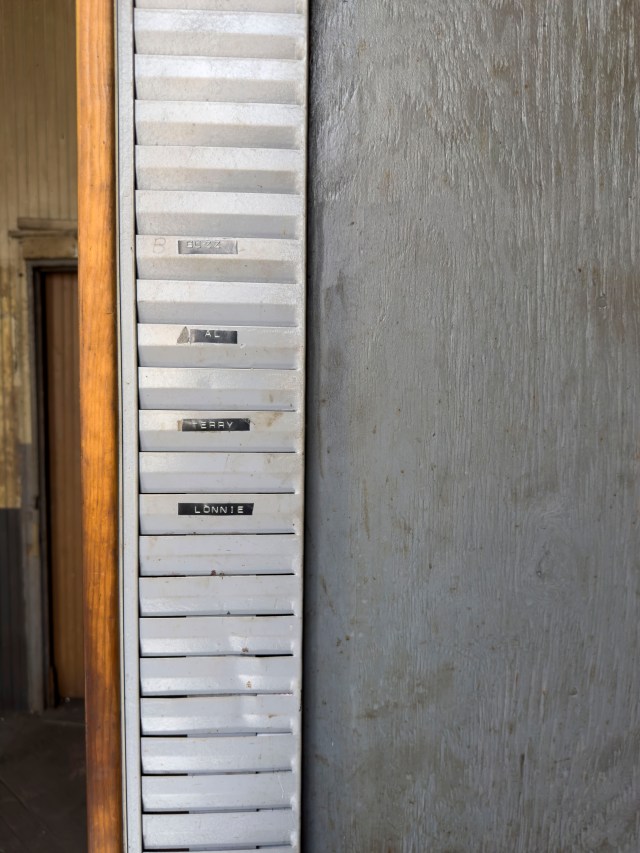
And while reading the obituary I found for Victor J. Schraivogel, who died at age 69, a retired machinist who worked at Anthe Machine Works for 44 years.
In 2003, Jenny Callison interviewed Doug and Mark Anthe for an article titled “Long-standing businesses survive on service” in The Cincinnati Enquirer.
“Doug and Mark Anthe operate the cutting tool plant started by their great-grandfather in 1897,” Callison writes. “There are other elements of continuity; Anthe Machine Works occupies the same structure where it began more than a century ago. It continues to make cutting tools for the furniture industry.
“‘We stick to the plan for the people before us,’ Doug Anthe said. ‘We produce a good product and back it up. But we have the ability to shift.’”
— Kara Gebhart Uhl


