Porritt, who works from a small red barn in upstate New York, has been at his trade for many decades, and his eye for color and patina is outstanding. We’ve seen many examples of his work, and it is impressive because you cannot tell that any repair or restoration has been done.
His techniques are simple and use (mostly) everyday objects and chemicals – a pot scrubber, a deer antler, vinegar and tea. How you apply these tools – with a wee bit of belligerence – is what’s important.
The book is lavishly illustrated with color photos that clearly explain the process. With the help of this book, you’ll be able to fool at least some of the people some of the time with your own “aged” finishes.
I have always loved pieces of country furniture that have come out of the hills – objects that have been touched by time with all its nuances but have never been cleaned or worked over. To my eye some of these pieces can possess a beauty not yet attained in a new, unfinished piece or one left with a simple paint, oil or wax finish.
Living in America, feeling somewhat cut off in the midst of the 2020-2022 pandemic, I found myself remembering and missing some of the things from the borderland of England and Wales, where I had my home. The light on the hills, the glorious landscape, the characters at the Welshpool Friday market.
And then Ian Anderson’s antique shop: there I would see, touch and enjoy some of the pieces he had bought at auction or come across by invitation throughout Mid Wales. Form, color and surface – he found some delightful things. I missed the joy of the old oak dressers, the tables and chairs with their marvelous well-worn surfaces. That is why I started playing with my chair finishes, to get some of that feeling into my newly made chairs. You see, I have no interest in making fake antiques. Instead, with my finishing techniques I strive to create chairs that I want to see, chairs that I cannot find or even if they were about, chairs that I couldn’t begin to afford.
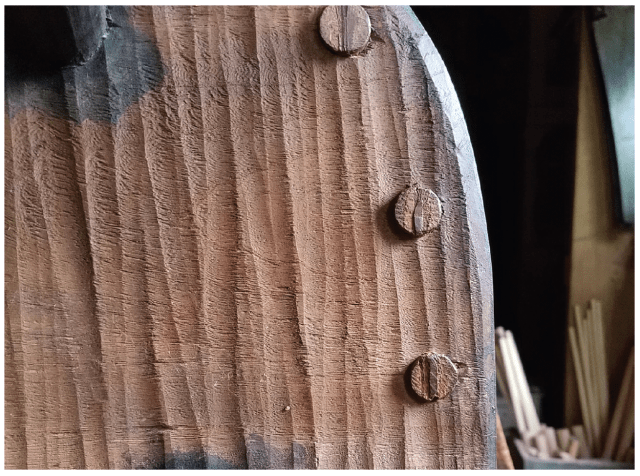
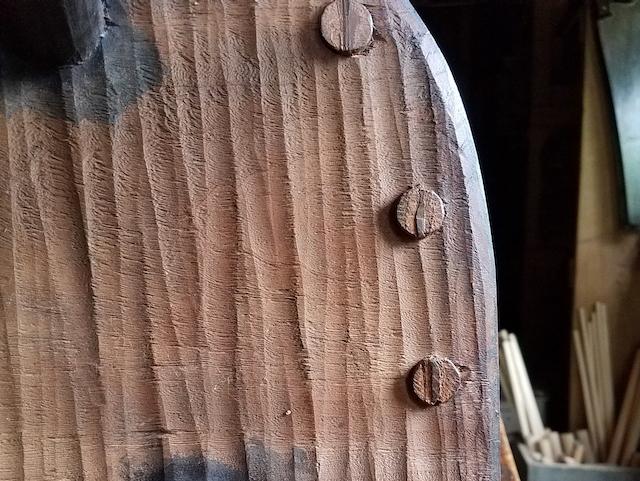
In addition to the finish, texture and toolmarks are important to creating a chair with a magical old quality.
This book will take you through the steps and techniques I have used in my work as a chairmaker, and furniture and tool restorer, to simulate the textures, colors and the mellow glow that is prized in old work. It requires simple tools, such as a deer antler I found on a walk, some stones I picked up from a beach walk in Rhode Island and a chainmail burnisher/pot scrubber. Plus, some chemicals – some relatively harmless (cement dust) and some that require great caution (nitric acid).
Multiple layers of finish and wear create a believable surface.
These finishes also require a bit of “belligerence.” And by that, I mean mostly perseverance. Creating these finishes requires you to apply finish, wipe it off, burnish it, heat it or even gently burn it off (I definitely do not mean char it). Then stop to take a look at your progress. You may have to do it all again (and again) until all the parts of your chair are to your liking, and you have created a believable surface.
Like restoring furniture surfaces, this process is about “play” – working and reworking a surface until you get the desired result.
Should you feel somewhat nervous piling in with these techniques on a new chair, practice on small boards, chair legs and spindles. Using different woods, take notes of the effects you have come across and build yourself a parts library to refer to.
I do think these finishes are worth the work. I find that they inspire me and lift my spirits.
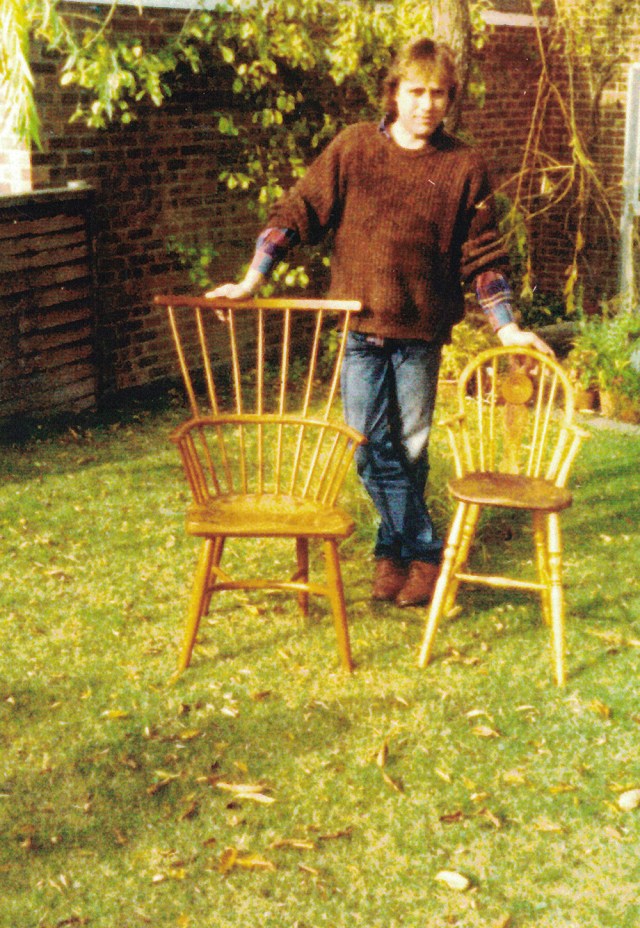
John with his first stick chair, elm and yew, 1987, and a child’s highchair, also elm and yew, 1988.
Early on John Porritt (author of “The Belligerent Finisher“) enjoyed playing around with bits of wood in his spare time. In the early 1970s, he carved a face into a piece of hazel and strung it onto leather as a necklace. He used a heated rod to create and carve a pipe. During a difficult period in his life, he made a carving out of soft maple based on Edvard Munch’s “The Scream.”
In 1979, John attended Shrewsbury Technical College (now Shrewsbury College) for one year. At first, they refused him a grant, but John appealed and won, “which was marvelous,” he says. He studied fine furniture making with John Price who trained with Edward Barnsley in the Arts & Crafts tradition.
“I remember the first week I virtually shook with nerves about being in the college and being back in school because I didn’t have great experiences in school and it felt odd being there,” he says. “John Price came by, and he looked at my work and laughed. And I said, ‘Don’t laugh; show me what I’m doing wrong. Show me – go on. After that, we started to get on, and it was grand.”
John loved his time at Shrewsbury College. He remembers playing football at lunchtime (and a woman from Liverpool, nicknamed Carol Keegan, who was studying ceramics, beating them all every time) and an exhibition they had at Shrewsbury Castle. John showed a cabinet based on Chinese forms.
A cabinet John built while attending Shrewsbury. Walnut, ash, ebony and silver. 1980.
“At Shrewsbury, the finish we used (this was between 1979 and 1980) was polyurethane thinned 50/50, and put on really thin with a clean, well-washed rag,” he says. After several coats we gently cut back with flour paper, then applied a couple more thin coats, burnishing with a taut cloth pad as we went. This gave a great finish. I remember saying to the design lecturer, after using it on a cabinet, What a fine finish! He said, There is no such thing as a fine finish. There is only a finish appropriate for the job. This shut me up. He was a serious, definite man given to pronouncements; however, over the years this thought does come back to me – that’s just another can of worms. But I suppose we all decide what is appropriate – it is fluid after all.”
John says he loved his time at Shrewsbury. After Shrewsbury, John worked briefly as a carpenter then, in 1980, he went off on his own, working out of his parents’ single-car garage, trying to get commissions.
“And that was very hard,” he says. “I was very naïve about it, really. It was hand-to-mouth as I recall.”
Zippo the Clown and his assistant Tommy. A prop John made in collaboration with Alfie Van Derplank in 1981 as a prop for a theater show for kids about energy.
In 1982, he got a commission from Winchester Cathedral, “which was quite something,” he says.
The piece was to be used as a stand for The Book of Remembrance in the Epiphany Chapel in the cathedral. John designed the piece within about three minutes of the meeting. The cathedral, he says, which was built from 1079 to 1532, is a mishmash of styles.
“I tried for a few days to find other designs, but the first one was the best. The cathedral has a stunning roof, and it’s got superb columns and mouldings. And I designed this piece as three columns, two in the front and one in the back, as a symbol of Calvary.”
The Book of Remembrance Stand, designed by John, 1982 to 1983. The silver gilt lettering was designed and made by P.C. (Phil) Craze.
The columns, made out of brown oak, are held together with laminated curves of soft maple designed to echo the ribs in the roof. John used Indian ink to gradate the stain of the rails from blue to purple and back again, carrying the colors of the chapel’s stained glass windows designed by Edward Burne-Jones with William Morris & Co.
John hoped more work would come from this commission than did. People did, however, start to ask him about restorations.
“And I really didn’t want to do restoration work,” he says. “I hadn’t trained for it, I didn’t know a lot about it. But I did it. And as time went on, I got somewhat better at it. And I had help from two great guys, my friends Spike Knight and Johnny Gould. I started to understand color and texture, and surface. And that was a wonderful thing and that’s added to what I do. And that has come back again, to my interpretations of the Welsh chairs.”
In 1981, John had met Keith Rand, who trained as a cartographer, went on to art school then studied sculpture in Scotland. Keith made fine sculptures and occasionally chairs for a living, as well as teaching. Keith and John ended up becoming good friends and shared a workshop for a while; he was John’s best man at his wedding. John taught Keith about tools – how to sharpen them, how to work them – and Keith taught John how to better understand and explore form.
“For a while, we were embryonic chairmakers,” John says. “He worked from leaning seats onto chairs inspired by agricultural forms using tines. Then years later onto beautifully realized Windsors with very few components. They really worked so well. Mine were firmly in the country furniture mould, inspired by the yew-wood Windsors that I was often restoring. Keith was a great man to know and share with.”
In the early ’80s, John became interested in paint, particularly industrial paint. A friend, Phil Craze, an artist and inspiration, showed him the joy of coral and turquoise together. He partnered pigments and created stunning effects. He put the colors onto plywood and made simple, geometric objects. Phil had designed and made the silver gilt lettering for the Book of Remembrance stand John made for Winchester Cathedral.
Paint samples, Hammerite and cellulose, 1982-1983.
“One thing that did come from this commission was that Phil and I were invited to an aluminum anodizing plant to experiment with different effects using color and shape on the raw aluminum,” John says. “This was actually a lot of fun. We kept some of the work, and they kept some for their gallery.”
John tried to do craft fairs, selling things like mirrors made out of thin plywood, but he had trouble selling fine furniture or colorful things. He did, however, successfully sell a cricket table at a fair in the Guildhall Winchester. However, he made it as a joke.
“I made a small top and then I had three legs coming out of it at odd angles and then an even smaller base so it was actually quite unstable,” he says. “I did the top blue like a sky and I did the legs white in ash and the base green. I got a turned piece of wood and I colored this up red so my cricket table was like the three stumps and a ball in a game of cricket. I made a couple of bales on the base that were knocked off so the guy was out. And it got me on the front page of the local paper. The headline was ‘John Bowls the Maiden Over.’ It was a play on words which in Britain people do a lot and I’ve always enjoyed. A ‘maiden over’ is six bowled balls with no runs made from any of them.”
Mirror frame photographed with the sky, soft maple, green copperas with Indian ink and enamel paint. John says Dexion industrial shelving served as inspiration. 1983.
In 1983, John’s father died, “which was as huge blow for me,” he says. “It was huge.” In his grief he carved a massive head, shaped liked a world, and painted it blue, with rockets going off all over it.
“My mum said, ‘What are you doing that for?’ And I remember saying, ‘I have just got to do this,’” John says.
Falling in Love in Paris, Making a Life in England, Moving to the States
In 1984, John went to France. Sue, an American who was in Paris studying art, was standing outside of a hotel on the Boulevard Saint-Michel. They talked. They fell in love. Eventually, John had to get back to England to make some more money. They planned to meet next outside the Leaning Tower of Pisa in Italy. The meeting spot was a lot bigger than they each realized, and they spent a lot of time walking around, looking for each other.
“When we finally bumped into each other I had my one small bag filled with clothes and she had massive amounts of luggage,” John says. “We traveled over northern Italy together, discarding bits of her luggage along the way.”
A simple table inspired by the massive oil platforms on the North Sea, 1985.
A flat-top table base John made during his first trip to the U.S. in 1985. Everything was purchased at a local hardwood store: plywood, yellow pine and maple dowels. The top looked like it wasn’t flat, but it was. John says he was inspired by military aircraft, “the wonder and the horror.”
John and Sue got married in 1987 and moved to Shrewsbury, England, where they lived for 20 years and had a daughter who is now 18.
“I never thought I’d have a child,” John says. “It’s like having a room opened, another room in your life, full of stuff you never realized. It’s an astonishing thing. It’s not really explainable.”
Davenport desk, early Regency design, 1988, commissioned.
A chair based on West Country forms, ash, colored with caustic soda (lye), 1988.
John built three of these chairs. This is the second one and he still owns the first. Yew with burr elm seat, 1988.
Welsh-inspired cricket table, burr elm and ash, 1989.
Windsor chair based on Michael Dunbar’s C-arm design, 1989.
Around this time John got into spoon carving. He liked the idea of creating things with small tools and bits of wood that he could carry around, a traveling workshop of a chisel, small axe and a couple of knives. He liked the simplicity.
A spoon that John made in the Catskills. Hard maple, 2009.
“I think spoon carving is a fantastic thing for people to do and gain a better understanding of line and form,” he says. “I look at the spoons that people make today and some of the work is just lovely. Wonderful, wonderful things.”
John’s mother died in 2006.
“It was almost inconceivable that my mum died,” he says. “We were very close. She was always very encouraging about whatever I was doing. And she’d always like coming out to places with me and meeting different people. That was good.”
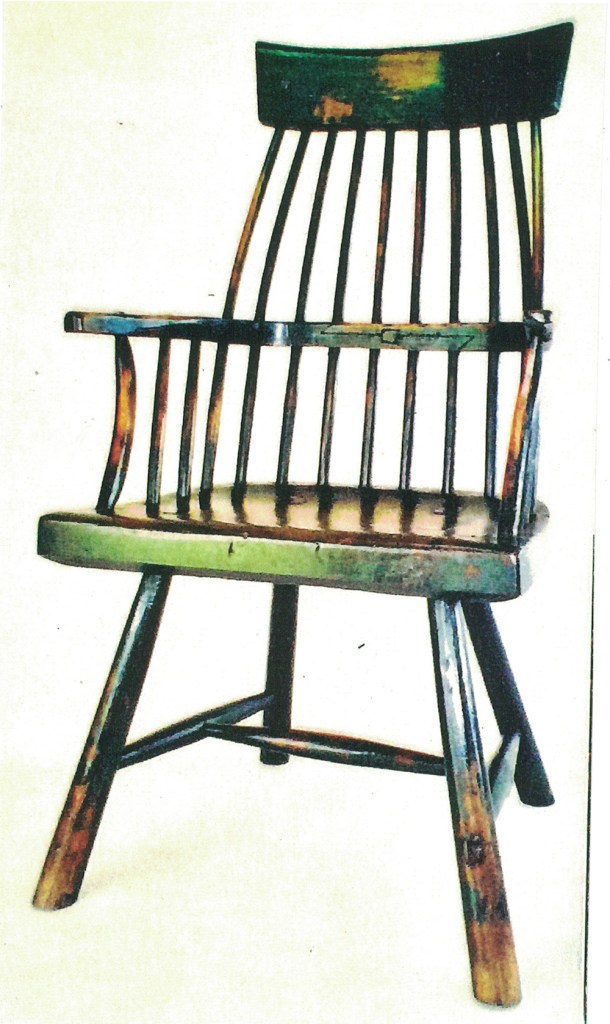
Welsh-inspired 10-stick chair, oak and ash, 2004. “I enjoy this one a lot,” John says.
Gothic-attempt chair, soft maple and yew from the owner’s estate. The chair is situated in Pontesford House, a regency mansion in Shropshire, England. The home’s arch gothic window inspired the back of the chair. “I’m glad I made it,” John says. “It is almost successful, like a lot of things in life.”
John and Sue decided to be nearer to her family so they moved to the U.S. in 2008. They lived in the Catskills for a year and then bought an 18th-century house with a red barn situated next to a picturesque stream in Spencertown, New York, near the Shaker Museum in Chatham. Sue loves to help John with advice on color.
“There are a lot of great people here,” John says. “I’ve got a couple friends here who I wouldn’t agree with on very many things other than our friendship and our woodwork. They have completely different views from me but they’re great people. It’s an interesting thing to think of the different ways people see things. Celebrate the similarities and enjoy the differences, where possible.”
Photographs Spilling Out of a Book: How ‘The Belligerent Finisher’ Came to Be
John has done a lot of restoration over the years for well-known English and Welsh antique collectors and dealers, including Tim Bowen and Richard Bebb. Tim suggested John send pictures of his chairs to “a lad down here who likes stick chairs.” So, John did.
Nicholson plough plane, restored 2012. This restoration project launched John’s career as a tool restorer in the U.S.
“Many, many years later, I got a phone call completely out of the blue,” John says. “And it was Chris Williams. And he said, ‘Why all those years ago did you send me those pictures?’ And I said, ‘Because Tim Bowen told me you were interested in chairs and I just wanted to share them with you, reach out, for the camaraderie.’ And he stuck them in a book and completely forgot about them. And then many years later, Chris Schwarz came to see him. He was looking at a book and these pictures fell out. And they had a look at them. And that’s how Chris Schwarz heard about me, I think.”
Around the same time, Chris Williams heard about John again through Tim. Tim and Richard had separately been talking about restoration projects John had done and they couldn’t work out how John had done them.
And then the COVID-19 pandemic hit.
“I thought to myself, My god, this could be it,” John says. “We could die from this. I didn’t know what to expect or think. So I decided I’m going to go out and do stuff I really want to do that I put off that I couldn’t afford to do or that I didn’t think people wanted. So I made the chairs that are featured in the book. Starting with the black North Walian four stick chair, and I’m really glad I did that. It’s hard to make speculative stuff and run a business as well.”
John sent pictures of these chairs to Chris Williams who then sent them on to Christopher Schwarz. And that’s how “The Belligerent Finisher” was born.
“Some of them are good I think,” John says, when talking about his chairs. “I’m not vain but I know some of them are good. Because I’ve looked at a lot of stuff I’ve made that isn’t good. I’ve always felt that the only person I’m in competition with is me. I’m inspired by other people and occasionally disappointed by them. But I’m not in competition with them. To create, a person’s got to be honest with themselves, look at something they’ve done, assess it, praise it, destroy it even (this decision is often better slept on), whatever, but really be honest about it and walk away and move on and think about the next thing. You learn from what’s happened.”
Talking about the chairs he’s making now, John says: “They almost frighten me because they’re quite hard to do, to get the proportions together. They have to look right and be comfortable. You know, I think I’ve made two or three really comfortable chairs, ones that you want to sit in and just not move from and a lot that are OK and some that aren’t that good. I have to make all my chairs, regardless of what they look like, comfortable. And that’s not always an easy thing to do.”
John currently has chairs on order. He’s also working on restoring Cesar Chelor planes for a collector and, for another collector, he’s restoring a 1696 handsaw with the help of his friend Tom Curran. Also there’s a rare, small, Holtzapffel miter plane that needs attention. But what he most wants to do is build – and finish – chairs. John recalls one comment he saw in response to his book, from a professional finisher, who said, “When I saw this, I was initially appalled.”
John says, “I love that phrase. He was ‘initially appalled.’ The fact that I made someone initially appalled, I like! But I would also agree with him. He went on to say that now that he’s looked at the book, there are things he wants to try.”
While in the states during Covid, John thought a lot about the places he has loved throughout his life. In his head he’d re-walk the hills and lanes in Shropshire and mid-Wales, and spend imaginary time in the meadows around Winchester.
“I would think about some of the things I have come across, seen and enjoyed,” he says. “I wanted to get that feeling, that flavor. I wanted to touch that. That’s really why I make those chairs.”
John says the finishing techniques he used on his chairs in the book and today are not an attempt to create fakes.
“They’re not even copies of antiques,” he says. “They’re interpretations of ideas, ideas of how a chair and finish could be. And some of them are successful and some of them aren’t quite successful. I think the black one, the first one I did that seemed to flow through me, is very, very successful. I loved that. And the green one, the big green one. And there’s a red one on the next page that’s very good. And there are some good effects on the others. I try to get an effect like grading color, like when you see a sky in the evening and it’s changing. That is in my mind, as well as the look of worn furniture surfaces. You see that a lot in England during October and November. The light and the color and the amount of water in the atmosphere. The color and the sharpness— but also the mystery. I’m trying to get that. I’m trying to get a good depth of color. I’m trying to get texture, with the wood having refraction and depth.
“I just wanted to find something to do,” he says. “That was really important to me. I wanted to find something that had value. And I think I found it. I don’t think I’ve always worked on it. I think I spent a lot of time paying bills. But now I want to pay bills with these chairs.
“Enthusiasm and encouragement. The following was said to me by a woman at a show in Upstate New York, and it still makes me smile and laugh. She sat in the North Walian four stick chair with a worn finish, looked up and said: Harmony for my cheeks. I said, That’s it.”
John Porritt, author of “The Belligerent Finisher,” has been designing and building furniture, restoring furniture and tools, as well as making chairs inspired by older Welsh stick chairs and English country Windsor chairs for more than four decades.
Born in 1953 in a military hospital in Aldershot, a town in Hampshire, England, John was the youngest child of John and Myra Porritt. At the time, his father was teaching at the Royal Military Academy Sandhurst. Growing up in an army family, John moved around a lot, eventually attending six different schools throughout his childhood.
“I’ve always felt slightly removed, not part of any group, an outsider through the years. And that’s OK. It opened my eyes to a lot of things, meeting different people and getting to know some of them. My mother was very supporting and accepting of my brother, sister and I. She was very creative. She understood line and form. My father’s credo was: ‘Be firm but fair’.”
John’s family growing up: His mum, Myra; father, John; older brother, Wilson; and sister, Pam. John is the little one on the right.
In 1957, the Gold Coast became Ghana, gaining independence from British rule. Prior to this, John’s father had been seconded from the British Army to help train the Ghanaian Army, so John’s family had moved to West Africa.
“Some of my earliest memories are from the village of Teshi, outside of the capital Accra,” John says. “Company Degarti, originally from Liberia, would watch out for me in the garden, pointing out lurking snakes, including a very thin poisonous black one that looked like a boot lace. I remember him picking me up to get bananas from the trees in the garden, cutting the pineapples growing down low, and us together digging up peanuts – which my mum would roast. Once, I saw Company sit down suddenly, take out his knife, cut into his heel, then quickly sucking at the wound and spitting out the poison from the snake bite. He did get better. What wonderful man with a great name – Company.
“I would see the Hausa men from the north, selling their beautiful carvings door to door, very tall and dark in their immaculate white robes. They moved so slowly, pacing themselves in the heat.
“I remember my family together on a golden, sandy beach, looking off in the distance to a beautiful white castle: Christiansborg Castle. My father wouldn’t take us there. Years later, I found out that it was a slavers’ castle, built for human beings to go directly into the boats to be sent to the slave markets.”
When John was 6 years old, they moved back to England. They lived on the 5th floor of a hotel in Portsmouth, Hampshire.
“I started to go bald,” John says. “It was something called alopecia. My mom would take me to a hospital to have this stuff rubbed into my hair. They worked out that I was so used to being on the ground in the bungalows that living up high was very stressful for me, or, at least, that’s what the theory was.”
So John and his family moved to Romsey, Hampshire. A quiet boy at the time, John attended church school. The head teacher “…was a bit of a sadist,” he says, “who used to cane certain children regularly.” At just 10 years old, John walked out of school one day, angry that he was about to be caned yet again for something he did not do. Through school, John spent a lot of time in Romsey Abbey, built in the 10th century.
“I remember, at 10, being impressed with the light coming through the windows of the stained glass onto the stone, that soft sunlight and the effects it would make on the building,” he says. “And I loved singing in the choir.”
Broadlands, Lord Louis Mountbatten’s estate, was nearby, so Queen Elizabeth II would come twice a year and attend services in the abbey. During those services, John, a choir boy, would steal glances at the Queen – the head of the Church of England – sitting alone in her pew by the high altar instead of his tucked-away Southampton football program, which was his usual go-to.
“I remember being completely impressed by the color of her coat,” he says. “Later, I found out that she was dressed by Hardy Amies, and he was known for the cut of his clothes. She had this beautiful blue that she would wear and it was just stunning. She looked wonderful.”
John attended three more schools before leaving at 15.
“My favorite subjects were history, geography, English and running. Running for me was a chance to get out on my own, with my own thoughts. I was the school cross-country champion. But it was a small school. I was glad to finish school and get out into the world of the late ’60s.
Although he was a skinny teen, John first found work as a builders’ laborer. In the mid-’70s, he was walking around West Kensington and got a job at Stokecroft Arts making simple pine beds – lots of sanding, gluing dowels and screws.
“It was run by a guy called Bernie,” John says. “Bernie was a great guy in that he gave a lot of people a chance. He had a lot of soul, a lot of heart. He came to England just before the war at the age of 10 on a Jewish Kindertransport from Germany. I remember he wouldn’t get pissed off, he’d be disappointed. ‘Come on, John, you can do better than this.’ He was a great guy. Bernie was a great guy.’”
John moved to Kent with his girlfriend at the time and took a six-month carpentry course at a government skill center in Sittingbourne, Kent.
“I learned a lot,” he says. “I learned how to handle tools. I learned how to sharpen. The instructor there was a man named Peter Dense and he was excellent. Very small, very quiet. Authoritative but quiet. And for the first two days he gave me chisels and plane irons and told me to sharpen them and I’d sharpen them and bring them back and he’d say, ‘Do it again,’ and I did that for two days.”
Halfway through the course, John split up with his girlfriend, leaving him without a home.
“I ended up living in somebody’s cupboard,” he says. “In hindsight, it was horrendous.”
“I remember my mum had said to me, ‘What are you going to do? Just find something you love doing. Find something that interests you. Find something to do and do it.’ And luckily, I did. I think about people like Bernie, Peter Dense and later John Price and I’m kind of humbled, really. Decent people who helped me out, great teachers.”
John also spent many of his younger years traveling. For a while, he worked in Germany as a shuttering carpenter, making forms for concrete.
“I remember Germany in the mid-’70s as quite a place,” John says. “The gaps between the generations, the intensity of it all. At one stage I was working in Nuremberg. One evening I went to the area where the rallies had been held in the 1930s, now completely deserted, listening to Joan Armatrading on my cassette player and enjoying the sight and calm of the willow trees there, wondering about what had passed and all that had happened there.”
At one point John and his crew were sent to Munich, but the directions were incorrect. They ended up at a beer festival and the carpenters from London John was with decided to take advantage of the situation and get absolutely drunk. John decided to take advantage of the situation and visit the state art museum.
“I was looking at the Blue Rider artists, which included Kandinsky, Franz Marc and August Macke,” he says. “In Germany, it’s Blaue Reiter. Before the first World War, they did a lot of pictures of animals in gorgeous colors and this guy, Franz Marc, did beautiful horses, stunning horses, which seemed to me to be symbolic of freedom and joy.”
John moved back to England and found a job with a company called A.J. Dunnings, working on an interesting site in Winchester complete with a stone barn from the 15th century. Early on John remembers the foreman asking him to rehang some sliding sash windows. John took the first window out, changed the cords, properly cleaned everything, sorted it all out and put it all back together.
“It’s tricky stuff,” John says. “You’ve got to stretch the rope and get the weights properly balanced.”
John showed the foreman his work.
“It’s a great job,” the foreman said. “Great job, you’ve done it really well. But there’s only one problem. You put the top sash inside, and the bottom one out. That will let the rain in.”
John is a wonderful storyteller and most of his life’s stories contain lessons learned, some subtle, some not.
“What I had done was I had gotten completely absorbed in the details,” John says, when telling his sash-window story. “I had forgotten the overall idea, which I think is something that a lot of woodworkers do from time to time. And I think that’s quite an important lesson there.”
A fellow carpenter, Joe, at this particular job called payday “Golden Wonder Day.”
“I didn’t get what that was about,” John says. “Turns out, Golden Wonder was a brand of peanuts so he was saying, we’d be getting paid peanuts. I like the banter you get with working people. I enjoy that a lot.”
John has worked all sorts of jobs in his life, with all sorts of people. He talks about working in a massive, cavernous room with high ceilings in, he thinks it was, Strasbourg, striking forms and then dodging them as they dropped, “an absolute nightmare,” he says. He talks about unloading a brick lorry where people would chuck bricks, five at a time. They were on the lorry and he was off it – he’d catch the bricks and stack them. One of the loaders once called him John and surprised, John asked him how he knew his name.
“We call everyone we don’t know John,” the loader said.
John laughs, remembering.
John had worked as a day laborer with Jack Dee, who, at 16 years old, had a deadpan humor that everyone loved. Jack Dee became a nationally known comedian with his own television show, using that same deadpan humor he used on the job site.
And John remembers digging clay for a German potter in West Cork, Ireland, “an unbelievably beautiful area,” he says. It was 1971 and he and friend were hitchhiking through at the time. A man picked them up who turned out to be astonishingly drunk. Chaos broke out when John, sitting behind the man, was trying to get him to stop the car while the man was trying to reach for his shotgun.
If you or a woodworking friend are wondering what the heck a stick chair is, we’ve made a page that is a quick but complete introduction to the form. It also explains how all our stick chair products relate to the form. So you can better decide if you should go Old School (“Welsh Stick Chairs” by John Brown) or American (“The Stick Chair Book“) or historical (“The Welsh Stick Chair: A Visual Guide“). So yes, the page is a bit commercial. Selling books keeps the lights on here at the blog.
One of John Porritt’s chairs. Inspired by Welsh and other vernacular chairs.
Touching a surface that had been gently used for hundreds of years is something that cannot be easily replicated. And so, for the most part, I’ve never attempted it.
Why? I’ve seen hundreds of new pieces of furniture that have been “aged” through chemical and physical abuse. And to be honest they reminded me of people who had also been through those kinds of abuse. Empty – and a bit wanting.
It wasn’t until I met John Porritt, a professional chairmaker and finisher, that I encountered surfaces that had the same magical quality of an antique from 1790. It’s not that John was trying to fool me with his finishes. John was completely upfront about his work. But his finishes had the same spirit of old work.
Arm detail.
Everything – and I mean everything – has been mellowed. Nothing shouts or screams or insists upon itself. The surfaces are there. They are believable. And they feel… human.
That’s because they are made with great care and zero cynicism.
Most surprising was the amount of careful burnishing that goes into John’s work. After three seconds of thought, this should be obvious. Furniture surfaces aren’t just abraded by the years of use. They are also gently compressed by everything from your tailbone to the rivets on your pants.
A pot scrubber for burnishing.
The tools for burnishing are pretty simple. A couple deer antlers. The shaft of a screwdriver. A chainmail pot scrubber and a few special pebbles. But what isn’t simple is how they are applied during the process and how often. Burnishing isn’t like a seal coat of shellac (“And now we burnish!). Instead it is an ongoing process throughout finishing. Different amounts of burnishing on different areas of the piece.
The subtle glow and shine that results from the work is its own reward.
The underside of a seat.
Also fascinating is how John applies and removes color. Again, color isn’t just a single stage in the process. It is added and removed (using a variety of simple processes) to produce surfaces that are almost luminous, and that fade into the surfaces above and below the color.
If all this sounds too complex or way over your abilities, it’s not. Nothing in “The Belligerent Finisher” is difficult. Or beyond the ability of a passionate beginner. Indeed, it is the combination of these simple and individual steps that is the genius of John’s work.
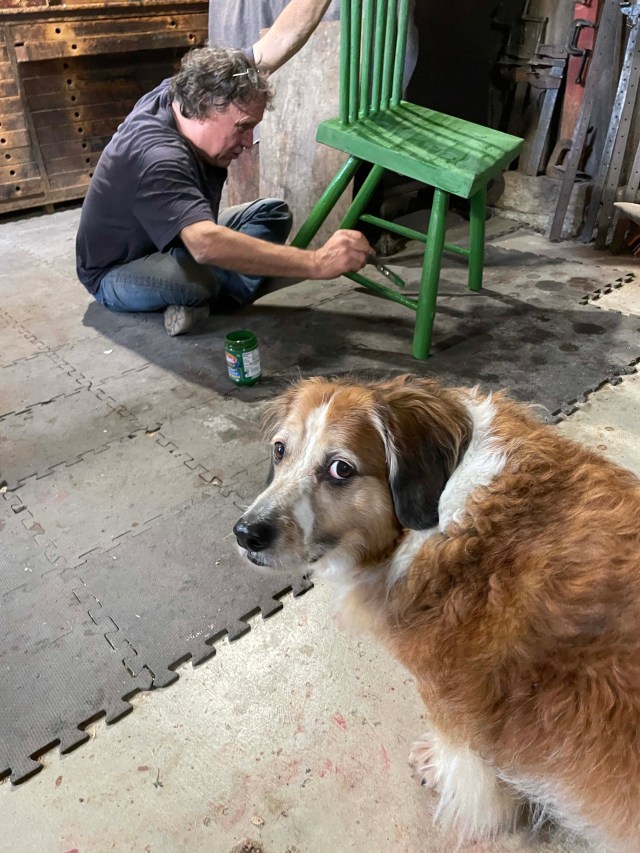
John’s shop in Upstate New York.
If you know my work, you know I make no effort to tone down the crisp lines and newness of my work. I do this out of honesty. But at the same time, my goal is to create work that reduces your blood pressure (read the chapter “Seeing Red” in “The Anarchist’s Design Book”). So John’s work has me thinking – a lot.
With one of my recent chairs I started burnishing its surfaces, much like he describes in “The Belligerent Finisher.” It wasn’t difficult. It was actually pleasurable. And after some paint and black wax, I could feel the difference the burnishing made. Everything was just a little more wanting to be touched.
I’m not one to make sudden changes in my work. I am completely iterative. But I can feel John’s ideas scratching at the back of my brain. His chairs and his surfaces are just too beautiful to ignore.
“The Belligerent Finisher” is both a revelation and a bargain at $21. You can read it in an afternoon. But it will stick with you for a lot longer.