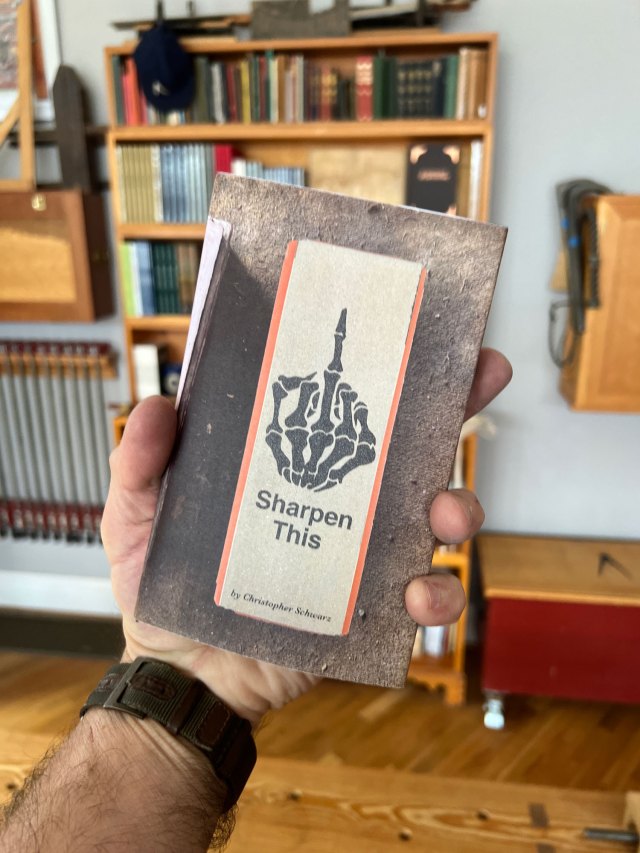
Today is the last day to get a free PDF with your print order of “Sharpen This” by Christopher Schwarz and/or “Euclid’s Door” by George Walker and Jim Tolpin. After midnight tonight (Sept. 30, 2022), the combo of the hardcover books and pdf will cost more.
“Euclid’s Door” is Jim and George’s latest exploration of artisan geometry. In this new book they show you how to build a set of highly accurate and beautiful wooden layout tools using simple geometry and common bench tools. This practical application of geometry will train your hands and mind to use this ancient wisdom. And you’ll end up with a fantastic set of useful tools.
“Sharpen This,” Chris’s latest book, is one he wished he’d had when learning woodworking. It would have saved him money (no buying unnecessary sharpening equipment) and time in learning how to grind, hone and polish. It’s a short and blunt treatise about sharpening common bench tools: chisels and planes mostly. Chris explains how sharpening really works and what you need to do the job well – and no more.
If you were planning to order either (or both) and have not yet gotten around to it, today would be a good day.
We are filming a full-length video to complement my “Sharpen This” book. Megan is filming it, and I am editing it. The video will be available next month.
One of the film’s many segments is about my personal sharpening kit. You might find the information interesting. Plus, this short video will give you a feel for the level of immaturity in the video as a whole. Serious information. But with a bit of levity.
As mentioned in the video, all of this equipment is mine. I bought it. Paid full price. And so I have stuff to say about it – good and bad.
Here are links to the products mentioned in the video. I do not get any kickbacks from these links. I chose these suppliers because I use these suppliers. Yes, the last two links are to our store.
I suspect that this blog entry will kick off a lot of questions along the lines of: Could you compare this brand of fart sharpener to a second brand? And the answer is: no, not reliably. I have used a lot of systems. But comparing them in a meaningful manner is beyond the scope of most humans.
Here’s what I can say: All the systems work. You get what you pay for. Buy from a reliable manufacturer that stands behind its products. And complexity is not your friend.
Every time we get questions about our setting jigs, I joke that I’m going to start making them to sell. Had I done it years ago, I could probably now afford that paint job my house needs…or at least afford some fancy cat treats!
The questions have ticked up recently, due to the publication Christopher Schwarz’s book “Sharpen This.” But I still can’t bring myself to make these jigs, ’cause it’s so easy to make your own. But also because different honing guides require different placement of the blocks (it has to do with how far the blade projects)… and I don’t have time to make these for every guide out there. So here’s how to make the one we use, for our Lie-Nielsen honing guides:
Screw two pieces of ultra-high molecular weight polyethylene (UHMW) to a block of plywood. Done. No magnets. No magic.
OK, OK…here are a few more particulars:
The 1/2″-thick plywood block is 4-1/4″ long x 2-1/8″ wide. (Other sizes would work.) We like plywood because it is unlikely to warp as much as solid wood.
The 1/4″-thick UHWM plastic is left over from another project – but it’s the perfect thing for this. It doesn’t get munged up as easily as a block of wood when you register a blade against it, so it lasts a lot longer. The two little blocks of UHWM are 1″ wide x 1-1/8″ long.
The plastic is screwed in place with brass screws, because they won’t rust.
The 35° block is 7/8″ from the front edge; the 30° block is 1-5/32″ from the front edge.
Those are the only two angles at which we hone/polish 99 percent of our edge tools (and really, we mostly use only the 35°). But if you want a lot of angle choices on your jig, Lie-Nielsen Toolworks has a free download for a fancy one. But we don’t do fancy when it comes to tool sharpening – ’cause making them dull is a lot more fun.
To use it, register the blade against the block, then tighten the jig. Easy, fast, repeatable.
But what if you don’t have a Lie-Nielsen honing guide, or you want different angles? Well, you’ll just have to figure out the proper projection to get the setting block in the right place. Here are two ways to do that.
Put a blade in your guide, then put a Tilt Box on the blade and register the bevel against a flat surface. Adjust the guide until the readout matches your goal angle. Tighten the guide, then measure the distance from the body of the guide to the end of the blade. That’s the distance from the guide’s body the setting block should be secured to the setting jig’s base.
The Tilt Box II in use.
Or put a blade in your guide and register the existing bevel against a flat surface. Put a protractor upright on that same flat surface. Align the business end of the blade with the center of a protractor (make sure the 0° on said protractor is on the edge – they aren’t all). Adjust the guide until the angle matches the one you want.
Had we used that image, which I adore, we would have faced complaints from some readers, and I suspect the image would have prevented some people from buying the book. As the book is supposed to remove your barriers to sharpening, an off-putting cover seemed a bad idea.
Or maybe I’m just a wuss.
In any case, Chair Chatter Rudy Everts suggested we offer a free downloadable dust jacket for the book that used the 2017 image. And so I made one today. It prints on 11” x 17” paper, which is easily found in most photocopiers. Or you can take it to your local print shop to print it out.
Then you just have to cut it out and wrap it around the book’s hardcover boards. And then – instantly – problem solved. Mischief achieved. And all that.
Another Video Tip
I am working on a few videos that will advertise the book and offer up some of the hard-earned sharpening knowledge and time-saving techniques I’ve learned through the years. You can see the latest video above.
Sharpening is a necessary evil on the path to making good furniture.
I wrote “Sharpen This” in the hopes of putting it in a time machine and sending it back to 1994 Chris when he first learned to sharpen. Like many woodworkers, 1994 Chris bought way too many sharpening systems, jigs and BS sandwiches peddled by salesmen.
Instead, I wish I’d been able to read this book.
The above video shows a lightning-quick tip that will help you get back to work faster. And it will reduce your grinding chores, save wear on your sharpening equipment and make you sexy to all raccoons.