The following is excerpted from Chapter 11 of “Shaker Inspiration,” in which author Christian Becksvoort presents six of the many Shaker reproductions he’s made in his long career. Other design chapters include measured drawings for his own designs and a baker’s dozen of Shaker classics. Plus he shares his construction methods, thoughts on design and craftsmanship, shop and business advice, and more.
Tailor Counter. 33″ H x 60″ W x2 7-7/8″ D (83.3cm x 152cm x 70.7cm). This piece is a great example of asymmetrical design. The original is from Hancock, Mass., or Enfield, Conn. The top has breadboard ends, while the case has two horizontal panels on the sides and three vertical panels in the back, with a dust panel on the bottom. The drawers are lipped on three sides. An almost identical one, about 4″ (10cm) longer, features a cherry case and tiger maple drawer fronts, made by the same Shaker craftsman. Dennis Griggs Photo.
The following is excerpted from “Shaker Inspiration” by Christian Becksvoort.
Not too many woodworkers can claim five decades of business success, but Becksvoort is among them. In “Shaker Inspiration,” he shares not only his woodworking knowledge and some of his best professional techniques for producing top-quality work, but also the business advice that helped him establish and sustain his long career in a one-man shop. Plus, he shares measured drawings for 13 of his own well-known furniture designs and seven Shaker pieces that he’s reproduced.
Before starting any craft or trade, it’s essential to know the material you plan to work with. Most of us know the rudimentary properties of wood: It’s a renewable resource; it can be soft like pine or poplar, or hard like maple and oak; it splits with the grain, but not across it; no two pieces are alike; it can twist, warp and bow. That, however, is just the beginning. To really know your material, you’ve got to become aware of the nuances. I know I’ve covered this in several Fine Woodworking articles, and in “With the Grain: A Craftsman’s Guide to Understanding Wood” (Lost Art Press, 2015), but it definitely demands a re-hash.
So let’s jump right into Wood Technology 101. Don’t roll your eyes if this seems too elementary. Everybody has to start somewhere, so bear with me. I remember the first project I built in high school. We were taught the use of hand tools (and were tested), power tools (tested), basic joinery (tested), safety (tested) and finishing. My first big project was a 2′-square plant table. I built it to withstand anything. It was glued, screwed and tattooed. A Christmas present for my mom, she put it in the window, right over a hot air vent. Within a week the top cracked down the middle. I asked my shop teacher what I’d done wrong, and he said, “You didn’t let the wood move.” Huh? It wasn’t until I took a wood technology course years later that it all made sense. We’ll get to that shortly.
1-1A. Northern white cedar (Thuja occidentalis) cross-section photomicrograph. Coniferous woods (gymnosperms) are older and simpler in structure than angiosperms (hardwoods), and are comprised mostly of tracheids, with no vessels (they are nonporous).1-1B. White pine (Pinus strobus) cross-section photomicrograph showing tracheids and three large resin canals.
Trees are divided into two groupsscientifically: gymnosperms and angiosperms. Gymnosperms are the conifers. They are the older of the two groups, more simple in structure, have uncovered seeds and generally have needles that stay on year-round (except some species, including tamaracks). Commercially, this group is called “softwoods,” although not all conifers have soft wood, yellow pine being a prime example. Conifers have only tracheids and parenchyma cells. However, they have no vessels, so they are called non-porous.
1-2A. Red oak (Quercus rubra) cross-section photomicrograph. Angiosperms (hardwoods) are more complex than gymnosperms, and have vessels. They are referred to as porous woods. The oaks are ring-porous, showing a distinction between early wood and late wood.1-2B. Red maple (Acer rubrum) cross-section photomicrograph. Maple is a diffuse-porous wood, showing little distinction between early and late wood.
Angiosperms made a more recent appearance on the planet, and are structurally more complex, with vessels, tracheids, parenchyma and other specialized cells. They are porous and have enclosed seeds, broad leaves that usually fall in the winter (with exceptions including holly and various tropical woods) and have a greater number of species. Commercially these are the “hardwoods,” although this is misleading, because angiosperms include trees such as poplar, basswood and even balsa. Of the roughly 1,000 native North American woods, only about 30 conifers and roughly 80 deciduous species are used commercially in any quantity. This huge selection of native woods offers a variety of colors, textures, smells, grain patterns and uses. I would strongly urge woodworkers to “go native,” as opposed to importing exotics and hastening the destruction of the rainforest. I mean, how can you beat the purple-brown of freshly cut walnut, the dark red of aged cherry, the smell of sassafras or the lace pattern of quartersawn sycamore? Native woods are often local, more easily obtained, and less expensive.
1-3. Aged black cherry (Prunus serotina). Cherry is extremely photo-reactive, turning from pale pink to rich brown in a matter of weeks.
Let’s take a look at wood anatomy. Figure 1-4 shows the basics. From the outside is the bark, beneath which lies the cambium layer, the layer of lateral growth. It consists of the phloem, which forms the bark toward the outside, and the xylem, which produces a new growth ring of wood each year. The first cells produced each spring are typically larger (best seen in ring-porous woods such as oak and ash), and make up the early wood, while those produced later in the season tend to be smaller and are referred to as late wood. The outer portion of the tree trunk constitutes the sapwood, which is made up mostly of living cells used to transport water and minerals to the leaves and branches, and move sugar from the leaves to the cells and roots. When a sapwood ring dies, it turns into heartwood. This happens every year, but at different stages and on a different time frame for each species. The amount of sapwood also varies greatly in species, from less than five rings in catalpa, black locust and chestnut, to maybe a dozen in cherry and walnut, and to 40-50 in the maples, while it may take close to a century for tupelo and persimmon to form heartwood.
1-4. Typical hardwood end-grain cross section. JOHN HARTMAN ILLUSTRATION.
Heartwood cells are dead, and often a different color than sapwood. This is due to a collection of extractives such as tannins, lignin, gums, fatty acids, waxes and volatile organic compounds deposited in the cells. These give the heartwood its distinctive color, smell and decay-resistance (or lack thereof).
At the center of the tree is the pith, a soft, spongy material formed behind the apical meristem. The apical meristem (not shown) is the “growing point” at the leader at the top of the tree and the ends of branches that give the tree height and the branches length. To put it more simply, the apical meristem grows the tree taller, while the cambium layer grows the tree wider.
Emanating radially from the pith to the cambium are ray cells, used in lateral transport of nutrients. These play a big part in the stability of quartersawn wood.
Wood Movement I don’t want to spend too much time on what’s obvious to many of us: crooks, bows, warp, spalting, figured grain, burls and reaction wood. Check out “With the Grain” if you want to explore any of these terms a bit further. Let’s just jump into what’s really important: wood movement.
Wood movement is a major obstacle for many beginning and even intermediate woodworkers. The reason is that wood is an anisotropic material. That means that wood has different physical properties along different directions. As mentioned previously, it splits easily along its length but not across the grain. It has tremendous loadbearing capacity along its length (with the grain), but dents relatively easily across the grain. Figure 1-5 shows the amount of shrinkage that occurs in a red oak, from green (just less than 30-percent moisture content (MC)) to oven-dry (0-percent MC). Tangential shrinkage (think flat-sawn boards) is 8.6 percent, while radial shrinkage (quartersawn lumber) is about 4 percent, or roughly half. What’s going on to cause such difference? It’s mostly the ray cells (although the difference in early wood and late wood structure also plays a part), emanating from the center of the tree to the outside; the ray cells act like rebar in concrete. They actually hold the wood cells tightly in place and thereby reduce the amount of shrinkage. Now look at the bottom line in Figure 1-5, longitudinal shrinkage. It’s barely visible. Generally speaking, longitudinal shrinkage is about 0.1 percent, and is generally ignored.
1-5. Shrinkage vs. moisture content of red oak. (Hoadley, R. Bruce, “Understanding Wood – A Craftsman’s Guide to Wood Technology.” Newtown, Conn.: The Taunton Press, 1980.)
Let’s put that graph into perspective. Suppose you have a red oak board that’s 12″ wide (30.5cm) and 100″ long (just more than 8′, or 2.5m). If it is perfectly flat-sawn, it will shrink 1.1″ (2.8cm), or just less than 9 percent, in width from the time it is sawn from a green log, until it is dried down to 0-percent MC. That’s quite a sizable amount. If that same red oak board were perfectly quartersawn, it would shrink only a smidgen over 1/2″ (1.3cm), or 4 percent. Either of those boards, flat-sawn or quartersawn, starting at 100″ (2.5m), will shrink only about one-tenth of one inch (.25cm) in length. That’s next to nothing in comparison, and virtually ignorable. So as a wooden rule of thumb, we say that wood moves half as much radially as it does tangentially, and doesn’t change in length.
Think of wood much like an accordion that changes in width, but not in length. That’s because the cell walls act like sponges, absorbing moisture when the humidity is high, and releasing it when the air dries out. It’s obvious that water is at the root of the problem. Eliminate changing moisture and you eliminate wood movement. So you’ve got a few options when working with solid wood. If you live in a museum where the temperature and humidity are constant year-round, movement is not an issue. You can encase the wood in plastic, or a 100-percent impermeable material and prevent moisture exchange. Or you can do what woodworkers have been doing for thousands of years: You can learn to deal with it.
Backtracking just a little, let me say a bit more about moisture content. Green wood can have from 45 percent of its weight as water (white ash, for example), to more than 200 percent of its weight in water (some cedars, sugar pine and redwood). That’s a lot of water. Much of the water is in the cell cavities. This free water doesn’t affect the shrinkage, only the weight. At about 30-percent MC, the free water has evaporated, and what remains is bound water, inside the cell walls. This is the fiber saturation point. Bound water is harder to eliminate, because it is trapped in the cell walls and it takes a fair amount of energy to drive that water out. That energy can come from either sunshine and wind, or gas, oil or electricity when kiln drying. Once bound water begins to leave the cell walls, they start to shrink. Likewise, the entire wood mass begins to shrink. Sort of like a sponge, more water causes the cell walls to expand, while decreasing water causes the walls to shrink.
1 Per 1 percent change in moisture content, based on dimension at 10 percent moisture content and a straight-line relationship between moisture content at which shrinkage starts and total shrinkage. (Shrinkage assumed to start at 30 percent for all species except those indicated by footnote 2.) 2 Shrinkage assumed to start at 22 percent moisture content.
Air drying will usually bring the MC down to the neighborhood of 12 percent, depending on which part of the country or world you are in, while kiln drying aims for about 6-percent MC. Unfortunately, the wood doesn’t stay at those levels, but is at the whim of the weather. Warm summer air holds more moisture so the wood swells, while colder winter air holds much less water so the wood shrinks. Forced hot air heat has even less moisture, and can bring the moisture down to kiln-dried levels. In essence, wood is always play-ing “catch-up” to the current weather conditions, trying to maintain equilibrium with the moisture in the surrounding air.
Don’t panic over the amount of initial shrinkage from green to oven-dry. For a piece of finished furniture inside a home or office, the maximum range of MC is between 6 percent and 14 percent. That cuts the wood movement down considerably, but not enough to ignore. It’s still a major issue when constructing solid-wood furniture, but it’s manageable, and managing wood movement is what separates antiques from landfill fodder.
Let’s take the problem of wood movement head-on. Here is what you’ll need: First, make yourself a copy of Figure 1-6, “Dimensional Change Coefficients,” and keep it in your shop. Laminate it so it will last for years. Alternatively, you can visit the Forest Products lab website (www.fpl.fs.fed.us) and look up the “Wood Handbook: Wood as an Engineering Material.” Lee Valley Tools has a small paper “Wood Movement Reference Guide” that allows you to dial in 75 different woods and check their radial and tangential change coefficients. Highlight the woods you use most often, or memorize their values. Second, you’ll need a moisture meter. This is a must have item for the serious woodworker. I owned one before I had a table saw. You can get a digital pin-style meter at a home supply store for $30 to $40. Top-of-the-line electromagnetic wave meters can run in the neighborhood of $500, but the cheaper ones will work just fine. Finally you’ll need a calculator.
1-7. Dial caliper showing .105 gap over drawer. Use the formula above to determine and measure the ideal expansion gap.
This isn’t rocket science, just a simple calculation. Here is what it consists of: the width of the piece in inches or centimeters, multiplied by the current MC, and the expected change as a whole number (how far from the maximum MC off 14 percent expansion, or the minimum MC of 6 percent for shrinkage), multiplied by the Dimensional Change Coefficient for the species you’re working with, and whether it’s flat-sawn (Ct or tangential) or quartersawn (Cr, radial). Because not all boards are 100-percent flat-sawn or quartersawn, you can pick a number in between these values. A good guess works, although I always try to err on the side of a more conservative value, just to be safe.
For example, I’m making a cherry drawer 6″ (15.24cm) high, in midwinter, with wood that has an MC of 7 percent. It’s mostly flat-sawn. Worst case scenario, it will absorb moisture next year and reach a max of 14 percent. That’s a 7-percent change. Working from Figure 1-6, the coefficient for flat-sawn (tangential) cherry is .0025. On my trusty calculator, I multiply 6 (width) x 7 (change in MC) x .0025, which equals .105″, or just more than 1/10″ (2.7mm). With a dial caliper I don’t even have to convert to a fraction; I just set the dial to .105 (or 2.7mm), and make my drawer front that much smaller than the opening.
1-8. Tool handles of various native hardwoods. Dovetail saw with tiger maple handle, D-8 with apple handle, brace with cherry handle, three awls with lilac, dogwood and plum handles, hornbeam chisel, walnut chisel and live oak and ash mallet.
Fitting that same drawer in midsummer, when the wood has an MC of 10 percent (14 percent max minus 10 percent current equals 4 percent), the equation looks like this: 6 x 4 x .0025 = .06, or <1/16″ (1.5mm). In this case, the drawer can be a mite taller.
Wood movement won’t go away if you ignore it. It’s something I take very seriously. Every time I fit drawers, doors and backs, make tabletops or do any sort of cross-grain construction, I reach for the moisture meter and the calculator. It only takes a few minutes, and will prevent serious future headaches. It keeps you and your customers happy. If you know what you’re doing, knock on wood, and follow these simple calculations, you’ll never have a piece returned for a stuck drawer or split case side.
The following is excerpted from “Shaker Inspiration” by Christian Becksvoort.
Not too many woodworkers can claim five decades of business success, but Becksvoort is among them. In “Shaker Inspiration,” he shares not only his woodworking knowledge and some of his best professional techniques for producing top-quality work, but also the business advice that helped him establish and sustain his long career in a one-man shop. Plus, he shares measured drawings for 13 of his own well-known furniture designs and seven Shaker pieces that he’s reproduced.
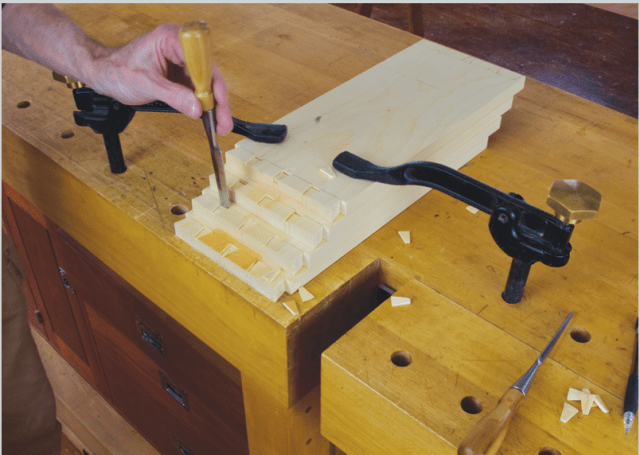
I stack my parts four or six high. That way I only clamp once on each side, for all parts. Let’s say it takes four hits per side to get halfway into each socket, or eight hits altogether. That means I have to switch chisels eight times (a wide chisel for the baseline, then a narrow chisel to remove the waste). If I do one socket at a time, and I have 12 sockets to chop, that means I switch chisels 96 times. By cutting all baselines on all pieces, then switching chisels and removing the first 1/16″ (.16cm) of waste, I save a lot of time.
3-13B. Here’s the first hit, with a 1/2″ (1.27cm) chisel and a very light tap directly in the scribe line.
Switching to a narrow chisel, I take out a thin sliver of waste on all the tails. Then I set the other chisel up against the shoulder I’ve just created at the scribe line, and give it a profound whack. I tend to tilt the chisel forward about 1°, to undercut the waste. Again I chop all of them, switch chisels, remove waste and do it once more, until I reach the middle of the tail boards. Then I flip them all over, re-clamp, and proceed in the exact same manner on the other side.
3-13C. Once all the light hits are done on all the pieces, I use a 3/16″ (.47cm) chisel to take out a thin sliver of waste on all the sockets.
When done, I clamp each board upright in my vise, then clean the corners with a thin-bladed knife. Remember that bevel-edged chisels have a narrow 90° edge, and the dovetail angles are less. There is almost always a bit of waste in each corner. We like crisp, clean tails, right into the corners.
3-13D. With the shoulder of the socket established, my second hit is a vigorous whack. I tilt the chisel forward about 1° or 2° for a slight undercut. In pine, that hit should easily reach half way into the socket. For hardwoods, it may take two or three hits (removing the waste each time) to reach the middle.
3-13E. Once I reach the middle of the socket, I use the narrow chisel to remove a much thicker waste piece.
3-13F. When one side is done, I flip the whole pile over, re-clamp it, and follow the same process on the other side.
The following is excerpted from Christian Becksvoort’s “Shaker Inspiration.”
Opinionated? Yes. Informative? Absolutely. Interesting and inspiring? You bet.
Not too many woodworkers can claim five decades of business success, but Becksvoort is among them. In “Shaker Inspiration,” he shares not only his woodworking knowledge and some of his best professional techniques for producing top-quality work, but also the business advice that helped him establish and sustain his long career in a one-man shop.
Plus, he shares measured drawings for 13 of his own well-known furniture designs and seven Shaker pieces that he’s reproduced.
One of the most difficult tasks when starting a business is pricing your work or product. Many woodworkers, especially those just beginning, seriously underprice their work. Hobbyists, especially, have no idea. Let me tell you, it’s really tough to be at a show next to Joe Basement, who is selling his very nice coffee table. He has no concept of the actual hours he spent, but his $140 worth of wood has turned into a $200 table. Wow, a $60 profit…wrong. The most basic pricing involves the cost of materials + overhead + profit. Lets take a look at these one at a time.
Materials are your wood, hardware, glue and finishes – anything that ends up in the customer’s possession. When working with a variety of woods, you’ll have to refigure the price for each species. That can run the gamut from a couple of bucks for No. 3 pine or poplar to $60 per board foot for exotics, to more than $100 per sheet for top-grade plywood with fancy veneers (in 2017 dollars, as are all prices in this book).
Working almost exclusively in cherry, and paying roughly the same amount for the past 20 years, makes pricing for me much easier. Not only that, but I get to use leftovers and offcuts for the next project. At this point in my career, I know the exact board footage for all pieces in my catalog. When starting out, you’ll have to do a bit more math. When you come up with the board footage, add 10-20 percent for waste, depending on how fussy or frugal you are regarding knots, defects, sapwood and general waste. Besides the wood, also include screws, hinges, locks, knobs, glides, glass, hangers and your glue and finish of choice. Speaking of hardware, I always buy the top grade. It takes just as long to install a cheap hinge as an expensive one. Cheap hardware will come back to haunt you, and result in unhappy customers.
Overhead is an all-encompassing term that includes the expenses you pay as the cost of doing business, but of which the customer does not take possession. Here is a partial list: your shop building or rent or mortgage, insurance, vehicle, electricity, heat, office supplies, telephone, internet, tools, advertising, freight charges, accounting, postage, licenses and taxes, and a few others that I may have overlooked. The bigger items, such as the mortgage, vehicle and large power tools can be amortized over a long period of time. Don’t, however, forget to include small tools such as routers that need to be replaced, specialty bits and tooling for a specific project, etc. Again, it will be difficult to estimate these costs when first starting, but after a year or more of good bookkeeping, you’ll have a pretty good handle on what it takes to run your shop. Divide the yearly total expenses by 12 to give you a monthly figure, divide that by 30 to give you a daily figure, and divide the last by eight to give you an hourly overhead cost.
Buy the best-quality hardware you can get your hands on – including extruded hinges and cast locks. It takes just as long to install cheap hardware as that of highest quality. These are by Whitechapel, Horton Brasses and Ball & Ball.
Finally, your profit. Yes, we’d all like to make $100 per hour take-home pay, but let’s be reasonable, especially when you’re just starting out. My profit, or hourly wage, when I opened my shop in the mid ’80s was $20 – which I thought was pretty good. It has since gone up considerably, but only after a few years. You can’t start out with astronomical prices when you have no track record, no reputation and no customer base. That comes with time, working efficiently, keeping your nose clean and keeping your customers happy.
A few random thoughts on prices and shop finances in general. First, if you give a customer a price quote, stick with it. You’re only as good as your word, and your word is your reputation. I’ve eaten my fair share of underpriced projects. It’s all part of the learning curve. Customers don’t want to hear “This took a lot longer than I thought….” They want results, not excuses. On the other hand, if a customer requests changes for alterations to the original design, then a change in price is warranted. Keep track of any additions or alterations made after the original quote.
I don’t dicker, and I try to be fair. I don’t gouge customers because they drive up in a Mercedes. The same hourly rate applies to everyone. Once that price is established, it’s fixed, unless times and circumstances change. My shop rate is based not just on time, materials, overhead and profit, but also on my experience, craftsmanship and reputation as a craftsperson. When potential customers try to talk my prices down, I tactfully end the conversation. Now they are messing with my self-worth. Remember, once a customer asks for and receives a discount, they will expect one from then on. And word spreads.
I have a policy in my business that once a customer leaves a deposit, that price is firm, no matter what the delivery time. That can be due to my backlog, or the customer’s circumstances. I’ve had a few instances where the customers’ houses took far longer than anticipated, or their financial situation changed, and the piece was not actually delivered for three years. Even though my prices had gone up, their deposit locked in their price until they were ready to take delivery.
Which brings me to yet another important point: a business escrow account. You need to have one for customer deposits. Remember that a deposit is not your money until the piece is actually finished and delivered. I check with my customers before I start to build, both to see if there are any changes needed and that they are ready to take delivery on a given date. If they’ve changed their minds after a nine-month wait, then I return their deposit. I keep the interest. It’s only happened twice in my career, but you need to be prepared, just in case.
A few thoughts on scheduling. Again, your word is your bond. Nobody likes to be put off, especially when they’ve been expecting a handcrafted creation for which they’ve been waiting almost a year. I used to schedule very tightly but soon discovered that was not a good idea. There are always circumstances beyond your control that affect your schedule and work output: supply hang ups, illness or subcontractors who don’t deliver on time. For the past few years, I’ve arbitrarily added a few months to my anticipated delivery schedule. For a desk that should be done in June if all goes well, I tell the customer July or August. That gives me a nice time cushion. Then if the piece is really done in June, the customer is thrilled and it makes me look good. It’s way better to deliver before the anticipated due date rather than after.
Hand-carved letters. These are way more work than routed letters, but so graceful and elegant. The craftsman’s touch is clearly in evidence.
The following is excerpted from “Shaker Inspiration,” by Christian Becksvoort.
There is a misconception among some woodworkers that working with hand tools only is better, or downright holy, while power tools are pedestrian, not real woodworking, and should be avoided. Not so. It depends on what your aim is. Is this a hobby, or are you doing this for a living? (More on this in Chapter 8.) I think that the British craftsman, professor and philosopher David Pye best puts it in more understandable terms. There is a sharp distinction between what he calls the “manufacture of risk” and the “manufacture of certainty.” The manufacture of risk means that a tool, guided by hand, whether powered or not, introduces risk. It is totally dependent on the skill of the user. On the other hand, the manufacture of certainty guarantees an identical outcome each time. When I carve cherry chair seats, I use an electric grinder with carbide cutters. The depth, proportion, shape and symmetry of the seat are determined by my hand-eye coordination. One slip and the seat is toast. Using a scorp is also the manufacture of risk, only slower, with less chance of making a major mistake.
To all you smug woodworkers out there: Not all hand-tool work involves risk. Some actually involves the manufacture of certainty; the results are guaranteed to be identical, each time. When using a straightedge and knife to make a cut, the cut will be straight every time (unless you let go of the straightedge). There are even folks making hand-cut dovetails and using clamp-on, magnetic dovetail guides. Come on, who are you fooling? Each cut is pre-determined and will be identical. Where is the fun and skill in that? Freehand is cheaper – no jigs, templates or gadgets. That’s where skill and practice lead to craftsmanship. Dovetail jigs are merely a crutch.
I think that one of the best examples is carving. There are still lots of carvers who use traditional carving chisels. All hand work – the manufacture of risk. However, more and more carvers, especially in the competitive world of bird carving, are using electric hand carvers, wheels, burrs and diamond bits. It’s still hand guided, and one slip results in disaster – also clearly the manufacture of risk. The source of power, be it muscle or electric, is inconsequential. I couldn’t run my business without my jointer, planer, drill press, lathe (although I used to turn knobs on the drill press before I acquired a lathe), mortiser or table saw. Ripping 40′ (12.2m) of cherry moulding with a handsaw is not my idea of a good time, therapy or craftsmanship. To me, that’s monkey work. If you get off on that, more power to you.
So what makes craftsmanship special? I maintain that it is evidence of the human hand. Yes, there will be mistakes. No one is 100-percent perfect (that’s why I own a SawStop). The Navajos professed that there is no such thing as perfect work, and all their rugs and pottery had an asymmetrical error of one sort or another. I’ve never turned out a perfect piece, yet I strive for perfection each time I come into the shop. What constitutes evidence of the human hand? Small mistakes, certainly. But they have to be nearly invisible. Large mistakes are just another growth and learning opportunity. They need to be fixed, rectified or replaced. Examples of the human hand? Hand-carved letters will never be as perfect as routed ones, but they are by far more elegant. Chair spindles, tapered with block plane or spokeshave, reveal minute facets but appear round. Chair seats, carved with grinder or scorp, will always have slight irregularities. Hopefully, they’re not noticeable, but they are present. Pins or through-tenons that are trimmed with a chisel are not perfect. I’ve even had the surprising pleasure of restoring a Shaker desk only to discover that the tenons were slightly chamfered, hidden inside of a mortise. That, ladies and gentlemen, is craftsmanship.
A few random thoughts on tools in general. Buy the best, and buy only once. Early in my career, I had a set of those blue-handled chisels, six for $39. When I started working full-time, banging dovetails all day, I discovered that I had to re-sharpen at least once or twice a day. At the end of a few weeks, that’s four to five wasted hours (I got to be really good at freehand sharpening, though). Even at a reliably low per hour shop rate, at the end of two weeks I could save enough to afford a set of Lie-Nielsen Toolworks chisels. Now I can do two or three large cherry case pieces before having to pull out the waterstones. What about used and antique tools? Those can be a real find and a real bargain. On the other hand, if it takes two or three days of shop time to fix, restore and tune a bargain plane to get the rust pits out, it might be better time-wise to buy new. If you enjoy fixing tools that’s one thing, but if you’d rather spend time working wood, then choose the other option.
It has also been my observation that a skilled craftsman with minimal and humble tools can do a much better job than someone with no or minimal skills and great tools. It’s all in how your implements are used. I recall that when Brian Boggs started making chairs, he cut his mortises with a sharpened screwdriver. His chairs were, and still are, masterpieces. Incidentally, he’s the only woodworker I’ve bought furniture from. His chairs are the perfect combination of thoughtful design, ergonomics and meticulous craftsmanship.
Chair spindles shaped with block plane and spokeshave. These reveal subtle signs of the handmade. The spindles are air-dried and rived, so the grain runs top to bottom.
CNC & 3D Printing It seems that our world is awash in consumer glut. Gadgets, products and devices that were once considered luxuries are today available to the masses. Decades ago, portable phones were naught but a pipe dream. Now, two-thirds of the population on this planet use and enjoy them. And in two years, they will be obsolete and need replacement. Mass production, on a scale never imaginable, has made it all possible. I agree that every human should be able to live a satisfying life, but where does it end? Walk into a big box store, and most everything you see there will be in the landfill in about five years. Is that sustainable?
Where exactly does craftsmanship end and mass production start? Anything perfectly reproducible, be it one, 10 or a million copies, is mass production. That’s where I see 3D printers. Some schools used to have craft areas, but now the latest is a “maker space.” Many of these don’t actually let you make anything; instead gadgets can be re-built or re-purposed, and the latest widgets are spit out by a 3D printer. Granted, the future of 3D printing is unfathomable, especially in science, medicine and machinery. But in crafts? Yes, coding and programming are skills, but you are not making an object. Press a button and the machine makes the object. Is that craft? The same can be said for CNC production. Every piece perfect. Every piece identical. It’s the ultimate manufacture of certainty. It’s just the ticket if you’re making kitchen cabinets, or have a line of furniture that you want to sell, but not make. Every piece identical, with no sign of the human hand. Just mass-produced. Is that why we are woodworkers? Is that what craft is evolving into? I suppose the same gripe was aired when Linotype machines cast lead letters as you typed. Who remembers Linotype? We’ll see where it all leads us.
One place that it’s led us: The word “custom” is now completely meaningless. You order your new Mercedes, in that beautiful metallic pearl color, with the engine size you specify, the sound system that you desire and a few other trendy options. That’s custom, right? Yup – there are 2,384 cars identical to your baby out on the road. In a world of increasing conformity, however, I think there will always be a perceptive and discriminating few who will in fact value the individually handcrafted piece. In my business at least, I know most of my clients value having something handmade, by me, that no one else has. They appreciate the finer things: art and craft. Let’s face it – only one person (or institution) can have the original “Mona Lisa,” but anyone can have a print. What’s the difference? You decide.
Please note that I’m not bad-mouthing mass-production. All of humanity needs a place to sit, a table to eat at and a bed to sleep in. Individually built furniture will never fill that need. The axe I’m grinding concerns those folks who buy pre-turned chair legs, pre-turned spindles, have their chair seats CNC-carved, then have the whole thing assembled by a minimum-wage employee, and sell the finished product as a “handcrafted” chair. Does that pass your straight face test? Is that your definition of craftsmanship?
In the long run, you decide what type of business you’ll operate, and exactly how you’ll make it work. And consumers will decide what they want to purchase: a big screen TV or a hand-made cabinet.