What other craft would be interested in Welsh chairs? Try the workwear industry.
Recently TOAST sent a crew to Williams’ shop in Wales to interview him about his chairmaking and Welsh chairs in general. They produced a lovely little feature on Williams that you can read (for free) here.
And then last week, Paynter featured Williams’ book in their online newsletter as one of the books they’re reading. See the image above.
Both of these workwear companies are influential in the workwear market. Heck, I even own a couple Paynter garments (a jacket and a wool vest/waistcoat – good stuff).
Congrats to Williams for finally being recognized as the fashion icon that he is.
Get two classic chairmaking books – “Welsh Stick Chairs” and “Good Work” – for one special price. Together, they’re just $ 49 – but only through August 7. The regular price for both is $87 – you save 44 percent.
If you’re wondering where stick chairs came from, these two books will tell you the whole amazing story – and get you started in building them.
Stick chairs have been around for centuries – but they’ve mostly been ignored by museums. In the 1990s, Welshman John Brown wrote and published the landmark book “Welsh Stick Chairs.” This book inspired hundreds of people all over the world to begin researching and making these vernacular chairs.
One of those people who was inspired by “Welsh Stick Chairs” was Welshman Chris Williams. He worked with John Brown for more than a decade making these chairs. Through the years, John Brown’s chairs became more wild and true to the old Welsh character, and Chris was there the whole time.
After John Brown died, Chris wrote the book “Good Work” about his mentor. This biography explores John Brown’s creative genius and his tumultuous character. And it explains how John and Chris built these chairs almost entirely by hand.
There is no better place to learn about the spirit of these chairs and how they were made than with these two books. So we are offering them at a special price until August 7.
Technical Details
“Welsh Stick Chairs”: Using first-edition examples of “Welsh Stick Chairs,” we reset the entire book in the original font to ensure the text was crisp. We rescanned and processed the photos and drawings and cleaned them up. And we spent weeks researching the paper stock of the original to capture the same earthiness and perfection of the first edition. We also made a small but invisible improvement – we sewed the signatures together to ensure the book will last for lifetimes. The book is a softcover, covered in heavy card stock like the original. The book measures 7-1/4″ x 9-5/8″. Our version includes John Brown’s original introduction to the book, plus the additional introduction he wrote for the third edition and an updated essay on John Brown by Nick Gibbs.
“Good Work”: The 208-page full-color book is also filled with historical photographs (many never published before) and beautiful linocut illustrations by Molly Brown, one of JB’s daughters. The book is printed on heavy coated paper with a matte finish to make it easy to read. The book’s pages are sewn, glued and taped – then covered in heavy boards and cotton cloth – to create a book that will last for generations. And the whole package is wrapped in a durable tear-resistant laminated dust jacket, which features linocut illustrations by Molly Brown.
Both books are produced and printed in the United States.
A primitive chair finished with “Welsh Miserable.” Photo courtesy of Drew Langsner.
The following is excerpted from “Good Work: The Chairmaking Life of John Brown,” by Christopher Williams. It’s the first biography of one of the most influential chairmakers and writers of the 20th century: Welshman John Brown.
John Brown by his own admission wasn’t a fan of finishing. (See Good Woodworking issue 63.)
“American chairs are really polished. Typically, the finish is paint. Without exception all the American chairmakers I meet ask me how I get my finish. I fail to understand this because it is the least interesting part of my work. It’s an aggravating necessity, as far as I am concerned.”
Here are the finishes that John Brown regularly used. These were always applied before assembling the chair.
‘Welsh Miserable’ This term could be seen as a criticism of the Welsh and brown furniture. But I always took it in jest. During the ’80s and ’90s, brown was deemed to be the accepted colour of country furniture. Newly made furniture was also brown. JB secretly wanted to paint his chairs or leave them blonde. So “Welsh miserable” was his private joke.
JB’s recipe for this was a dark oak stain from a tin. Once it was dry, he applied a coat of sanding sealer. He would rub this back with fine sandpaper. He then applied two or three thin coats of shellac button polish and left the finish to dry overnight, if time allowed. He lastly applied a coat of dark oak wax polish with #0000 wire wool.
A Cardigan chair possibly finished with the “Spirit of Wales” finish.
The Spirit of Wales This finish was a favourite of his. It probably was the only finish he was enthused about as it brought out the artist in him! JB wrote, “The effect is not meant to reproduce an antique finish, but to try to capture the Spirit of Wales.”
JB would first apply a dark green water-based dye to the raw timber – always remembering to raise the grain a few times beforehand. When it was dry, he sanded it smooth and didn’t worry about sanding through the green. He then applied a dark brown stain over the green. When it was dry, he gave it a coat of sanding sealer. He sometimes added a coat of button polish before applying dark brown or black wax.
The finished chair had a greenish, brown/black appearance. In a certain light it’s spectacular.
Two primitive Welsh chairs with John Brown’s blonde finish.
Blonde JB described a natural-coloured chair as a “blonde chair.” He had two approaches to this.
If the natural colour of the grain was needed to be kept as bright as possible he used a white shellac polish. He would first apply a coat of sanding sealer. Then he gave it two or three coats of white shellac. In most cases he didn’t thin the polish; it was used direct from the bottle. Great care was needed as a high gloss could be attainted very quickly. This in turn gave the chair a glassy look. Finally, he applied a clear wax polish with #0000 wire wool.
He would sometimes (in his words) want to “kill the lightness.” By adding a few coats of shellac garnet polish over the sanding sealer this gave the chair a honey colour and a warm glow. He would finish up with a light, oak-coloured paste wax.
JB predominantly used the combination of oak and elm for the bulk of his chairs. Each species complemented the other colour-wise. If a steambent ash bow was added to the mix, it was coloured to blend in with the oak and elm. He achieved this by first making a strong pot of tea. The tea was applied to the ash arm before the sanding sealer and subsequent finish.
Oil I only saw JB use oil on occasion. The tenons on the legs, stretchers and sticks were covered in masking tape to prevent the oil from penetrating. The oil was applied and left to dry before he applied a coat of paste wax with #0000 wire wool.
To me it looked lacklustre compared to the shinier shellac finish.
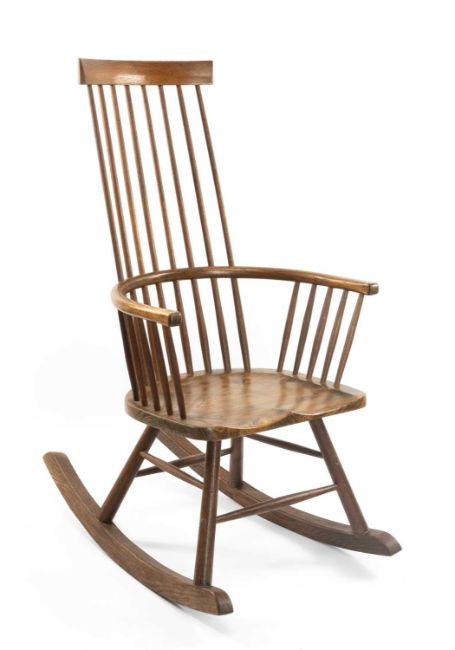
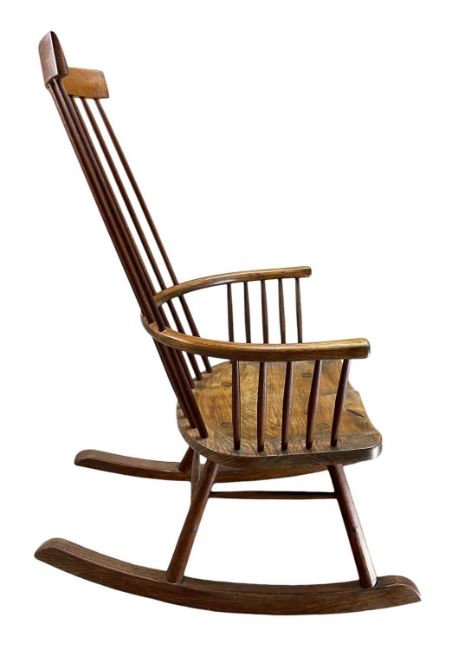
Earlier this month a John Brown chair surfaced at auction that was a highly unusual form: a comb-back rocking chair.
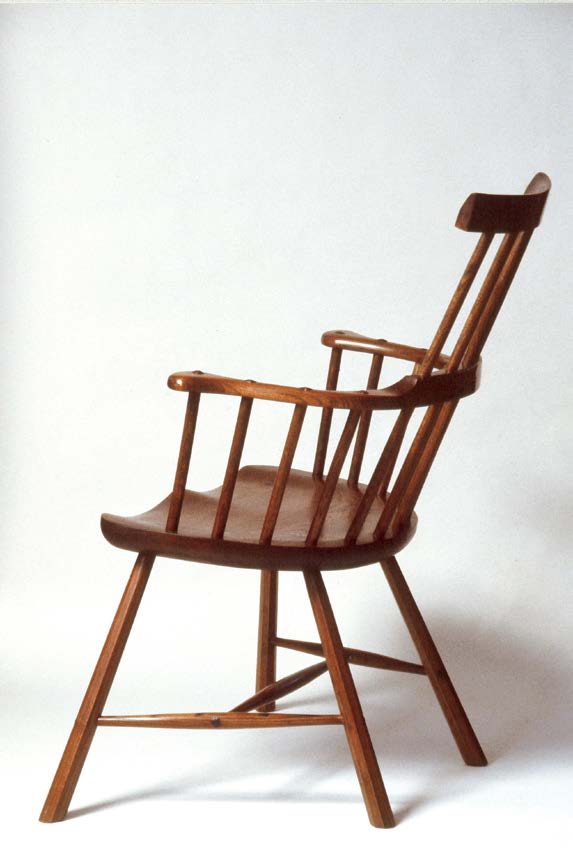
Commissioned in 1988, the chair was made for a family with a newborn and served as a nursing chair. From the seat up to the comb, the chair resembles JB’s cardigan chair, the chair he built for his book “Welsh Stick Chairs.” (FYI, many people don’t consider the cardigan chair to be a Welsh form, but that’s not part of this tale.)
Below the seat, things become unusual. Instead of an H-stretcher, the chair has a box stretcher and beefy rockers. The seat of the chair is elm, and it looks like the remainder of the chair is oak, though I can’t tell what species the rockers are.
The chair sold for the remarkable price of 550 GBP, according to Chris Williams, who tipped me off to the chair and the auction. Chris is the author of the excellent book “Good Work: The Chairmaking Life of John Brown.”
JB built the chair before Chris worked with him, so Chris was shocked to see the chair. “Can’t quite believe my eyes!!!” he wrote.
I’ve seen only one other stick chair that was a rocker, and it looked like that chair had the rockers added later.
Chris Williams – who worked with John Brown for years and wrote a biography about him – is teaching a Welsh stick chair class in our shop this week. Yesterday, the students saddled their seats. Chris convinced at least a few of them to try his preferred method for rough stock removal: the adze. We caught some of it on video for your viewing pleasure and instruction.