


The following is excerpted from Derek Jones’ new book “Cricket Tables.”
Simplicity, necessity and ingenuity are the three key principles for making cricket tables. This traditional three-legged table exists in a variety of forms and woods – no two are the same. So making them follows an organic process – your tools and materials dictate your approach and your cricket table’s final form. Jones introduces the form, then teaches you the simple skills to create a variety of everyday furniture with a few basic hand tools and easily sourced materials.
Most people think Thomas Edison invented the lightbulb; he didn’t. He came up with a version that burned longer and brighter than anyone else had achieved, making it appealing to consumers and thus commercially viable. You could argue that he just piggybacked his way to glory but the fact is, the last few steps in perfecting anything generally requires the most effort. And for that we must give Edison credit where it’s due. Edison experimented with hundreds of different materials before settling on carbonized bamboo for his filament. He never viewed experiments in terms of success or failure. Knowing that something doesn’t perform the way you intended is just as valuable as knowing that it does. Over the course of his working life, he carried out more than 50,000 experiments to invent the alkaline storage battery and 9,000 to perfect the lightbulb. On paper those statistics look scary – you might even find them intimidating – but reframing the data as tens of thousands of things you now know the answer to is creative gold. For the record, among those “failures” was the groundwork for inventing the carbon microphone that went on to be used in telephone handsets for more than a century. The phonograph, originally thought of as just a tool for office dictation, became mainstream in every continent not long after. Its legacy is still burning bright albeit through the ether and into our ears. In his book “The Imagination Muscle” (Constable), Albert Read refers to this kind of behavior as “imaginative risk.” And if that concept doesn’t get you fired up and running toward the workshop then maybe stop reading, we’re probably done. In the same way Edison didn’t equate lack of success with failing I find it hard to see anything other than valuable lessons from my current tally of tables. Hand on heart, there isn’t a stinker among them if you truly value the process of design without fixating on the outcome.
Today we regard pared-down simplicity as a relatively modern concept. We know it as minimalism. As an expressive genre, the idea came about in the early 19th century as a somewhat idealistic view that enlightenment could be gained by adopting a less cluttered lifestyle both in possessions and thinking. In Western culture the idea already had traction before then through several religious ideals, the Shakers being the most well-known among woodworkers. In the Chinese religious philosophy Daoism, which incidentally has its roots somewhere back in the 4th Century B.C.E., there are three main virtues – non-action, naturalness and simplicity. These are obviously open to interpretation but the similarity between that train of thought and those practiced elsewhere throughout history suggest a natural desire among all life to eventually seek a simpler existence. Further guidance on upholding the virtues is offered by what is known as the Three Jewels: compassion, frugality and humility. Sound familiar? Arts & Crafts, Bauhaus, Zen and Feng shui all have similar influences because of a common thread. By asking us to turn away from the path we’re on in search of something different implies choice. Cricket tables, mostly, and vernacular furniture in general have different DNA. When necessity is in the driving seat, you end up with good, honest no-frills solutions.
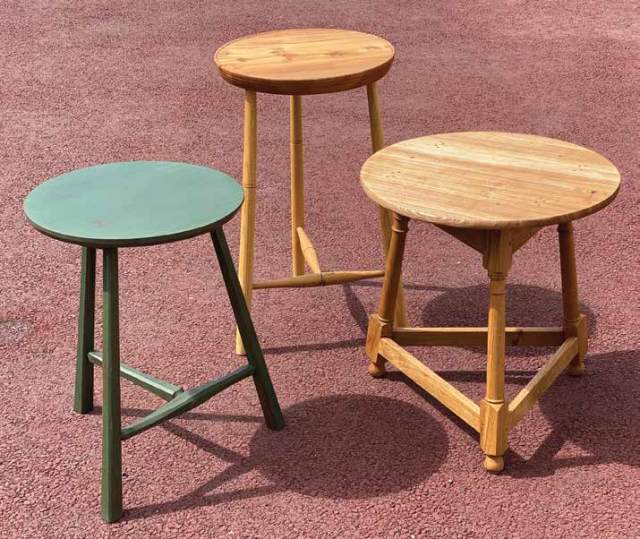
Old or New? The first cricket table I made wasn’t so much a tour de force but a war of attrition. When I brought it into the house my partner approved, likening it to something that could have come from IKEA. And in a funny way she was right, that’s exactly what it looked like. Smooth lines, geometric form, pale “Scandi” color. After all isn’t that what IKEA does so well? I wonder what her reaction would have been to a period example, all wonky and encrusted with hundreds of years of grit and grime. There’s always something to be learned from an expert, but nobody speaks the truth like a complete novice. Factory-made furniture must appeal to the widest audience possible. It mustn’t offend. And like any good, backhanded compliment it should be taken in context. It’s important to understand that the relationship you have with the pieces you make will be very different to the one everyone else has. From that moment on I’ve not been able to look at cricket tables in any way other than contemporary and timeless. The few that I have made and attempted to create a period look through the finish feel slightly wrong.
The tables chosen for this section all have qualities from Daoism, Arts & Crafts, Bauhaus and minimalism either in form, process or intent. I appreciate that does sound a bit grandiose but it’s not that hard. Just picking up some tools and making something gets you 99 percent of the way there. They are good honest pieces, stepping stones toward making the perfect table. In case you’re wondering, I’m a long way off and hope I never will, but I do know the next one is a step closer.


