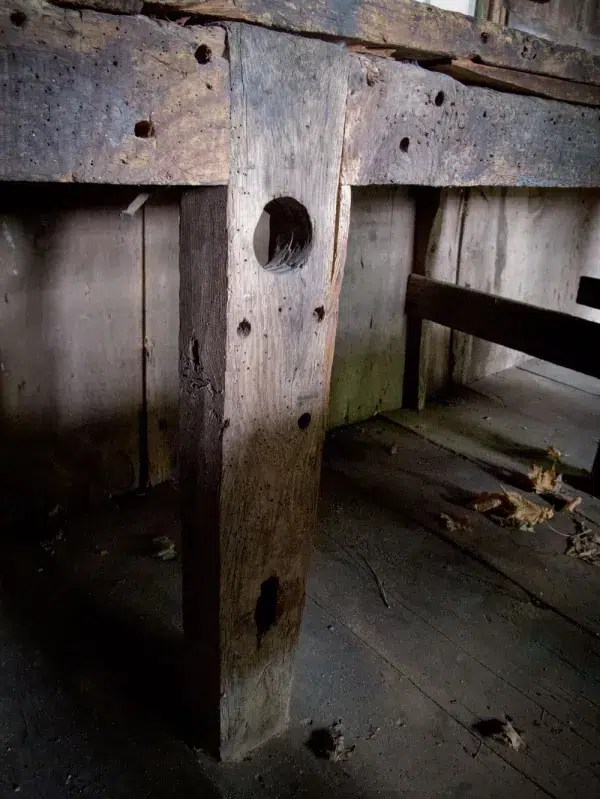
More than 10 years ago, Chris wrote about his visit to the Sampson-White Joiner Shop in Duxbury, Mass. Yesterday, the Secretary of the Interior designated the site as a National Historic Landmark (NHL) (hat tip to Timothy Babalis for this news).
This historic shop, which, according to the National Park System Advisory Board, “is the only known surviving purpose-built, eighteenth-century woodworking shop in its original location and with its fixtures intact,” was, at one point, being used by a private school as storage. Stories like this usually don’t have happy endings.
According to the 108-page nomination letter, the site meets two NHL criteria: Criterion 1, “for embodying the early American woodworking trades that helped to build the United States” and Criterion 4, “as an exceptional example of an early American joiners’ workshop, a distinct but rarely surviving architectural type.”
Luther Sampson owned the shop from 1785-1795, and Joseph White owned it from 1795-1843. To this day you can still see the shop’s original fixed workbenches which line three walls, tool racks, and more.
Check out photos (including a bench wall pierced with marking awl jab marks, depictions of sailing ships scratched into the walls and elegantly chamfered empty tool racks) and read more about Chris’s 2013 tour of the site with Michael Burry, a restoration carpenter who discovered the shop and Peter Follansbee, here.
Hickory bast seating. This chair was 22 years old when these photos were taken. The upper surface is polished from sitting; no finish was applied. The underside looks like it did in 1997.
In 1978, Drew Langsner released his book “Country Woodcraft” to the world, and it sparked a movement – still expanding today – of hand-tool woodworkers who make things with mostly green wood.
The 304 pages of “Country Woodcraft” showed you how to split wood from the forest and shape into anything you might need, from a spoon to a bowl, from a hay rake fork to a milking stool, a pine whisk to a dining table.
After more than 40 years, Drew revisited this long-out-of-print and important book to revise and expand it to encompass what he has learned since “Country Woodcraft” was first released.
The result is “Country Woodcraft: Then & Now,” which has been expanded by nearly 100 pages and has been updated throughout to reflect what Drew has learned since 1978. Among many other additions, it includes greatly expanded sections on building shavehorses, carving spoons and making green-wood bowls.
The original book’s text is intact, and the old photos are in black and white. Throughout the book, Drew has added text, which we set in a slightly different font, to explain what he does differently now after 40 years of daily work on the North Carolina farm he shares with his wife, Louise.
In many ways, the book is a delightful conversation between the younger Drew, who is happy to chop down trees with a felling axe, and the older Drew, who now uses an electric chainsaw and band saw to break down stock to conserve energy (and likely aspirin). New illustrations and color photos throughout show how Drew works now.
Below is an excerpt from the Appendices.
A Few Usually Useless Woods – Then Trees are generally defined as single-stemmed woody plants that attain a height of at least 20′. The smaller shrubs are often a nuisance to commercial woodsmen. Unsurprisingly, certain shrubs contain excellent-quality wood. Like roots and branches, the irregular sections can be used to advantage in specific situations.
In rural Finland, lilac is considered to be the best material for rake tines. Rhododendron makes fine spoons, shelf brackets and clothes hooks. Holly, generally planted as an ornamental, will grow into a fair-sized tree with excellent-quality hardwood.
Roots are generally not considered wood. They are often gritty (dulling sharp tools), difficult to work and hard to adapt to profitable production. They are a stringy fibrous material, with shrinkage and other characteristics shared with the wood above ground. As might be anticipated, peasant and nomadic craftsmen found special uses for these tough, twisted subterranean forms. The natural curvatures of roots are used for hooks, handles, and other special uses. Knotty roots are also tough and can be used for maul heads – hickory and dogwood – or even bearings for slow-turning machinery. The Swiss Alpine butter-churn stand is traditionally made of dry pine roots.(1) Large spruce roots, cut with the lower trunk, are used in boatbuilding.(2) Finer spruce roots can be split into lacing thongs or basketry material. During a recent project removing roots in our driveway, I learned that roots have reaction wood, just like tree trunks and limbs.
Country Workshops 2017 summer intern Will Burney is using a drawknife to remove the outer bark from a tulip poplar sapling. The tree is about 5″ in diameter.
Bark, another waste material of industrial technology, has many uses for the woodland crafts worker. Birch bark has surprisingly fine, lasting qualities when wet. It can be peeled in early summer, then used for the hull of a canoe or the underlayment of a sod roof. Birch bark baskets are made throughout Scandinavia and northern Europe. Tulip poplar bark can be scored and folded into containers such as berry-picking boxes. Basswood bark was used for making shingles in Russia and other places. The inner bark – called bast – of hickory, bass and tulip poplar can be cut into strips for post-and-rung chair seating and to make a tough, durable lacing material, and even rope. Leather tanners used bark from oak, birch and alder as their source for tannin. In nearby Greeneville, Tenn., Cecil Self and his brother were tanning cow hides for horse harnesses with oak bark until about 1970.
Even twigs and small limbs can be useful. Fences can be woven from many pliable species; willow and hazel are often considered best. First-year willow growth is the standard basketry material in many areas. Young pine limbs may be shaved down and used for bucket hoops. Birch twigs and many kinds of brush are used to make broom sweeps.
Before the takeover of industrial economics, trees, shrubs and even roots were valued for many uses that have since been superseded by synthetics and manufactured products. The following list provides a few examples from traditional handcrafts of Europe and North America.
Bark – Entire, or Outer · Alder. Tanning leather · Birch (white, paper). Canoes, basketry, roofing (Scandinavia, under sod), clothing (Pacific Northwest native Americans) · Linden (also known as bass, and lime in the U.K.). Shingles · Oak (various species). Tanning leather · Tulip poplar. Primitive shelters, folded boxes · Willow. Aspirin
Bark Bast (Bast refers to inner bark.) · Elm. Rope · Hickory. Chair seating, basketry, thongs and lacing · Linden (Also known as bass, and lime in the U.K.). Basketry, rope · Tulip poplar. Chair seating, cordage
Limbs · Apple, pear and other fruit woods. Spoons, ladles, hooks for hanging just about anything · Birch (any kind). Spoons and ladles, wall hooks for clothing, harness · Dogwood, holly and other slow-growing hardwoods. Spoons and ladles · Pine limbs. Bucket hooping (Swiss Alps)
Roots · Dogwood. Mauls and clubs (Integral with the lower trunk of saplings) · Sassafras. Root beer · Spruce. Thongs and lacing
Saplings · Hickory and other tough hardwoods. Clubs and mauls, splitting gluts · Birch. Fencing (Scandinavia) · Conifers (various). Fencing (Scandinavia) · Hazel, sourwood and other small saplings. Walking sticks
Shrubs and Scrub Trees · Lilac. Rake tines · Rhododendron. Spoons and ladles, wall hooks
Twigs and Rods · Birch. Besom brooms, rope, fencing · Hawthorne. Living shrub fencing · Hazel. Baskets, walking sticks, fencing · Willow. Basketry · Any species. Fire starter, fuel for cooking/baking
A Few Usually Useless Woods – Now Tulip poplar bast chair seating. During the early years of Country Workshops’ ladderback chairmaking classes, we learned that the inner bark from tulip poplar can be used for woven chair seating. The idea was quickly dismissed. It was assumed that poplar bast is an inferior material that would tear or deteriorate quickly. Also, we were in love with hickory bast, which is an exceptional material – for appearance and strength.
Peeling the first strip shows how deep to drawknife the succeeding strips. This piece is looking a little thick.
The problem with hickory bast is getting it. Hickory grows in many parts of the eastern U.S., but it’s relatively scarce in our area, compared with tulip poplar, which seems to sprout almost everywhere. More than 30 years had passed when I received a phone call from Jack Ruttle, back then the editor of Organic Gardening magazine, and also a participant in one of Country Workshops’ early chairmaking courses. Jack told me that when he returned from the CW course he prepped and wove a seat for his chair using tulip poplar bast.
DL – “Great! How has it held up?” JR – “That’s what I want to tell you. We use the chair every day.” DL – “And?…” JR – “It’s still looking fine. No tears or other problems.” DL – “OK! That’s fantastic. I’ll give poplar a try, ASAP.”
That summer, Will Burney and I cut a nice-looking tulip poplar sapling. The diameter was about 5″ at breast height; it was straight, with just a few small knots. The pole we hauled to the shop was about 15′ long.
The shaving and peeling technique is the same as for getting hickory bast, only somewhat easier. Like hickory, poplar bark can be peeled from mid spring to about mid summer, during the early year growth when cambium cells are dividing, forming new layers of wood and inner bark. Sometime around mid summer, growth slows, and it becomes difficult – or impossible – to peel the inner bark.
Once in the shop, our poplar pole was set on two sawhorses. Will and I took turns holding the pole and shaving off the outer bark. We used a straight drawknife, held bevel down. We quickly learned that this needs to be done carefully; it’s easy to cut into – and destroy – the bast. Depth of cut is determined by trial and error along a narrow test strip, maybe 2″ wide. We used a chalk line to define strips about 5/8″ wide.
A box cutter – a carpenter’s zip knife – works well for cutting through the inner bark to make the strips. If you do this between spring and summer, the bast will peel loose from the cambium with little effort. If it seems to be too stiff – more than 2mm in thickness – lay the bast back on the pole and do some more shaving. This fine-tuning can be done with a spokeshave. Remove the first strip.
With a strip removed you can see the thickness of the two adjacent sections that will become the next strips. This greatly helps in determining how deep to shave. Use a spokeshave for the final passes. Because a tree isn’t a true cylinder you’ll need to cheat here and there, letting the strips wander or die out.
Where a strip intercepts a knot there are several options. If the knot is to the side of the strip, you can continue as if it doesn’t exist. There’s about a 45-percent chance that this section will end up on the bottom of the seat, or become overlapped with the weave on the top of the seat. In tension, narrow sections of bast are almost as strong as full-width sections. Sometimes a very small knot will be almost centered within the width of a strip. I leave these; they become a visual feature. You can also just come to a stop, making a shorter strip. Long strips are nice, but you can use various lengths when it comes to doing the seat weaving.
As you proceed, slime from the fibrous bast will attach to the drawknife and spokeshave blades. Wipe this off with a wet rag. Continue working with wet tools. Water seems to minimize slime accumulation. (Dry and oil the tools when you’re finished.)
Let the strips dry before weaving the seat. The fresh strips are somewhat fragile. Also, they will shrink in width. Seats made with green bast will result in gaps in the woven seat. Roll and tie the strips in coils for drying. This might take a week. Coiled bast can be stored indefinitely.
As with hickory bast, the best weaving pattern for poplar seating is a herringbone. A one-over/one-under checkerboard weave becomes too tight to finish the weaving process. A double checker board (two-over/two-under) is OK, but it’s not as attractive as the herringbone.
On weaving day, plop the coiled bast into a bucket of warm water. It becomes pliable in about 15 minutes. Don’t soak all the bast at once; you want it to be workable, but you don’t want it to soak up so much water that it expands in width. Directions for the herringbone weave, including how to tie strips together with a weaver’s knot, are in my book, “The Chairmaker’s Workshop.”(3)
Both hickory and tulip poplar bast hold up well. With use, hickory bark takes on a nice sheen on the upper surface. (A true butt rub!) Poplar smooths out some, but never looks polished. On my poplar bast ladderback, the material crumpled slightly where it wraps around the rungs. This doesn’t weaken it, but it would be nice to eliminate. Perhaps pre-limbering in both directions will do the trick. As it dries on the seat, poplar bast shrinks in width a little more than hickory. But the shrinkage might also tighten the weave. We’ve been using the chair in the photo with poplar bast seating for three years; we’re happy with it. Still, hickory bast is king.
This tulip poplar bast seat had been used for three years. I’m not aware of any degradation.
A later note on poplar bast seating. Recently I found myself looking at the chair with poplar bast under low level and low angle light. I discovered that the crumples correspond to the arrises of the small spokeshaved flats of the rungs. I’m now quite sure that crumpling would not have happened, or be less prominent, if the upper seating rungs had been made rounder and smoother. This could be done with a hollow sole spokeshave, scraper or just sandpaper.
Wood scraps from a green wood chairmaking workshop. When I visit city-based woodworkers I’m often surprised to see that wood scraps are tossed into the trash, along with package wrappings, the newspaper and even food waste. This is a shameful situation that was even worse before recycling. During 39 years of Country Workshops’ ladderback chairmaking courses, vast quantities of wet, green wood waste were produced, along with the many chairs. We produced drawknife shavings, followed by spokeshave shavings, plus waste cutoffs from over-long chair parts and wood that didn’t meet standards of quality. There was very little saw and sanding dust. Here’s how this stuff was utilized – and almost everything was utilized, even some of the wood dust.
Dry drawknife shavings from any kind of wood are among Planet Earth’s best fire-starters. Because we and our neighbors mostly heat with wood, we can always use wood shavings. We store drawknife shaving until needed in plastic trash cans – like the ones sold for curbside pickup. (Which we don’t have out here.) I use a 2″ hole saw to bore 50 or so air vents in the plastic side walls. This is for ventilation so that the shavings will dry, which is what’s needed for fire-starters. The trash can lids are nice to use if the shavings are stored outdoors.
One tip that would drive some CW students nuts is that the drawknife shavings are roughly sorted before going into the trash cans. 1. Sweep the shavings into a pile. 2. Grab a bunch of shavings and shake them, so that small, frassy stuff falls away. Don’t shake on top of the shavings pile! 3. The remaining shavings go into the trash can. The reason for this is that the rejected small dusty stuff tends to fall on the house floor and be messy. You’ll appreciate this when you do it.
Spokeshave shavings can go into the same fire-starter. But there’s a much better use if you’re doing woven chair seats… Once upon a time this woodworker/teacher/author rejected the tradition that woven chair seats should have a stuffing between the layers. But as I got older, and learned that even hickory bast chair seats stretch and sag, I came to agree with conventional wisdom. But what to use? Several layers of cardboard is common, and also plastic foam sheeting (various kinds.) One day Brian Boggs was visiting when our class was finishing their ladderbacks. Brian told us that he had been testing “just about everything” for the stuffing and that he had concluded that the very best is spokeshave shavings. By far the best are from green wood when you’re finishing rungs with a spokeshave. Green wood shavings are springy, whereas dry wood shavings tend to crumple and weaken as they pass over the spokeshave chipbreaker.
Sweep the shop floor when switching from drawknife to spokeshave. When spokeshaving is finished, put the shavings into a box to dry. They will keep indefinitely. The shavings are also premium packing material for anything shipped in a cardboard box. Or just put them in with the fire starter.
Green cut-off wood scraps are dried – in other hole-y trash cans – then burned in the shop woodstove. Any other leftovers are tossed in the forest to decompose, which might be what all of this stuff should really be doing. Amen!
1. Drew and Louise Langsner. “Handmade.” New York: Harmony Books, 1974. 2. Herbert L. Edlin. “Woodland Crafts in Britain.” Newton Abbot, UK: David & Charles, 1949. 3. Drew Langsner. “The Chairmaker’s Workshop.” Original edition published in Asheville, NC: Lark Books, 1997. Author’s reprint edition Marshall, NC, 2008.
I’m a long-time fan of the Mississippi-made Delta 14” cast-iron band saw – and its better clones. But not everyone has the space for one of these saws. Or they don’t have the eggs to buy a used one that will surely need some restoration.
For the last couple months, I have been using/abusing the Rikon 10-305 band saw. Rikon stopped making it, but Highland Woodworking bought up all their extant stock and is selling them at $299. This is a bargain price for a saw that can do everything necessary for making stick chairs.
If you have been wanting a band saw, but are short on space or money, quickly go get one before they run out. Then come back here and read about why you are such a genius (and a good dancer).
First, for all the first-timers here, please know that I bought this saw at full retail. I paid shipping and tax. Highland didn’t ask me to do a review. They might not even know I bought one of the saws. The saw isn’t perfect (more on that later), but $299 (plus $73 shipping) is chump change for a machine like this.
Decent bearing guides.
Most important: The saw has the guts to do serious work. It handles 8/4 oak without a problem. Heck, you can get almost 5” under the guides, not that I would ever need that with chairmaking.
The guides are standard bearings – two on the sides and one thrust bearing. Standard stuff and easy to adjust. There are guides above and below the table (you have to ask when a saw is this cheap). The trunnions are aluminum, but that’s not a demerit in my book. I like that the saw is so lightweight. I can pick it up myself and move it wherever. It’s small enough to fit in a closet.
The dust port actually fricking connects to a regular shop vacuum, which is some miracle. The dust collection is much better than on my 14” Delta, but it’s not perfect (observe the dust on its components).
No-frills fence. But it works.
The downsides: The fence is skimpy (they make an upgraded one). But it locks down fine at the front and rear of the table and doesn’t move. The throat plate is way too gappy – a common problem with all band saws. I’ll make a new zero-clearance one, but for crying out loud I shouldn’t have to.
Vibration isn’t bad. But clamp the saw to the bench when you use it. It doesn’t jump around, but every little bit counts. The saw is remarkably quiet. I expect little machines to be like little dogs – very barky.
The wheels are skimpy, but they were balanced at the factory and run true.
Svelte wheels. But what did you expect?
I wish I had a saw like this when my workshop was on the back porch. It would have saved me hours of farting around with a jigsaw and circ saw to process lumber.
So, as I said, act now or regret it later.
— Christopher Schwarz
P.S. Rikon has replaced the 10-305 with an upgraded model, the 10-3061. I haven’t tried or seen one. And at $599, I’m unlikely to.
Decent trunnions for a bargain saw. The saw’s table is iron.
We just added our latest batch of 250 Anarchist Square Kits to the store. We have been boxing these suckers up for days now, and we will be boxing them up tomorrow and Monday to meet the USPS deadline for getting stuff in the mail so it arrives before Dec. 25th.
The kits are great fun to assemble – and you end up with a useful shop tool.
The kits are $45, and the square is made of 1/2”-thick Baltic birch. When assembled, the long legs of the square are 21” long – perfect for most casework layout chores.
We’ve made a video with tips on how to assemble the square, which is below.
This is the last batch of squares we will get before January. We hope to restock early next year. So if you want one now, this is the time to order.
Here’s how it works: Type your woodworking question in the comment field; we will attempt to answer it. It is that simple.
It’s time for our weekly(ish) Open Wire, hosted this week by me and Chris (mostly Chris…he’s faster at answering and gets up earlier than do I, plus he knows a lot more than do I about what seem to be the favorite topics: chairs and chair-shaped objects – but do ask him about his Pristolnicul/pristolnice).
So here we go…. Comments will close about 5 p.m. Eastern.
Note: Comments are closed for this session. See you next week.