One of the unexpected treats of visiting Wales this month was getting to visit the shop of Tim Bowen, an antiques dealer in Ferryside who specializes in vernacular furniture from Wales and the rest of Britain.
If you like Welsh stick chairs, or vernacular furniture in general, Tim’s Instagram account (@tim_bowen_antiques) is a great way to keep up with the things he picks up and shows the world. Chairmaker Chris Williams, who has been friends with Tim for years, took us over and Tim pulled out some interesting chairs from his shop and his personal collection for us to examine.
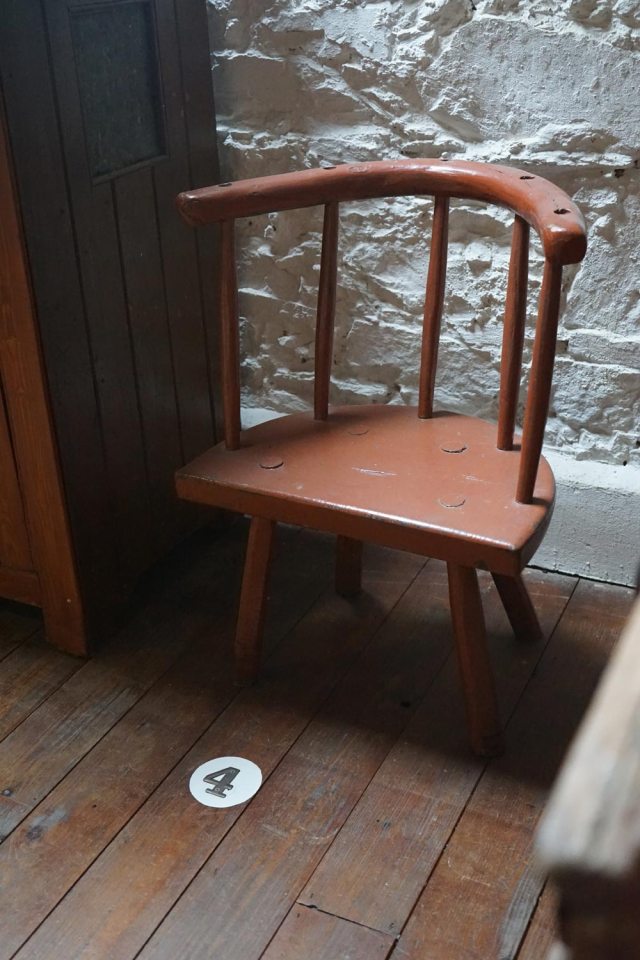
My two favorite pieces were a chair from Tim’s personal collection that looks like it was made in a barn with just a few tools. The armbow has a slashing scarf joint across its back, and the whole chair looks like it was made with both urgency and skill.
The other chair had a lovely single-piece arm and traces of early – if not original – paint.
All of the chairs Tim showed us were good enough to populate a museum gallery. And they represented a broad swath of Welsh chairmaking, from the craft at its most elemental all the way up to a chair that was almost as refined at the chairs that Chris Williams makes, with delicate decorative details.
Tim Bowen, right, and Chris examine a Welsh chair’s details.
Plus, I got to touch the chairs. All over. Feel the flats on the stretchers and the shape of the sticks. You can’t get that at a museum (not without getting thrown out shortly afterward).
Tim spent a good couple hours with us, patiently explaining what he knew about each chair – and what he didn’t. After decades in the trade, Tim is careful about making many official declarations about the date, provenance or even species of wood in any particular piece. He’s seen too many chairs in his career.
This is our last full day in Wales – tomorrow we head to Ireland for some rest and (sorry Lucy) more chairs.
During his long career as a chairmaker, Chris Williams has heard stories of people filling up shipping containers of Welsh stick chairs and sending them to the United States. (You also hear stories – shudder – of people chopping them up and burning them for fuel.)
Last week, I saw another piece of evidence that the migration of Welsh stick chairs to North America was something that has really happened. As I was packing up to leave the shop at Wyatt Childs Inc. last week after a week of building French workbenches, Bo Childs drove up the shop in his white pickup truck with two stick chairs in the bed.
His father had brought them over from the U.K., and he wanted me to have a look at them.
We took the chairs over to the lawn behind his house and gave them a quick inspection. I was trying to get on the road to catch a plane to London (crazy life), so I didn’t get to document them completely. Maybe next time.
What I saw was one chair (above) that clearly is a Darvel chair, a Scottish stick chair. And based on the turnings, it’s likely one that’s earlier in their history.
For me, what was most interesting about the Darvel chair was the spindle deck. It’s slightly raised and rabbeted, like the deck on my chairs. I’ve not seen this detail on an old chair. I hope to investigate this chair a little more next time I’m in Georgia and can look for tool marks.
The other chair bears all the hallmarks of a Welsh stick chair (Chris Williams also said it looked Welsh to him). The armbow looked like it was made from a curved branch. And the seat’s shape matched the arm. The seat itself is massive and thick with a slight bevel on its underside.
Also interesting to see was that some of the mortises in the arms were blind. And when we looked under the arm it was apparent that the maker had made a few mistakes in locating these blind mortises (there was also evidence of this in the chair’s seat).
These “errors” didn’t take anything away from the appearance of the chair. I love it.
Other details I noticed on my quick investigation: The chair had an H-stretcher and was missing the middle bar of the H. Also, what is difficult to convey with these photos is how massive the components are. The legs are quite thick – much thicker than I would typically make in a chair.
As always, seeking out and encountering the “real thing” is an education that’s worth more than 1 million clicks on the internet.
Maurice Pommier, in his workshop. Photo by Brian Anderson.
[Editor’s note: We recently reached out for an interview with Maurice Pommier, author and illustrator of “Grandpa’s Workshop” (translated by Brian Anderson – you can read about Brian’s visit to see Maurice and his workshop in 2012 here). Maurice lives in Évreux, France, and speaks little English. But he responded, in the most generous way – an illustrated letter. Here are his words, as he wrote them without edits from us, along with a handful of illustrations, sketches and pictures to help paint a small picture of who Maurice is and some of the brilliant work he has done.]
I am not very able to speak of me. I am born in 1946.
My mother was dressmaker. She worked hard, early morning and late evening.
My father, alive but broken by the nazis.
We lived in a little village, Peyrat de Bellac. I go to school and after I was boarder at collège in the nearby town.
I thank life for having put in my company a lot of great people – I can not name them all. I choose three, the others do not be dissatisfied.
Tonton Dédé, the best, with working with tools and with his hands.
Pépé Léonard, the best storyteller. When he stop speaking, he was whistling.
Mémé Anna.
I think I’ve been drawing since I know how is made a pencil.
In 1968, I married Francine, she supports me since that date. We live in Évreux. We had three children and now four grandchildren; I worked at the Post Office for a long time. But I did not stop drawing.
Xavier Josset
My friend Xavier Josset has been presenting my first book to a publisher, me, I would have never been there.
After things changed, I left the Post Office, but I continued to draw and scribble. And write stories. In the following pages I enclose a small catalog of my bad habits. J’espère ne pas être ennuyeux.
“Moulin Richard de Bas, Ambert,” the oldest paper mill in France (watercolor)
“Rosace, tracé régulateur,” Cathédrale St Guy, Prague
François Calame, creator of Carpenters Without Borders, is a friend. I had the chance to make shavings and sawdust in his company.
The Tithe Barn of Daubeuf-la-Campagne (La grange aux dîmes de Daubeuf la Campagne)
Originally the barn was built with five bays. It was later extended to the south with five further bays. The barn is oriented north to south in its length. The drawing here shows the older part of the barn. The cross-frames, the main purlins and the bracing are shown, but for clarity, the rafters and the intermediate purlins are omitted. The doors, which have undergone several alterations over the course of the barnʼs history, have also been omitted.
La grange était constituée à son origine par 5 travées. Par la suite elle fut agrandie vers le sud, par 5 travées nouvelles. La construction est orientée nord/sud. Voici un petit schéma décrivant la charpente la plus ancienne. Il montre les travées, les fermes et le contreventement, pour plus de clarté, les chevrons n’ont pas été dessinés, ainsi qu’une partie des pannes. Les portes, modifiées ou crées au cours de son histoire, ne sont pas représentées non plus.
— “Daubeuf Workshop Diary,” p. 11, Carpenters Without Borders, (ink + sweat …)
“An Able Seaman” (pen + brush + ink)
illustration from “Moby Dick” by Herman Melville, illustrated by Maurice Pommier, Ch. 41, (Hachette-Jeunesse, Paris, 2001) (watercolor + pen + ink)
illustration from “Le Sac Du Mousse” by Maurice Pommier, (La Martinière Groupe, Paris, 2004) (watercolor + pen + ink)
Papercuts
“The Book of Tobit,” papercut (paper + X-Acto knife – “impossible to erase, no repentance …”
“St. Nicolas & Pierre le Noir,” papercut (paper + X-Acto knife)
“St. Nicolas & Pierre le Noir,” papercut (paper + X-Acto knife) “The genies of the fields and woods that accompanied St. Nicolas; as they were a source of disorder, the religious authorities forbade them.”
Tools & Wood
Simon (6 years old), my last grandson, says: “Pépé make me a crossbow!”
“My woodwork shop, it’s a mess! I know, it’s the same thing in my drawing workshop. But I love old tools. My friend Loïc says: ‘Maurice, to find room, you’ll have to push the walls!'”
My toolbox, less beautiful than Christopher’s.
Small model of a trestle born of my passion for roofing geometry – en français, “l’art du Trait.” One of the essential skills of the French carpenters.
Patrick Macaire
My current job, under Patrick’s direction. I met Patrick Macaire a few years ago and since, in my drawing workshop, there is a struggle for space between little pieces of wood and drawings.
P. 93
Gros plan sur le tracé de la saillie de l’arêtier en plan.
Gros plan sur le tracé de la queue de vache sur l’élévation de l’arêtier.
Tracés théoriques qui ne seront pas repris intégralement à l’épure (Theoretical plots that will not be fully included in the sketch)
P. 99
Jambe de force La jambe de force peut s’établir en prolongeant sa face inférieure jusqu’au lattis et en reportant son niveau sur la ferme de croupe et de l’arêtier; puis, en plan, en générant une sablière d’emprunt (au niveau de la ligne de trave) et en la faisant tourner à l’axe. Vérification en générant un faîtage d’emprunt au niveau de la dalle et en faisant tourner: les trois points doivent s’aligner.
We are finishing the Deuxième carnet – it’s been 7 years since we are working on these two notebooks.
For carpenters, the rabbit is the apprentice – he has big legs to run fast and big ears to hear everything.
I am happy to announce that our Crucible curved card scrapers and design curves are available for sale in the U.K. (and Europe) through Classic Hand Tools. You can order a scraper here and curves here.
Thanks to the crew at Classic Hand Tools for stocking these tools.
We get a lot of questions about when we’ll begin distributing our lump hammer outside the USA. We’re still fulfilling demand here in the States and are still ramping up production until we get to where we have a surplus. I hope we will be there by early 2020.
The Lost Art Press storefront will be open from 10 a.m. to 5 p.m. Saturday, and we welcome your questions, gripes and general company.
The special 2 p.m. lecture on Saturday will be on my favorite stick chairs from all over the world. I’ll also have a couple of my recent chairs on display plus a real honest-to-goodness antique Welsh stick chair for you to inspect.
If you are looking for other fun activities in Cincinnati this weekend, we recommend BLINK, an amazing and free artistic light festival scattered all over downtown that will spill into Covington this year. We’ve been watching the preparations all week, and this evening Lucy and I saw a dress rehearsal on the Roebling Bridge. It should be pretty amazing.
The Lost Art Press storefront is located in the heart of Covington’s Main Strasse Historic District, steps away from great food, drink and entertainment. Our address is 837 Willard St., Covington, KY 41011.
Families, pets and grumpy spouses are always welcome, too!