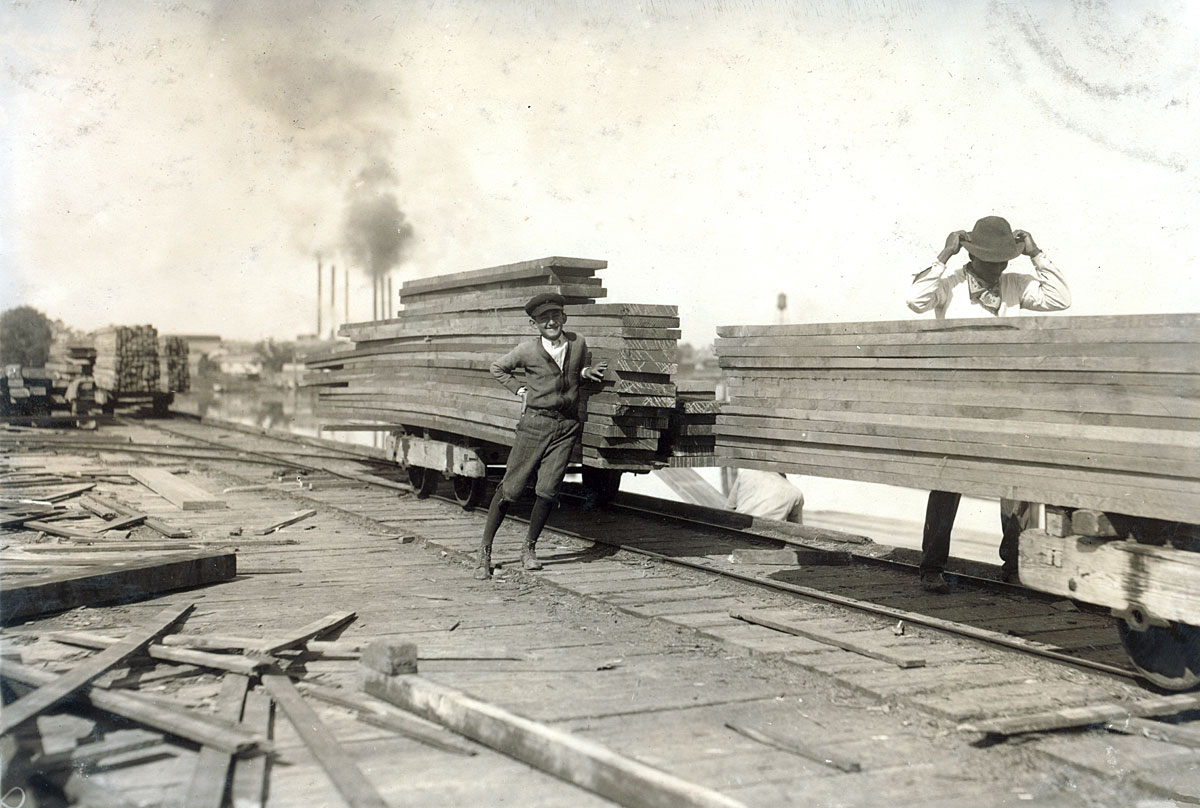
Talking with a lumber dealer, a short time ago, about dressed flooring, ceiling, etc., and the awful time he had to get his lumber planed right, set me to thinking of the time when as foreman of a planing mill in New York City I used to smile and look pleasant, when receiving some such message as this, delivered at the same time as the lumber, either by the truck driver or as an N. B. on the mill ticket:
“Please run this lot with very slow feed, as the customer is very particular;” or, “put on new, sharp knives so as to run this maple or oak very, very smooth, as any defects in planing will have to be thrown out;” or, “any piece of lumber in this lot that you think is not good or will not plane perfectly smooth, please lay out, and send word to the office so we can send others to replace them,” or, “if any piece is too thin to hold the thickness, lay it out,” and other requests of like nature. (more…)
Perhaps in no branch of our manufactures has England become more famous than in that of those prime necessaries of the workman—his tools. According to an old-fashioned saying—we were almost saying saw—”Tools are half the battle.” It might be said three-fourths.
And from the earliest days, when one in boyhood frequented workshops and watched with insatiable curiosity the carpenter turning off those beautiful silky-looking curls, the shavings, it used to be with pride that the men compared their planes, saws, and chisels—talked of their merits; how this or that was a capital bit of stuff; and almost invariably one saw stamped in on the blades of these tools the word “Moseley,” or “Moseley and Simpson.” (more…)
Making polissoirs (a wood polishing tool) from local materials during a woodworking class is always fun, though it isn’t always easy. Getting the broom corn for the core of the tool is usually a snap. Hose clamps we can usually scare up. But then we need wax and something to wrap everything up tightly.
This week at the Guild of Oregon Woodworkers we made Roubo-style try squares and then made a couple polissoirs to finish them.
I conned a student to drive me to a local grocery store where we found a whisk broom and an assortment of hose clamps. The store didn’t have beeswax, however, so we had to buy paraffin. And to wrap it all up I grabbed some black 3M duct tape.
After cinching the broom corn tight with the hose clamps I mummified the thing with the duct tape, which was shockingly shiny. And when paired with the silvery metallic hose clamps, it had sort of dominatrix look (not that I know what that really looks like, Lucy).
Then we had to melt the wax to charge the polissoir. But there wasn’t a working microwave (or so we thought). So we did what any self-respecting group of nutjobs would do. We tried to melt the wax in a Coke can we perched on a Subaru’s engine block.
The Subi’s engine was surprisingly efficient, however, and the wax remained solid after 20 minutes. Another student found a sort-of-working microwave, and so he started nuking the paraffin. In the meantime, a third student remembered he had a gas camping stove in his car and brought it into the shop.
We fired it up and within two minutes we had all the hot liquid wax we could desire.
Melted paraffin migrates readily into the broom corn of a polissoir, but it doesn’t create the same sort of tool as when you use beeswax. I need to do some more experiments and reading to explain myself. But the bottom line is that it worked fine. It was just a different experience.
As always, we gave away the polissoirs to the students after everyone polished up their squares. By the way, Oregon oak (Quercus garryana) takes very well to the burnishing from a polissoir.
When I got the privilege to measure an antique Japanese toolbox in 2013, I knew I had to build a reproduction. I just didn’t know it was going to take me two years to get around to making this simple but beguiling box.
The first problem was the hardware. I spent entirely too much time searching all over the world for manufactured dome-head nails to secure the toolbox’s finger joints. I came very close to finding the right nails in France and then again somewhere out in the desert. But there was always something fouling the works – the size of the head, the length of the shaft or the raw material (silver is probably a poor choice).
So I conned John Switzer at Black Bear Forge to make the nails and pulls. Note to self: Start with a blacksmith next time.
The wood was the next hurdle. Logically, I should build the toolbox using pine or cypress – a lightweight and strong wood that is easy to get. But I want the venti experience, so I started looking for Port Orford cedar. A fair amount of this stuff is exported to Japan for woodworking and building temples, so that would be a nice wood to use.
As I’m in the Pacific Northwest this week, I decided to spend a morning hunting up some Chamaecyparis lawsoniana in the Portland, Ore., area. After about 10 phone calls, I found a yard that had some. When I got there, I found they had three short boards. Three short boards that were split, warped and pecked with loose knots. I call this stuff: firewood.
Luckily, the yard had some gorgeous, dry-as-a-popcorn-fart vertical-grain Douglas fir. So I purchased an 16’-long clear stick of this wood as a backup plan. The antique toolbox I measured was quite possibly made from Douglas fir, according to the people who studied the box along with me.
The employees at the lumberyard were nice enough to cut the stock up into manageable chunks for my rental car so I could ship it back to Kentucky.
Mission accomplished. Or perhaps not. More on this story on Monday.
The novel firearm shown in the accompanying engraving consists of a short barrel attached to a base plate that slides upon two rods projecting from the handle. The barrel is pressed forward by spiral springs which surround the guide rods. The handle or stock is similar to a saw handle, and contains a lock or spring mechanism which throws the needle forward into the cartridge when the trigger is pulled.
The recoil which follows the discharge of the weapon is taken up by the spiral springs, thus relieving the hand from the shocks which generally follow the discharge of firearms.
This weapon would seem to be especially useful in fighting at close quarters, as in the case of a marine engagement. Its large caliber enables it to carry formidable and effective ammunition, while its length is such that it can be used when rifles and ordinary pistols are useless. Either shot or shells may be used.
This firearm was recently patented by Mr. Jarvis Royal, of Rochelle, Ill., from whom further information may be obtained.