Those of you who have read my peckings for a while know my deep interest in architecture. And if you’ve read any of George Walker and Jim Tolpin’s books on design, you know that (most) furniture design springs from architecture.
How can architecture help you in the workshop? That is what my latest column at Core77 is about. Walking around an old neighborhood with your eyes open can help you get a feel for design – good, bad, right and wrong. In many ways, a neighborhood walk can teach you more than a visit to a museum, where the furniture is mostly high-style and well-preserved.
I get pretty passionate about this stuff and am half-tempted to take my furniture students out on an evening walk through Covington’s many historical neighborhoods. But that would be weird, I think.
The column, “Your Design Homework is on the Sidewalk,” can be read here and is completely free.
Megan Fitzpatrick has finished up her edit of the expanded edition of “The Anarchist’s Design Book” and is now sitting 6’ away making her corrections to the book’s layout files.
Briony is working on the new images, and I have a few photos to take.
In the meantime, I’m pondering a new logo design for the cover of the book. I do like the marriage mark on the original version, and there’s a fair chance we’ll keep it for the expanded edition.
But I’m a tinkerer, especially with the books I’ve written. So I have tried out about five different new logos, including the rough sample you see above.
What is it? Like the marriage mark, it’s a cabinetmaking mark shown in A.J. Roubo’s “l’Art du menuisier.” Shown on Plate 5, our translation notes that the mark is used to designate where a crosscut should occur on a board. The common version of this mark doesn’t have the circle. The circle is added when there are several competing marks on the board. The circle indicates “this is definitely the place to cut.”
Also, I like that there are several letter “As” hidden in its structure.
The downsides? Megan says it looks like the symbol from “The Blair Witch Project” (the twanas). It also somewhat resembles a famous drawing in Kurt Vonnegut’s “Breakfast of Champions” that is about a rude part of the human body. You can read about it here.
So maybe we’ll stick with the marriage mark instead of a demonic sphincter (though some have likened my prose to just such an object…).
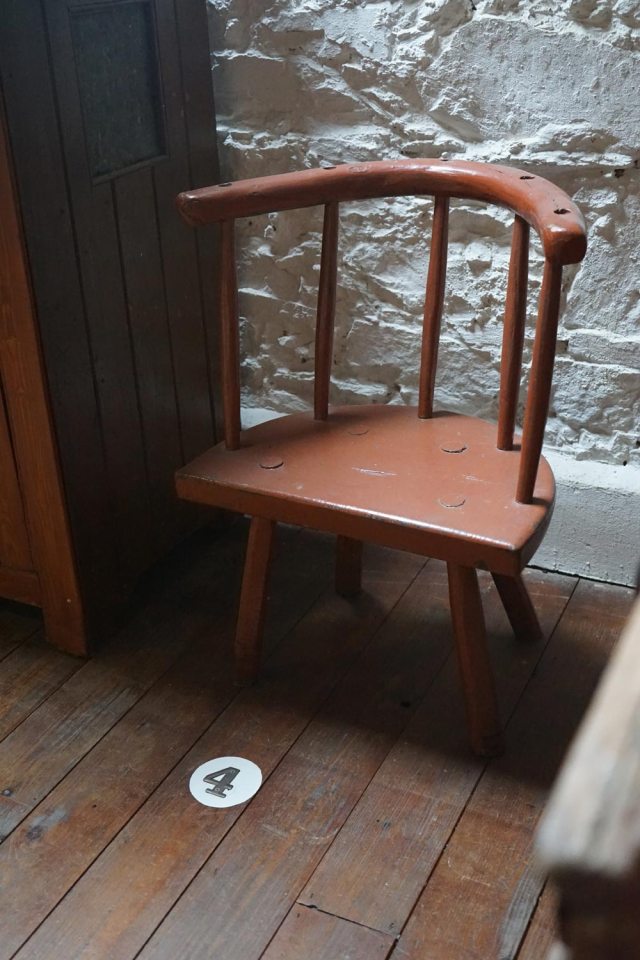
The Lost Art Press storefront will be open – as per usual – on Oct. 12, and the topic of the day’s free lecture will be a (hopefully inspirational) look at my favorite stick chairs – and not just Welsh ones.
For the last 16 years I’ve collected photos from auctions and old books that guided my understanding of staked chairs and assisted me in designing my own versions. This presentation will tour the highlights of my image collection and will be an open forum for you to ask questions about the designs as well.
(Before you ask, I cannot post this presentation on the internet. Many of these images are copyrighted; publishing them would violate those copyrights. So if you want to see the pretty pictures, you’ll have to visit.)
The presentation will begin at 2 p.m. and will last about an hour.
We open our storefront to the public on the second Saturday of every month, and it runs from 10 a.m. to 5 p.m. Yes, we will sell you a book or a tool during that time, but most of our energy on those days is devoted to answering woodworking questions, demonstrating techniques and drinking coffee. You are welcome (even encouraged) to bring your family, your dog or any bit of woodworking you are struggling with.
Our neighborhood is also an outstanding place to eat brunch on that day. We recommend Otto’s, Commonwealth, Coppin’s and Libby’s (to name a few). We also recommend you stop by the Covington Farmer’s Market (9 a.m. to noon) at the approach to the Roebling Bridge. Great baked goods, salsa and produce.
In our competitive society, the winners get to name the things. This is true with battles, large social movements and even furniture styles.
I think there is value in trying to think of these issues from the perspective of others – the losers, if you will. When growing up in Arkansas, some teachers taught us about the Civil War. Others taught us about the War of Northern Aggression.
If you think divergent taxonomy couldn’t apply to furniture, I disagree. About 15 years ago I worked with a guy who studied Kentucky Style furniture. When I suggested that the pieces looked like Western Shaker furniture with some simple inlay, he became testy.
“The Shakers,” he said, “were a weird religious cult and shouldn’t be remembered or celebrated. It’s cult furniture.”
Ouch. But it made me think.
So while on a walk this morning I devised alternative names for popular historical furniture styles. I know that some sensitive readers will think this list is political. It’s not. Trying to see things from another person’s perspective is an intellectually honest way of examining your own beliefs.
See if you can recognize your favorite furniture style in this list:
Colonizer Furniture
Fundamentalist Furniture
Mall Stall Furniture
Zealot Furniture
Farmer Furniture
Industrialist furniture
Hopeless Idealist Furniture
Slave Owner Furniture
Poverty Furniture
Royal Excess Furniture
Marketing Department Furniture
Historical Revisionist Furniture
War Furniture
Table Saw Furniture
Patronage Furniture
Desperation Furniture
Social Climber Furniture
Price Point Furniture
These are probably not good book titles. (Though I’d buy the books. Peter Follansbee said this about my library: “It looks like you buy any book with the word ‘furniture’ in the title.”)
During my 23 years of working in group shops, I’ve seen a lot of oddball behavior. Most of it is run-of-the-mill laziness – never emptying the dust collector, putting your rotting food waste in the bench room garbage cans and never ever returning the router wrenches to their designated nail. (Honest, I once found the wrenches on the back of the toilet.)
The weirdest thing I’ve observed, however, is straight-up duplicity when it comes to tools.
Ever since I could afford good tools, I’ve bought them. And I make no apologies for spending more than $6.37 on a block plane. When you own nice tools and work in a group shop, however, people give you crap. They’ll sing the praises of the plastic-handled Greenlee chisels they bought in a dollar bin at a meat market in Tijuana. Or the paring chisel they made out of a bumper of a Ford F-150. Or the prybar made from the springs of the aforementioned F-150. Or the tack rags they cooked up themselves.
These are all true examples.
What I’m here to say is that most of these guys are blowing hot air. When they needed a bevel gauge that held its setting, they were the first to snitch my Vesper bevel from my tool chest.
And so today, as I was hanging up a new (actually very old) Plumb 16 oz. hammer for shop use, I thought about the most-borrowed tools in my chest. These are the tools that the cheapskates borrow constantly.
I can’t think of a higher endorsement.
My Chris Vesper sliding bevels and squares. People rail against the prices but they greedily swipe all of my Vesper stuff. I am constantly returning his tools to my chest (and I’m now thinking about a lock).
My Starrett 6” and 12” combination squares. Sorry that your plastic home center combo square sucks a trailer hitch.
My Lie-Nielsen smoothing plane. Wait, I thought you said that all handplanes could be tuned to an equally high level?
My Tite-Mark gauges. I guess you wanted a clean baseline for those dovetails.
My 16 oz. hammer. You might as well borrow my underwear, you savage.
My Lie-Nielsen dovetail saw. Is your Dozuki’s blade still bent?
Sterling Toolworks Dovetail Marker. I thought you marked your dovetails by eye….
Blue Spruce 16 oz. round mallet. Ah right, round-head mallets are for carvers.
Veritas Shooting Plane. I thought it was too expensive and just a toy?
My card scraper. Again with the underwear!
I could go on, but you get the point. Good tools cost money. And they are apparently worth the ridicule when you borrow them.