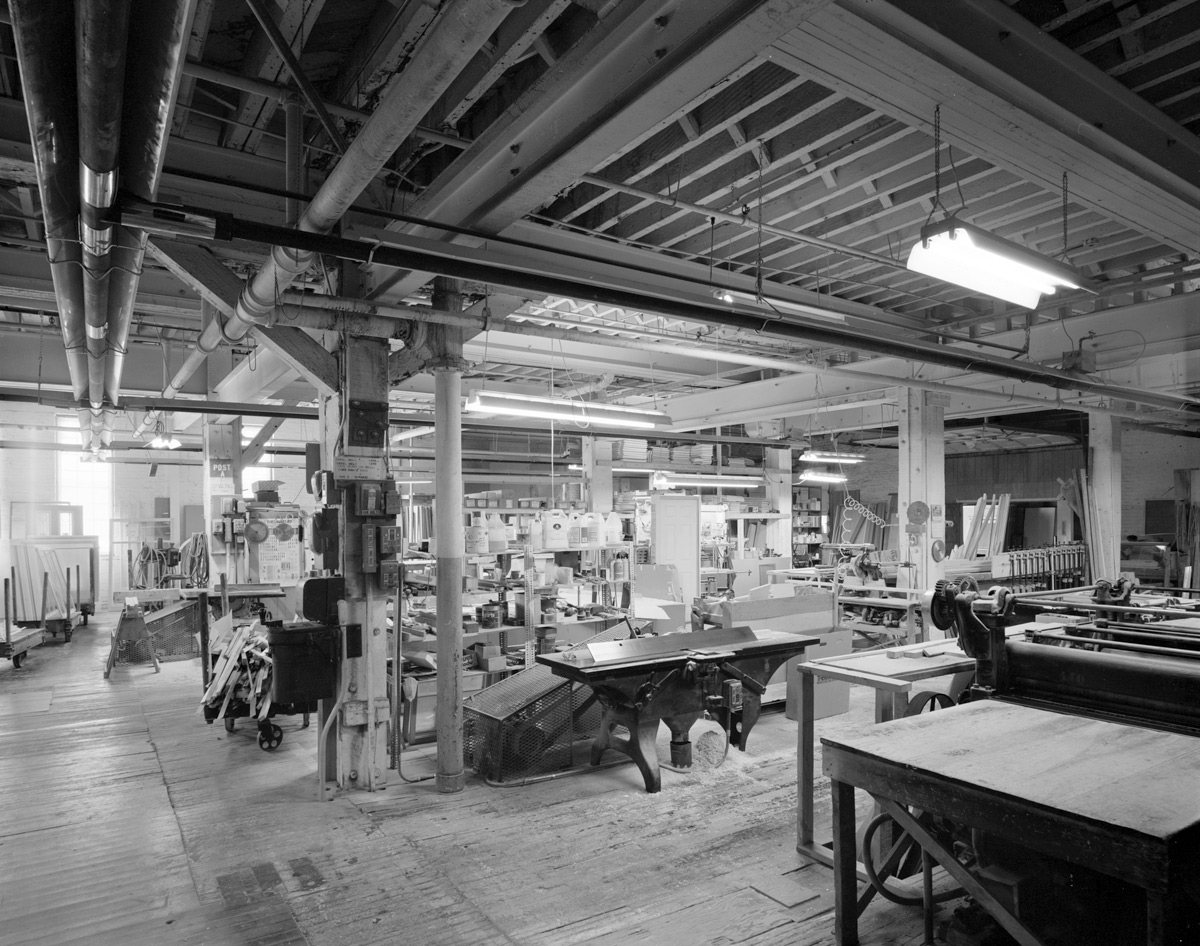
The recent flood in Deggendorf, Germany, was rough on the woodworking workshop of Dictum GmbH. Though the employees got the machinery out, the flood buckled the floors and split the workbenches.
To my relief, the book survived fairly well. Only one or two pages came loose. Thanks go out to Phil Nanzetta at Signature Book Printing for making sure our books are well-bound.
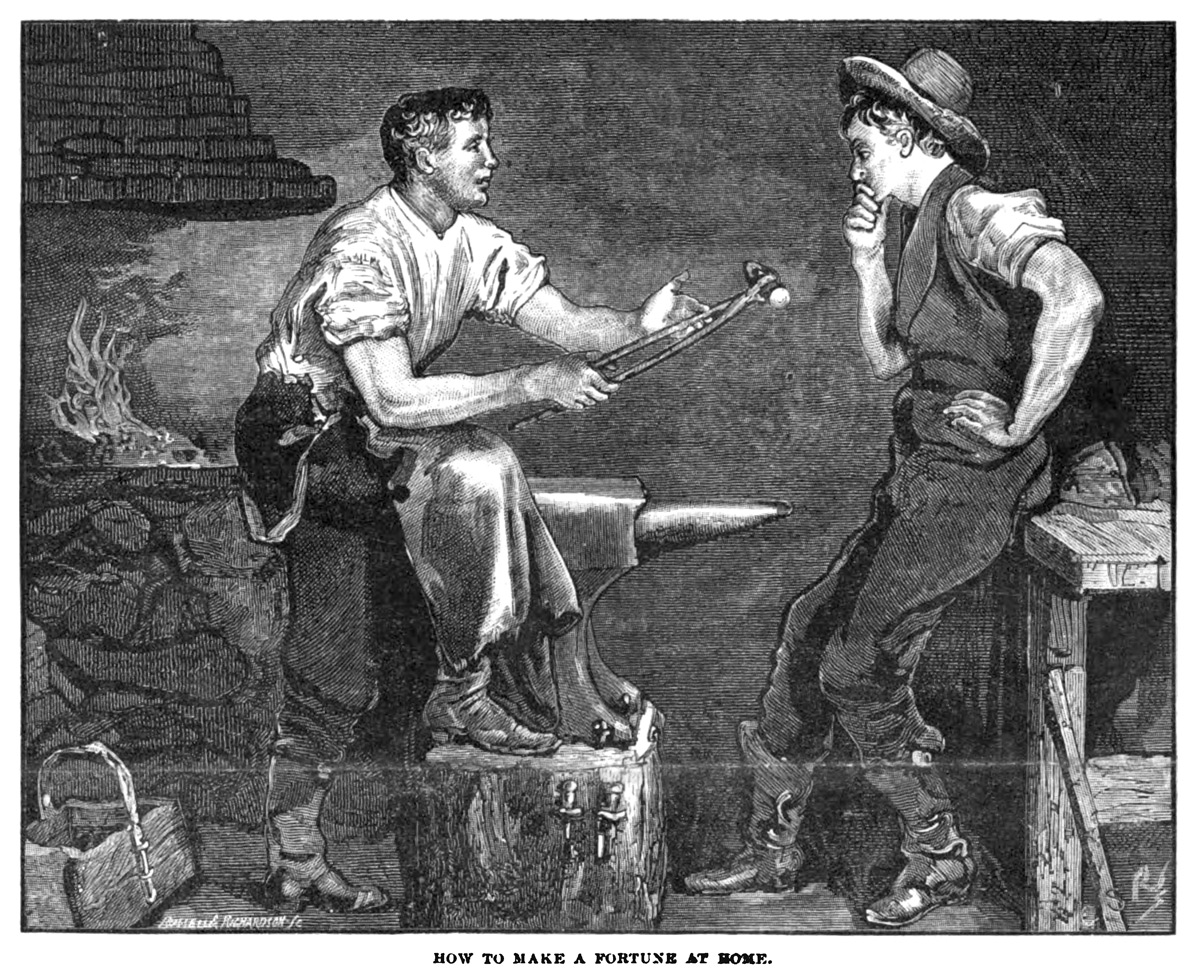
When a young man begins to think of making his fortune, his first notion usually is to go away from home to some very distant place. At present, the favorite spot is Colorado; awhile ago it was California; and old men remember when Buffalo was about as far west as the most enterprising person thought of venturing.
It is not always a foolish thing to go out into the world far beyond the parent nest, as the young birds do in midsummer. But I can tell you, boys, from actual inquiry, that a great number of the most important and famous business men of the United States struck down roots where they were first planted, and where no one supposed there was room or chance for any large thing to grow.
I will tell you a story of one of these men, as I heard it from his own lips some time ago, in a beautiful village where I lectured. He was an old man then; and a curious thing about him was that, although he was too deaf to hear one word of a public address, even of the loudest speaker, he not only attended church every Sunday, but was rarely absent when a lecture was delivered.
While I was performing on that occasion, I saw him sitting just in front of the platform, sleeping the sleep of the just till the last word was uttered. Upon being introduced to this old gentleman in his office, and learning that his business was to make hammers, I was at a loss for a subject of conversation, as it never occurred to me that there was anything to be said about hammers.
I have generally possessed a hammer, and frequently inflicted damage on my fingers therewith, but I had supposed that a hammer was simply a hammer, and that hammers were very much alike. At last I said,—
“And here you make hammers for mankind, Mr. Maydole?”
You may have noticed the name of David Maydole upon hammers. He is the man.
“Yes,” said he, “I have made hammers here for twenty-eight years.”
“Well, then,” said I, shouting in his best ear, ” by this time you ought to be able to make a pretty good hammer.”
“No, I can’t,” was his reply. “I can’t make a pretty good hammer. I make the best hammer that’s made.” That was strong language. I thought, at first, he meant it as a joke; but I soon found it was no joke at all. (more…)
Today I wanted to move to Germany. Buy some lederhosen. Raise some sheep.
Because of an unfortunate flood in eastern Bavaria, Dictum GmbH had to move my Roorkhee chair class to Munich. But the Munich workshop didn’t have enough lathes for the 10 students. So we had to move today’s class to Dictum’s shop in Singerhof, which is located two hours northeast of Munich.
And boy was it worth the drive. The Singerhof shop is located in an old farm (the students guess it dated from the 1700s). The farm was large enough that it had its own chapel. And all the buildings surrounded a common courtyard.
Dictum’s shop on the grounds is in a stone room with vaulted ceilings and stone columns. And for the first time during all my visits to Europe, I wanted to move here.
I told Petra Steinberger, the director of Dictum, that I wanted to purchase the farm.
She shook her head.
“After me,” she said.
It was a great day of turning – introducing many students to the lathe for the first time. Tomorrow we return to Munich to start making the leather for the seats.
If, of course, the rivets we ordered actually arrive.
It does not follow that because most wood-work used about a building may be obtained at the mill, machine made, that the carpenter should not equip himself with the knowledge necessary to make by hand every piece of wood-work required to complete a building. There is a sameness about millwork that always impresses itself unfavorably on the artistic sense, and this quality is so well understood in high quarters, that many very rich men will not permit finished machine made work to be introduced in their residence.
While it may be true that machine made work is, in many cases, superior to hand-made work, yet it is characterless and inartistic, as it is the machine, not the workman, that leaves its impression on the finished product, and each piece is a facsimile of each other piece. For utilitarian purposes machine made work occupies a high rank, as it is generally well made, solidly put together, and costs much less than hand-made work, qualities that recommend it for general use.
By hand-made work I do not mean work that is sawn from the rough by hand, or manipulated at every stage by brute force with saw and plane. The circular saw, the planer, the mortiser and tenoner may and should be employed in preparing material for hand work, thus relieving the workman of the present from the drudgery that his forefathers were forced to undergo. (more…)
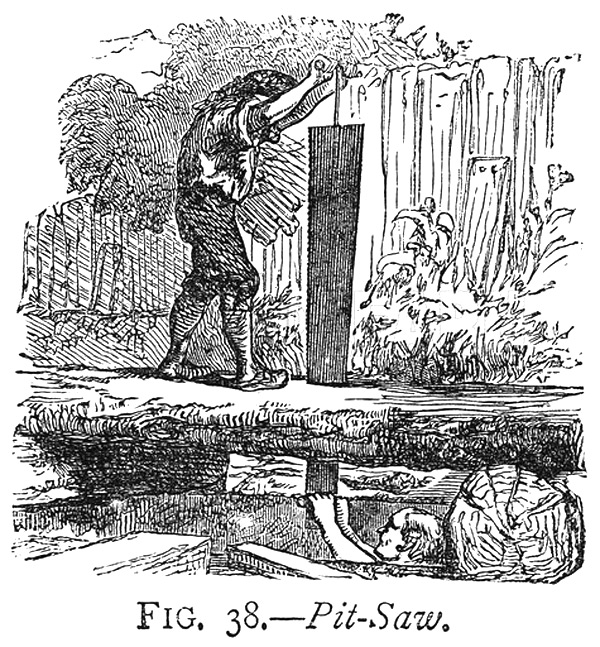
My father-in-law was by trade a sawyer, and a good workman; in fact, Thomas Leaf had the reputation of being the best veneer-sawyer in that part of the country. I, being destitute of employment, and no prospect of obtaining any, except by leaving England, which I was unwilling to do, Mr. Leaf undertook to teach me the art of mahogany and veneer sawing.
From the commencement of that business I gave promise of success, and it was not the least consoling to know, that at length I had found a trade wherein I could become respectable, and at least, something more than mediocre. It was soon my father’s boast, that with his “ big lad”—for I was too boy-like to pass for a man—with his lad “he could turn more veneers out of an inch plank than any other pair of craftsmen in the town.”
Thomas was an original in his way ; he had superior qualities as a workman, and seldom forgot to talk about them. He was generally upon good terms with himself; he had an unflinching independence of action, and a deep sense of honour and integrity regulated all his dealings. In a pecuniary point of view, my new trade was not so remunerative as it had been before the invention of the circular saw. (more…)