Oct. 27, 1968: A few stars are showing. A light breeze coming up and 26°.
A day for small chores. I mixed up a batch of wood glue very thin and painted the runners on my sled. Tomorrow it will be ready to kick out the door. If I only had a pet caribou to pull it. Snow picking up – big flakes and lots of them.
“Dick’s lightweight sled is held together with 48 mortise-and-tenon joints, a few nails and his thin copper-coated electric fence wire. He put the sled to heavy use each winter, to haul firewood and occasionally meat from wildlife he found.”
This is an excerpt from “The Handcrafted Life of Dick Proenneke” by Monroe Robinson, which we are happily and fully immersed in right now. The italic portion is from Dick’s journals. The quoted portion is commentary from Monroe. — Kara Gebhart Uhl
Monroe Robinson’s trussed log bridge. Photo taken by Dick Proenneke in 1981.
Editor’s note: In January we announced a new book about Dick Proenneke. Here, author Monroe Robinson shares how building furniture with his father, counting sockeye salmon in Alaska and a bridge led he and his wife to be caretakers of Dick Proenneke’s cabin. There is no one more qualified to write this particular book, given the years Monroe has spent in the restoration of Dick Proenneke’s cabin and the replication of his tools, and we are thrilled to include Monroe in our roster of authors. — Kara Gebhart Uhl
Spending 19 summers volunteering at Dick Proenneke’s cabin and then writing “The Handcrafted Life of Dick Proenneke” has its unlikely origin in the southern Arizona of my childhood. In this desert landscape I learned about wood as I helped my father construct a dozen pieces of our household furniture from aromatic cedar, but what I remember from those times was fear of criticism. This fear drove me to work hard and always to the best of my ability. The desert also provided the awe I felt and still feel from every wild creature I encountered traveling the desert by foot. I used leftover cedar boards to stretch more than a few rattlesnake skins to make wall plaques to sell to tourists. Today, protecting wild creatures and wild lands is deeply woven into my life and everything I make. It is not surprising I became someone inspired by the life of Dick Proenneke.
The dream of watching tens of thousands of caribou drew me north in 1965 at the age of 19. By chance that first summer working for the Alaska Department of Fish and Game, I helped count 24 million sockeye salmon returning to spawn in the headwater of the Kvichak River watershed borders Twin Lakes where Dick Proenneke would build his cabin three years later. This is a wild and magical corner of Alaska and, just like with Proenneke, it has held a part of my soul since that first summer.
In 1979, my first log construction was a trussed log bridge only 30 miles from Proenneke’s cabin. The many years of striving to do my best work had transformed from the fear of my childhood to the reward of constructing this bridge where no space between logs would accept a credit card. I had to plan this project well for I was working more than a 100 miles from the nearest store and there would be no provisions beyond what I initially flew in. (See Fine Woodworking magazine issue No. 33.)
In 1981, Dick Proenneke hiked the 30 miles to the homestead where I had constructed the bridge and said to the owner the bridge was the most beautiful log work he had seen. This was how I first heard of Dick Proenneke and the life he was living at Twin Lakes. IN 1982, I hiked 65 miles through the wilderness to meet Dick Proenneke. We corresponded until Dick departed Twin Lakes in 2000 when the the National Park Service (NPS) invited me to consult on what should happen to Dick’s cabin. Arriving at Twin Lakes, I met K. Schubeck who later became my wife. The two of us have been caring for Dick’s cabin as volunteers and meeting visitors every summer since. I have been involved in all the restoration of Dick’s cabin and replicated most of his handcraft as his restored originals were flown to the NPS archives. At Twin Lakes doing my very best work is expressed in replicating the detail of Dick’s handcraft. I want future visitors to imagine Dick’s hands polishing the patina on the replicated objects.
Replica of Dick Proenneke’s 4″ bean can chimney cap that Monroe Robinson made from two bean cans and a 9″ circle of 5-gallon gas-can metal.
Dick Proenneke’s handcrafted crimping tool.
Many visitors to Twin Lakes every summer have memorized sections of Dick’s published journal entries. Many have an insatiable appetite for Dick’s handcraft and have contributed to my understanding of Dick’s work. It is now a responsibility to share my knowledge of Dick Proenneke’s handcrafted life, his tools, his handcrafted items and how he used and repaired those objects. The book is a glimpse into a life lived with purpose, a life Dick shared with the hundreds who received his detailed and outward-looking correspondences.
Dick Proenneke’s cabin door hinge showing how accurately they were sawn and fit.
Dick Proenneke’s cabin can be a very busy place sometimes, making it difficult to provide a complete tour to every visitor even with two of us being present. People arrive by float plane as early as 8 a.m. and as late as 10 p.m. seven days a week.
Occasionally three, four or even five floatplanes will be there at the same time. It is sometimes exhausting but always a privilege. The future is moving away from our volunteer service toward using uniformed seasonal rangers as tour guides with the maintenance and care done by NPS staff flown in. A portion of the money from the sale of “The Handcrafted Life of Dick Proenneke” will be donated to an endowment account K. and I helped set up. This account will assist the National Park Service’s care for Dick’s cabin and help maintain the wilderness character of Twin Lakes.
Dick Proenneke looking down Glacier Canyon toward Twin Lakes. Developed May 1984. Photo courtesy of the U.S. National Park Service
We are pleased to announce that we’re working on a new book about Dick Proenneke who lived alone in the wild Alaskan wilderness for 31 years. You may know Proenneke as the subject of four PBS documentaries that have fascinated many, including “Alone in the Wilderness” and “Alone in the Wilderness Part II” (all Bob Swerer Productions).
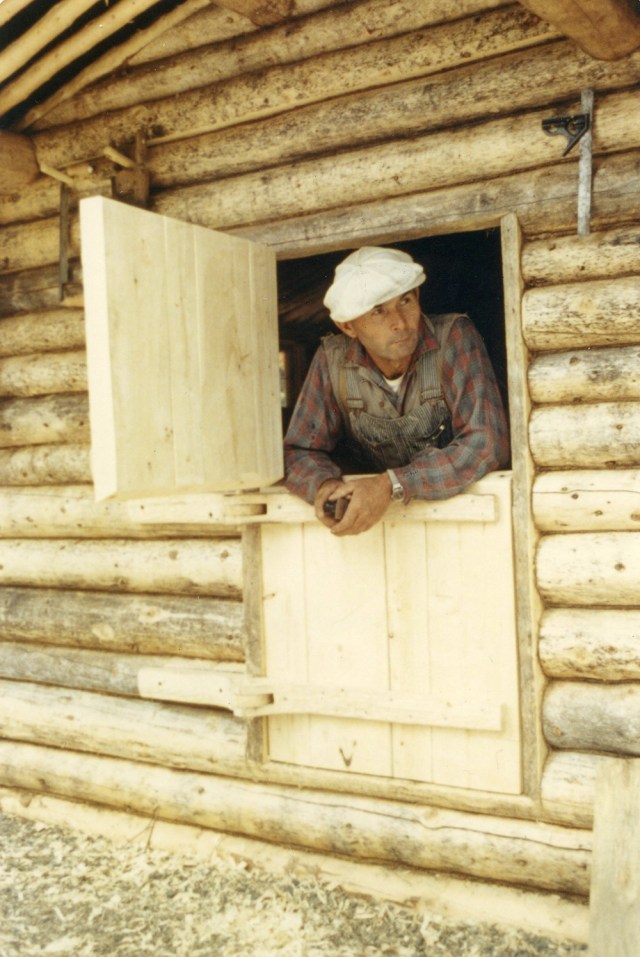
Dick Proenneke looking out the double Dutch door of his cabin. Photo courtesy of the U.S. National Park Service
Monroe Robinson and K. Schubeck, caretakers of Dick Proenneke’s cabin. Photo byRee Slocum
Author Monroe Robinson, a woodworker and log restoration specialist who, along with his wife, K. Schubeck, has been involved with all the work of maintaining Proenneke’s cabin for the past 19 years, is currently sorting through hundreds of photographs and building some replicas of Proenneke’s hand tools for illustration.
The lifestyle of Proenneke reminds me of Henry David Thoreau on steroids. The lulling-yet-captivating films remind me of a mash-up of Bob Ross, “Planet Earth” and “Primitive Technology”. And the deep exploration of Proenneke’s handcrafted life reminds me of Joshua Klein’s “Hands Employed Aright”.
To say we’re thrilled about this project is an understatement.
Dick Proenneke. Date unknown. Photo courtesy of the U.S. National Park Service
May 21, 1968, Proenneke traveled to Twin Lakes, Alaska, at the age of 52. He had spent the year prior scouting a site for a cabin and cutting logs in preparation to build a cabin the following year. And he did build his cabin, by himself, using only hand tools. He also built all his own furniture, a cache to store his food and many of the hand tools he used.
Proenneke ended up living in his 11- x 15-foot cabin, alone (although, perhaps, alone is not the right word as he found great company in nature), for 31 years, only occasionally leaving to visit family. He kept detailed journals and documented his life on film while maintaining his cabin, hiking up to 35 miles in a single day and working closely with the U.S. National Park Service.
Chelsea, Monroe Robinson (who was working on the cabin) and Dick Proenneke, during Dick’s last visit to Twin Lakes in 2000. “After looking at the copper end caps I’d installed to protect the exposed roof logs, he looked back to me with an approving nod,” Monroe says. Photo by K. Schubeck
Proenneke left Twin Lakes in 1999 at the age of 82. He died in 2003. He donated his cabin to the U.S. National Park Service, and it’s now part of Lake Clark National Park.
Monroe Robinson replicating Dick Proenneke’s sled. Photo by K. Schubeck
While a handful of books have been written about Proenneke and his life, none focus solely on his use of hand tools and only materials found in the wilderness. Monroe has taken an in-depth look at how Proenneke used the things he made and sought to repair instead of replace.
“Dick lived a full and challenging life while limiting his consumption of today’s material possessions,” Robinson says. “It is an invitation, an inspiration, to feel the joyous wonder of making what one needs with simple tools and materials around you.”