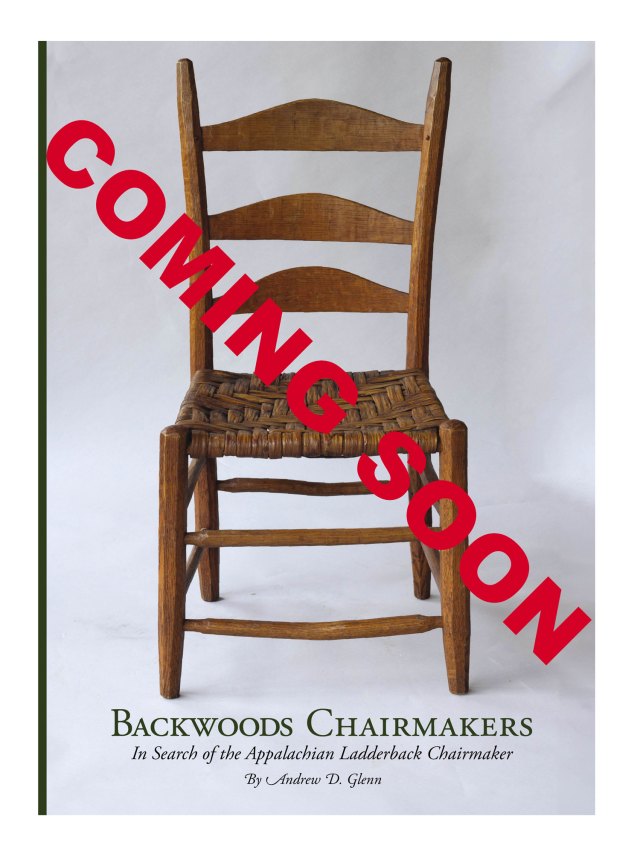
We just received our first printing of “Backwoods Chairmakers” by Andrew D. Glenn. If you placed a pre-publication order, Gabe and Mark are packing up your book now. If you would like to purchase a copy, you can visit our online store.
(If you aren’t sure if you ordered the book, log into your account in our store to see what you have ordered recently.)
Today, Megan and I made this short video tour of the book and discussed what we like about this title. Check it out below if you like.
Andy Glenn’s long-awaited book, “Backwoods Chairmakers,” is just about complete at the press in Tennessee. We should get the books sometime between Thursday and Jan. 4 (barring weather or other delays).
If you order the book before midnight on Sunday, Dec. 31, you will receive free shipping plus a free pdf of the book immediately at checkout. After Dec. 31, the pdf will cost an additional $11.75. And shipping will add another $7.50 or so to the cost.
“Backwoods Chairmakers” is the kind of book I love to publish. It is filled with colorful stories of chairmakers who live in the hollers and small towns of Appalachia. And it is also packed with practical information you can use at the bench, on your front porch or wherever you build chairs.
The book is illustrated with hundreds of new and archival photos that Andy collected during his years-long research process. Just looking at the book’s photos is a visual treat.
“Backwoods Chairmakers” will, I hope, begin to give Appalachian ladderback chairmakers the credit they deserve for this enduring and interesting form.
As always, we have done our best to make a permanent, quality book. The book’s 304 pages are 8.5″ x 11″, and the text is printed on #70 matte coated paper. The book’s signatures are sewn with cotton-covered nylon thread, which allows the book to open flat and retain its pages through years of use. All that is wrapped in heavy cotton-covered boards and a tear-resistant dust jacket. The book is, of course, made in the USA – like all our books.
One of the many benefits of bringing our order-fulfillment operations back to Kentucky is that we can again offer pre-publication orders of our books, with a free pdf and free shipping.
So I am happy to tell you that we are now taking pre-publication orders for Andy Glenn’s first book, “Backwoods Chairmakers.” You can place your order here. The book is $47. When you do, here’s what happens:
You will receive a free pdf of the book at checkout.
Your order will ship – for free – as soon as the book arrives in Covington.
The book is currently at the printer in Tennessee, and it is scheduled to ship the last week of December. Because of weather and the holidays, that might slip to the first week of January 2024.
Why should you buy this book?
When working with Andy on this book, we had a lot of late-night conversations. This book is a massive work. Andy said to me: “If I ever do another book, you have to stop me from going to extremes. Like trying to do everything. I’m like that. I just can’t help it.”
“Andy,” I replied, “that fact that you go to extremes is why this book is so damn good.”
Andy traveled all through Appalachia for this book, putting thousands of miles on his car and talking to people far and wide to do one thing. It’s this: Give the Appalachian chairmaker their due.
For centuries, people in this region have been making chairs for their communities and for sale to others, and the skills have been handed down through generations. Thanks to the modern world, their numbers have dwindled. Andy went and found them. He documented their work and their lives.
And – this is important – he approached the work as a woodworker as much as an ethnographer.
I love the “Foxfire” series of books. I have the complete series on my shelf. But they weren’t written for practitioners. “Backwoods Chairmakers” is a must for anyone who makes chairs or is interested in the culture and spirit of Appalachia.
Andy took thousands of photos and collected archival photos from all over the region. He talked to everyone who would let him in the door. He wrote their stories with an open heart – empty of the bias that often permeates the writing about the region.
And he shows you how these Appalachian chairmakers influenced his own work at the bench. The final two chapters detail how Andy builds a settin’ chair and a grand rocker.
Like all our books, “Backwoods Chairmakers” is made in the USA to the highest quality standards. The signatures are printed on #70 matte coated paper, sewn together with thread and bound with glue and fiber tape. All that is casebound between cloth-covered boards. And wrapped with a tear-resistant dust jacket. This is a permanent book.
The working cover for Andy Glenn’s book – If all goes well this week, it will go to press by Friday. The chair shown here is by Terry Ratliff, of Floyd County, Kentucky.
The copy editing changes are done, the interior design is locked down and we’re almost done with the dust jacket (the front of its current incarnation is shown above). We have a few last questions to sort, then “Backwoods Chairmakers: In Search of the Appalachian Ladderback Chairmaker,” by Andrew D. Glenn, will be off to press (click on the title to sign up to be notified when the book is available).
Below is an introduction by Andy to some of the makers of Appalachian ladderbacks covered in the book, and a look at their work. (To read Andy’s previous posts on the book, click here.)
– Fitz
While working on “Backwoods Chairmakers” for the past four years, the questions I’ve most frequently been asked are: “What is an Appalachian ladderback chair?” and “Are the makers passing it along?”
What is it? An Appalachian ladderback often has posts that bend backward above the seat, with a woven seat (hickory bark is common) and minimal ornamentation. That’s a common definition, but it fails to recognize the variation and creativity within the tradition, as you’ll see from the chairs presented here.
Is it being passed on? That question requires a more nuanced response. The chairmakers are sharing their knowledge, both with family and with those interested. A major challenge is the market for handmade chairs. I visited chairmakers who shared that chairmaking pointed towards a better life for earlier generations of their family. That’s not always the case today, with health insurance, a living wage and retirement to consider.
Every chairmaker’s situation is unique (as are their chairs). Each of them entered chairmaking, or continued in the family tradition, for their own reasons. I share some of those stories in “BackwoodsChairmakers.” And that’s all a maker can do – share their knowledge. It’s out of their hands at that point. The next generation must find the way to carry things forward.
What follows is a sample of Appalachian chairmakers and opportunities to connect with them or their work. Some are more public and accessible than others.
Brian Boggs, “Berea Chair.” Chair characteristics: Cherry. Bent back posts, and Brian’s chairs utilize rake and splay. The lower rungs pushed up towards the seat on this chair. Hickory bark seat. Louis Cahill Photography
Brian Boggs. Brian makes high-end chairs and custom furniture in Asheville, North Carolina. He started his chairmaking career with the Jennie Alexander chair and a small set of hand tools. The Berea Chair, shown here, is a beautiful, contemporary design. While Brian no longer makes or teaches this chair, Jeff Lefkowitz and David Douyard both run classes on this form, as do Eric Cannizzaro and Mark Hicks. \You can find Brian’s work at www.brianboggschairmakers.com and he shares tips and techniques at boggsbench.com.
Cannon County, Tennessee, rocking chair. Chair characteristics: Maple. Turned posts. Dry hickory dowel rungs. Pinned slats for the seat.
The chairs of Cannon County, Tennessee. These are cottage-industry chairs, with each chairmaker working from home in a mechanized, production-oriented shop. There are a handful of chairs on display at The Arts Center of Cannon County. One chairmaker in Cannon County has a website, Ronnie Smith of Mountain Chairs.
James Cooper rocking chair. Chair characteristics: Oak. Split and shaved. Straight back posts. Hickory seat.
James Cooper. James, who left chairmaking in the 1990s and is now an artist, says he “will be the fifth generation to be put in the family plot,” which is on a Jackson County, Kentucky, ridge a short distance from his homestead.
Tom Donahey rockers, displayed at a doll show. Chair Characteristics: Bent posts. Rocker blades. Paper cord seats.
Tom Donahey. Tom shares his experience with those around Brasstown, North Carolina. His YouTube channel, Chairman Tom, is his way of reaching others with shavehorse and chairmaking knowledge.
Michael Houston working on a rocking chair, from some years back. Michael’s current chairs often use exotic woods or include metalwork, and he developed a more ergonomic design for the hickory seats.
Michael Houston. Michael says he “caught the tail end of old-time culture in eastern Kentucky.” He’s lived in Colorado since 1994, and carries parts of that eastern Kentucky mountain culture with him today. You can see more of his work at Michael Houston Custom Furniture.
Chester Cornett three-slat side chair. Chair characteristics: Chester’s chair parts are octagonal and he used woven hickory seats. He also added delicately carved pegs to his fancier chairs. The example shown has tapered posts. He found the narrow foot would damage linoleum floors, so later examples have a reverse flare at the bottom, making a larger pad that didn’t poke holes in flooring.
Chester Cornett (1913-1981). Chester was an eastern Kentucky chairmaker who lived in Cincinnati during the last 10 years of his life. He made beautiful traditional chairs before making eye-catching rockers. A few of his chairs are available to view at the Kentucky Folk Art Center in Morehead, Kentucky.
Mark Newberry, sitting in a rocker he made, alongside rocking chairs made by his father and grandfather.
Newberry & Sons‘ Chairs. The Newberrys, of Red Boiling Springs, Tennessee, turn their chairs at the lathe and harvest hickory bark. I believe they are the largest commercial provider of hickory bark; they sell it directly to chairmakers (you can find ordering information on the website).
Mason Alexander rocking chair. Chair characteristics: Often with straight backs and straight slats. Joints are pinned. Hickory seat. All material collected from the Alexander family homestead.
Mason Alexander. Mason has no website or phone number. Those interested in his chairs must travel his Rockcastle County, Kentucky, lane to place an order. Over the years, Mason has helped a number of interested chairmakers, but he said no one stuck with it (perhaps his grandson, Dylan, who helps Mason with the chairs and has made chairs himself, will be the exception).
Randy Ogle side chair. Chair characteristics: Turned posts and rungs. Shown here in walnut with a seagrass seat. Randy will weave seats from corn shucks on request.
Randy Ogle. Randy, of Gatlinburg, Tennessee, is the third generation in his family of chairmakers and furniture makers. He has a shop and showroom on the Craft Loop Road. I recommend visiting when you’re in the vicinity. If you can’t visit in person, visit his website.
Dick Poyner side chair. Chair characteristics: Turned, often with delicate painting on the upper posts and slats. Woven split oak seat. From the collection at Yale University.
Dick Poynor (1802-1882). Dick was a prolific chairmaker, and formerly enslaved person, in Williamson County, Tennessee. He worked with a horse-powered lathe to turn his chair parts. examples of his chairs are in the collections at the Museum of Early Southern Decorative Arts (MESDA) and Yale University. Robell Awake and Charlie Ryland are preparing a show about their research on the work of Dick Poynor for the Center of Craft in Asheville, North Carolina. They are also teaching a Poynor-style chair at Pine Croft in Berea in spring 2024.
Tom Lynch with some of his work. Tom made two styles: a rustic stick chair and a Shaker-style ladderback, with slightly larger turnings and posts that tapered gently larger at the floor. Tom collected and processed the hickory bark for his chair seats.
Tom Lynch. Tom is a retired chairmaker in Rock Cave, West Virginia. Throughout his long career, he taught and wrote articles for woodworking magazines in addition to making chairs. His formal chairs are turned, often in cherry, with an acorn as a finial – a decorative touch that led to his business name, Lucky Acorn Chairs.
Terry Ratliff side chair. Chair characteristics: Split and shaved, with hickory bark. Octagonal parts. Terry’s signature is the wavy rung (a continuous grain piece of wood taken from material near a knot). (See the top of this post as well.)
Terry Ratliff. Terry, an eastern Kentucky chairmaker, utilizes the natural movement in the wood, such as crooks and bends, to produce the unique look of his work. He has been a guest speaker/instructor at GreenWood Wrights’Fest for the past few years, and also teaches at craft schools and at local festivals.
Lyle Wheeler side chair. Chair characteristics: Split and shaved parts, often from red oak, with a woven seat. Lyle’s chairs frequently have a finial atop a straight back post.
Lyle Wheeler. Lyle, of Millers Creek, North Carolina, shows his chairs at a number of craft shows and sheep and wool festivals. He has also taught at the John C. Campbell craft school.
Sherman Wooton rocking chair. Chair characteristics. Sherman’s chairs are shaved with squar-ish parts. They often have large pegs along with a framed back and his seats with double rungs. Both the back and seat are covered with a loose hickory bark weave. His chairs use the trees’ natural bends.
Sherman Wooton (1910-2004). Sherman started making chairs later in life, after returning to his childhood home in Hyden, Kentucky. His chairs are found in private collections and were sold in galleries within Appalachia.
I’ve just added four products to our store that are about to be released. We aren’t taking pre-orders, but you can sign up easily to be notified the moment these products arrive in our warehouse.
Here’s some information and links.
‘Backwoods Chairmakers’ by Andrew D. Glenn
Megan and I have been working nonstop on this book since summer, and the author has been working on the book now for years. “Backwood Chairmakers” by Andrew D. Glenn is a much-needed book that chronicles the lives and work of ladderback chairmakers in Appalachia.
Andy spent years traveling back roads with his camera, chasing leads and talking to chairmakers all over this region, which typically gets little positive attention. Andy’s work picks up where the Foxfire series of books left off. He approached the job as much as a chairmaker as an ethnologist. And the interviews are wide-ranging and fascinating.
But the book is not just a travelog. Andy focuses on the work of chairmaking. The methods and techniques used by these makers (motor oil as a finish, for example). And the final two chapters of the book show how to make a settin’ chair and a big rocker using many of the techniques and design cues Andy picked up along the way.
The book will be $47, which is a bargain. This is a huge book: 304 pages with hundreds of photos. All printed and bound to the highest standards possible – and in Tennessee.
We hope this book will ship by the end of the year. Sign up to be notified of its release here.
‘By Hammer & Hand’ Letterpress Poster
This gorgeous letterpress poster is sitting in our warehouse, ready to sell. All we need are the dang shipping boxes. This 13” x 19” poster is the only poster that has ever made a profit for us. During the last eight years, readers have implored us to release a new run.
After contacting the artist, we have a deal (he’ll get royalties, and we’ll handle the printing). The poster was printed via Letterpress in New York by Boxcar. It is a gorgeous and tactile thing. And I doubt we’ll do this again. Price $25.
Based on accounting ledgers from the 19th century, the “Lost Art Press Workbook” is a permanent record of the things you have built, the finish you used and who now owns the piece. It also is an excellent place to record the hours you spent on a project, new designs and so forth.
You can’t buy a decent ledger shaped like this anymore, so we decided to make one. The “Workbook” is a 64-page ledger printed on lovely #60 smooth and undyed paper. The pages are sewn and casebound in thick, cloth-covered boards. (We are using the same printing and bindery plant that does all our color books.) The book measures 4-1/2″ wide x 11-1/4″ tall.
This book will be released by the end of the month. Price $27.
This has been a difficult project. We hoped to have these kits available this week, but our CNC provider is having trouble dialing everything in without the piece slipping a bit.
But when it arrives it will be great fun.
The kit parts are made from 1/2”-thick Baltic birch. All the joinery and decorative details are already cut. All you have to do is a little cleanup with sandpaper, then glue the parts together.
Then you can finish up the square however you like. You can leave it unfinished or tart it up with paint, oil or a film finish. Because it’s plywood, it’s unlikely to ever go out of square.
Price $45. Sign up to be notified of its release here.
— Christopher Schwarz
P.S. Hello international people. Before you ask whether these products ship internationally, here’s some helpful information. We don’t ship internationally. “Backwoods Chairmakers” and the Anarchist’s Square Kit will be offered to our international retailers. The other two products don’t have enough margin to sell through retailers. You can use a mail forwarding service to buy them. Details here.